

ONWARD Medical, the BCI Company That Enabled Paralyzed Patients to Walk Within a Day, Reportedly Files for IPO Ahead of Year-End Commercialization Push

ONWARD
Implantable Neurostimulator Developer
As medical research continues to advance, researchers’ understanding of paralysis is deepening. In recent years, with continuous breakthroughs in technologies such as brain-computer interfaces, neuromodulation therapies, and stem cell therapies, an increasing number of teams have begun attempting to restore motor function in patients with paralysis.
For the Dutch medical technology companyONWARD Medicalthis goal is within reach. In 2023,The company achieved the world’s first successful implantation of the ARC-IM neural stimulation system and brain-computer interface device in the human body., to restore upper limb movement and function in patients after spinal cord injury, including movements of the arms, fingers, and other areas.
In 2024, the company successfully raised €20 million, which will continue to drive the integration of brain-computer interface technology with its ARC-IM therapy to restore consciously driven lower-limb mobility after spinal cord injury.
From Epidural Electrical Stimulation to Brain-Computer Interfaces: Enabling “Personalized” Movement for Paralyzed Patients
In 2014, Jocelyne Bloch and Gregoire Courtine, neuroscience researchers at the Swiss Federal Institute of Technology, founded ONWARD Medical, a company that initially focused on epidural electrical stimulation technology.
The application of this technology in the field of sports rehabilitation is not new. As early as 30 years ago, multiple preclinical and clinical studies had demonstrated that epidural electrical stimulation (EES) can promote the restoration of motor function, particularly walking ability, in patients with spinal cord injury. However, the therapeutic effects of this technology are not immediate. Paralyzed patients undergoing EES therapy typically require assistance from several physicians or physical therapists and must adhere to high-intensity treatment regimens for several months before success may be achieved. Both the probability of success and the extent of rehabilitation remain uncertain.
However, in 2018, Jocelyne Bloch and Gregoire Courtine developed a targeted neurotechnology,Transformed this uncertainty into a universal therapeutic approach.
Unlike traditional epidural electrical stimulation technology,Targeted neuromodulation technologies place greater emphasis on precisely stimulating specific neuronal populations within the spinal cord to restore motor function.. The core of this technology lies in identifying and activating those neuronal subpopulations that are critical for the recovery of motor function.
Through targeted neurotechnology, Jocelyne Bloch and Gregoire Courtine successfully enabled three patients with chronic paraplegia to regain the ability to walk. This study was published as a cover article in the prestigious academic journal Nature.
As brain-computer interface technology matures, ONWARD Medical has charted a new course. The goal is not only to help paralyzed patients stand and move again, but also to enable them to voluntarily control their movements. In 2022, the team integrated AI technology with its targeted neurotechnology, naming the resulting platform the STIMO-BSI system.
The STIMO-BSI system comprises a computational model that integrates high-resolution structural and functional imaging, electrodes, and software capable of rapidly delivering device-specific neuronal stimulation. Patients can select their desired movement patterns via the software to control bodily activities.
Three patients with complete paralysis successfully regained independent mobility through this technology, enabling them to perform activities such as standing, walking, cycling, and swimming. Meanwhile, the team also identified the specific types of neurons that play a key role in spinal cord neural remodeling, which could accelerate subsequent rehabilitation research for paralyzed patients.
One year later, the team integrated brain-computer interface (BCI) technology into the device.Patients need only connect to a brain-computer interface to establish a link between the brain and the spinal cord regions involved in walking.. Additionally, the device can be calibrated within minutes and maintain reliable and stable operation for over a year. This technology was later named ARC Therapy and has become the current commercialization focus of ONWARD Medical.
Both Major Technology Platforms Have Received FDA Clearance
To date, ONWARD Medical has developed three products based on its ARC therapy.namely, the implantable ARC-IM and ARC-BCI, and the non-invasive ARC-EX.
ARC-IM consists of an implantable pulse generator and leads, primarily designed to help patients restore motor function and movement in the upper limbs, including the arms and fingers. Subsequently, the Swiss biomedical research center Clinatec developed a brain-computer interface (BCI) device. This BCI device captures neural signals from the patient’s brain, decodes the underlying intent using artificial intelligence algorithms, and transmits the information to the ARC-IM spinal cord stimulator, thereby enabling thought-driven movement. Building on this foundation, the team developed ARC-BCI.
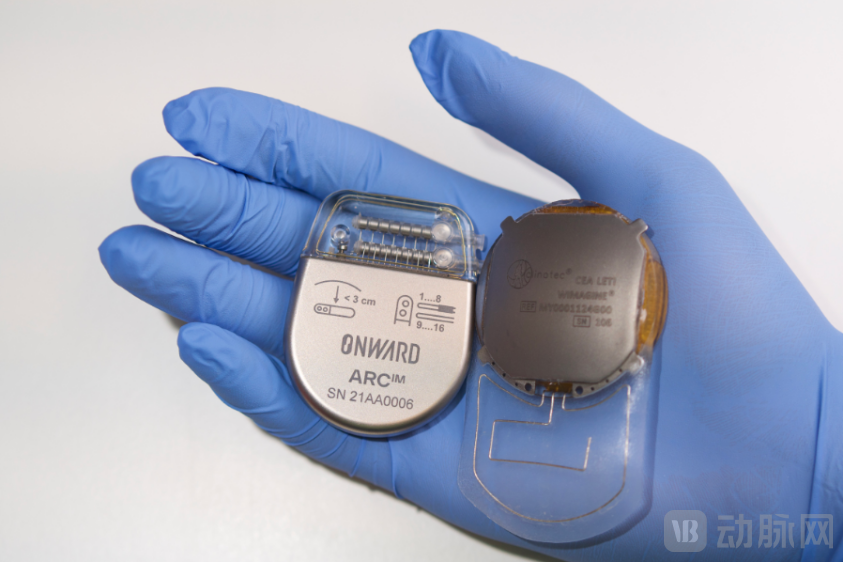
ARC-BCI Schematic Diagram (Source: PLATO)
In September 2023, ONWARD Medical announced the completion of the first implantation of ARC-BCI. Data results indicate that spinal cord stimulation via ARC-BCI ensures a high level of safety and demonstrates efficacy in restoring upper limb motor function in patients with paralysis.
Previously, the device had already been proven through trials to enhance patients’ control over movement in paralyzed legs. This study marks a new breakthrough in the therapeutic applications of ARC-BCI.
andARC-EX delivers electrical currents to the site of spinal cord injury via electrodes placed on the skin, activating nerve fibers and facilitating neural signal transmission to help patients restore motor function.Compared with brain-computer interface devices, this device enables non-invasive therapy, offering greater speed and safety. Furthermore, it can be flexibly and seamlessly integrated with other physical therapies, facilitating easier adjustment of treatment plans for patients.
It is reported that ARC-EX has completed its clinical trial, in which 60 patients underwent four months of treatment. The results showed that 72% of patients met the improvement criteria for strength and function in their hands or arms, 90% showed improvement in at least one of these metrics, and 87% experienced an enhanced quality of life. Currently, this treatment regimen has been published in the prestigious academic journal *Neuromodulation: Technology at the Neural Interface*.
Nowadays,ONWARD Medical’s Implantable and Non-Implantable Technology Platforms Both Received FDA Breakthrough Device DesignationAmong them, ARC-EX has submitted a De Novo application for the ARC-EX system to the FDA and is expected to receive commercialization approval by the end of 2024.
Breakthrough Progress Achieved in Multiple Brain-Computer Interface Studies
In addition to the ONWARD Medical team, numerous international research teams are exploring the connection between brain-computer interface technology and neuromodulation.
For instance, in 2024, researchers from institutions such as the University of California, Davis, utilized brain-computer interface technology,Restored Speech Function in a 45-Year-Old Patient with ALSResearchers implanted four microelectrode arrays into the brain regions responsible for coordinating speech in patients. When a patient intended to speak, the electrodes recorded the associated neural activity; researchers then decoded and “translated” these recordings into the words the patient wished to express, displaying them on a screen and finally converting them into synthetic speech that mimicked the patient’s own voice. This marks the first time that brain-computer interface technology has achieved a breakthrough in real-time decoding functionality.
Research on brain-computer interface-based neuromodulation in China is also progressing rapidly. Previously,Tsinghua University and Xuanwu Hospital TeamThe jointly conducted clinical trial of wireless minimally invasive brain-computer interfaces has achieved breakthrough progress. Patients have realized brain-controlled functions, such as autonomously drinking water by driving a pneumatic glove with their electroencephalographic (EEG) activity, achieving a grasp decoding accuracy of over 90%. Additionally, another paralyzed patient achieved mind-controlled cursor movement through the wireless minimally invasive brain-computer interface.
In terms of motor function recovery,Team from Huashan Hospital Affiliated to Fudan UniversityIt has helped two paralyzed patients regain basic motor functions, such as standing, walking, and even cycling, and holds promise for enabling more patients to restore their mobility and independence in daily living.
In terms of commercialization, the Chinese enterprise Zhentai Intelligence is currently advancing through"Brain-Computer Interface + VR Technology + Rehabilitation Robotics"...approach, exploring a new pathway to help paralyzed patients regain motor function. It is reported that the brain-computer interface (BCI) device developed by the team achieves an EEG signal recognition accuracy of over 90%, effectively facilitating rehabilitation therapy for patients with neurological impairments.
Breakthroughs in brain-computer interfaces and neuromodulation technologies have been achieved by research teams, heralding broad future applications in neuromodulation and human–computer interaction. As brain-computer interface technology continues to mature, it is poised to offer curative possibilities for a wider range of diseases.