

Hainan Unveils Three-Year Action Plan for Digital Health, Bolstering Its Leadership in Digital Therapeutics
On August 29, the General Office of the People’s Government of Hainan Province issued the Three-Year Action Plan for High-Quality Development of Hainan’s Digital Health System and Digital Health Economy (2024–2026) (hereinafter referred to as the “Three-Year Plan”). The plan provides specific planning and deployment for the construction of Hainan’s entire digital health system, including digital therapeutics. This development represents a significant boost to China’s digital therapeutics industry and further solidifies Hainan’s position as a domestic “highland for digital therapeutics.”
Following closely, the 2024 Digital Therapeutics Conference was held in Haikou, Hainan, on August 30–31. This marked the second time the conference has been hosted in Hainan. Leading domestic experts in digital therapeutics from government bodies, healthcare institutions, academia, the investment community, and the corporate sector convened in Hainan to offer insights and strategies for advancing the development of digital therapeutics in China.
Zhang Yuhui, Deputy Director of the Hainan Provincial Health Commission, issued an initiative at the conference, calling for joint efforts to innovate and explore a new digital health paradigm in the Hainan Free Trade Port that can revolutionize human health, thereby accelerating the full arrival of the digital health era in China and worldwide.
Prior to this, on August 22, the Hong Kong Stock Exchange (HKEX) published the post-hearing information pack of Naodong Jiguang, indicating that the company had passed the listing hearing and was poised for an imminent IPO. From its initial application last year to passing the hearing now, the countdown has begun for it to become the “first listed digital therapeutics company in China.”
These waves of good news suggest that digital therapeutics may truly be poised for a bottoming-out and rebound.
Prior to this conference, Hainan announced another “major development”: the General Office of the People’s Government of Hainan Province issued the Three-Year Action Plan for High-Quality Development of Hainan’s Digital Health System and Digital Health Economy (2024–2026) (hereinafter referred to as the “Three-Year Plan”), which explicitly mentions digital therapeutics in multiple sections.
The General Office of the People’s Government of Hainan Province released the “Three-Year Action Plan for Tackling Key Issues to Promote High-Quality Development of Hainan’s Digital Health System and Digital Health Economy (2024–2026)” (screenshot from the official website of the People’s Government of Hainan Province)
Previously, Hainan Province included “exploring pilot trials of digital therapeutics” as one of the key tasks in its 14th Five-Year Plan for Digital Health, marking the first time digital therapeutics were incorporated into a provincial-level plan. On October 10, 2022, the General Office of the Provincial People’s Government issued the Notice on Printing and Distributing Several Measures to Accelerate the Development of the Digital Therapeutics Industry in Hainan Province, representing the first full-lifecycle industrial support policy for digital therapeutics launched not only in China but also globally. The current Three-Year Action Plan, issued by the General Office of the Provincial People’s Government and formulated in coordination with multiple departments, further underscores Hainan’s prominent position as a “policy highland” for digital therapeutics.
In simple terms, the Three-Year Plan promotes the coordinated advancement of “one vision, two goals, four domains, 15 scenarios, and one chain.” Among these, “creating a new digital health paradigm in the Hainan Free Trade Port that can revolutionarily enhance human health” is the ultimate objective the plan seeks to achieve, namely the “one vision.” This is further divided into “two goals”: “establishing a nationwide-leading, comprehensive, full-lifecycle digital health service system,” and “forming a nationwide-leading highland for digital health technological innovation and a digital economy industrial cluster.”
It is evident that, beyond the aspiration to improve local health and hygiene conditions, Hainan places high hopes on building a digital economy industrial cluster. The Three-Year Plan explicitly sets forth specific targets to be achieved by the end of 2026: “A nationwide-leading, comprehensive, full-cycle digital health system will be basically established; innovative application scenarios in areas such as public benefit, medical support, government assistance, and industry promotion will be abundant and vibrant; support platforms for the orderly opening of health and medical data elements and their innovative transformation will operate effectively; the digital health industry will achieve clustering; residents’ health levels will rise rapidly; and the revenue scale of digital health innovation enterprises across the province will double.”
As the last province to be established, Hainan early on adopted a development strategy that eschews reliance on traditional industry and prioritizes environmental protection. Its exceptional natural environment, combined with policy advantages granted by the central government, makes it highly suitable for fostering new quality productive forces in the digital economy, led by digital therapeutics.
Currently, the rapidly developing digital economy is becoming a crucial factor in reshaping the global competitive landscape. According to statistics, China’s digital economy has reached a scale of 50.2 trillion yuan, ranking second worldwide in total volume, with its share of GDP rising to 41.5%. The digital economy has become an important engine for local governments to stabilize growth and promote transformation. As part of the digital economy, the surge in digital therapeutics has naturally attracted the attention of local governments.
For Hainan, digital therapeutics are not constrained by the foundational upstream and downstream industrial chains that affect sectors such as biopharmaceuticals, nor do they require specialized land resources. Meanwhile, as a new form of productive forces, digital therapeutics offer distinct advantages and potential to accelerate the smart upgrading of the healthcare system, deepen healthcare reform, promote the substantial and in-depth development of Hainan’s internet healthcare industry, rapidly attract industrial clustering, and thereby foster the growth of the digital health sector.
“The Three-Year Plan,” acting as “a single chain,” links together all segments of the digital health industry ecosystem. Through a cascading mechanism of “scenario-driven attraction, cluster formation, technological support, and policy backing,” it ultimately realizes its envisioned goals and objectives.
“Scenario-driven” refers to innovative application scenarios in digital health. In the past, Hainan Province mobilized multi-stakeholder collaboration to address bottlenecks and challenges in the implementation of digital therapeutics, proposing an action plan that leverages high-value application scenarios to accelerate and enhance the effective deployment and promotion of digital therapeutics.
This initiative is highly forward-looking and of significant importance. This is because the promotion and application of digital therapeutics are crucial to their development, while healthcare institutions urgently need the support and impetus of digital therapeutics to achieve high-quality development in health and wellness in the new era. An effective approach to meeting both these needs is to strategically design innovative application scenarios for digital therapeutics.
These innovative scenarios enable the integration of digital therapeutics with ongoing public health initiatives and the mandated responsibilities of medical institutions at all levels. This approach not only facilitates the broader adoption of valuable digital therapeutics but also leverages them to accelerate, enhance, and improve the efficiency of various public health efforts.
Based on this, Hainan has begun to rapidly promote the integration of digital therapeutics into government public welfare projects, thereby exploring innovative application scenarios for digital therapeutics. These initiatives aim to demonstrate the advantages of digital therapeutics, first establishing benchmark effects on a small scale before expanding province-wide. Ultimately, the successful application of digital therapeutics in Hainan will serve as a national model, driving the broader implementation and adoption of digital therapeutics across China.
Subsequently, Hainan has successively introduced digital therapeutics to empower cognitive rehabilitation in the elderly, diabetes management within the “2+3” health service package, and interventions for children aged 0–6 with autism spectrum disorder, achieving considerable results.
The “Three-Year Plan” continues this approach and significantly expands the scope of application scenarios. Its coverage extends beyond digital therapeutics to encompass the broader field of digital health, including the digitalization of pharmaceuticals and medical devices. Hainan aims to provide innovative institutions and enterprises with opportunities and space for R&D, validation, and application, thereby fostering a closed loop for commercialization and policy by fully opening up healthcare innovation scenarios.
The expanded innovative application scenarios will involve “four domains” (public benefit, medical assistance, governmental support, and industry development), encompassing “15 scenarios.” Among these, the public benefit domain includes the largest number of scenarios, with six accounting for nearly half. These scenarios also represent the innovative application contexts previously implemented in digital therapeutics. In addition to public benefit, the initiative covers medical assistance, governmental support, and industry development, addressing all aspects of the healthcare sector.
Hainan aims to leverage these scenarios as catalysts to foster local industrial agglomeration. Specific initiatives include cultivating key clusters in specialized segments of the digital health industry, establishing an innovation alliance for industry-academia-research-application collaboration in digital health technologies, launching campaigns to enhance the quality and effectiveness of investment promotion, and implementing foundational standardization efforts.
Certainly, these specific actions require a range of support measures. The Three-Year Plan categorizes this support primarily into “technical support” and “policy support.” The former calls for accelerating the development of new digital health infrastructure, establishing an open platform for healthcare data elements, and building a public service platform for the digital health industry. The latter emphasizes the need to develop open and inclusive policy frameworks to foster innovation in healthcare data elements, establish and improve systems for the circulation and security of healthcare data, provide policy support for the high-quality development of the digital health services industry, and offer fiscal and financial support policies.
To ensure the smooth implementation of the plan, the “Three-Year Plan” also explicitly establishes a provincial-level coordination and promotion mechanism for digital health, involving departments such as Development and Reform, Finance, Industry and Information Technology, Health, Big Data, Market Regulation, Healthcare Security, and Drug Administration. It further designates lead departments for each key initiative and formulates annual work plans. This underscores Hainan Province’s determination to build a robust digital health system and foster a thriving digital health economy.
Compared with previous iterations, the “Three-Year Plan” encompasses a broader scope, extending from digital therapeutics to the entire digital health industry ecosystem. The content covered is more extensive, with a greater emphasis on building the ecosystem. Evidently, after gradually establishing a stronghold in digital therapeutics, Hainan is now striving to create a more comprehensive “digital health highland.”
On the one hand, expanding from digital therapeutics to digital health is a logical approach. On the other hand, this does not indicate a diminished emphasis on digital therapeutics; rather, it represents a necessary step to further advance the field.
This is because the characteristics of digital therapeutics dictate that the realization of their value requires support from the development of the entire digital health ecosystem.
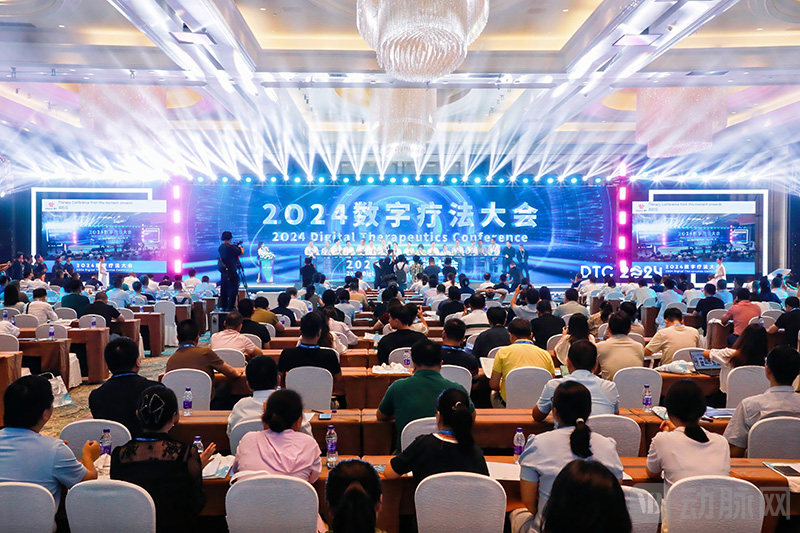
2024 Digital Therapeutics Conference Held in Haikou
As a long-standing expert in digital therapeutics research in China, Jiang Tianjiao, Dean of VCBeat Institute, also provided an interpretation at the 2024 Digital Therapeutics Conference.
He stated that prior to the advent of digital therapeutics, the digitalization process had already been underway for a considerable period, progressing through three distinct eras: the informatization era, which focused on enhancing hospital management and operational efficiency; the internet healthcare era, which leveraged the internet to overcome spatial constraints and information barriers, linking high-quality medical resources with precise patient needs to unlock healthcare value; and the intelligence era, which utilizes data and algorithms to assist in medical diagnosis and decision-making, thereby improving the efficiency of medical treatment.
Unlike previous scenarios, digital therapeutics have enabled digitization to achieve “diagnostic and therapeutic intervention” for the first time, penetrating into the “core of diagnosis and treatment.” This represents a monumental paradigm shift, marking the transition of healthcare digitization as a whole from the era of “connectivity” to the era of “intervention.”
Jiang Tianjiao believes that, from a micro perspective, the development of the modern healthcare industry has evolved from initial single-track pharmaceutical interventions to dual-track parallel growth of pharmaceuticals and medical devices, and now to an era where pharmaceuticals, medical devices, and digital health coexist: “Digital health, marked by the large-scale penetration of digital technologies, is becoming a technological revolution with a significant impact on human longevity, comparable to that of pharmaceuticals and medical devices.”
As a critical component of digital health, digital therapeutics (DTx) integrate software and hardware, transcending the traditional boundaries of digital technology to penetrate the core segment of the healthcare industry—treatment. This evolution shifts digital health from mere connectivity to active intervention, representing a significant trend for future innovation in the healthcare sector.
At the macro level, as a new form of productive force in healthcare, digital therapeutics can enhance the operational efficiency of the healthcare system, improve the efficacy of clinical interventions, and boost the development efficiency of the medical and health industry. This progressively empowers the sectors of public health, clinical practice, and industry, facilitating a paradigm shift and enabling “leapfrog development.”
However, Jiang Tianjiao also stated that the value realization and acceleration of digital therapeutics and the digital health industry would become an empty promise if divorced from the construction of a digital health ecosystem.
In terms of mechanism of action, digital therapeutics are quite similar to pharmaceutical drugs. The mechanism by which drugs exert their effects involves the absorption (via oral administration, injection, or other routes), distribution, metabolism, and excretion of drug molecules within the body, along with the biological effects generated throughout this process. In contrast, the principle of digital therapeutics can be summarized as producing downstream biological effects through cognitive and behavioral interventions. For example, digital therapeutics help patients improve their lifestyle habits and engage in moderate exercise, which clearly has beneficial effects on cardiovascular health.
Among these, the active ingredient of a drug refers to the drug molecules or cellular entities that produce therapeutic interventions, whereas the active ingredient of digital therapeutics is information capable of producing such interventions, including text, images, audio-visual content, and other interactive biofeedback. Molecules or cells are physical entities, which differ significantly from virtual information in many aspects. For instance, information lacks physical substance, does not require traditional logistics and distribution, incurs nearly zero marginal cost, can be transmitted at extremely high speeds via current high-speed broadband networks, and allows for more flexible pricing.
In terms of commercial characteristics, there is a significant gap between digital therapeutics and pharmaceuticals. Unlike drugs, which often require billions of dollars in investment and take more than a decade to reach the market, digital therapeutics involve substantially lower costs and can achieve commercial launch within a few years, entailing much lower risk. However, due to the challenges in securing patent protection for digital therapeutics, their peak sales are relatively smaller.
In other words, digital therapeutics exhibit distinct characteristics: they demonstrate a pronounced zero marginal cost effect, with marketing activities conducted on digital platforms and delivery reliant on digital networks. Under the influence of Metcalfe’s Law, their output value grows proportionally to the square of the user base; once the number of users surpasses a certain critical threshold, costs approach zero asymptotically, while output value can achieve explosive growth.
Such characteristics and business logic necessitate leveraging industrial ecosystem forces to achieve scale and industrialization, with ecosystem development driving empowerment across multiple dimensions, including technological R&D, scenario-based applications, and industrial scale.
However, as an emerging industry, digital healthcare currently exhibits weak self-sustaining capabilities and requires support from external forces across many aspects. Taking mechanism discovery in digital therapeutics as an example, strengthening basic scientific research is essential. Breakthroughs in neuroscience, cognition, psychiatry, and related physiology and pathology are difficult to achieve solely through corporate efforts, necessitating continuous increases in research investment.
Furthermore, the business models of digital health and digital therapeutics across multiple dimensions are heavily dependent on relevant policies and regulations, including those governing online diagnosis and treatment, prescription management, pharmaceutical distribution, physician practice, commercial insurance support, and medical insurance reimbursement.
Jiang Tianjiao emphasized that digital therapeutics remains an emerging field, with various regulations and frameworks in urgent need of refinement. The industry landscape is still fluid and has not yet solidified. This is a critical juncture for the development of digital therapeutics and the broader digital health sector; China’s strategic choices will determine whether it can secure a leading position in the global digital health industry, with government leadership playing a pivotal role.
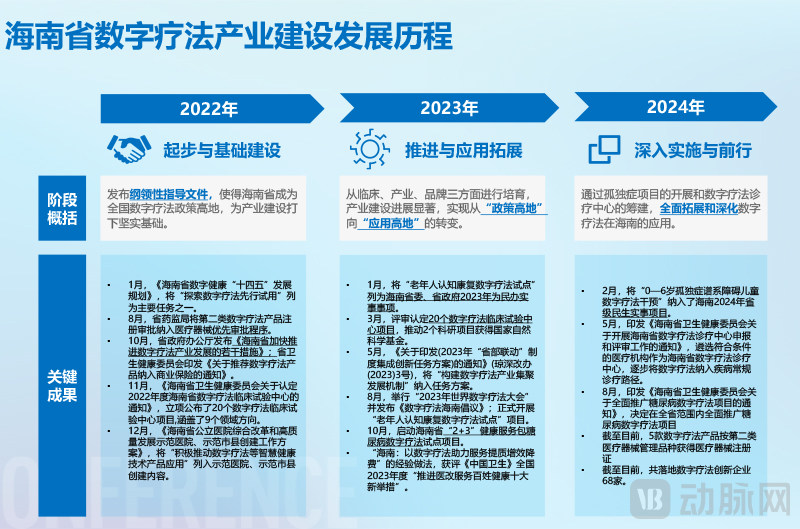
Development History of the Digital Therapeutics Industry in Hainan Province
For this very reason, the current breakthrough of the digital health industry still relies on the government's planned planning and guidance. Hainan has already taken a half-step lead, and its exploration in this field will also provide experience and reference for China.
This is one of the key reasons why Hainan Province maintains a leading position in the development of digital therapeutics and the digital health ecosystem. According to research by VCBeat, the construction of Hainan’s digital therapeutics industry has achieved four major highlights: first, Hainan has implemented China’s first, and globally pioneering, full-lifecycle support policy for digital therapeutics; second, industrial clustering is evident, with an initial industrial layout taking shape; third, the province boasts abundant innovation resources, ranking first nationwide in innovation vitality and capacity; and fourth, provincial-level pilot projects have been successfully rolled out, comprehensively improving residents’ quality of life.
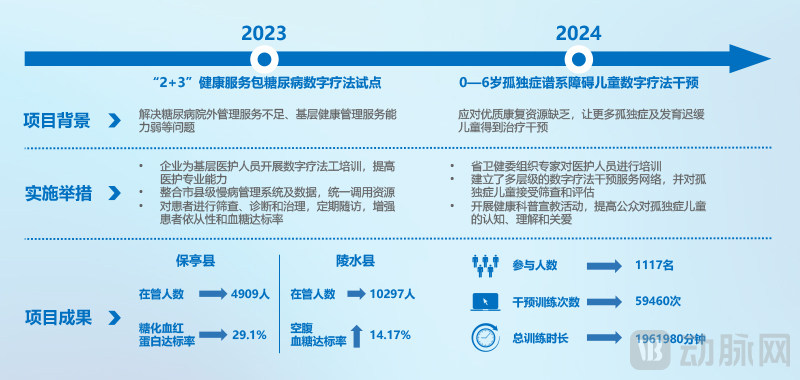
Hainan Maintains Its Lead in Innovating Application Scenarios for Digital Therapeutics
In 2023, Hainan Province launched a pilot program for digital therapeutics targeting diabetes within its “2+3” health service package, aiming to address issues such as insufficient out-of-hospital management services for diabetes and weak capacity for primary healthcare management. By having enterprises provide digital therapeutics training to primary care medical staff, the professional competencies of healthcare providers were enhanced. Meanwhile, city- and county-level chronic disease management systems and data were integrated to enable unified resource allocation for patient screening, diagnosis, and treatment, along with regular follow-ups, thereby improving patient adherence and glycemic control rates.
Currently, in Baoting County, where digital therapeutics pilot programs are being implemented, the number of diabetes patients under management is 4,909, with the glycated hemoglobin (HbA1c) target attainment rate increasing by 29.1%. In Lingshui County, the number of patients under management is 10,297, with the fasting blood glucose target attainment rate improving by 14.17%.
In 2024, “Digital Therapeutic Intervention for Children Aged 0–6 with Autism Spectrum Disorder” was included in Hainan’s 2024 Provincial Livelihood Projects. This initiative aims to address the shortage of high-quality rehabilitation resources and ensure that more children with autism and developmental delays receive therapeutic interventions. The Provincial Health Commission organized expert-led training for healthcare professionals, established a multi-tiered digital therapeutic intervention service network, and conducted screening, assessment, and intervention for children with autism.
To date, 1,117 children aged 0–6 years with autism spectrum disorder have received digital therapeutic interventions, with a total of 59,460 intervention sessions and a cumulative training duration of 1,961,980 minutes.
Hainan Province was the first region to formally propose a comprehensive promotion of digital therapeutics and has taken the lead in the innovative application scenarios of digital therapeutics. It has played a significant role in driving the development of China’s digital therapeutics industry, serving as a representative example of the “Chinese practice” in this field.
With the release of the “Three-Year Plan,” Hainan has entered a new phase, upgrading its support for digital therapeutics to actively fostering the organic development of the entire digital health ecosystem. As this ecosystem matures, it will further accelerate the realization of value from digital therapeutics and bolster Hainan’s efforts to strengthen, optimize, and expand its digital economy. This will also solidify Hainan’s leading position in the development of digital therapeutics and, more broadly, in the competitive landscape of the digital health economy.
Can digital therapeutics seize this opportunity to revive and usher in a new phase of development? VCBeat will continue to monitor industry trends; stay tuned.