

From a Pharmaceutical Wholesaler to a Global Reagent Giant: The 130-Year Journey of TCI

Tokyo Chemical Industry
--
When it comes to companies in the reagent sector, most people immediately think of global giants such as Thermo Fisher Scientific, Merck, Danaher, Roche, Qiagen, and Honeywell, whose media coverage is consistently prominent across various public channels. However, in reviews of leading international reagent manufacturers and recommendations for high-quality reagents, besides these well-known industry titans, one often encountersTokyo Chemical Industry Co., Ltd. (TCI), known in Chinese as Tixiai, the “invisible giant.”
As a remarkably low-profile global leader in reagents, TCI is celebrating its 130th anniversary this year. The company entered the Chinese market as early as the 1980s, more than three decades ago. Furthermore, TCI has established subsidiaries in the United States, India, Europe, and other regions, providing customers worldwide with organic chemical reagents, raw materials, and custom synthesis services for various intermediates.
As a century-old industry giant, TCI has remained remarkably “low-profile” and “under the radar.” Yet its status as a powerhouse was not preordained; even the rise of such an exceptional enterprise follows discernible patterns. How did TCI evolve from a small pharmaceutical wholesale store in Iwamotocho, Nihonbashi, into a global leader in research reagents? And how has it managed to not only withstand but also thrive through 130 years of turbulence and change?
In 1894, a pharmaceutical wholesale store named Asakawa Shoten was established in Iwatsuki-cho, Nihonbashi. Starting with Chinese herbal medicines sourced from Japan, the store expanded its business scope to include all pharmaceutical products, such as those listed in the Japanese Pharmacopoeia and new drugs, thereby growing into one of the leading wholesalers in Nihonbashi Honcho.
In 1940, Asakawa Shoten leveraged its accumulated capital, resources, and experience in pharmaceutical wholesale to acquire Nippon Yoyaku Manufacturing Co., Ltd. and Matsumoto Pharmaceutical Works (a partnership firm), thereby entering the pharmaceutical manufacturing industry. In 1946, the company was renamed Tokyo Chemical Industry (known as TCI; Chinese name: Tixiai), a name it has retained to this day, specializing in the manufacture and sale of organic reagents. In 1983, TCI expanded into the chemical products business.
These represent the only few business shifts in TCI’s 130-year history, yet each new strategic deployment has been built upon industrial accumulation spanning years or even decades. This clearly reflects the inherent “rigidity” and rigor characteristic of Japanese enterprises, as well as TCI’s unwavering commitment to focusing on a single mission for over a century.
This commitment is also plainly reflected in the TCI logo. The TCI logo consists of three hexagons, resembling the chemical structure of anthracene (a polycyclic aromatic hydrocarbon with three fused rings). This signifies TCI’s engagement in the chemical industry, while embedding the company’s acronym “TCI” within the anthracene structure underscores its specialization in the chemical reagents sector.
TCI Company Logo, Image Source: TCI Official Website
Currently, TCI’s business consists of only two segments.
First, as a specialty chemical reagent supplier, TCI’s primary business is undoubtedly the research and development and manufacturing of laboratory chemical reagents for various testing, basic research, and product development applications.These reagents are widely used in the pharmaceutical, food, electrical products, textile, analytical, and environmental industries.
In 1952, TCI released its first product catalog, which featured only a few hundred reagent products. Currently, TCI offers more than 30,000 specialty organic chemical reagents, with a product portfolio covering organic synthesis reagents, functional materials reagents, biochemical reagents, glycan chains, analytical reagents, and reference standards. Notably, approximately one-third of these products are unique offerings proprietary to the company.
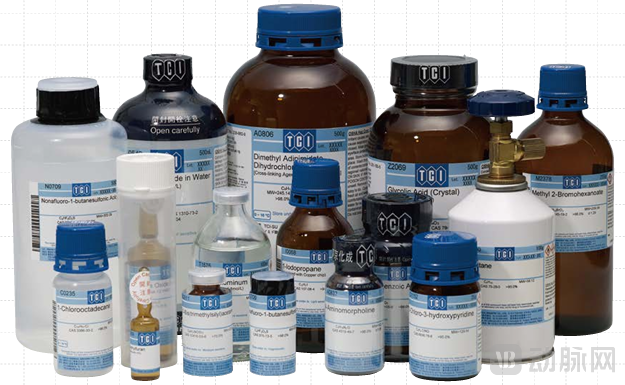
TCI Product Reagents, Image Source: TCI Official Website
Specifically, in the field of organic synthesis reagents, TCI’s synthetic reagents are applicable to a variety of reactions, including coupling, C–C bond formation, synthesis of building blocks, protecting group strategies, and catalysis. In materials science, TCI’s high-purity reagents enable manufacturers to develop and produce lighter, stronger materials as well as cleaner energy solutions. In the life sciences sector, TCI leverages advanced synthesis, purification, and analytical technologies to provide a wide range of world-class life science reagents, such as chromogenic enzyme substrates, biochemicals, and antioxidants. Furthermore, TCI offers various multifunctional intermediates, enzymes, reference standards, and other products.
Secondly, leveraging its accumulated technology and expertise in reagent research and development and production, TCI provides customers with organic chemicals and various intermediate raw materials ranging from milligram to ton scales, as well as related contract synthesis services.
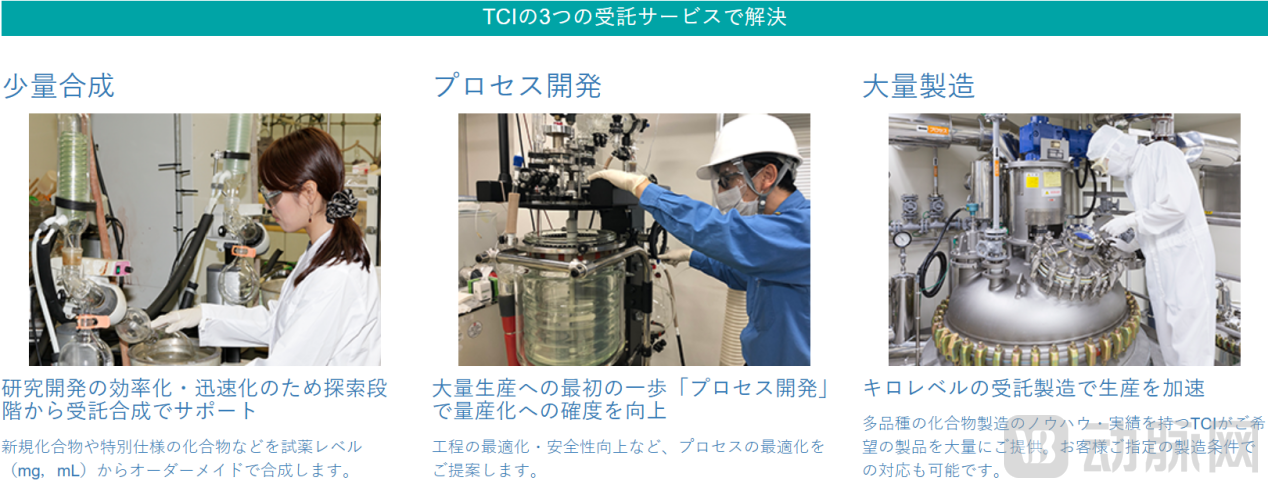
Custom Synthesis Service, image source: TCI
In the contract synthesis services sector, TCI offers three types of contracted services: small-batch synthesis, process development, and large-scale manufacturing. Adhering to strict Good Manufacturing Practice (GMP) management standards, TCI also provides contract services for the production of active pharmaceutical ingredients (APIs), intermediates, and other materials for clinical trials. TCI operates GMP-compliant facilities dedicated to the contract manufacturing of clinical substances, intermediates, and APIs, along with kilogram-scale laboratories specializing in GMP operations, all supported by comprehensive quality systems.
Notably, in the multi-kilogram large-scale manufacturing sector, TCI boasts over 300 units of equipment across more than 100 types, including multipurpose reactors, high-pressure reactors, concentrators, odor compound processing equipment, manufacturing-related apparatus, filters, distillation systems, analyzers, and other production facilities. This extensive infrastructure enables TCI to meet diverse contract manufacturing needs at the multi-kilogram scale. Furthermore, TCI’s manufacturing plants are located on the same campus as the R&D department responsible for process development, facilitating rapid and seamless transition of commissioned products from development to scaled-up production.
To date, TCI has accumulated extensive large-scale manufacturing experience in the following fields: organic acids (including organic acids, organic acid salts, organic acid anhydrides, and organic acyl chlorides), amines (including amines and quaternary ammonium salts), derivatization reagents (including protecting and derivatizing agents, halogenating agents, ethynylating agents, and dimethylaminomethylene reagents), monomers, solar cell materials, sulfur-containing compounds, analytical reagents, acylbenzenes, alkylbenzenes, alkylcyclohexanes, terminal olefins, diols, and long-chain saturated carboxylic acids.Among them, the scale-up production of 1,5-hexadiene reached 2,000 kg, and that of tetrabutylammonium fluoride (approximately 1 mol/L in tetrahydrofuran) reached 1,000 kg.
Whether for various reagents independently developed and manufactured in-house or for contract manufacturing services undertaken for external clients, TCI strictly adheres to a rigorous management system. In terms of quality control, TCI adopts the global product quality control system of Tokyo Chemical Industry to ensure that product quality fully complies with Tokyo Chemical Industry standards. For the production of high-purity electronic materials and active pharmaceutical ingredients (APIs) requiring stringent quality control, TCI is equipped with dedicated cleanrooms. Building on this foundation, TCI implements even stricter testing criteria and a broader range of test items across all stages—from raw material procurement, production, and processing to analysis and packaging—thereby delivering the high-quality products it is known for today.
“A user once stated on a public platform, ‘The purity of TCI’s standard reagents is so high that they can even be used as reference standards.’”
In the rapidly evolving field of life sciences, merely maintaining good product quality is insufficient; after all, for many downstream customers, a supplier’s failure to advance is tantamount to falling behind.
For enterprises, “advancement” here refers not only to the continuous refinement and improvement of technologies, products, and services, but also to maintaining a mindset that keeps pace with the times in an industry characterized by rapid iteration.In the former aspect, TCI has remained dedicated for a century to reagents and related services, continuously improving and breaking through with its products to achieve unparalleled excellence. In the latter, while meticulously refining its products, TCI also keeps pace with emerging trends.”。
As early as the 20th century, before electronic computers became widespread, TCI innovatively introduced internet-enabled devices to systematize inventory management and product catalogs: In 1971, TCI adopted electronic computers, enabling networked and systematic inventory management. In 1998, TCI released digital catalogs (CD-ROM and online versions). Currently, TCI has implemented a Laboratory Information Management System (LIMS) to comprehensively manage quality and analytical information.
Furthermore, in the 20th century, TCI made a decision that was ahead of the industry curve at the time: in 1988, TCI entered Shanghai, China, and established a reagent distribution center. More than three decades ago, China’s life sciences sector and its related industries had not yet experienced explosive growth or iterative development, with most niche segments still in their early stages. Although TCI’s entry into the Chinese market at that time involved a certain degree of risk, it was driven primarily by its recognition of the mismatch between supply and demand in China’s life sciences field, as well as the vast, high-growth potential of the country’s future life sciences market.
In addition to various forward-looking strategic initiatives within the company, TCI introduces new products annually. These product launches are communicated from the Japanese headquarters to global branches, which then promote them within their respective regions. New product planning involves on-site supply chain assessments conducted by regional managers to determine whether local industries have corresponding TCI products suitable for integration and sales. Currently, many of TCI’s proprietary products are aligned with local relevant industries, including traditional materials, electronic materials, battery materials, and biological reagents.
Currently, TCI’s flagship products have achieved significant commercial success in regions such as Shanghai, Jiangsu, Shandong, and Zhejiang, as evidenced byCUBICTissue clearing reagents have carved out a niche in biological research at universities and colleges; meanwhile, traditional materials also achieve significant sales volume in Shandong Province, a major industrial hub.
In addition to expanding internally to promote innovative products, external customers can subscribe independently to TCI MAIL, the magazine published by TCI (Founded in 1968), with a focus on new reagents from TCI in the fields of synthetic organic chemistry, analytical chemistry, and materials chemistry. Furthermore, TCI MAIL features technical papers submitted by leading professors and scientists, serving as a comprehensive chemical technology magazine that integrates new reagent launches, product education, and cutting-edge scientific research content.
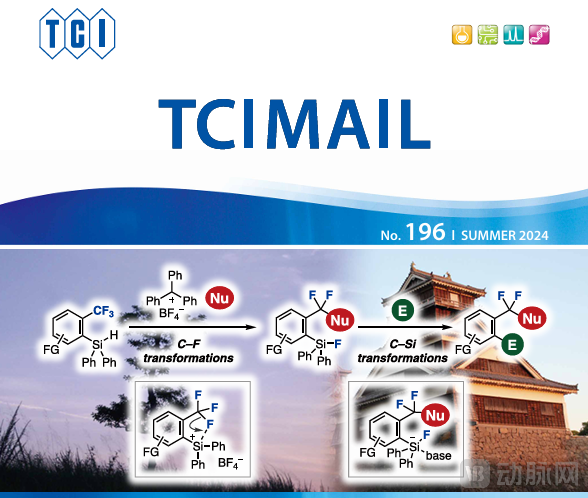
Latest Issue (No. 196) of "TCI MAIL", image source: TCI official website
Beyond this, TCI’s commitment to staying current manifests in many other ways. For instance, the workplace has seen an influx of post-2000s talent in recent years. To better align with societal developments and resonate with the mindset of younger employees, companies and media outlets have become increasingly active on major social networking platforms. Tokyo Chemical Industry (Shanghai) has kept pace with this trend by maintaining official accounts on platforms such as Bilibili, Xiaohongshu (Little Red Book), and Douyin (TikTok). It has also introduced “Narumi” (Chinese name: Dong Chengmei), a cartoon mascot representing its brand image, to engage more effectively with its increasingly youthful customer base.
In addition to “dedication” and “innovation,” there is another distinctive key factor behind TCI’s success.
Unlike most companies that expand their industrial chain layouts through mergers and acquisitions, TCI does not appear to be keen on such strategies.According to public records, in its 130-year history, TCI has publicly disclosed only two acquisition events.Specifically, in 1940, TCI acquired Nippon Yakuza Manufacturing Co., Ltd. and Matsumoto Pharmaceutical Works (Incorporated), thereby entering the pharmaceutical manufacturing industry; and in 1971, TCI acquired Metacom Inc. (formerly a subsidiary of Dow Chemical).
Rather than spending heavily on acquisitions, TCI prefers to establish localized manufacturing facilities tailored to the differentiated market demands of each region. Currently, TCI has established subsidiaries, research centers, and logistics hubs in multiple countries, including China, the United States, India, Belgium, Germany, and the United Kingdom.
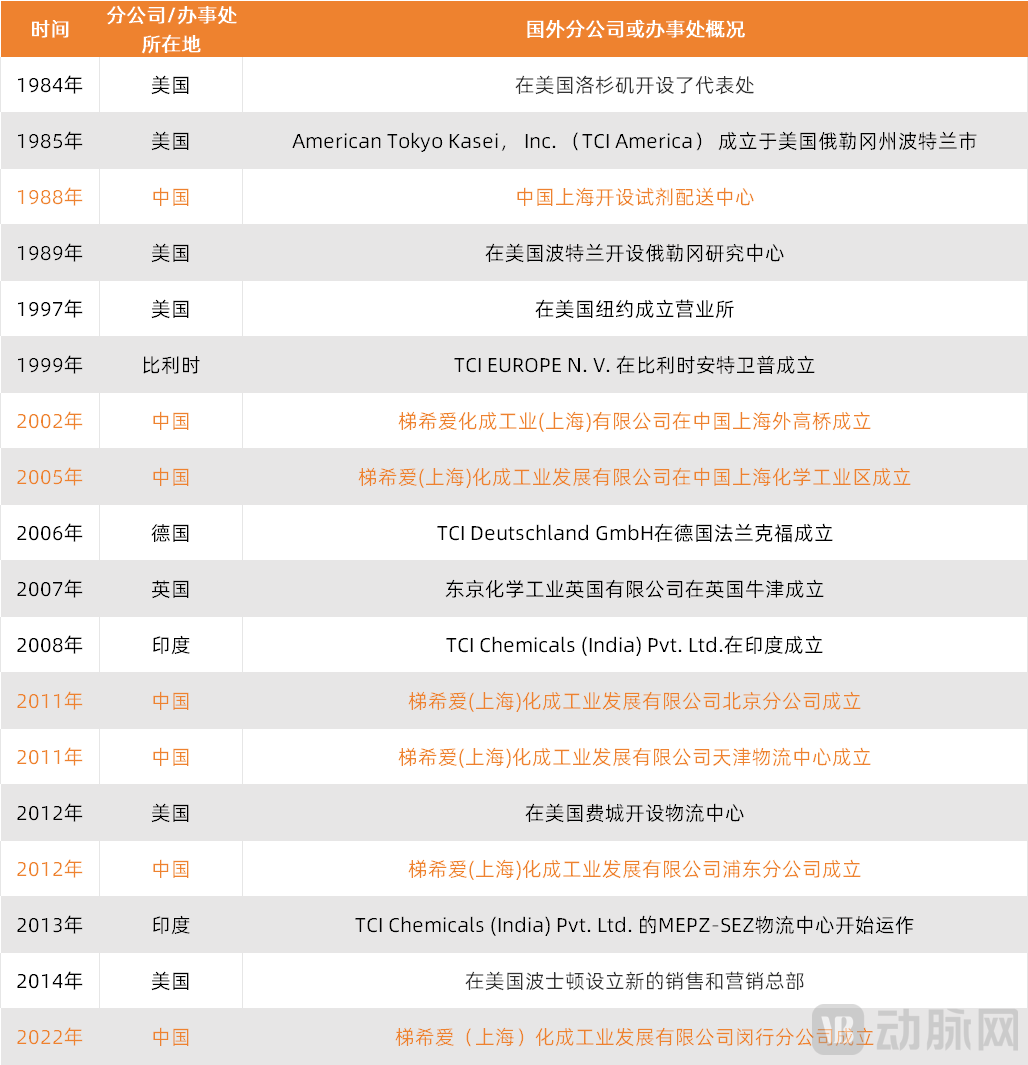
According to incomplete statistics, TCI's global footprint since its establishment
In China alone, TCI has established multiple branches, including Tokyo Chemical Industry (Shanghai) Co., Ltd., TCI (Shanghai) Chemical Industry Development Co., Ltd., Beijing Branch of TCI (Shanghai) Chemical Industry Development Co., Ltd., and Pudong Branch of TCI (Shanghai) Chemical Industry Development Co., Ltd.
Amidst soaring industry enthusiasm and eager capital investment, TCI’s preference for establishing local factories over pursuing mergers and acquisitions may be judged as “conservative.”However, amid the broader downturn in the capital markets, establishing a localized enterprise—built upon the parent company’s unique organic synthesis technologies accumulated and refined over many years and tailored to local development characteristics—remains a sound strategy to facilitate the parent company’s rapid expansion.
Taking TCI’s footprint in China as an example, Tokyo Chemical Industry (Shanghai) Co., Ltd. (hereinafter referred to as “TCI Shanghai”) was established in 2005 in the Shanghai Chemical Industry Park. TCI Shanghai is a wholly-owned subsidiary of TCI in the Shanghai Chemical Industry Park. Leveraging TCI’s unique organic synthesis technologies accumulated and refined over many years, the company has built a young team of senior and mid-level specialists in advanced organic chemical synthesis. As TCI’s R&D center in Shanghai, TCI Shanghai primarily focuses on new product exploration and the development of synthetic processes, ranking among the most efficient units within TCI’s global R&D network. Supported by its localized subsidiary, TCI Shanghai, TCI has additionally established several other branches in China in recent years, achieving remarkable growth momentum.
It is worth noting that, according to the official website, TCI (Shanghai) has been matching the monthly number of new product developments achieved by TCI Japan’s Fukaya Technical Research Institute in recent years.
Furthermore, in the current climate where cost reduction and efficiency improvement are advocated across all industries, establishing localized companies in target markets can also provide customers with logistics services that are low-cost, fast, timely in after-sales support, and accurate.In China, TCI maintains warehouses in Shanghai and Tianjin, with over 90% of its products available in stock. Deliveries to the Beijing-Tianjin-Hebei region and the Jiangsu-Zhejiang-Shanghai area are completed within 24 hours.
The domestic market exceeds RMB 100 billion,
How to Build a Giant from China
Specialization, innovation, and deep integration into local culture are the three key factors that have enabled TCI, a century-old enterprise, to remain steadfast and continue to thrive.So, can a considerable number of Chinese reagent companies, regarded as rising stars (defined by their establishment date), stand on the shoulders of giants and export China’s ownGlobalReagent Leader?
The answer is yes.
First, there are many classifications of chemical reagents., they can be classified into high-end reagents and general-purpose reagents based on manufacturing difficulty and application; into solid reagents and liquid reagents based on physical state; into inorganic reagents and organic reagents based on chemical category; and into hazardous reagents and non-hazardous reagents based on safety properties.Currently, there are over 200,000 types of chemical reagents worldwide, with more than 120,000 having Material Safety Data Sheets (MSDS). In China, there are hundreds of thousands of reagent varieties, among which over 10,000 are domestically produced.
Furthermore, reagents serve various fields of scientific research and national economic development, including biomedicine, food safety, environmental analysis, inspection and quarantine, and high-purity materials.
In recent years, the continuous growth of downstream demand in life science-related fields, driven by national policies, has spurred rapid development in upstream sectors such as reagents.
Factors such as a wide variety of products, broad application scope, and rising downstream demand have continuously expanded the market for chemical reagents.According to data from China Merchants Bank Research Institute,From 2017 to 2021, the compound annual growth rate (CAGR) of revenue for reagent companies among A-share listed firms was 53.78%.According to data from the New Thinking Industry Research Center, the market size of chemical reagents in China was RMB 124.3 billion in 2018, and is expected to reach RMB 249.6 billion in 2024, with a compound annual growth rate (CAGR) of 12.3% from 2018 to 2024.
On this basis,FutureThis presents greater possibilities for the development of domestic enterprises. Furthermore, beyond the reagents sector, most life science tools in China remain dominated by foreign companies, leaving substantial room for domestic substitution and even surpassing international competitors.
In the future, domestic chemical reagent manufacturers can pursue the following three pathways (among others) to rapidly surpass overseas giants.First, expand product offerings from a few types to a diverse portfolio and evolve systems from simple to complex, thereby increasing the number and scope of customers. Second, reagent companies should strengthen their industrial chain infrastructure by gradually expanding capabilities across the upstream supply chain, midstream manufacturing, and downstream services, enhancing brand influence and customer recognition, with particular attention to accelerating the growth of overseas business revenue. Furthermore, companies can diversify reagent formats beyond pure chemicals to include interdisciplinary applications involving new materials and biology. Examples include wet electronic chemicals, biochemical reagents for medical and diagnostic use, pharmaceutical intermediates and excipients, environmental protection reagents, and high-purity materials required for new energy applications, all of which have seen rapid development in recent years.
Overall, the success of TCI follows a clear trajectory. By standing on the shoulders of overseas giants, Chinese enterprises are poised for even more rapid development. We also anticipate that outstanding companies will gradually emerge from among China’s life sciences tools firms—such as those producing reagents—that are currently in the early stages of development. We look forward to seeing excellent enterprises like Macklin, Sinopharm Chemical, Titan Technology, Aladdin, and Univer grow into emerging global giants.
References:
1. Chemical Reagents, Vol. 45, No. 1, “A Brief Discussion on the Path of Innovative Development in the Chemical Reagent Industry”
2. Wanghua Mall, “A Century-Old Reagent Brand TCI | Craftsmanship Hidden in the Details, Forging First-Class Quality”