

Zhejiang University to Spin Off Four Fibrin Gel-Related Biomedical Innovations Valued at RMB 10.02 Million
Recently, Zhejiang University issued a public notice,4 itemsThe achievements are planned to be invested at a valuation (in the form of establishing a new enterprise), with a conversion price reaching up to 10.02 million yuan (preliminary assessed value).. The public notice indicates that all four achievements involveFibrin Gel, Kit, and Applications Thereof。
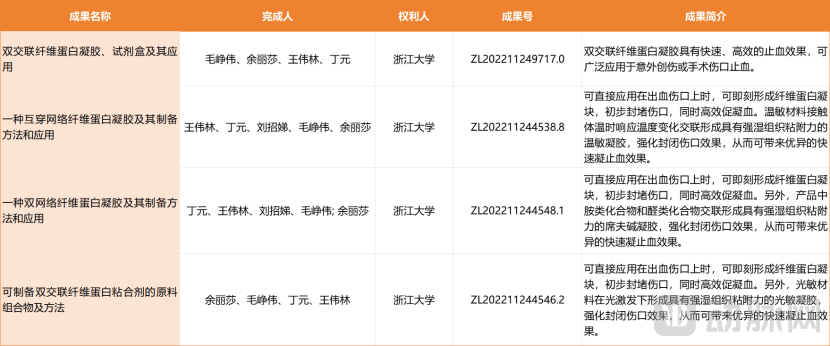 Zhejiang University Publicizes Brief Introductions to Four Achievements
According to the official website of Zhejiang University, the inventors of the four patents are all distinguished experts in the fields of biomaterials and healthcare. For instance, Professor Mao Zhengwei’s primary research interests include nanobiomaterials and polymeric tissue adhesives and hemostatic materials. He has served as the principal investigator for prestigious programs such as the National Science Foundation for Distinguished Young Scholars and has published more than 100 SCI-indexed papers in top-tier journals in his field. Professor Wang Weilin and Researcher Ding Yuan have conducted extensive research on organ transplantation and the clinical practice of hepatobiliary and pancreatic surgery.
Not only a hemostatic material, but also a drug carrier
Fibrin Glue, also known as fibrin sealant, is primarily composed of preparations such as thrombin and fibrinogen. Due to its favorable tissue compatibility, non-toxicity, and absorbability, fibrin glue has been widely used in clinical practice for hemostasis and accelerating wound healing.
In addition to hemostasis,In recent years, fibrin gel has also been frequently used as a carrier in the field of drug delivery.To achieve sustained and controlled drug release as well as targeted delivery, thereby enhancing therapeutic efficacy. For instance, the combined application of fibrin gel with novel dosage forms such as microspheres, liposomes, and nanoparticles is particularly suitable for local antitumor therapy, nerve repair, and bone healing.
Microspheres possess a stable structure and are one of the common drug carriers.Incorporating drug-loaded microspheres into fibrin glue not only enables prolonged retention of the drug at the administration site but also prevents burst release.In 2012, a team from the Chinese PLA General Hospital developed a “PLGA microsphere–fibrin glue sustained-release system” that could continuously and stably deliver insulin to peri-implant tissues, promoting new bone formation around tibial implants in rats with type 1 diabetes and improving impaired osseointegration.
Liposomes are nanoscale carriers capable of encapsulating both hydrophilic and lipophilic drugs.Incorporating liposomes into fibrin glue enables prolonged drug retention at the administration site, reduces the burst release effect, and enhances therapeutic efficacy.Studies have utilized a mixture of fibrin glue and poly(lactic-co-glycolic acid) (PLGA) microspheres encapsulating glial cell line-derived neurotrophic factor (GDNF), delivered to the site of nerve injury. The results demonstrated that, compared with the control group, the experimental group significantly enhanced distal nerve regeneration and the recovery of limb motor function following nerve regeneration.
Furthermore, nanomedicines can enhance the solubility of poorly soluble drugs and improve formulation stability.TransferThe combined use of nanomedicines and fibrin glue can enhance local retention capacity while preserving the inherent advantages of nanomedicines, thereby further improving therapeutic efficacy and safety.
Rapid Development of Domestically Produced Fibrin Sealants in China Shows a Trend Toward High Market Concentration
In the 1980s, Austria’s Immuno AG launched a product called Tissuccol, which was rapidly promoted in the European market. The main components of this product include fibrinogen, thrombin, and aprotinin,One of the earliest fibrin products to be commercialized。
During the same period, researchers in China developed a medical-grade fibrin sealant extracted from human blood and applied it clinically. However, due to the limited availability of human blood sources, it did not immediately achieve commercialization.It was not until 1994, when Guangzhou Beite Biotechnology Co., Ltd. (now Beixiu Bio) developed porcine-derived fibrin glue using mammalian blood as a raw material through scientific research collaboration, that fibrin gel officially entered the market in China.
In terms of development level, there is little difference between the domestic and international markets. According to a report by Global Info Research, the Asia-Pacific region is the largest consumer market for human fibrinogen globally, accounting for over 60% of the market share, followed by the North American and European markets, which together account for more than 30%. The substantial market demand has created favorable development opportunities for domestic companies, driving the industry toward a highly concentrated trend.
Currently, the leading companies in the global fibrinogen market includeCSL Behring, LFB, Shanghai RAAS Blood Products Co., Ltd., Boya Bio-pharmaceutical Group, Hualan Biological Engineering Inc., Harbin Paskfyk Biopharmaceutical Co., Ltd., etc.
Some domestic companies have even achieved milestone accomplishments in this field. For instance, Hualan Biological Engineering Inc. developed a product named Kangpuxin. This is a human fibrin sealant composed of fibrinogen and thrombin concentrates derived from human plasma, which can be used as an adjunct for local hemostasis during surgical procedures. This product was among the first domestically produced fibrin sealants to receive approval from the China Food and Drug Administration (CFDA).
Furthermore, researchers are also driving the commercialization of related scientific achievements. For example,Professor Zhen Gu’s Team at Zhejiang University, collaborated with researchers at the University of North Carolina at Chapel Hill to develop a fibrin gel. This gel can be combined with immunotherapy to exert a synergistic effect; its delivery into the brains of post-surgical mice with glioblastoma enhanced the efficacy of immunotherapy. The findings were published in Science Advances. Professor Gu Zhen is also an entrepreneur who co-founded a startup focused on regenerative medicine research, dedicated to leveraging stem cell technology for tissue repair, which is currently in the incubation stage.
Currently, domestically produced fibrin sealants have demonstrated unique advantages. In the future, with continuous technological advancements and growing market demand, China’s fibrin sealant industry is poised for broader development.