

Empowering Governance with Intelligence: New Advances and Hainan Practices in Digital Therapeutics for Cognitive Impairment
Alzheimer’s disease, as the predominant form of cognitive impairment disorders, exhibits persistently high incidence and mortality rates, having become the fifth leading cause of death in China. More critically, the diagnosis and treatment of cognitive impairment disorders currently face numerous challenges. Due to the lack of efficient, cost-effective, and universally applicable biomarkers, many patients are not diagnosed until the late stage of the disease—namely, the dementia phase—thereby missing the optimal window for intervention. Meanwhile, progress in pharmacological treatments has been slow; even newer agents such as lecanemab can only delay disease progression by approximately three years, and a fundamental solution remains elusive.
Faced with such a vast patient population and a heavy medical burden, Hainan Province has taken the lead by pioneering digital therapeutics. For two consecutive years (2022–2023), it included cognitive function screening for the elderly and digital therapeutic interventions for cognitive rehabilitation among its key public welfare initiatives, achieving significant results in the early screening, intervention, and management of cognitive disorders. This has provided valuable experience for China and even the world. As a pilot institution, Hainan Provincial People’s Hospital has made outstanding contributions to these efforts.
 Conference Venue
On the afternoon of August 30, 2024, a lecture on “New Advances in Digital Therapeutics for Cognitive Impairment and Practices in Hainan” was held concurrently with the 2024 Digital Therapeutics Conference. Liu Tao, Deputy Director of the Healthcare Center at Hainan Provincial People’s Hospital, served as a featured speaker, leveraging practical outcomes from Hainan Province as case studies to analyze and share new developments and potential opportunities in digital therapeutics for cognitive impairment.
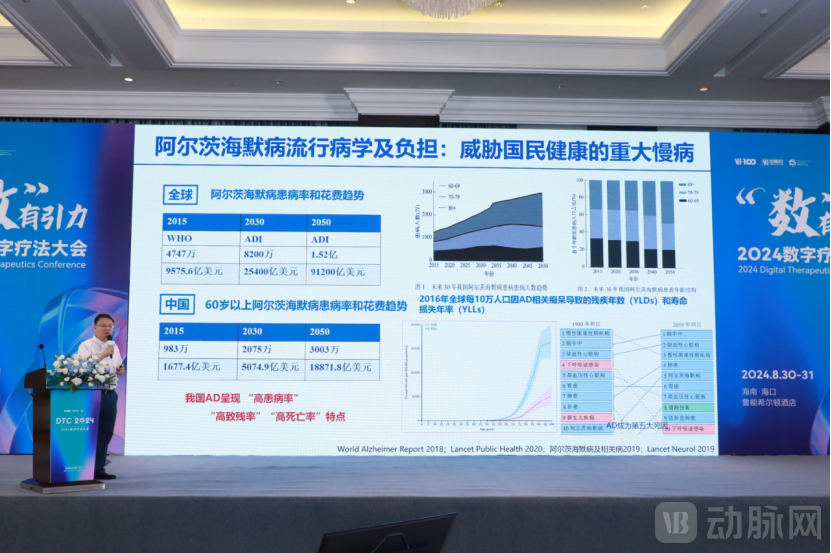
Deputy Director Liu Tao began his lecture by pointing out that cognitive impairment, particularly Alzheimer’s disease, not only severely affects patients’ quality of life but also imposes a heavy economic burden on families and society. It is projected that the annual cost of this disease will reach $1.8 trillion by 2050, becoming a social issue that cannot be ignored. However, current efforts in the prevention and treatment of cognitive impairment still face numerous challenges. On one hand, the lack of efficient and universally applicable biomarkers has led to insufficient rates of early screening and diagnosis; on the other hand, progress in pharmacological treatments has been slow, with existing drugs only able to delay disease progression for a limited period, failing to meet clinical needs. Therefore, non-pharmacological interventions, especially digital therapeutics, are gradually emerging as a research hotspot and a new direction for prevention and treatment.

Liu Tao, Deputy Director of the Healthcare Center, Hainan Provincial People's Hospital
By introducing digital therapeutics, Hainan Province can play a significant role in multiple aspects, including the assessment and intervention of cognitive impairment, as well as the upstream management of chronic diseases and daily monitoring. It provides patients with personalized and precise cognitive training programs, achieving remarkable results in the following areas:
1. Innovation in the Assessment Platform:Hainan Province has introduced digital screening tools at the assessment stage, including electronic screening scales and AI-based micro-movement analysis, to achieve efficient screening and evaluation of cognitive impairment disorders. These digital tools have not only increased screening coverage but also significantly reduced labor and time costs. Meanwhile, through continuous data accumulation and analysis, researchers can further explore the pathogenesis and risk factors of these diseases, providing strong support for future prevention and control efforts.
2. Breakthroughs in the Interventional End:On the intervention side, Hainan Province has provided patients with personalized cognitive training regimens using digital therapeutics. These training protocols are designed based on classic neuropsychological tasks and stimulate patients’ interest and engagement through gamified and interactive approaches. Preliminary statistical results indicate that patients who underwent digital therapeutic training showed significant improvements in cognitive function. Furthermore, the project team validated the effectiveness of digital therapeutics in enhancing brain structural connectivity through methods such as brain functional assessment.
3. The Closed-Loop of Chronic Disease Management:In addition to the assessment and intervention phases, Hainan Province has also applied digital therapeutics to the daily management and monitoring of upstream chronic diseases. By establishing a three-tiered chronic disease management system linking families, individuals, and hospitals, and implementing precise diagnostic programs, Hainan Province has successfully achieved comprehensive management and precision diagnosis and treatment for patients with cognitive disorders. Meanwhile, closed-loop management models have been formed through measures such as community-based management services, effectively improving patients’ quality of life and well-being.
Deputy Director Liu Tao concluded by stating that, through efforts and practical applications in recent years, Hainan Province has achieved remarkable results in the field of digital therapeutics for cognitive impairment. These achievements have not only set a benchmark and model nationwide but also provided valuable experience and reference for the prevention and treatment of cognitive disorders globally. According to statistics from relevant departments in Hainan Province, a comprehensive digital therapeutics system and platform has been established, covering 90 medical institutions across the province with over one hundred sets of equipment, facilitating cognitive impairment screening for more than 220,000 elderly individuals. Furthermore, Hainan Province emphasizes alignment with international standards and active exchange and cooperation, proactively introducing and learning from advanced international technologies and experiences. Through collaborations with renowned international research and medical institutions, Hainan continues to achieve new breakthroughs and progress in the field of digital therapeutics for cognitive impairment.
Although digital therapeutics for cognitive impairment have already achieved significant results, Hainan Province has not rested on its laurels. In the future, the province will continue to increase investment and efforts to promote the in-depth application and development of digital therapeutics in the field of cognitive impairment. Particularly with the continuous emergence and expanded application of new technologies such as artificial intelligence, the metaverse, and brain-computer interfaces, the possibilities for extending the boundaries of human sensory perception will become increasingly broad. Empowered by these new technologies, digital therapeutics for cognitive impairment are poised to deliver more precise, efficient, and personalized interventions and treatments, bringing improved quality of life and hope to patients.
In summary, Hainan Province’s exploration and practice in the field of digital therapeutics for cognitive impairment have provided new insights and directions for the prevention and treatment of cognitive disorders in China and globally. It is believed that in the near future, with continuous technological advancements and expanding applications, cognitive disorders will no longer be considered incurable but will become one of the chronic conditions that can be effectively controlled and managed.