

WeDoctor Unveils AI-Driven Value-Based Healthcare Solutions at Tencent Global Digital Ecosystem Conference Amid IPO Filing

Tencent
Internet Comprehensive Service Provider
On September 5, the 2024 Tencent Global Digital Ecosystem Summit was held at the Shenzhen World Exhibition & Convention Center. The event brought together more than 1,000 pioneers of digital and intelligent transformation and industry experts from around the world to explore how intelligent technologies can empower a new future for industries. Yan Jinhong, Senior Vice President of WeDoctor Holdings and President of WeDoctor Cloud Platform, was invited to attend and delivered a keynote speech titled “AI-Driven Realization of Value-Based Healthcare.” He engaged with industry professionals in discussing the prospects and strategic considerations for the digital and intelligent transformation of China’s healthcare service system, and shared WeDoctor’s practical experience in leveraging AI to drive the upgrading of the medical and health industry.
As an annual flagship event in the industrial internet sector, the Tencent Global Digital Ecosystem Summit not only showcases cutting-edge technological achievements but also provides attendees with comprehensive insights and benchmarks by deeply analyzing industry best practices. As a globally leading digital health platform, WeDoctor has continuously supported healthcare reform and industrial upgrading through technological and business model innovations over the past decade. Its pioneering “Digital Health Community” model, first proposed by the company and implemented across multiple provinces and municipalities, along with the AI-driven “Six-Disease Co-Management” service system developed in collaboration with Shanghai Ruijin Hospital, have become key instruments for deepening healthcare reforms at the local level.
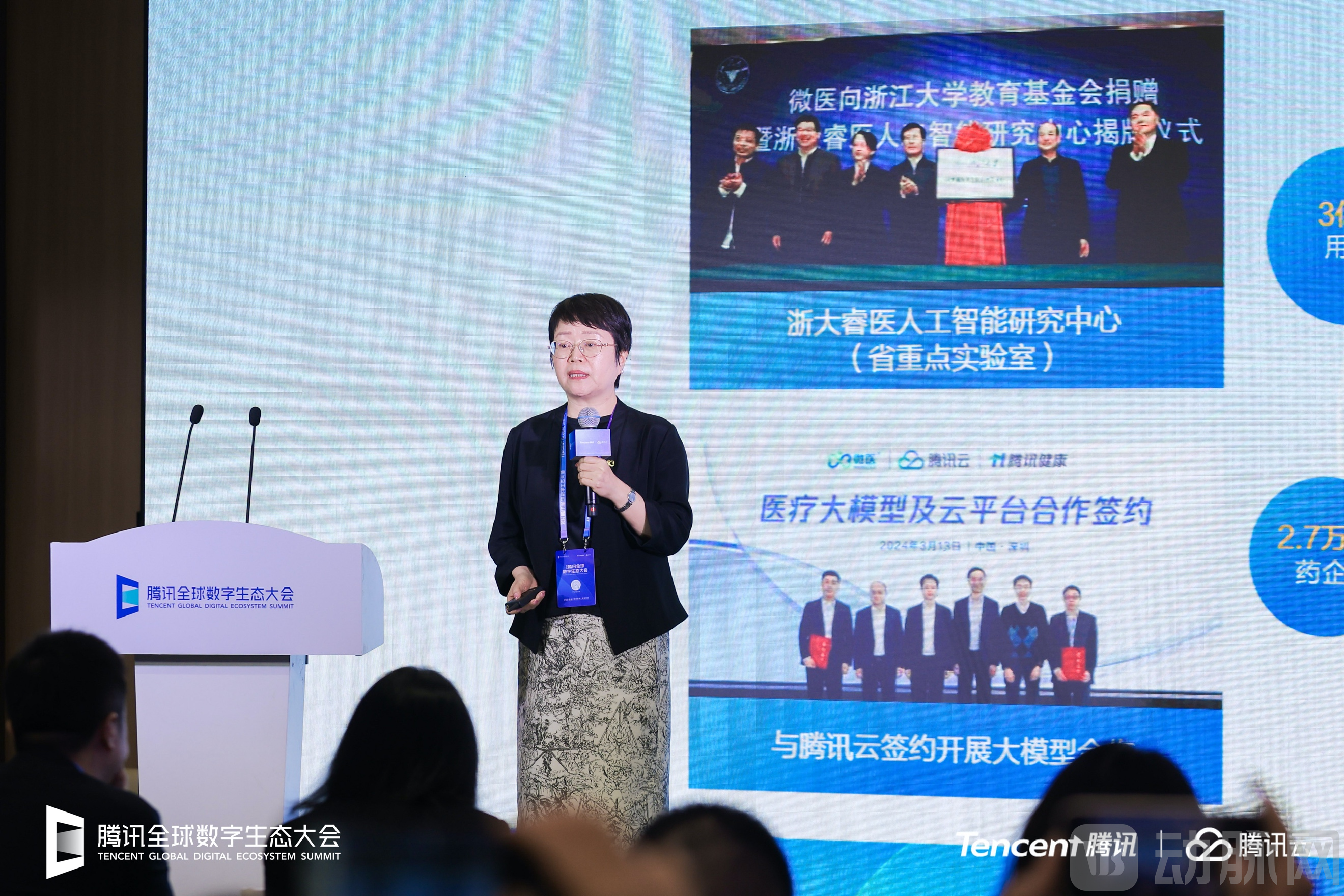
Figure | Yan Jinhong, Senior Vice President of WeDoctor Holdings and President of the WeDoctor Cloud Platform, delivers the keynote address
Yan Jinhong introduced that WeDoctor, leveraging its technological advantages and accumulated medical resources, closely aligns with national strategies and is committed to transforming the healthcare model from “disease-centered” to “health-centered.” Driven by the dual engines of “mechanism innovation + AI empowerment,” WeDoctor is striving to build a cost-effective healthcare service model. Currently, WeDoctor has facilitated the implementation of Digital Health Communities in multiple provinces and cities, including Tianjin and Shandong; collaborated with Shanghai Ruijin Hospital to establish a “Six-Disease Co-Management” Center covering the full life cycle; and is exploring new models of digital therapeutics for chronic disease management in regions such as Hainan.
As an innovative model, the Digital Health Community centers on user health and leverages health insurance payment mechanisms, big data, and AI technology to achieve deep integration of "medical care, health insurance, and pharmaceuticals," thereby promoting the implementation of value-based healthcare. In Tianjin, this model has used chronic disease management and family doctor contracted services as entry points to explore and implement health insurance payment reforms based on diagnosis-related groups (DRGs) and capitation, achieving guaranteed health outcomes at the provincial level with determined costs.
The “Six-Disease Co-Management” across the full life cycle has driven a shift from “disease management” to “patient-centered care.” Targeting six chronic conditions—oncology, metabolic disorders, cardiovascular and cerebrovascular diseases, respiratory diseases, reproductive medicine, and geriatrics—the model integrates “Ruijin Medicine + Sanming Demonstration + Weiyi AI” to establish a comprehensive healthcare system covering prevention, screening, diagnosis, treatment, management, and rehabilitation, along with a multidisciplinary diagnosis and treatment model. Currently, this model has been first implemented in Sanming, Fujian Province.
Notably, in March this year, WeDoctor entered into a comprehensive partnership with Tencent. Leveraging key digital technologies such as cloud computing, large language models (LLMs), and digital humans, the two parties are jointly promoting healthcare-specific LLMs. By focusing on the integrated management of six major diseases as a strategic entry point, they are developing intelligent products for specialized conditions. Tianjin, Sanming, Shanghai, and other regions serve as demonstration application scenarios to further drive the digital and intelligent upgrading of close-knit medical consortia, while also providing industry-wide, full-scenario joint solutions.
“The WeDoctor Solution” is profoundly influencing the course of healthcare reform across various regions. Yan Jinhong stated that the transition from “Medical Consortia” to “Health Consortia” has driven the innovation from volume-based payment to value-based payment. WeDoctor will continue to upgrade its innovation mechanisms and technical systems to better support the implementation of health-centered care.
Not long ago, WeDoctor launched China’s first AI-powered hospital in Shanghai, marking the maturity and refinement of its AI product ecosystem. Leveraging its industry-leading proprietary large medical language model, WeDoctor has developed four intelligent agents: “AI Doctor,” “AI Pharmacist,” “AI Health Manager,” and “AI Intelligent Control.” This initiative not only integrates AI throughout the entire health management pathway but also promotes deep coordination among healthcare delivery, medical insurance, and pharmaceuticals. By addressing patients’ out-of-pocket costs, optimizing the integration of medical resources, and enhancing the efficiency of medical insurance funds, WeDoctor is comprehensively advancing higher cost-effectiveness in healthcare services.
WeDoctor’s practice in Tianjin has validated the immense potential of AI in enhancing the efficiency and quality of medical services. The Tianjin Digital Health Consortium, jointly established by the Tianjin Municipal Government and WeDoctor, has leveraged large-scale applications of artificial intelligence to reduce costs and improve efficiency for primary healthcare institutions. For instance, AI-driven health management has significantly boosted the individual productivity of health managers, while AI pharmacist services have lowered labor costs associated with prescription review, simultaneously improving the rationality and cost-effectiveness of medication use.
Driven by sustained national policy initiatives, particularly the ongoing promotion of close-knit medical consortia and the Sanming healthcare reform model, China’s healthcare industry is entering a golden era of digital and intelligent transformation. Yan Jinhong stated that, against this backdrop, WeDoctor will continue to deepen collaboration with its partners and accelerate the clinical application of AI technologies. By providing systematic and innovative solutions, WeDoctor aims to help various regions explore localized upgrade pathways, thereby enabling broader access to higher-quality, more efficient, and more accessible healthcare services.