

ScieHome raises tens of millions RMB Series A financing to build an innovative ultrasound ecosystem of "ultrasound energy, drug-ultrasound synergy, precision theranostics"

ScieHome
Developer of Ultrasound Energy Technology and Pharmaceutical-Device Combination Technology
ScieHome has recently completed a tens of millions RMB Series A financing round, led exclusively by EFUNG Zhuohua Fund, a renowned investment institution focused on the healthcare industry. This capital injection will further accelerate the commercialization of ScieHome's innovative ultrasound energy devices, strengthen its core technological moat in drug-ultrasound combination therapy, and comprehensively build ScieHome's innovative ultrasound ecosystem centered around "ultrasound energy, drug-ultrasound synergy, and precision theranostics."

Venous thromboembolism (VTE) encompasses deep vein thrombosis (DVT) and pulmonary embolism (PE), which are different stages of the same disease. VTE is the third most deadly vascular disease after coronary heart disease and stroke.
DVT most commonly occurs in the lower extremities, and its major adverse consequences are pulmonary thromboembolism (PE) and post-thrombotic syndrome (PTS). Acute PE has a mortality rate as high as 20%–30%, representing an extremely high risk of fatality. If acute DVT is not diagnosed and treated in a timely manner, it can progress to chronic DVT, with 30%–50% of patients developing PTS within two years; once PTS occurs, the amputation rate can reach 10%–30%, indicating a very high risk of disability. Both PE and PTS pose serious threats to patient health. Therefore, the prevention and treatment of DVT cannot be delayed.
However, the onset of DVT is insidious, and most patients already present with mixed-type thrombus (predominantly subacute or chronic thrombus complicated by acute thrombus) at the time of consultation. Current mainstream treatment modalities have suboptimal efficacy in clearing such thrombi, making acute mixed with subacute or chronic DVT a treatment challenge and focal point in the field.
Ultrasound thrombolysis technology, with its unique therapeutic approach, holds promise for addressing the aforementioned challenge of mixed-type thrombus clearance. This technology utilizes the cavitation effect of ultrasound to separate and disrupt fibrin strands within the thrombus, thereby exposing more drug receptor sites. Meanwhile, the ultrasound-induced microflow environment enhances the penetration of thrombolytic agents into the thrombus, delivering the drug deep into the thrombus core. As a result, thrombus dissolution can be accelerated with lower doses of thrombolytic agents, achieving safe thrombolysis.
As the treatment paradigm for thrombus shifts from simple "thrombus removal" to a comprehensive model of "thrombus clearance—vessel protection—vessel rehabilitation," ultrasound thrombolysis technology is poised to become an important direction in the field of thrombus clearance.
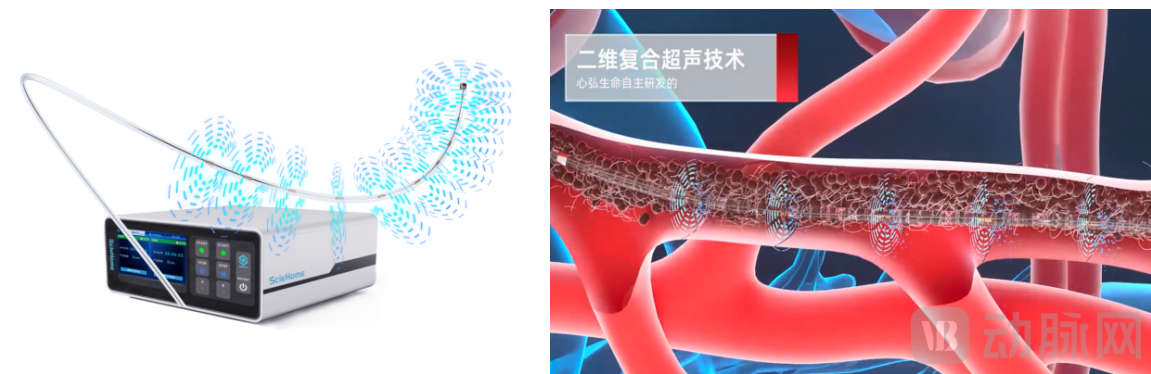
Founded in June 2022, ScieHome has built a unique and innovative technology platform centered around "ultrasound energy, drug-ultrasound synergy, and precision theranostics." The Company's independently developed integrated multidirectional pulsed ultrasound thrombectomy system, based on its proprietary two-dimensional composite ultrasound technology, is specifically designed for refractory and mixed-type thrombi. This product can rapidly clear polymorphic mixed-type thrombi using less than one-fourth the thrombolytic agent dosage required by conventional catheter-directed thrombolysis (CDT), significantly reducing bleeding risk while causing no damage to the vascular intima or venous valves. The product has completed registrational clinical studies, with results confirming its excellent safety and efficacy in treating mixed-type thrombi. The product has been granted access to the National Innovative Medical Device Special Review Program and is currently under regulatory review, with the potential to provide a novel treatment option for patients with thrombus in the near future.