

Antern Biotech Files IPO Prospectus to Scale AI-Driven Precision Nutrition Solutions in China's Booming Functional Food Market
There is undoubtedly significant room for growth in China's functional food sector.
“The current penetration rate of functional foods exceeds 50% in the United States and 40% in Japan, while it remains well below 20% in China. In 2022 alone, the market size of functional foods in China approached RMB 200 billion, and is projected to reach RMB 1 trillion by 2030,” pointed out Mr. Shi, CEO of Anteen.
This highly promising market has also prompted Antern to enter the fray.
However, the functional food sector is crowded with competitors, making it increasingly difficult to achieve success by replicating past strategies. Ultimately, grounded in market insights, Anteen chose a relatively unique niche: delivering “precision nutrition” powered by AI tools.
Antein has chosen to enter the precision nutrition sector, driven by the growing nutritional needs of current consumer groups and the failure of existing products to adequately meet these demands.
Users’ demand for precision nutrition is rising rapidly.Currently, with the rapid rise in health awareness, young consumers are increasingly becoming the primary demographic for functional foods. They hold strong expectations for these products and tend to make precise choices aimed at improving their personal health conditions.
However, the issue is that there is currently no comprehensive personalized nutrition solution to meet users' demands.The CEO of AntEn pointed out that, first, in the field of nutritional diagnosis, “there is a lack of a ‘gold standard’ for diagnosis in nutrition. The most fundamental condition in clinical nutrition, ‘malnutrition,’ only reached a standardized consensus in 2018, and many clinical nutritional issues still lack industry-recognized diagnostic criteria.” Second, regarding the provision of nutritional products, “there is currently a shortage of products tailored to specific diseases and specialties; instead, most practices involve compounding and using basic products with generalized effects.”
The emergence of digital tools, such as AI, has created the conditions for addressing this issue and enabling precision nutrition.From the user’s perspective, the integrated hardware and software solution combining AI with continuous monitoring enables the efficient and convenient delivery of personalized nutritional health products and services based on individual physiological metrics. From an industry perspective, by deeply integrating clinical practice with industrial applications and leveraging digital tools such as AI, stakeholders can better identify clinical product needs, facilitate efficient scientific research, and accelerate product development. This approach not only establishes a basis for diagnostic and therapeutic methods but also delivers products that are highly targeted, functionally robust, and well-accepted by patients.
For AntEn, the goal is to leverage its own platform and AI tools to drive the clinical and industrial sectors in developing precision nutrition solutions that meet user needs.
To enable the provision of “precision nutrition solutions,”Anten has established a Clinical R&D Center (Chongqing) in collaboration with top-tier tertiary hospitals, and partnered with leading domestic universities to establish a Data R&D Center (Suzhou) and a Product R&D Center (Tianjin).
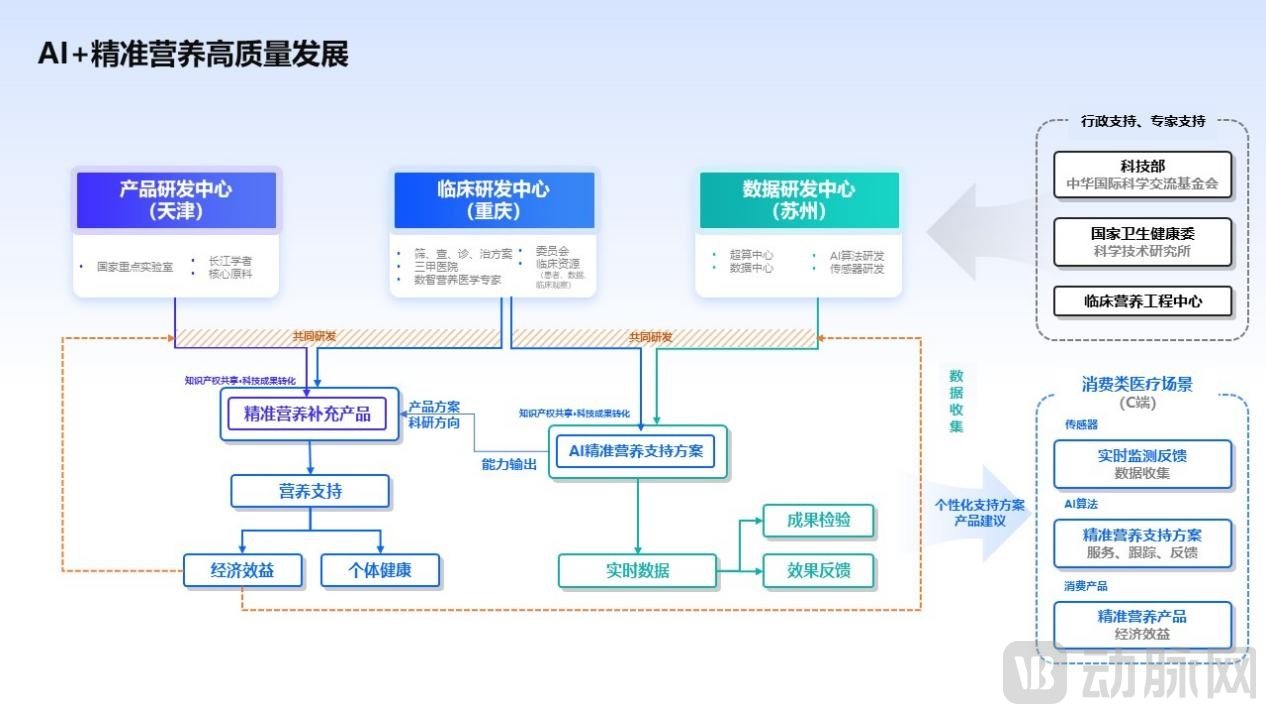
Among these, the Clinical R&D Center is responsible for gathering clinical needs, conducting clinical product research, and validating product efficacy. The Data R&D Center serves as the company’s data hub and AI algorithm research center; on one hand, it provides decision support for clinical research and product development through big data analytics and AI technologies, and on the other hand, it enhances data processing efficiency based on algorithms to further predict market trends. The Product R&D Center is tasked with researching and rigorously validating product efficacy, safety, and palatability in a laboratory setting, ensuring that products meet the highest standards before market launch, while also conducting further product assessments and validating product value.
According to VCBeat, the collaboration among the three major centers is built on two core principles: first, demand-driven product development; second, ensuring that product performance meets expectations.
It is important to note that the products referred to here are not limited to nutritional health foods; they also include wearable devices for monitoring users’ physiological data, as well as related algorithms.Leveraging AI, wearable devices, and nutritional health foods, Anten is able to provide tailored health products and services based on the specific nutritional and wellness needs of different users. Anten aims to achieve market profitability by collaborating with universities and medical institutions to jointly develop precision nutrition supplements and other products with strong market demand.
Currently, Anteen is developing a nutritional health food that promotes human protein synthesis or reduces protein breakdown, helping to prevent muscle atrophy and thereby supporting muscle health and growth. In addition, in terms of algorithms, Anteen is also conducting research on a nutritional diagnostic algorithm and a nutritional support plan recommendation algorithm. It is reported thatAnten plans to further expand into a broader range of nutritional support scenarios, building on its specialized products for specific diseases, to address more comprehensive nutritional issues and provide holistic health management solutions.Anten’s CEO emphasized, “We place particular focus on key medical areas such as oncology treatment and postoperative rehabilitation, designing patient-centered treatment plans with meticulous care. We attach great importance to patient treatment adherence, ensuring that our regimens are easy for patients to accept. Meanwhile, we fully account for patients’ sensitivity to treatment costs, striving to provide cost-effective healthcare options while guaranteeing therapeutic efficacy.”
This has also shaped AntEn’s core business direction, namely the sale of precision nutrition products and services tailored to users. It is reported that AntEn is currently considering promoting its products through two major channels: first, by leveraging precision nutrition Clinical Decision Support Systems (CDSS) within medical institutions to present products directly to physicians, who then decide whether to adopt them; and second, by offering personalized precision nutrition support plans to users via online e-commerce platforms, nutrition support apps, and mini-programs, while further enhancing user stickiness through data-driven feedback from wearable devices.
It is reported that multiple clinical institutions and research institutes are currently collaborating with Anteen. The company has established connections with over 200 medical institutions, including more than 40 leading regional healthcare providers, and jointly conducts patient management with clinical departments to achieve efficient data collection. It has also aggregated expert resources from several leading medical institutions in Chongqing and jointly established the “Digital Intelligence Nutritional Medicine Expert Committee.”
There are good reasons for its ability to forge collaborations with a host of clinical medical institutions and research institutes.
On the one hand, clinical medical institutions and research institutes themselves face difficulties in transforming their achievements and urgently need platform support.For instance, clinical healthcare institutions are at the forefront of identifying clinical needs, yet they often lack the capacity for subsequent industrial integration, making it difficult to rapidly translate scientific research achievements into practical applications. Furthermore, clinicians may have an inadequate understanding of the market, potentially mistaking individual needs for common ones, which leads to low translation efficiency.
On the other hand, AntEn has accelerated the translation and implementation of clinical research achievements through a series of mechanisms.First, in clinical translation projects, it adopts a market-led R&D strategy to maximize the market adaptability and competitiveness of its R&D outcomes. Second, by leveraging industrial synergy for scientific research and innovation, it has resolved the common challenge of many projects failing to move beyond the laboratory, ensuring that research topics align with industrial upgrading and technological advancement, thereby maximizing the commercial implementation of research achievements. In the translation of scientific research achievements, Antein ensures a “demand-oriented technological innovation model” and a “market-driven mechanism for translating scientific research outcomes,” providing comprehensive support and safeguarding for scientific and technological innovation to the greatest extent.
Furthermore, more importantly,AntEn not only leverages AI technology to support the R&D process, but also further extends its support to product commercialization and sales.Currently, its AI engine is assisting researchers in R&D to discover more nutritional intervention strategies and optimize product formulation combinations. Furthermore, leveraging the AI engine embedded in the Clinical Decision Support System (CDSS) for physicians and the AI-driven precision nutrition solutions for end-users, the company is further advancing its product market promotion.
Achieving these results would not have been possible without the robust core competencies of the AntEn team.
On the one hand, the AntEn team is a multidisciplinary technical team.The founder has long been engaged in the investment sector, possessing not only strong adaptability but also keen market insights and the ability to integrate resources across the upstream and downstream segments of the industrial chain. The rest of the team comprises senior food experts (including a renowned university professor with extensive research achievements in functional food ingredients), sensor technology specialists, artificial intelligence experts, and clinical nutrition specialists, enabling faster implementation of industrial applications.On the other hand, AntEn boasts two core databases: the BSPdb (Biosynthesis Gene Database) and a probiotics database.It possesses a comprehensive platform and technological system for both disciplinary and applied research, has systematically studied 2,270 polysaccharide molecules, and established a database containing more than 15,000 glycosynthesis genes/elements with diverse functions. In the field of probiotics, it has screened and built a resource bank of over 1,000 probiotic strains. This has also enabled the development of its proprietary compounded formulations, creating an intellectual property barrier.
Policies are continuously driving the development of the nutritional intervention sector.
Documents such as the “Healthy China 2030” Planning Outline, the National Nutrition Plan (2017–2030), and the Guidelines for the Construction and Management of Clinical Nutrition Departments (Trial) require hospitals at Level II and above to establish clinical nutrition departments, implement resident nutrition monitoring systems, and carry out clinical nutrition interventions to reduce disease incidence.
In this context, the need to deliver more precise nutritional and health support has become increasingly urgent.
Meanwhile, Antern is further accelerating its collaboration with clinical medical institutions to develop precision nutrition support products that have gained market recognition, andContinuously refine the business model of continuous monitoring plus precision nutrition support, and develop artificial intelligence algorithms with precision nutrition support capabilities., promote the publication of research papers with industry influence.
Anten stated that it aims to become the preferred partner for domestic medical institutions in the commercialization of scientific and technological achievements, build AI service capabilities that are leading in China and influential globally, and emerge as a market leader in the consumer sector for precision nutrition support products.
To achieve this goal, AntEn is currently raising funds to accelerate the rapid implementation of the project.
“Our ultimate goal is to align closely with policy directives, drive the transformation and upgrading of the health industry, better meet people’s health needs, further narrow disparities in health services and health outcomes across urban and rural areas, regions, and population groups, and thereby facilitate the achievement of optimal health for all residents.”