

Tencent Health Files IPO Prospectus, Leading the Medical Large Model Race with Deployment in 1,300 Institutions

Tencent Healthcare
Developer of Digital Healthcare Products
Much like the fervor surrounding deep learning in its heyday, emerging large language models are sweeping through the healthcare industry at a visibly rapid pace. In less than two years, the number of healthcare-specific vertical models on the market has exceeded one hundred, with many leading hospitals proactively deploying related platforms and spontaneously embarking on explorations into the next generation of artificial intelligence.
In this context, numerous research institutions have affirmed the promising prospects of large medical models. Witnessing the success of ChatGPT and Sora, they expect large medical models to follow suit, driving the intelligent development of hospitals more effectively than previous technologies and achieving scalable implementation at a faster pace.
However, for tech-driven healthcare to establish a firm foothold in the medical field, it requires not only substantial technological innovation but also products that are highly adapted to specific clinical scenarios and seamlessly integrated into existing healthcare workflows.
The presence of this characteristic makes it difficult for large models in the medical field to be rapidly deployed, unlike in other sectors. Even tech giants like Tencent are grappling with the challenges of implementing large language models in practice.
Over the past eight years, Tencent Healthcare has built an ecosystem in public health, medical services, patient services, drug R&D, and omics analysis, with AI as its core technological foundation. In terms of large models, in addition to comprehensive support from the general-purpose Hunyuan large model, Tencent Healthcare has also developed specialized large models for the healthcare industry, molecules, and genes, tailored to the specific needs of segmented scenarios.
Despite its broad business coverage, Tencent Healthcare has been exceptionally cautious in advancing its large language model initiatives. At this year’s Digital Ecosystem Conference, during the session dedicated to digital and intelligent healthcare, Wu Wenda, President of Tencent Healthcare, cited “practical implementation” as the key reason for this approach.
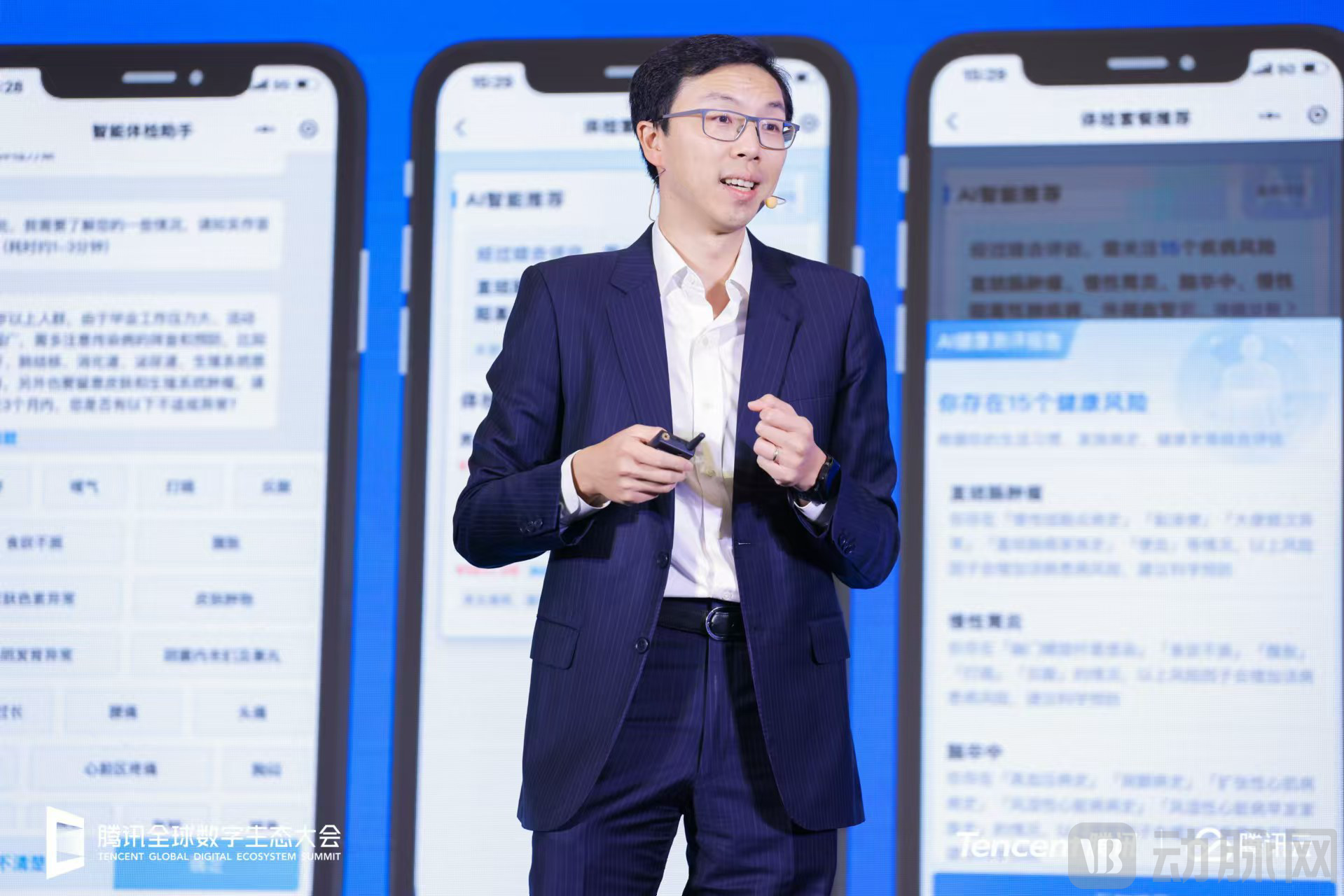
Wu Wenda, President of Tencent Healthcare, Delivers Keynote Address at the Digital Intelligence Healthcare Session of the Tencent Digital Ecosystem Conference
“Faced with emerging trends, people often rush to enter the market, fearing they will miss the first-mover advantage. However, healthcare is a complex sector. Many innovative products appear promising and boast impressive technology, but if their market fit or business logic is flawed, technological innovation alone clearly cannot resolve these fundamental issues. Therefore, when we decide to apply large language models to a specific scenario, we first assess whether the value proposition is substantial enough to benefit doctors and patients, and then evaluate its commercial prospects to ensure successful future implementation.”
AI-powered pre-consultation is one of the large language model applications that Tencent Healthcare has already implemented at scale, addressing the issue of doctor-patient communication amid the supply-demand imbalance in medical services.
Many physicians at tertiary hospitals have long been operating at full capacity, leaving them with insufficient time to conduct thorough patient consultations. As a compromise, their diagnostic process has become more akin to a “transaction,” with little opportunity to establish long-term relationships with patients or engage in comprehensive, full-cycle observation.
Drawing on its experience with intelligent triage systems, Tencent Healthcare has leveraged large language models to develop an AI-powered pre-consultation system. After scheduling an appointment, patients can engage in a detailed pre-consultation interview with the system, providing information such as their chief complaint, medical history, and medication contraindications in advance. This allows physicians to have a preliminary understanding of the patient’s condition before the formal consultation, enabling them to ask more targeted questions and thereby improving diagnostic accuracy.
Revisiting the Intensive Care Unit (ICU) Setting. Patients in this environment are often subjected to interventions from multiple medical devices, with their physiological status closely monitored through a dense array of vital signs. They may also receive extensive pharmacological treatments and diverse therapeutic regimens. In such a highly specialized setting, physicians find it challenging to address all questions immediately during ward rounds.
In this scenario, the value of large language models (LLMs) lies in enhancing efficiency. By integrating medical device monitoring data, electronic health record (EHR) data, and the clinical expertise of ICU physicians, LLMs can rapidly respond and provide support when patients experience emergencies.
For example, when a patient experiences a sudden decline in renal function, physicians may need to thoroughly review extensive medical records to identify the underlying cause. In contrast, large language models can automatically screen and flag medications that may adversely affect renal function within treatment records from the past 7 to 14 days, pinpointing the cause within seconds. This enables physicians to intervene in the patient’s condition more promptly and precisely.
Beyond considerations of value and implementation, Tencent Healthcare places particular emphasis on “trade-offs.”
Wu Wenda stated, “There are many scenarios suitable for large language models, and we will carefully consider whether we should develop them in-house. For some deeply clinical and particularly complex scenarios, we have the capability to execute them, but they should be left to enterprises with greater comparative advantages. After all, Tencent’s greatest strength still lies in its ‘connectivity’ capabilities.”
Thus, we can clearly see the distinction between Tencent Healthcare’s strategic layout in the medical sector and that of other internet companies. Rather than directly engaging in simplistic and blunt scenarios such as drug purchasing and sales, it has allocated more resources to the B2B segment, serving healthcare providers, medical insurance entities, and pharmaceutical enterprises to enhance the operational efficiency of the entire healthcare system.
At the Tencent Digital Ecosystem Conference, Tencent Healthcare announced collaborations with China Resources Sanjiu, Yidu Cloud, Haiyun Health, Zhuoyue Weilai, Yuyi Health, and Huayu Yuntuozhan Intelligent, among others, in the field of large medical models. Notably, the large model for intensive care unit (ICU) scenarios was jointly developed by Tencent Healthcare and Mindray Medical.
Furthermore, Tencent has partnered with AstraZeneca China to launch the development of a “Next-Generation Customer Engagement Platform.” By enhancing communication efficiency, facilitating cross-departmental collaboration, deepening data insights, and promoting intelligent decision-making, this initiative aims to comprehensively drive the pharmaceutical industry’s transformation toward digital models. Ultimately, it seeks to foster efficient communication and in-depth collaboration between healthcare enterprises and medical professionals, jointly pioneering new paradigms for academic exchange.
Yuanxin Technology has leveraged Tencent’s large medical model technology to develop the Huibao Large Model, specifically tailored for its health insurance business. This large model not only handles more than half of customer inquiries during peak periods but also empowers insurance brokerage firms, enabling them to rapidly evolve into professional health insurance stewards that integrate marketing, claims processing, and health management expertise. Meanwhile, Yuanxin Technology has also applied the large model to its subsidiary, Yuanxin Pharmacy, to implement refined, whole-course disease management for patients.
To meet diverse requirements as comprehensively as possible, Tencent Healthcare also provides partners with “out-of-the-box” intelligent solutions tailored for the healthcare sector.
“In the construction of vertical models, the needs of each enterprise and partner vary. However, not every enterprise can build a large development team to create its own large language model (LLM) based on specific requirements. Therefore, we aim to empower every team with the foundational capability to independently optimize LLMs through an ‘out-of-the-box’ solution, enabling them to refine the models according to their own needs and thereby establish a competitive barrier in the market.”
Reflecting on the entire Tencent Digital Ecosystem Conference, Tencent Healthcare is currently pursuing two key strategies: one is to delve deeper into granular scenarios, such as pre-consultation and intensive care units (ICUs), to thoroughly explore value for both doctors and patients; the other is to strengthen its ecosystem capabilities, attract more partners to join, and accelerate the realization of scenario-based value from large language models.
According to data released by Tencent Healthcare, its medical AI has been deployed in more than 1,300 healthcare-related institutions, including hospitals, pharmaceutical and medical device companies, research and academic institutions, and health-tech enterprises. In addition to core AI capabilities such as large-model foundations and R&D, AI-native toolchains, and medical imaging, AI services also extend to scenarios including patient services, clinical decision support, genomics, and smart marketing. This scale of deployment places it at the forefront of the industry.
Nevertheless, Tencent Healthcare has maintained a restrained stance toward large medical models. At the conclusion of the conference, Wu Wenda called on the industry to take a rational view of the development trajectory of large medical models.
After all, the complexity and inertia of the healthcare system make it difficult for companies to rapidly rewrite the rules through innovation. This is a protracted battle. In the end, what matters most is which ecosystem is more comprehensive, which service is of higher quality, and which offers better cost-effectiveness.