

Think Surgical Secures Three FDA Clearances in Three Months for TMINI Robotic System, Files IPO Prospectus

Think Surgical
Medical Robot Device Manufacturer

Zimmer Biomet
Medical Device R&D Manufacturer
Recently, orthopedic robotics developer Think Surgical announced that its TMINI miniature surgical robot system has received FDA 510(k) clearance for use in conjunction with Zimmer Biomet’s (NYSE: ZBH) personalized knee system, Persona.
Think Surgical’s specialized version of its knee replacement system is designed to pair with Zimmer Biomet implants. The FDA has approved the combined use of these two systems, marking Think Surgical as the only company offering a robotic system that can be used exclusively with the Persona Knee System while also functioning as an open platform compatible with implants from multiple manufacturers for total knee arthroplasty.
On May 30, 2023, Think Surgical announced that its TMINI™ miniature robotic system had received FDA 510(k) clearance.
The TMINI™ Miniature Robotic System is a stereotactic instrument system designed for total knee arthroplasty (TKA). The system comprises three main components: a 3D graphical preoperative planning workstation (TPLAN Planning Station), an optical tracking navigation console (TNav), and a robotically controlled handheld tool (TMINI Robot).
It provides orientation and reference information for identifiable anatomical structures by establishing software-defined spatial boundaries, thereby assisting surgeons in the accurate placement of knee implant components. The positioning of the robotic device is performed based on anatomical landmarks recorded by the system intraoperatively and the surgical plan determined preoperatively.
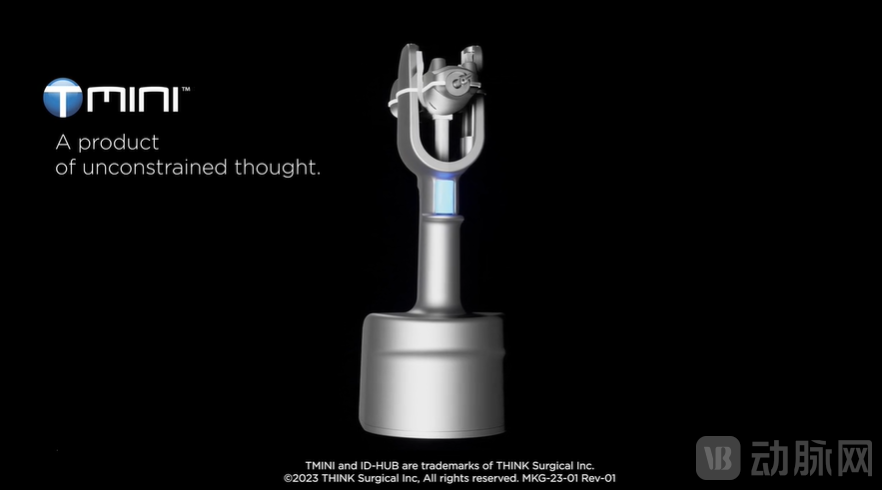
TMINI™ Micro-Robotic System
The TPLAN Planning Station assists surgeons in creating personalized 3D surgical plans based on patients’ CT scans. The software generates a 3D surface model of the operative leg from preoperative CT scans for use in case templating and intraoperative registration. Additionally, the planning workstation includes a library of knee replacement implants cleared via the 510(k) pathway. Surgeons can select an implant model from this library and manipulate its 3D representation relative to the bone model to achieve optimal implant placement. Once the surgeon is satisfied with the implant’s position and orientation, the data are exported to a file to guide robot-controlled handheld instruments.
The handheld robotic tool TMINI Robot is optically tracked relative to optical markers placed on the femur and tibia, and this tool can move in two degrees of freedom. This design allows the user to precisely place bone pins in a planar manner on the femur and tibia, thereby providing stable reference points and fixed positions for subsequent surgical steps. The mechanical guide is clamped onto the bone pins, enabling the surgeon to place cutting slots and drill guide holes at predetermined positions and orientations. This ensures that distal femoral and proximal tibial cuts can be performed at the predetermined positions and orientations, and allows for the placement of the implant manufacturer’s multi-planar cutting block relative to the drilled distal femoral guide holes.
TMINI™ Miniature Robotic System features a small footprint, an open implant platform, and an intuitive workflow. The system meets surgeons’ demand for an ergonomic, wireless, handheld robotic system, accelerating the adoption of robotics in knee surgery and, in particular, opening up possibilities for using surgical robots in outpatient and clinic settings.
On July 23, 2024, Think Surgical announced that version 1.1 of its TMINI® Miniature Robotic System had received FDA 510(k) clearance. The TMINI 1.1 system software has been updated to provide surgeons with greater flexibility during total knee arthroplasty procedures. The new TMINI PRO™ workflow features dynamic data capture and real-time feedback, enabling precise adjustment and optimization of implant positioning based on individual patient needs. Furthermore, this intuitive workflow can be customized according to the surgeon’s preferences and implantation philosophy, and it adds the capability for intraoperative real-time assessment of soft tissue balance. Adjustments to the surgical plan can be transmitted wirelessly to the TMINI robot, ensuring a seamless surgical experience.
Think Surgical stated that the company places “implant selection” at the core of robotic surgery and collaborates with surgeons and implant device partners to develop orthopedic surgical robots capable of supporting implants from multiple manufacturers.
Think Surgical is committed to making its handheld TMINI micro-robotic system accessible to as many customers as possible, catering to the diverse preferences of different customer segments. The company serves two distinct customer groups: one prefers an open platform that allows for the selection of various implants on the robotic system, while the other favors a dedicated platform utilizing the Persona Knee System.
From July to September, Think Surgical received FDA approval three times:
In July, the Company received 510(k) clearance for the update to Version 1.1 of the TMINI Micro-Robotic System;
On August 29, Think Surgical announced that it had received FDA 510(k) clearance for the use of its system with Medacta International’s GMK® Sphere and SpheriKA® knee systems under their collaborative agreement. The GMK® Sphere and SpheriKA® knee systems have been added to Think Surgical’s ID-HUB™, a proprietary implant module database for the open-platform version of its TMINI® system.
Among them, the GMK Sphere implant is a leading ball-and-socket knee joint design, while the SpheriKA implant is the world’s first knee system specifically designed based on the principle of kinematic alignment. Their addition to Think Surgical’s database means that Medacta customers can now perform robot-assisted total knee arthroplasty in the United States.
On September 5, the TMINI system added the FDA-approved Persona knee implant system from Zimmer Biomet, which is compatible with its miniature robotic system. This update further expands the device’s indications for use and enhances its compatibility with knee implant systems.
Overall, traditional orthopedic surgeries—including joint replacement, spinal surgery, and trauma surgery—suffer from clinical pain points such as poor precision, high osteotomy error rates, and high rates of improper screw placement. Surgical robots can enhance surgical accuracy and stability, reduce neurovascular injury, and prevent severe complications such as paralysis.
In recent years, the market for orthopedic surgical robots has shown a trend of rapid growth. According to the "2024-2029 In-Depth Research Report on the Global and Chinese Surgical Robot Industry" released by China Business Industry Research Institute, the market size of China's orthopedic surgical robots was approximately 574 million yuan in 2023, with a compound annual growth rate (CAGR) of 20.9% over the past four years. It is expected that the market size of China's orthopedic surgical robots will grow to 744.6 million yuan in 2024.
From the perspective of the industry’s competitive landscape, the market share of orthopedic surgical robots in China is relatively concentrated. The top three players—Tinavi, Medtronic, and Stryker—collectively account for 70.60% of the market. However, domestic companies are currently accelerating their efforts to catch up.
According to relevant data from VCBeat, as of October 15, 2023, a total of 20 orthopedic surgical robots with navigation and positioning capabilities had been approved in China. Among these, the largest number were indicated for joint replacement, followed by those for spinal procedures.
Tinavi Medical Technologies Co., Ltd. specializes in the research and development, manufacturing, sales, and service of navigation and positioning robots for orthopedic surgery. It is the first company to obtain a Class III medical device registration certificate for orthopedic surgical robots issued by the China Food and Drug Administration (CFDA). The TiJI II is the latest orthopedic surgical robot launched by Tinavi. This product optimizes the robotic surgical workflow, enhances the functionalities of the robotic arms, and adapts to a wider range of complex surgical scenarios.
Hangzhou Jianjia Medical Technology Co., Ltd. specializes in the research and development, production, and sales of surgical robots and related products. The company’s flagship product, the ARTHROBOT Hip Replacement Surgical Robot, was included in the Special Review Procedure for Innovative Medical Devices in February 2021 and became the first domestically produced hip replacement surgical robot to obtain a Class III Medical Device Registration Certificate in April 2022. The company’s ARTHROBOT Knee Replacement Surgical Robot received its Class III Medical Device Registration Certificate in January 2023. The ARTHROBOT series can be used for both hip and knee replacement surgeries, breaking the long-standing monopoly held by imported joint replacement surgical robots in this field.
Huaruibo specializes in the R&D and manufacturing of surgical robots and the development of intelligent surgical management platforms, providing comprehensive smart orthopedic solutions to medical institutions. Its innovative products continue to expand across knee, hip, and spine applications, delivering multimodal, digital preoperative planning information along with high-precision, automated intraoperative registration and execution solutions. Its navigation and positioning system for total knee arthroplasty secured China’s first registration certificate for a domestically produced total knee arthroplasty surgical robot.