

Yuanhua Intelligence's All-in-One Orthopedic Robot Kunwu Gains Approval for Three Indications in Three Years

Yuanhua Tech
Medical Robot Developer
With the advancement of personalized medicine, orthopedic subspecialties are also trending toward greater specialization. In some hospitals, the Department of Orthopedics has been subdivided into nine subspecialties, including Spine Surgery, Joint Surgery, and Sports Medicine. Treatment approaches vary in focus depending on the specific orthopedic condition.
As an important tool in modern orthopedic surgery, orthopedic surgical robots have been developed into various types to address the technical challenges of different subspecialties. Currently, the mainstream classification of orthopedic surgical robots in the market is as follows:Joints, TraumaandThree Major Categories of the Spine. In joint surgery, kneeJoints, Hip JointsandUnicompartmental Knee ArthroplastyMost representative.
However, in clinical practice, to meet the demands of different types of orthopedic surgeries, physicians may need to frequently switch surgical robots or adjust their configurations, which increases the complexity and cost of the procedures to some extent.
In July 2024, Yuanhua Tech’s independently developed Kunwu orthopedic surgical robot achieved another major breakthrough, receiving approval from the National Medical Products Administration (NMPA) for unicompartmental knee arthroplasty. This signifies thatKunwu has become the first domestic hip, knee, and unicompartmental all-in-one total joint orthopedic surgical robot capable of addressing multiple indications to pass the NMPA’s Special Examination Procedure for Innovative Medical Devices.
Four Years On, Breaking the Monopoly of Overseas Technologies
Traditional orthopedic surgeries are primarily categorized into three types: joint, spine, and trauma, with joint surgeries being particularly distinctive.
Joint surgeries are primarily dominated by artificial joint replacement. This surgical procedure, which originated in the 20th century, has been widely adopted due to advancements in biomaterials technology and the general improvement of clinicians’ technical skills. To date, artificial joint replacement remains the most common treatment modality for joint diseases such as advanced hip osteoarthritis, avascular necrosis of the femoral head, developmental dysplasia of the hip, and rheumatoid arthritis.
However,The outcomes of joint replacement surgery are inextricably linked to the surgeon’s operative technique.The shape matching of artificial joints, the degree of ligament stretching, and the management of surrounding soft tissues all require individualized handling based on the patient’s specific condition. However, prior to the advent of surgical robots, surgeons relied solely on personal experience during procedures, which inevitably led to errors, resulting in complications or suboptimal prognoses.
With the advent of joint surgery robots, joint surgery has transitioned from the “experience-based” era into a new phase, significantly improving surgical outcomes while reducing operational difficulty for surgeons and enhancing surgical efficiency.
However,In addition to the personalized selection of prostheses and surgical techniques, joint surgeries at different anatomical sites also exhibit significant differences.In knee joint surgery, if the patient presents with simultaneous limitations in flexion and extension, the surgeon must perform soft tissue release and nerve protection. In hip joint surgery, the surgeon must carefully consider various parameters of the prosthetic joint, such as the abduction angle, anteversion angle, and center of rotation, to ensure that the patient’s normal motor function remains unrestricted. Meanwhile, unicompartmental knee arthroplasty requires particular attention to precise joint gap balancing to guarantee joint stability.
Based on varying requirements, the end-effectors at the front of surgical robot arms also have different specifications, while internal modules such as navigation systems and guidance systems have their own unique requirements. Therefore,Developing a comprehensive orthopedic surgical robot requires not only an in-depth understanding of diverse surgical needs, but also the ability to achieve both general applicability and procedure-specific precision at both the hardware and software levels.
Yuanhua Tech has consistently adhered to an innovation system integrating medicine and engineering, breaking the monopoly of overseas technologies within just four years and launchingChina’s First All-in-One Knee Orthopedic Surgical Robot System—Kunwu Total Orthopedic Surgical Robot(hereinafter referred to as: Kunwu Robot).
An All-in-One System Supporting All Orthopedic Surgical Procedures
Kunwu mainly consists of three major components: the master console, robotic arms, and a navigation system.
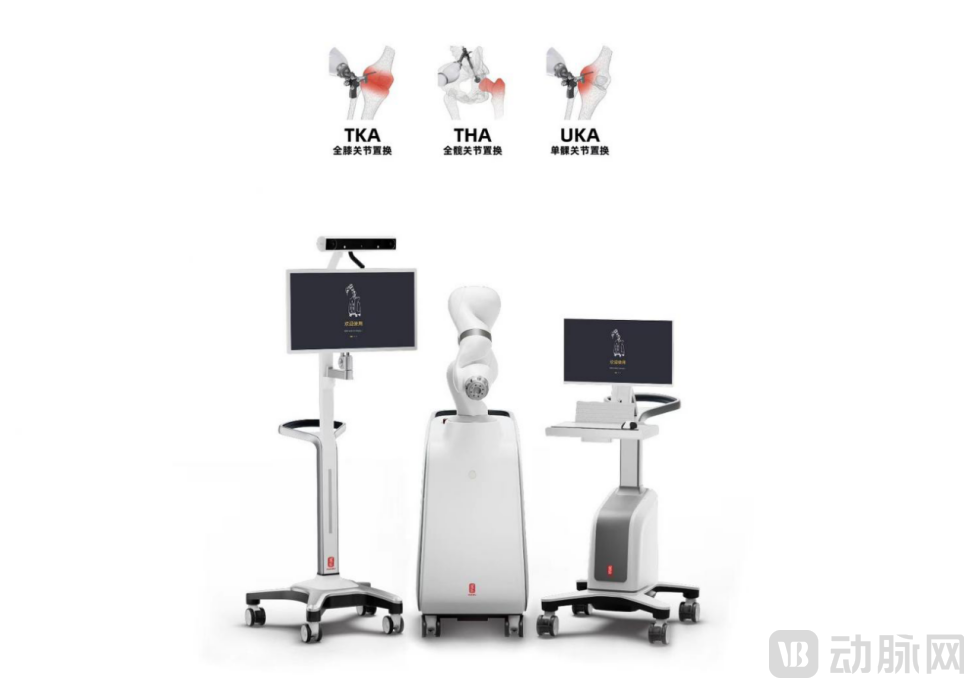
Hip, knee, and unicompartmental knee arthroplasty: An integrated orthopedic surgical robot capable of addressing multiple indications (Photo provided by the interviewee)
The central console serves as the brain of the Kunwu robotic system, responsible for rapid preoperative modeling, formulation of personalized surgical plans, and comprehensive safety protections. Its embedded system, independently developed by the Yuanhua team, features deep learning capabilities. The robotic arms function as the hands of the Kunwu robot. At the distal end of the robotic arms, surgeons can select and freely combine various tools according to surgical requirements, enabling a single platform to perform multiple surgical procedures. Furthermore, binocular cameras with a frame rate exceeding 300 Hz achieve near-zero latency, while the proprietary navigation system enhances the depth, longitudinal range, and width of the surgical field of view, laying a solid foundation for precise surgical manipulation.
When applied to clinical surgery, these features can significantly enhance surgical safety and improve patients’ postoperative recovery outcomes.In Knee Joint Surgery, enabling sub-millimeter precision in osteotomy without the need for cutting guides. Meanwhile, assisted by the intelligent system, surgeons can complete six-step precise osteotomies with just a single registration, significantly improving surgical efficiency and reducing uncertainties associated with repeated bone cuts.
In the Field of Total Hip ArthroplastyKunwu can precisely position bone grinding and cup placement, including location and angle, and personalize the polishing of artificial joints according to patient needs, thereby minimizing postoperative recovery pain. Due to individual patient differences, the suitable surgical approaches vary. Kunwu can easily accommodate multiple surgical positions, such as the posterolateral approach and the direct anterior approach, and provide personalized surgical planning based on each patient’s specific condition, enhancing surgical precision and outcomes.
In Unicondylar Knee Arthroplasty, in addition to safe and precise osteotomy. Kunwu can also accurately position the femoral component peg holes, facilitating comprehensive prosthetic fit, reducing postoperative discomfort and pain, and improving patients' quality of life. Furthermore, Kunwu’s pre- and post-operative gap assessment and full-process visualization of motion trajectories help ensure the long-term durability of surgical outcomes. Postoperatively, AI-driven personalized rehabilitation plans can be developed for patients to promote rapid recovery of joint function.
Dr. Yan Tingfang of Yuanhua Tech introduced, “Currently, the Kunwu orthopedic surgical robot has established a set ofA comprehensive medical service system covering intelligent preoperative planning, precise intraoperative navigation, and postoperative rehabilitation. In the future, the team will continue to refine its technology and strive to launch more groundbreaking Made-in-China products.”
From its founding to the commercial deployment of its orthopedic surgical robot, Yuanhua Tech took only six years—a feat underpinned by decades of accumulated expertise by its R&D team. In the field of orthopedics, Yuanhua Tech has achieved milestone progress. Looking ahead, the company will also focus on areas such as gastroenterology and gynecology, accelerating the research, development, and market introduction of related products to provide more clinical professionals with intelligent and precise medical devices.