

ZT002, a Novel Once-Monthly GLP-1 Receptor Agonist, Demonstrates Promising Efficacy and Safety in Phase Ic Trial for Obesity Treatment, as Reported by ZiT Bio at EASD 2024

QL Biopharm
Recombinant Protein Drug Developer
* ZT002 demonstrated favorable safety and tolerability with both biweekly and monthly dosing regimens in overweight or obese patients, with an overall tolerability profile consistent with that of GLP-1 receptor agonists (GLP-1 RAs).
* During the open-label extension study, ZT002 120 mg administered once monthly resulted in a 17.1% reduction in body weight at Week 30
Beijing, China,September 12, 2024– Beijing QL Biopharmaceutical Co., Ltd. (hereinafter referred to as “QL Biopharm” or the “Company”) is an innovative pharmaceutical company dedicated to developing clinical-stage novel therapeutics for metabolic diseases. At the 2024 Annual Meeting of the European Association for the Study of Diabetes (EASD), it announced itsMonthly Novel GLP-1RA ZT002Phase Ic clinical data.
Professor Ji Linong from Peking University People's Hospital delivered a presentation on behalf of the company, titled“ZT002, a Novel Ultra-Long-Acting GLP-1 Receptor Agonist in Adults with Overweight or Obesity: A Randomized, Placebo-Controlled, Multiple Ascending Dose Phase Ic Study”conference report, highlighting the latest progress of ZT002.ZT002 is an investigational novel ultra-long-acting GLP-1 receptor agonist (GLP-1RA) administered via once-monthly subcutaneous injection for the treatment of obesity.
This study consisted of two parts, Part A and Part B. Part A enrolled a total of 28 overweight or obese patients across two cohorts. Eligible subjects were randomized to receive subcutaneous injections of ZT002 once every two weeks (Q2W) with dose escalation to 40 mg or 80 mg (n=10+10), or the corresponding placebo (n=4+4). The treatment duration was 12 weeks for the 40 mg group and 14 weeks for the 80 mg group. The primary endpoints were safety and tolerability, while the secondary endpoints included pharmacokinetics, pharmacodynamics, and immunogenicity. A 6-week washout period followed the last dose in Part A to assess pharmacokinetics, after which an open-label extension study (Part B) was conducted. Patients from the ZT002 80 mg Q2W group who voluntarily participated in the extension study (n=8) received additional treatment with ZT002 120 mg once monthly (Q4W) for 12 weeks. The primary endpoints were safety and tolerability, and the secondary endpoints were pharmacokinetics, pharmacodynamics, and immunogenicity. All study endpoints were met.
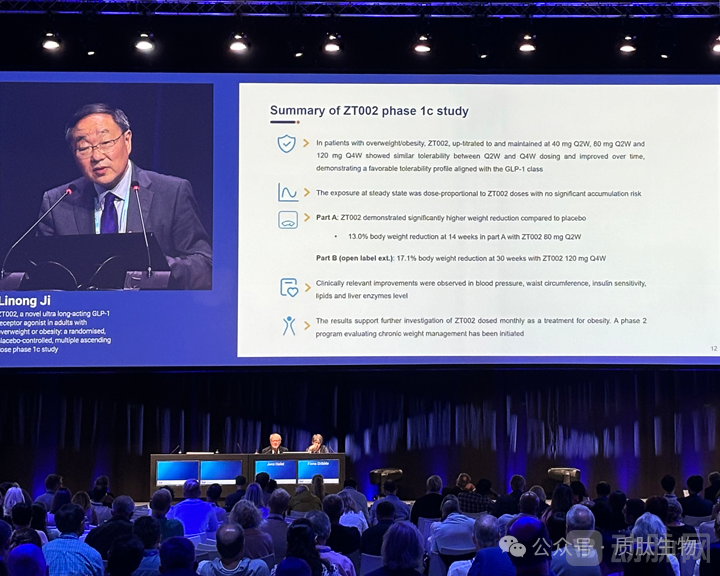
Professor Ji Linong from Peking University People's Hospital stated:“There is a huge unmet clinical need for obesity globally and in China. In recent years, novel weight-loss drugs represented by GLP-1 RAs have achieved breakthrough progress in providing patients with safe, effective, and convenient treatment options. ZT002, with its optimized molecular structure, offers the advantage of ultra-long duration of action and is expected to”Monthly Administration“The regimen delivers sustained and efficient weight loss treatment, with favorable safety and tolerability, further enhancing the convenience of long-term weight management and improving patients’ quality of life, thereby providing a new option in the field of obesity therapy.”
Dr. Zhang Xujia, Founder, Chairman, and CEO of Beijing QL Biopharmaceutical Co., Ltd., stated:“We are delighted to have the opportunity to present the latest research findings from the ZT002 program at EASD. These results fully demonstrate the potential of ZT002 and its clinical prospects in the treatment of obesity. Compared with weekly dosing, monthly administration significantly improved the quality of life for patients with obesity, greatly enhanced patient adherence, and yielded superior therapeutic outcomes. We will expedite the Phase II clinical studies of ZT002 for overweight and obesity, look forward to further research results, and provide updates in due course.”
QL Biopharm is a clinical-stage biopharmaceutical company dedicated to developing novel best-in-class therapies for metabolic diseases. Leveraging its proprietary E. coli production platform, the company can rapidly and efficiently scale up manufacturing to meet large-scale market demand. ZT002, QL Biopharm’s innovative drug candidate, is an ultra-long-acting subcutaneous GLP-1 receptor agonist currently undergoing Phase II clinical trials for obesity and Phase I clinical trials for type 2 diabetes. In Phase I trials, ZT002 demonstrated the potential for once-monthly dosing and exhibited a compelling safety and tolerability profile consistent with other GLP-1 receptor agonists. Additionally, the company is advancing a robust pipeline that includes a series of preclinical innovative drugs for metabolic disorders and a semaglutide biosimilar that has progressed to Phase III clinical studies. QL Biopharm’s core management team comprises seasoned pharmaceutical industry veterans with extensive experience in developing metabolic disease therapeutics, and the company is backed by professional biomedical investment institutions both in China and abroad.
The European Association for the Study of Diabetes (EASD) is a membership-based, non-profit academic organization. Founded in 1965, it is headquartered in Düsseldorf, Germany. The association aims to encourage and support research in the field of diabetes, facilitating the rapid dissemination of professional knowledge and its clinical application.