

Atum Files IPO Prospectus: 21 Years of Synthetic Biology Innovation Powering Global Biotech Solutions

ATUM
Supplier of Life Science Tools and Solutions
In 2004, synthetic biology was named one of the ten technologies that will change the world by MIT Technology Review. In the decades since, with the emergence of numerous new technologies and engineering approaches, synthetic biology has experienced rapid development.
Currently, synthetic biology has become increasingly integrated with various global industries, expanding its applications to bio-based chemicals, bioenergy, disease diagnostics, drug and vaccine development, crop breeding, environmental monitoring, and more. Today, synthetic biology is regarded as the “key to understanding life” and a “disruptive technology that will change the future,” driving industry transformation in next-generation biomanufacturing and the future bioeconomy.
Founded in 2003 and headquartered in California, USA,ATUM is a biotechnology company dedicated to providing integrated tools for gene design, optimization, synthesis, and expression vectors, as well as platforms for protein and strain engineering and production.
Over the past 21 years, as a provider of upstream life science tools and solutions in the field of synthetic biology, Atum has been delivering high-quality, efficient services to life science researchers. These services include, but are not limited to, gene design and synthesis, protein engineering, protein production, antibody services, cell line development, and master cell bank (MCB) creation. By facilitating the transition of biology from exploratory discovery to engineered production, Atum accelerates technological breakthroughs and research advancements in the life sciences sector.
In 2003, ATUM was co-founded by Drs. Claes Gustafsson, Jeremy Minshull, Sridhar Govindarajan, and Jon Ness. Prior to establishing ATUM, all four founders served at the biopharmaceutical company Maxygen, where they accumulated decades of management and technical expertise. Their extensive experience and professional knowledge have significantly influenced ATUM’s technological research and development as well as its product development. For instance, Dr. Sridhar Govindarajan’s research on protein folding and evolution laid the foundation for ATUM’s core technologies.
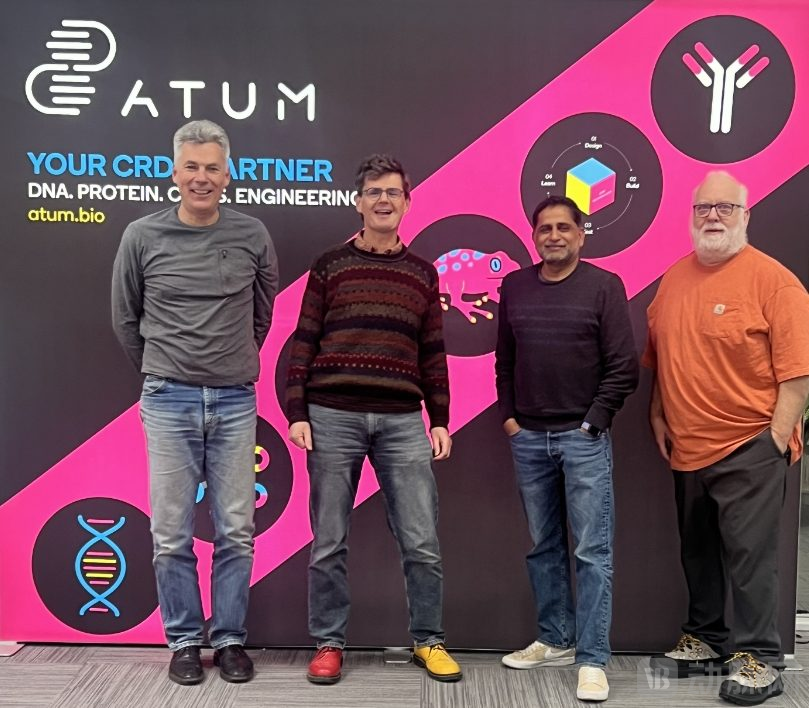 Atum’s Founding Team | Image source: Atum official website
Atum, originally named DNA 2.0, was initially a provider of gene synthesis and protein engineering services. Leveraging its expertise in DNA design and synthesis, the company developed an integrated suite of solutions serving academia, government entities, and industries including pharmaceuticals, chemicals, agriculture, and biotechnology.
Leveraging its team strengths and technical expertise, ATUM has developed a codon design and optimization algorithm (now registered as GeneGPS) to optimize gene expression in any host organism, thereby enhancing expression efficiency in specific host cells.In 2009, this codon design and optimization algorithm technology was named one of the Top 10 Innovations in Life Sciences by *The Scientist* magazine.
As its core technologies gain industry recognition, ATUM is also advancing other collaborations in the field of gene synthesis.
In 2009,ATUM, together with gene synthesis companies such as Aclid, Aldevron, and Ansa Biotechnologies, jointly established the International Gene Synthesis Consortium (IGSC), aiming to strengthen collaborative efforts to prevent and address biosafety issues arising from the rapid development of the gene synthesis field.Promote the beneficial application of gene synthesis technologies while ensuring biosafety. Currently, IGSC members include Azenta Life Sciences, BGI, GenScript, Synbio Technologies, and Thermo Fisher Scientific, among other well-known companies. Together, these members represent the majority of global commercial gene synthesis capacity.
After 21 years of strategic development, ATUM has built a comprehensive, integrated bioengineering solution leveraging its machine learning platform, proprietary algorithms, and fully integrated Laboratory Information Management System (LIMS). This end-to-end solution covers every stage from DNA design and synthesis optimization to protein production and GMP cell line development.
It is reported that Atum currently serves a global clientele, with its business spanning academia, government, and industries including pharmaceuticals, chemicals, agriculture, and biotechnology. According to incomplete statistics, more than 1,200 scientific papers have been published using its products and services. To date, Atum has become one of the largest providers of synthetic genes for industrial and academic use in the United States.
Over the past 21 years, Atum has been dedicated to deeply integrating biotechnology with innovative technologies such as AI to develop cutting-edge technology platforms, thereby accelerating the development and commercialization of life science tools and services. Currently, Atum boasts three core technology platforms: GPS technology, Leap-In Transposase®, and discoCHO™, and has filed multiple patents for their protection.
Specifically, ATUM’s GPS technology platform integrates Design of Experiments (DoE), precise empirical measurements, and machine learning tools. Essentially, GPS employs a “bottom-up” approach to design and create new variants, aligned with the iterative “Design–Build–Test–Learn” (DBTL) cycle strategy in synthetic biology.
According to its official website, GPS operates on principles similar to satellite systems and has extremely broad applications. It can be utilized across multiple levels of bioengineering, including vector and gene optimization for expression in specific hosts, protein engineering for the development of biocatalysts, as well as antibody humanization and affinity maturation.
Currently, the GPS technology platform has become a key differentiator for Atum’s products and services. Building on this core GPS technology, Atum has developed VectorGPS.®、ProteinGPS®、AntibodyGPS®Three specialized platforms that can further optimize the expression of genes, proteins, and antibodies in host organisms.
Leap-In Transposase®This technology is a comprehensive solution that combines Atum’s proprietary recoding algorithms, unique genetic vector elements, and transposon-based mechanisms to effectively insert genetically stable elements into the genome, enabling rapid, robust, and efficient production of high-quality protein therapeutics.
It is reported that Leap-In Transposase®The technology features multiple characteristics. For example, by integrating the entire transposon, Leap-In Transposase®It eliminates the risk of rearrangement or tandem integration in expression constructs. Meanwhile, by maintaining the structural integrity of the integrated sequence, it ensures that regulatory elements remain associated with the appropriate open reading frames (ORFs), thereby guaranteeing that multiple ORFs are expressed at the desired ratios. Finally, it achieves genomic integration through an enzymatic cut-and-paste mechanism, ultimately facilitating gene co-expression.
In August 2024, ATUM launched discoCHO, a CHO-K1-based cell line.TM, for transient protein production. It is reported that discoCHOTMOptimized through innovative technologies such as gene editing and cell engineering, the system enables robust transient therapeutic protein expression. Its critical quality attributes are comparable to those of Atum’s existing CHO-K1 manufacturing cell line, miCHO-GS, demonstrating high expression performance, stability, and scalability.
Notably, discoCHOTMSuccessful R&D outcomes can be seamlessly integrated into the miCHO-GS platform to enable stable biologic production, ultimately accelerating time-to-market while minimizing risk.
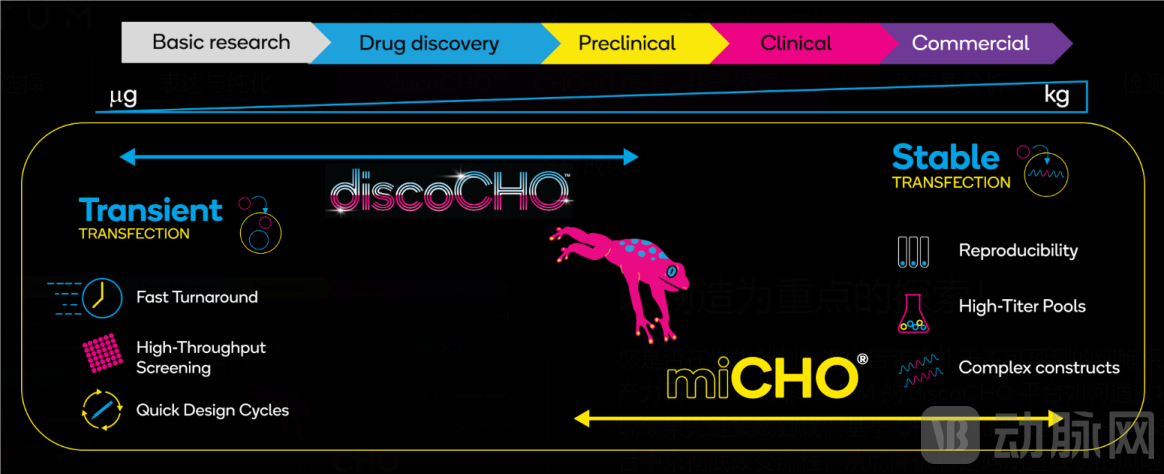 Image source: ATUM official website
In addition, ATUM has developed a suite of free software tools. For example, the bioinformatics software package Gene Designer enables molecular biologists to design, clone, and verify genetic sequences; the plasmid mapping tool DNA ATLAS displays features within any DNA vector sequence, such as promoters, markers, restriction sites, and open reading frames. Furthermore, its online Bioinformatics Toolbox was named “Best of the Web” by Genetic Engineering News.
Leveraging multiple technology platforms, Atum has built a comprehensively integrated bioengineering solution that provides customers with tools and solutions covering every stage—from gene sequence design and synthesis to early-stage protein production and detailed analysis, as well as cell line and GMP master cell bank development—thereby accelerating the translation of research findings from the laboratory to commercial applications.
While continuously innovating technologies and launching new life science tools and solutions,ATUM also expands its business scope and the application boundaries of synthetic biology technologies through external investments and collaborations with other innovative companies in the field of synthetic biology.
In terms of outbound investment, in June 2022, Atum participated in the $21 million Series A financing round of Vernal Biosciences, a biotechnology company. Vernal Biosciences is a CDMO specializing in gene editing, providing mRNA and LNP-mRNA manufacturing services to advance the development and production of mRNA therapeutics.
In April 2023, biopharmaceutical contract development and manufacturing organization (CDMO) Wheeler Bio announced the completion of a $31 million Series A financing round, with Atum as one of the investors. This round of funding advanced the construction of the company’s cGMP cell bank and active pharmaceutical ingredient (API) production facilities.
In terms of external collaborations, ATUM actively partners with companies in the application layer of synthetic biology.In September 2023, ATUM announced an expanded collaboration with the biopharmaceutical company Anagram Therapeutics, aiming to jointly advance oral enzyme therapies for the treatment of malabsorption and nutritional metabolic disorders by combining ATUM’s core technological strengths with Anagram’s research expertise.
In addition,ATUM Continues to Advance the Out-Licensing of Its Core Technologies.with Leap-In Transposase®as an example. In April 2022, ATUM entered into a distribution partnership with Tuo’ao Biology to sell and promote Leap-In Transposase in China®platform, thereby providing strong support for Chinese pharmaceutical companies in the production of protein drugs, viral drug vectors, and cell therapies. To date, multiple pharmaceutical companies worldwide have engaged with it regarding Leap-In Transposase®The platform has secured licensing agreements, and regulatory authorities have approved IND applications for more than 10 candidate drugs utilizing this technology.
According to McKinsey’s forecasts, synthetic biology is expected to generate a direct annual economic impact of $2–4 trillion globally over the next 10–20 years, with the pharmaceutical and healthcare sector accounting for 35% (approximately $0.5–1.3 trillion). By 2025, the economic value of synthetic biology and biomanufacturing is projected to reach $100 billion. At a time when the global economy lacks new growth trajectories, the immense potential of synthetic biology and biomanufacturing will become a significant force driving economic growth and sustainable development. Alongside the booming synthetic biology industry, there is a growing demand among researchers worldwide for tools in this field.
The core of synthetic biology lies in the precise control and programming of biological components, thereby creating biological entities capable of performing specific tasks. As such, advancements and maturation in enabling technologies—such as DNA synthesis, sequencing, and editing—are critical to the progress of synthetic biology. In the future, continuous updates to tool-layer enabling technologies, coupled with the deep integration of artificial intelligence and machine learning into synthetic biology, will further enhance the precision and efficiency of biological design, driving the application and development of synthetic biology across diverse fields.