

Midea Group Launches $3.5 Billion Hong Kong IPO, Showcasing Five-Pillar Healthcare Strategy
Hong Kong Stocks, Long Quiet, See an Uplifting Scene.
Today, domestic home appliance giant Midea Group officially listed on the Hong Kong Stock Exchange at an issue price of HK$54.8 per share, offering approximately 492.1 million shares and raising an estimated HK$27 billion, marking the largest IPO on the Hong Kong market since JD Logistics went public in 2021. As of press time, Midea Group’s shares had risen by 7.5%.
As one of the world’s largest home appliance enterprises, Midea has focused on the manufacturing of household appliances since its establishment in 1968. Over more than 50 years of development, Midea has continuously expanded its product portfolio while strengthening its presence in core components for home appliances and related industries, commercial air conditioning, robotics and automation, and other fields, achieving business coverage in more than 200 countries and regions worldwide.
Yet Midea, the company that virtually defined China’s “home appliance era,” has in recent years begun to pursue a transformation. It has made frequent strategic acquisitions to enter new business segments in several high-growth markets. Moreover, in its prospectus, Midea has clearly delineated its business into"Smart Home"and"Commercial and Industrial Solutions"two major sectors, and proposedDriving Growth with Commercial and Industrial Solutions as the Corestrategy.
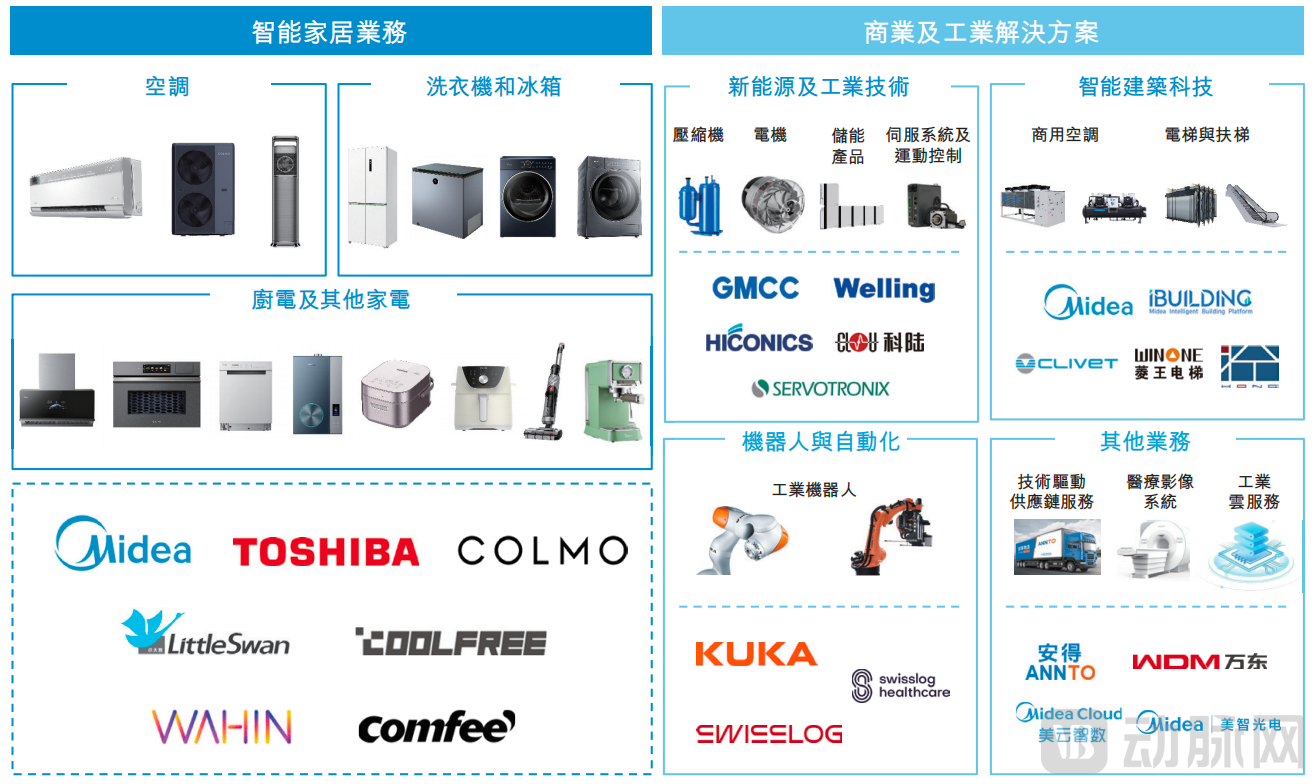
Midea's Business Layout
In its commercial and industrial solutions, healthcare has become one of Midea’s key focus areas.
From Midea’s 2017 acquisition of the German robotics company Kuka for RMB 29.2 billion, to its multi-billion-yuan investment in building a smart hospital in Foshan, and its acquisition of Wandong Medical, among other initiatives, all demonstrate its determination to expand into the healthcare sector.
In contrast to the excitement in the Hong Kong stock market, the “de-appliancization” of home appliance giants may be more thought-provoking. After all, to sustain a market capitalization of hundreds of billions accumulated over decades, Midea needs to find more than one pillar of support. Rebuilding its footprint in new fields requires clear strategic positioning and the accumulation of core competencies. Can Midea truly capture a share of the healthcare market? What is the underlying logic of its healthcare business? And what room for growth remains after its listing?
Cross-Boundary Healthcare: Building a Multi-Sector Industrial Consortium
Midea’s formal entry into the medical sector can be traced back to 2007. That year, Midea established an independent medical device division dedicated to the research and production of electronic physiotherapy products. However, during the ten years following the launch of this medical initiative, Midea’s presence in the market was barely noticeable, with all efforts seemingly remaining in an exploratory phase.
Midea’s large-scale expansion into the healthcare sector truly began a decade later. Currently, Midea operates five major business segments: Wandong Medical, KUKA Healthcare, Midea Biomedical, Swisslog Healthcare, and Midea Building Technologies.
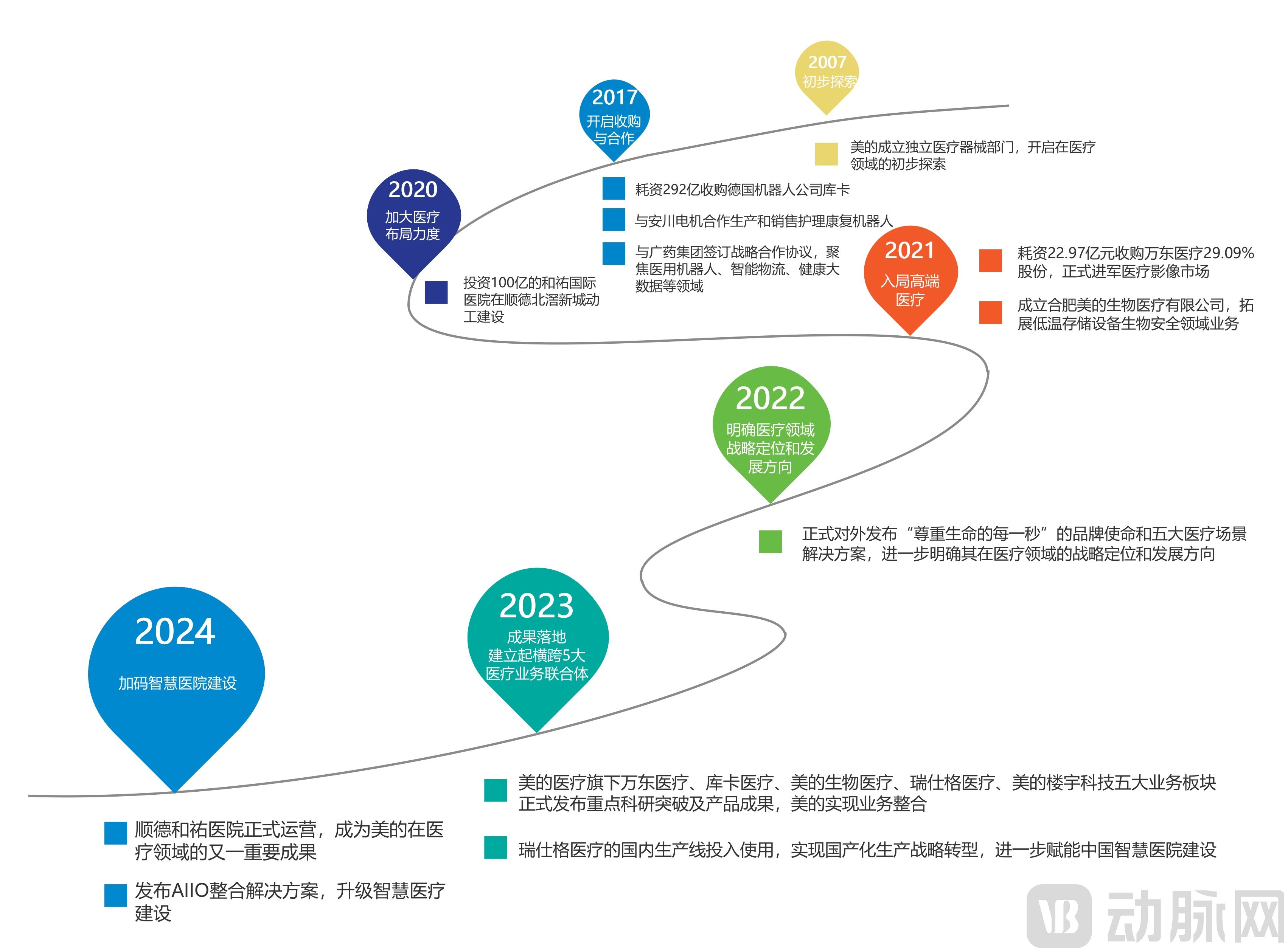
Midea's Development History in the Healthcare Sector (Chart by VCBeat)
In January 2017, Midea completed the acquisition at a price of RMB 29.2 billion, representing a 36% market premium.KUKA (Germany)the acquisition, granting it the capability to manufacture industrial robots. Through the acquisition of KUKA Group, Midea also indirectly gained control overSwisslog Healthcarecontrol.
This move is undoubtedly forward-looking. It is worth noting that while hospital logistics infrastructure in China was still in its nascent stages, KUKA’s subsidiary Swisslog had already implemented logistics system projects worldwide, maintaining the largest global market share.
Following the acquisition of KUKA, Midea did not rest on its laurels; instead, it first partnered with Japanese industrial robot manufacturer Yaskawa Electric to jointly promote the production and sales of nursing and rehabilitation robots in the Chinese market. Subsequently, it entered into a strategic cooperation agreement with Guangzhou Pharmaceutical Holdings Limited (GPHL) to engage in deep collaboration in cutting-edge fields such as medical robots, intelligent logistics, and health big data.
In 2020, as Midea’s healthcare business gradually gained momentum, the company harbored greater ambitions in the medical sector—To Establish an International, Smart, Research-Oriented General Hospital That Integrates Inclusive and Premium Care, and fully integrate Midea’s vision for smart hospital development and its related technologies into the construction process.
Achieving this medical ideal is no easy feat; it requires not only profound industry insight but also robust technological support and substantial capital investment.
Consequently, Midea began to intensify its strategic layout in core technologies such as medical robotics, intelligent logistics, and medical imaging. Simultaneously, it actively established in-depth collaborations with domestic and international medical institutions, universities, and research organizations to jointly formulate standards for smart hospital construction. It was also from this year onward that Midea became increasingly active in the healthcare sector.
In 2021, Midea invested a cumulative RMB 4.359 billion to acquire a 45.46% equity stake in Wandong Medical, a leading domestic enterprise in digital imaging technology, becoming its controlling shareholder and further strengthening its presence in the high-end medical market. This acquisition also marked Midea’s formal entry into the medical device sector through cross-industry expansion.
In addition to directly acquiring leading companies to expand into new business areas, Midea is also actively exploring cross-industry applications of technology, leveraging its existing technological advantages to enter the medical field and expanding into new market spaces by building on established technical barriers.
March 2021,Midea BiomedicalThe establishment of [the entity] represents Midea’s significant foray into the market for biomedical low-temperature storage equipment, leveraging its refrigeration technology. And the transformation and upgrading in 2021Midea Building TechnologiesMidea has integrated its HVAC systems, building intelligence, elevator operations, and energy management technologies—previously serving the real estate sector—into hospitals, thereby accelerating the development of hospital facility management.
At this stage, Midea has preliminarily established its development framework in the medical sector.
In 2022, Midea officially released its brand mission andTop 5 Healthcare Scenario Solutions, to further clarify its strategic positioning and development direction in the healthcare sector, namelyMedical Technology Building Scenario, Surgical Department Scenario, Outpatient Pharmacy Scenario, Inpatient Ward Scenario, and Logistics Command Center Scenario, and in 2023, achieved deep business integration by leveraging key scientific research breakthroughs and product achievements, establishingCross-Sector Industrial Consortium, with business coverage in imaging diagnostics, logistics automation, pharmacy automation, therapeutic assistance robots, HVAC, elevators, low-voltage intelligent systems, building automation, cleanroom engineering, digital platforms, and cryogenic sample storage.
This integration covers“Clinical Medicine and Medical Technology” Sector: Wandong Medical, Kuka Medical, and Midea Biomedical, andSwisslog Healthcare and Midea Building Technologies in the “Construction and Operation & Maintenance” Segment. Ultimately, Midea Healthcare has also gradually moved towardComprehensive Medical Technology GroupAdvancing.
This year, whether it is the release of the “HEST White Paper on Four-Dimensional Smart Hospital Construction” or the completion of Heyou Hospital, both may represent Midea’s best answer to its years of exploration in the medical field. The former signifies that Midea has moved beyond its initial entry into the healthcare sector and has begun to establish standards for smart hospital construction within the medical industry, while the latter demonstrates that Midea Medical’s concepts and products for smart hospital construction have entered the stage of practical application.
For example, Heyou Hospital has not only integrated all five of Midea’s medical scenario solutions but also realized its vision for smart hospital construction, achieving an integrated system encompassing smart healthcare, smart services, smart management, smart operations and maintenance, and smart logistics. This demonstrates Midea’s comprehensive capability in building end-to-end solutions for smart healthcare.
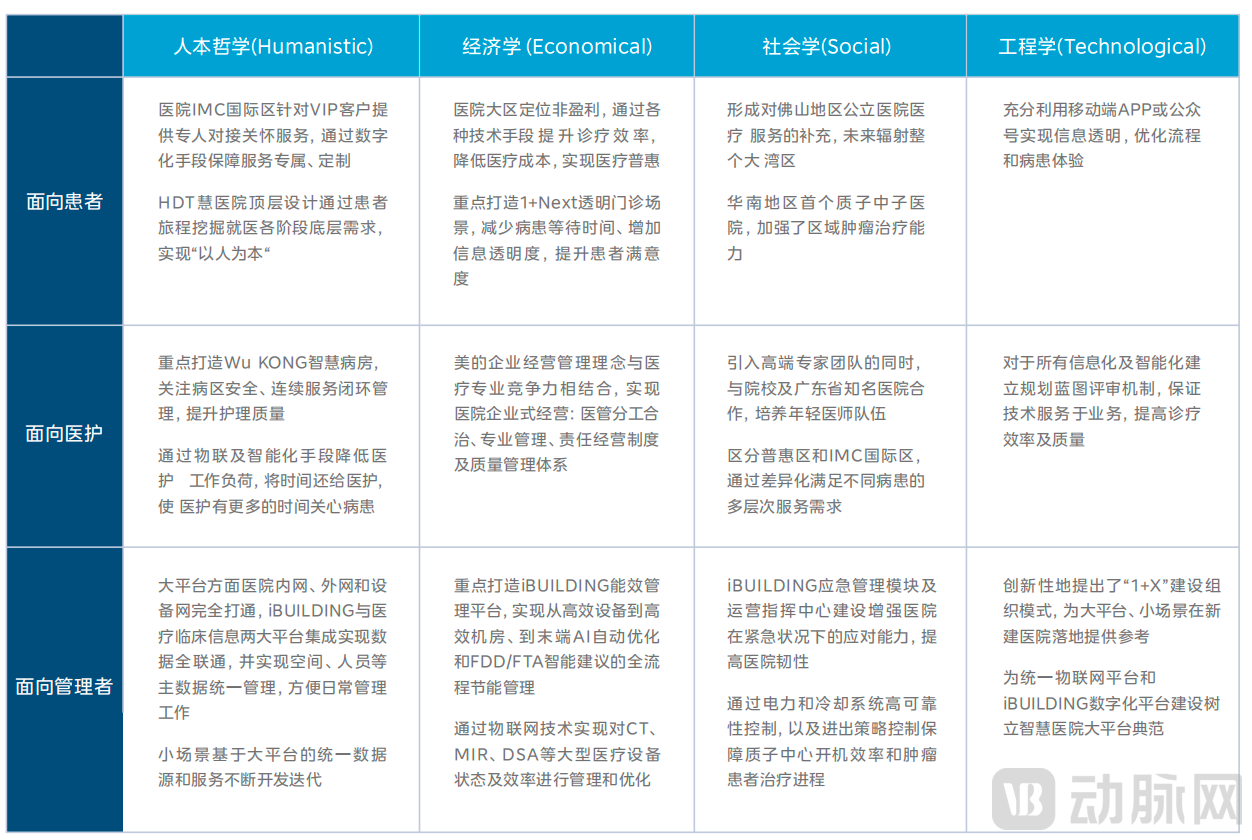
Construction Plan for Heyou Hospital
Midea’s Layout in the Medical Field, Subdivided intoWandong Medical, KUKA Medical, Midea Biomedical, Swisslog Healthcare, and Midea Building Technologies—Five Major Business Segments, and from an aggregated holistic perspective, the focus is on two core areas: clinical medical technology and construction and operation/maintenance. These two areas essentially cover the main development directions in the healthcare sector.
In the clinical medical technology sector, Wandong Medical, KUKA Medical, and Midea Biomedical have respectively established deep expertise in high-end medical equipment fields such as medical imaging, medical robotics, and biomedicine.
It is worth noting that the medical equipment sector clearly represents a larger market. In 2023, the scale of China’s medical equipment market achieved a historic breakthrough, reaching RMB 1.27 trillion, with an annual growth rate as high as 10.4%. The areas in which Midea has strategically positioned itself are not only drawing significant industry attention but also experiencing sustained growth in market demand.
However, competition in this market is equally fierce.
Taking the medical imaging sector as an example, although Wandong Medical ranks in the second tier and its CT, MR, and DSA products have reached high-end standards, a significant gap remains compared to the more lucrative ultra-high-end market. Furthermore, the synergy between medical equipment and building technologies is currently limited, making it difficult to create new value growth points through industrial integration in the short term. As the landscape of the medical imaging equipment market becomes increasingly consolidated, achieving further business growth may also prove challenging. Compared to its logistics services sector, Midea’s contribution share in the medical equipment market appears relatively limited.
Focusing on the construction and operation & maintenance segment, Midea Healthcare’s business development appears relatively optimistic.Swisslog and Building Technologies even directly helped Midea become a major leader in hospital logistics within a few years, implementing its solutions in 316 cities across China and serving 2,071 hospitals.
First, Swisslog Healthcare boasts decades of experience in the automation of medical institutions. In the field of logistics automation, Swisslog Healthcare continues to innovate, providing comprehensive solutions for in-hospital logistics and pharmacy automation. Today, the development of smart hospitals has become a crucial pillar for modern hospitals to achieve transformation and upgrading. In daily hospital operations, the effective distribution of medical supplies is vital to ensuring the quality and efficiency of healthcare services. Logistics systems such as pneumatic tube transport, rail-guided vehicles, and Automated Guided Vehicles (AGVs) have essentially become standard infrastructure in hospitals.
Amid the growing demand for smart logistics systems in China, 17 of the top 20 hospitals in the country have adopted Swisslog’s products, with logistics systems costing tens of millions of yuan contributing significantly to Midea’s healthcare revenue. As an integral component of smart hospitals and hospital IoT ecosystems, smart logistics systems represent a strategic opportunity that Midea—committed to delivering comprehensive smart hospital solutions—is poised to capitalize on.
At Heyou Hospital, it is evident that Swislog Medical has installed smart logistics systems in all essential areas throughout the buildings. Additionally, the hospital’s elevator system integrates automated guided vehicle (AGV) linkage functionality, enabling efficient and precise elevator operations for medical robots.
Secondly, in terms of smart hospital construction, Midea Building Technologies’ entry has further strengthened Midea’s control over hospital logistics and even introduced a new model for the development of smart hospitals.
In the vision of Midea Building Technologies, traditional hospital construction models have been excessively technology-oriented, featuring a hierarchical technical structure centered on technology. In such systems, the top-level system cannot effectively influence the underlying subsystems. Meanwhile, due to the strong coupling among various subsystems, the overall iteration speed is extremely slow, which may easily lead to scenarios where facilities become obsolete upon completion.
Midea’s conception of a “smart hospital” is not static; its very definition must continuously “evolve” in tandem with the times and the changing needs of patients and healthcare providers. Only with robust institutional and mechanistic support, coupled with top-level design spanning the entire lifecycle, can such a system be better equipped to sustain its long-term operation.
Although Midea Building Technologies is a relative newcomer to the healthcare industry, it has pioneered a break from traditional smart hospital construction models by introducing the “LIFE” framework. This framework emphasizes the integration of Logistics, Information, Feeling (experience), and Energy flows, flattening and integrating technologies and resources around specific scenarios and medical workflows. This approach enables “smart” capabilities to permeate deeply into every specialized medical space. Furthermore, the solution can rapidly decouple and iterate based on specific spatial requirements, recombining components to form new applications that meet the evolving needs of hospitals.
Following the establishment of standards, Midea has launched its comprehensive smart healthcare solutions and core products, leveraging its technical expertise in HVAC systems, building automation, elevator operations, and digital platforms. These offerings focus on four key areas: outpatient and emergency spaces, inpatient wards, surgical departments and medical technology units, and logistics command centers, thereby helping hospitals reduce costs and enhance efficiency across the board.

A Brand Under Midea Building Technologies
Among these, the solutions include scenario-based offerings such as smart diagnostic and treatment spaces, smart wards, and logistics command centers; the products range from small components like valves, temperature control panels, and variable frequency drives to large-scale systems and equipment such as system platforms, elevators, fluorinated refrigerant chillers, and water-cooled chillers.
Leveraging its strengths in hard technology and software systems, as well as its deep understanding of smart hospital development, Midea Building Technologies’ solutions have been implemented in public hospitals such as Shanghai Tongji Hospital, Guangzhou First People’s Hospital, and Shanxi Provincial People’s Hospital, as well as in private institutions including Heyou International Hospital and Shanghai Jiahui International Hospital.
This is precisely a microcosm of the gradual development of Midea’s healthcare business.
Midea has made significant strides in its medical sector. Will its listing on the Hong Kong Stock Exchange unlock new growth opportunities for the company?
In the ensuing discussion, some view this as Midea’s proactive response to market trends as a home appliance giant, marking a significant milestone for the industry in embracing change; others see it as a critical step in its globalization strategy. Still others believe that Midea’s move is driven more by corporate strategic considerations, aiming to optimize its capital structure and enhance market valuation by divesting non-core businesses, thereby concentrating resources on fostering the integration of core operations with emerging technologies—though this does not necessarily imply a fundamental disruption of its business model.
The prospectus indicates that the Company’s proposed listing on the Hong Kong Stock Exchange aims to secure additional funding for business development and expansion, while enhancing its corporate image and market position within the industry to better attract overseas investors and talent. The Company will also continue to pursue global business expansion.
In just a few lines, Midea’s ambition to develop its B2B business and accelerate its global expansion is clearly evident.
In fact, Midea’s overseas revenue accounts for more than 40% of its total revenue, with products widely sold to over 200 countries and regions worldwide. Furthermore, Midea has established 17 R&D centers and 22 major production bases across 16 countries. In addition to organic growth, Midea is actively expanding its overseas markets through joint ventures, collaborations, and acquisitions.
As the scale of overseas expansion by domestic medical device enterprises continues to grow steadily, Midea’s move may also create more opportunities for its medical business to expand globally or pursue acquisitions. After all, the acquisition of Kuka Group was a successful step by Midea to accelerate its entry into overseas markets while simultaneously expanding its market share in China’s medical sector.
However, regardless of differing perspectives, it is undeniable that Midea’s strategic transformation is an inevitable choice aligned with the current zeitgeist. Emerging from this adjustment, Midea is now poised to embark on a new chapter of development.