

Organon to Acquire Dermavant Sciences for Up to $1.2 Billion, Gaining Global Rights (Ex-China) to Tapinarof Cream, a First-in-Class Topical Therapy Originating from China

Organon
New Drug Research and Development, Manufacturer
Dermavant Sciences
Developer of Skin Treatment Inhibitors
September 18,Global healthcare company Organon (NYSE: OGN) announced that it will acquire Dermavant Sciences (“Dermavant”), an immuno-dermatology therapeutics company under Roivant Sciences (“Roivant”), for a total consideration of up to approximately $1.2 billion (approximately RMB 8.53 billion). Through this acquisition, Organon will also obtain the overseas rights to Dermavant’s new product, VTAMA® (tapinarof) Cream, 1%.
Pursuant to the terms of the agreement,Organon Acquires Dermavant for Total Consideration of Up to Approximately $1.2 Billion, Including a $175 Million Upfront Payment; a $75 Million Milestone Payment Upon Regulatory Approval of VTAMA® (tapinarof) Cream, 1%, for the Indication of Atopic Dermatitis (AD); and Up to $950 Million in Commercial Milestone Payments
Furthermore,Organon will pay tiered royalties to Dermavant shareholders based on net sales. Dermavant holds the global (excluding China) commercialization rights for VTAMA® (tapinarof) Cream, 1%, and has secured licensing rights in Japan.
VTAMA® Cream: The First FDA-Approved Steroid-Free Topical Medication in Its Class, Originating from China
Psoriasis is a chronic, recurrent, inflammatory, systemic disease mediated by immunity and induced by the combined effects of genetic and environmental factors. Its typical clinical manifestations are scaly erythema or plaques. Once contracted, the disease is currently incurable. Psoriasis can occur at any age, but the vast majority of cases onset between the ages of 16–22 and 57–60. Patients with psoriasis have a significantly increased risk of developing other chronic and severe health conditions, including psoriatic arthritis, inflammatory bowel disease, hypertension, and depression, which also severely impact their quality of life and mental health.
According to statistics from the National Psoriasis Foundation, psoriasis currently affects more than 8 million Americans aged 20 and older, as well as 125 million patients worldwide. In the past, conventional therapies often failed to achieve consistent and satisfactory efficacy, leaving many treatment needs of psoriasis patients unmet.
VTAMA® (tapinarof) Cream, 1%, is a first-in-class topical aryl hydrocarbon receptor (AhR) agonist.AhR is a ligand-dependent transcription factor that plays a role in the expression of multiple genes involved in maintaining homeostasis. Specifically, AhR contributes to the maintenance of homeostasis in barrier tissues such as the skin, lungs, and intestines. VTAMA® cream, a non-steroidal small-molecule drug with a molecular weight of 254 Da, exhibits favorable skin penetration. By modulating the function of the aryl hydrocarbon receptor, it inhibits IL-17-mediated inflammatory responses.
In two pivotal Phase 3 clinical trials, tapinarof met all primary and secondary endpoints. Specifically, in the Phase 3 PSOARING trial, tapinarof achieved all primary and secondary endpoints, with data demonstrating a favorable safety and tolerability profile. Furthermore, patient satisfaction data from the Phase 3 long-term extension (LTE) study indicated that patients held consistent and positive perceptions of VTAMA cream across many measures, with 81.7% considering it more effective than their previous topical treatments. In another Phase 3 clinical trial, 40% of patients treated with tapinarof achieved clear or almost clear skin, compared with 6% in the control group (p<0.0001).
With its favorable clinical trial results,In May 2022, Dermavant announced that the FDA had approved VTAMA® (tapinarof) Cream, 1%, for once-daily topical treatment of plaque psoriasis in adults.The press release at the time noted that this approval covers all psoriasis patients, regardless of severity, and the label imposes no restrictions on duration of use or body sites for application.Furthermore, this product is the first new molecular entity (NME) topical drug approved in the United States in 25 years for the treatment of psoriasis, and it is also the first and only steroid-free topical agent in its class approved by the FDA.
In June 2024, Dermavant announced that VTAMA® (tapinarof) Cream (1%) was approved for marketing in Japan for the treatment of psoriasis in adults and atopic dermatitis (AD) in patients aged 12 years and older.
Meanwhile, Dermavant is continuously expanding the indications for VTAMA® (tapinarof) Cream 1%.In April 2024, Dermavant announced that the U.S. Food and Drug Administration (FDA) had accepted the supplemental New Drug Application (sNDA) for VTAMA® (tapinarof) Cream, 1%, for the topical treatment of atopic dermatitis (AD) in adults and children aged 2 years and older. The PDUFA action date is set for the fourth quarter of 2024.
Currently, Dermavant is conducting Phase 4 clinical trials of VTAMA® (tapinarof) cream for intertriginous plaque psoriasis (iPsO) and head-and-neck plaque psoriasis, both of which have yielded positive results.
It is worth mentioning that,Tapinarof, with the Chinese generic name benvimod, was initially co-developed by the domestic enterprises Beijing Wenfeng Tianji Pharmaceutical and Guangdong Zhonghao Pharmaceutical. It is a global innovative drug with independent intellectual property rights and is first-in-class.
In 2007, Tianji Medicine initiated clinical research applications for benvitimod; in 2016, benvitimod completed industrialization studies and formally submitted a marketing authorization application to the Center for Drug Evaluation (CDE).In May 2019, benvitimod cream was approved for marketing in China through the priority review and approval pathway, indicated for the topical treatment of mild-to-moderate stable plaque psoriasis in adults. On December 28, 2020, benvitimod cream was officially included in the National Reimbursement Drug List, which took effect on March 1, 2021.
Notably, in 2012, Tianji Medicine licensed the overseas development rights of benvitimod to GSK, with an upfront payment of nearly $200 million; in July 2018, GSK sold the overseas development rights of benvitimod to Dermavant for $330 million.
It is worth noting that,Benvitimod Cream is one of the three first-in-class innovative drugs approved for marketing in China over the past decade, and it is the first innovative drug to date that was approved for marketing in China prior to receiving FDA approval.
One Deal Facilitates a Win-Win Partnership Between Organon and Roivan
As the key player in this acquisition of Dermavant, Organon is a global healthcare company that was spun off from Merck & Co. in 2021 and is dedicated to improving women’s health throughout their lives. Since its founding in 1923, Organon has grown into a major global pharmaceutical company with a primary therapeutic focus on women’s health.
Currently, Organon has established a diversified product portfolio spanning three key areas: women’s health, biosimilars, and established brands. Its portfolio comprises more than 60 medicines and devices, addressing multiple therapeutic areas including reproductive health, cardiovascular disease, neurology, autoimmune disorders, and respiratory diseases. With a global presence and world-class commercial operational capabilities, Organon’s products are sold in over 150 countries and regions worldwide.
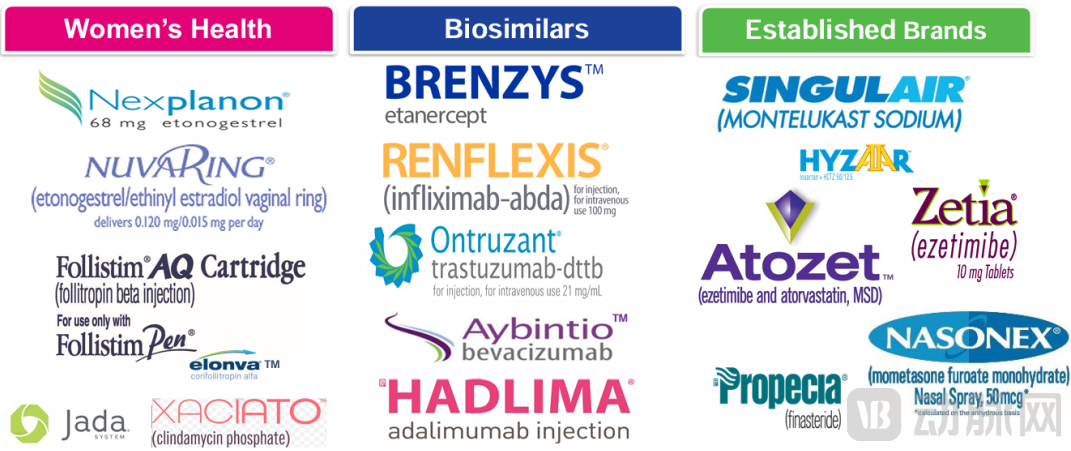 Image source: Organon official website
According to Organon’s Q2 2024 earnings report, the company’s revenue for the second quarter ended June 30, 2024, was $1.607 billion, flat year over year, with Women’s Health revenue up 3% and Biosimilars revenue up 22%. Organon projects full-year 2024 revenue to be between $6.25 billion and $6.45 billion, representing a growth forecast of 2% to 4.7% on a constant currency basis.
Therefore, Organon is increasing its investment in innovative solutions and research to drive future growth opportunities in the fields of women’s health and biosimilars.Meanwhile, Organon is seeking opportunities to collaborate with biopharmaceutical partners and innovators, leveraging its scale and agile influence in rapidly growing international markets to commercialize its products, thereby strengthening its market position in the healthcare sector.
At Organon & Co.’s 2024 Annual Meeting of Shareholders, Kevin Ali, CEO of Organon, also stated, “Organon will continue to advance its existing product portfolio and integrate and develop new assets through collaborations and business development, ultimately bringing more innovative products to patients around the world. Currently, Organon has sufficient cash flow to support business development and asset acquisitions.”
This collaboration with Dermavant represents a win-win strategic move for both Organon and Roivant.
For Organon, the acquisition of Dermavant will not only expand its product portfolio and strengthen its presence in immuno-dermatology, but also advance Organon’s goal of improving women’s lifelong health by investing in treatments for diseases that affect women differently.
According to the financial data released by Roivant, the net product revenue for VTAMA® (tapinarof) Cream (1%) amounted to $18.4 million as of June 30, 2024. If the supplemental New Drug Application (sNDA) for VTAMA® (tapinarof) Cream in the treatment of atopic dermatitis (AD) is successfully approved, the market potential for this product is expected to expand fourfold. In the future, VTAMA® (tapinarof) Cream (1%) may become one of the key products driving Organon’s revenue growth.
For Roivant, the sale of Dermavant generated approximately $500 million in payments and cash savings, with the potential to deliver additional returns to shareholders, while retaining a significant share of the upside potential for VTAMA® (tapinarof) Cream 1%. When sales exceed $1 billion, Roivant will receive a 30% royalty rate (with tiered single-digit royalties applied on sales below $1 billion).
Jefferies analysts stated that Dermavant is considered a secondary asset of Roivant. In an investor report, Roivant wrote: “Most investors have a lukewarm attitude toward Dermavant due to its low revenue, slow product launch trajectory, and high operating costs—namely, significant cash burn. Therefore, divesting Dermavant is important.”
According to the agreement,Dermavant’s acquisition is expected to close in the fourth quarter of 2024. Upon completion of the transaction, Organon will assume Dermavant’s liabilities as part of the purchase price consideration. Roivant reported liabilities of approximately $286 million as of June 30, 2024, which Organon will account for at fair value.
From this perspective, the transaction will reduce Roivant’s operating expenses on its balance sheet by $200 million. Jefferies analysts stated that these funds could be used to support the development of autoimmune disease therapies at Immunovant, its subsidiary focused on autoimmunity, including batoclimab for the treatment of myasthenia gravis and thyroid eye disease. Immunovant is expected to initiate several pivotal Phase 3 studies in the coming years.
Matt Gline, CEO of Roivant, also stated in the press release: “This is another example of Roivant delivering innovative, win-win collaborations. We have been able to meet Organon’s strategic objectives and secure a transaction that is highly attractive to both Roivant and Dermavant shareholders, while still retaining potential future economic benefits from VTAMA® (tapinarof) Cream, 1%.”
Domestically Produced Anti-IL-17A Monoclonal Antibody Approved for Market Launch; Chinese Pharmaceutical Companies Accelerate Entry into the Billion-Dollar Psoriasis Market
According to the Guidelines for the Diagnosis and Treatment of Psoriasis in China (2018 Complete Edition), the prevalence of psoriasis in China is approximately 0.5%, with nearly 7 million patients currently affected, among whom about 57% have moderate-to-severe psoriasis. The Global Report on Psoriasis published by the World Health Organization (WHO) in 2016 indicated that 94% of patients expect rapid improvement in skin lesions, 93% expect complete clearance of skin lesions, and 83% expect disease stability without worsening.
According to Frost & Sullivan data, the market size of psoriasis drugs in China was US$1.1 billion in 2021 and is expected to grow to US$9.5 billion by 2030, with a compound annual growth rate (CAGR) of 27.1%.
Faced with this promising multi-billion-dollar psoriasis market, domestic pharmaceutical companies have long been making strategic moves.
Taking the IL-17A therapeutic segment as an example. In August 2024, China’s National Medical Products Administration (NMPA) approved the market launch of two domestically produced IL-17A monoclonal antibody drugs—Secukinumab-like antibody from Zhixiang Jintai and Funakizumab from Hengrui Medicine—both indicated for the treatment of moderate-to-severe plaque psoriasis. The launch of these two domestic IL-17A monoclonal antibody products has broken the monopoly held by imported drugs in the IL-17A treatment field and filled the gap in China’s domestic biologic agents for psoriasis.
In addition, Akeso, 3SBio, Livzon Pharmaceutical Group, Junshi Biosciences, Huaotaibio, CSPC Pharmaceutical Group, and other companies have established a presence in the IL-17A field and achieved positive progress.
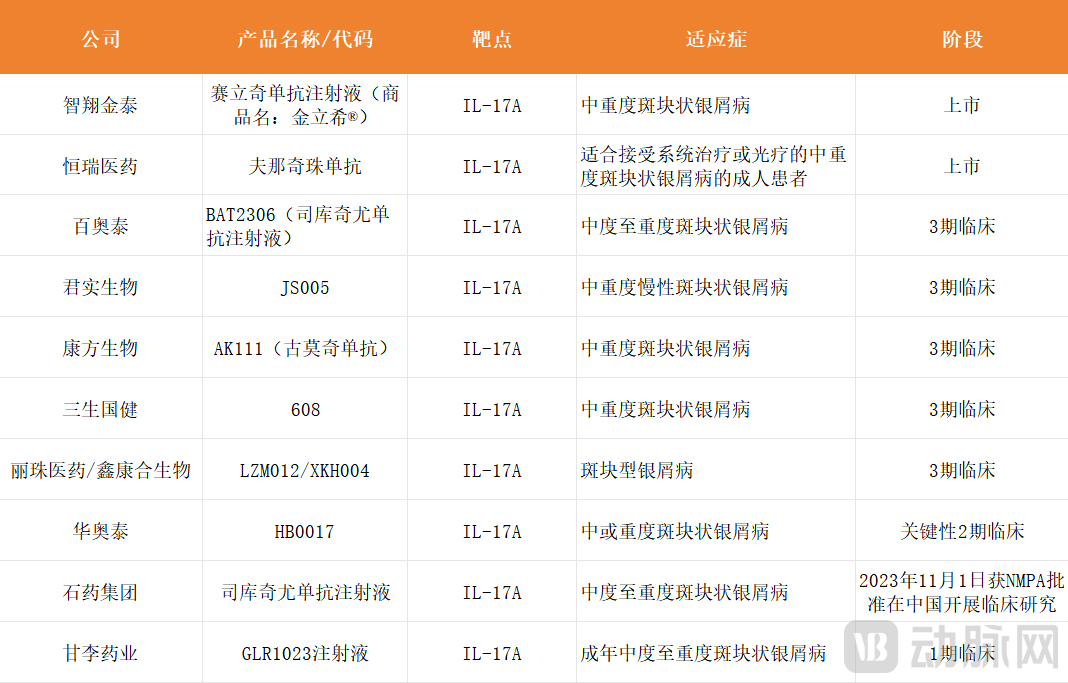
Source: Compiled from public data; graphic by VCBeat (incomplete statistics; company rankings are not in any particular order)
Currently, these companies are actively advancing the R&D and commercialization of their candidate products. In the future, with continued research progress, a number of domestically produced IL-17-targeting antibody drugs may be launched in quick succession, further breaking the dominance of imported products and providing patients with more treatment options.