

Zhejiang University Licenses Four Parkinson's Early Diagnostic Patents for RMB 600,000

ZJU
Comprehensive, Research-Oriented, and Innovative University
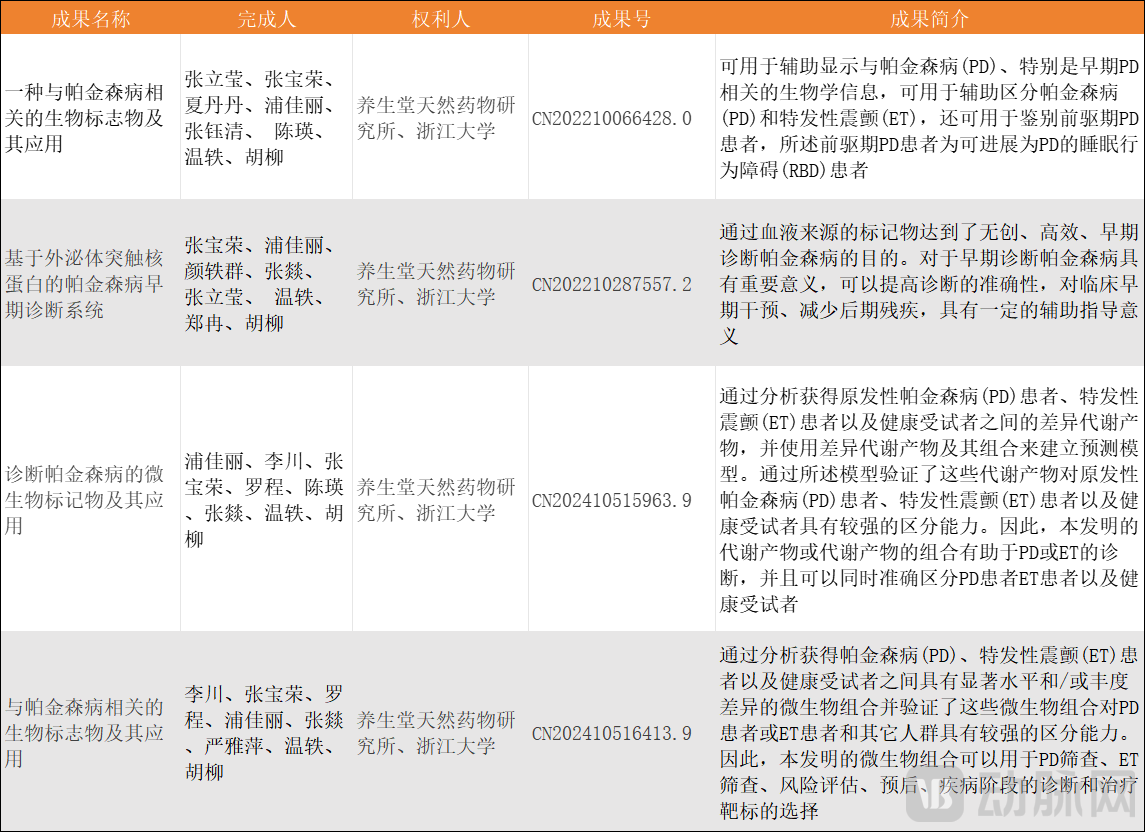
Recently, Zhejiang University issued a public notice proposing to transfer four invention patents, including “A Biomarker Associated with Parkinson’s Disease and Its Application,” to Zhejiang Yangshengtang Institute of Natural Medicine Co., Ltd. (hereinafter referred to as “Yangshengtang Institute of Natural Medicine”), for a transaction amount of RMB 600,000.
The other party to this transaction, Yangshengtang Institute of Natural Medicine, serves as the R&D center of Yangshengtang Group. It focuses on cutting-edge basic and applied research in neurodegenerative diseases, cardiovascular diseases, and anti-aging, providing new perspectives for disease intervention. Currently, the institute has established multiple technical support platforms, including a molecular biology research platform, a safety and efficacy evaluation platform, a microbial technology research platform, and a separation, purification, and component analysis platform.
Parkinson’s disease (PD), the second most common neurodegenerative disorder worldwide after Alzheimer’s disease, is characterized by prominent motor symptoms such as tremor, rigidity, bradykinesia, and postural instability, as well as non-motor symptoms including sleep disturbances, hyposmia, and cognitive and psychiatric abnormalities.
With the accelerating aging of China’s population, the number of patients with Parkinson’s disease (PD) has increased significantly. The Fourth Edition of the Chinese Guidelines for the Treatment of Parkinson’s Disease points out that by 2030, the number of PD patients in China will reach 5 million, accounting for nearly half of the global total. Moreover, the age of onset is showing a trend toward younger populations. According to Chinese epidemiological data, the prevalence of PD among individuals aged 65 and older is 1.7%. However, the self-awareness rate at initial diagnosis is only 3.75%, and the misdiagnosis rate is as high as 23.5%, highlighting the severe challenges in early diagnosis.
The crux of misdiagnosis and missed diagnosis in Parkinson’s disease (PD) lies in the non-specific nature of its early symptoms, which are easily confused with those of various other neurological disorders. Furthermore, traditional diagnostic approaches, such as clinical observation and imaging assessments, are limited by physicians’ experiential judgments and inter-patient variability in clinical presentations, making it difficult to ensure diagnostic accuracy. Therefore, the exploration and application of PD-related biomarkers for precise detection have become a key direction for improving the diagnosis of Parkinson’s disease.
α-Synuclein is currently one of the most prominent biomarkers under investigation in Parkinson’s disease. As the principal component of Lewy bodies, the pathological hallmark of Parkinson’s disease, α-synuclein undergoes pathological deposition and propagation during the onset and progressive worsening of the disease, thereby constituting the primary pathological basis of Parkinson’s disease.
α-Synuclein is primarily present in neurons of the central nervous system, particularly at presynaptic terminals and in glial cells. Furthermore, red blood cells also produce this protein; therefore, Parkinson’s disease cannot be diagnosed by directly detecting α-synuclein in peripheral blood.
However, exosomes secreted by neuronal cells in the brain can cross the blood-brain barrier and enter the peripheral system. Therefore, changes in the levels of biomarkers within neuron-derived exosomes in peripheral blood can be used to detect pathological changes in central nervous system diseases. Extensive literature indicates that α-synuclein levels in neuron-derived exosomes from the peripheral blood of patients with Parkinson’s disease are significantly higher than those in healthy individuals, corroborating that α-synuclein is a potential biomarker for Parkinson’s disease.
The invention patents proposed for transfer in this transaction also include an early diagnostic system for Parkinson's disease based on exosomal α-synuclein.。
This invention reveals that, in patient studies, the level of α-synuclein in total plasma exosomes was mildly elevated in patients with Parkinson’s disease (PD) and REM sleep behavior disorder (RBD), and significantly elevated in PD patients, compared with healthy controls. The level of α-synuclein in central nervous system-derived plasma exosomes was significantly elevated in both RBD and PD patients, demonstrating value for early diagnosis. Furthermore, the level of α-synuclein in total plasma exosomes increased with disease progression, indicating its potential for predicting disease progression.
This invention achieves non-invasive, efficient, and early diagnosis of Parkinson’s disease through blood-based biomarkers. It holds significant importance for the early diagnosis of Parkinson’s disease, improves diagnostic accuracy, and provides valuable auxiliary guidance for early clinical intervention and the reduction of subsequent disability.
InIn May 2024, the exosome-based auxiliary diagnostic kit for Parkinson’s disease, independently developed by Beijing Kaixiang Hongkang Biotechnology, was approved for market launch by the Beijing Medical Products Administration.This product can enrich neuron-derived exosomes from peripheral blood and detect the content of α-synuclein in them through chemiluminescence technology.
The kit has successfully completed clinical registration and is the first registered product worldwide for detecting α-synuclein in exosomes, achieving an internationally leading position in this field. Clinical registration data demonstrate that, compared with existing clinical diagnostic methods, the product achieves a sensitivity of 91.48% and a specificity of 93.38%, exhibiting excellent performance and holding promise as a new tool for the precise diagnosis of Parkinson’s disease.
In addition to α-synuclein, Aβ42, total α-synuclein (t-α-Syn), total tau (t-tau), and phosphorylated tau (p-tau) are all key directions in the development of technologies for the pathological diagnosis of Parkinson’s disease.
The intensifying global population aging, coupled with increased public awareness of Parkinson’s disease and advancements in medical technology, has directly driven growth in the Parkinson’s disease diagnosis and treatment market. According to analysis by Data Bridge Market Research, the global Parkinson’s disease treatment market was valued at USD 4.99918 billion in 2022 and is projected to reach USD 10.03452 billion by 2030, representing a compound annual growth rate (CAGR) of 9.10% during the forecast period.
Given that traditional diagnostic methods rely on clinical observation of symptoms, the improvement and development of more accurate diagnostic tools represent a key direction for market growth.With the advancement of AI technology, preliminary evidence has emerged supporting the use of AI models to assist in the early diagnosis of Parkinson’s disease, such as predicting the disease through human signal data collected by wearable devices. Wearable devices can objectively and accurately capture complex and diverse motor and non-motor features, and their capacity for continuous recording facilitates long-term monitoring and assessment of symptoms in patients with Parkinson’s disease.
At the China International Fair for Trade in Services (CIFTIS) held in September 2024, the “Handwriting-Based Parkinson’s Disease Diagnosis System,” jointly developed by Beijing Institute of Technology, Beijing Aerospace General Hospital, and Ligong Genshu, was unveiled. By leveraging machine learning to deeply mine and establish specific mapping relationships between patients’ hand movement characteristics and Parkinson’s disease symptoms, the system provides scientific and precise data support. Meanwhile, the system’s cloud platform shares patient diagnostic data, medication records, rehabilitation progress, and other information, enabling physicians to devise personalized treatment plans.
In July 2024, Dailai Technology completed its first round of financing. The company has developed a series of wearable neuromodulation products targeting various motor and non-motor symptoms of Parkinson’s disease, committed to achieving intervention and management throughout the entire disease course and improving patients’ quality of life in multiple dimensions.
In January 2023, Ningdong Medical’s MoDAS system received approval from the National Medical Products Administration (NMPA), becoming the world’s first medical device for assisted assessment of motor dysfunction based on AI technology using natural images. Leveraging intelligent mobile devices and computer vision AI, MoDAS rapidly provides physicians with precise, quantitative diagnostic evidence, thereby enhancing the efficiency of diagnosis and treatment for motor disorders such as Parkinson’s disease.
Previously, in October 2022, Zhenluo Science’s quantitative assessment system for Parkinson’s disease also received approval from the National Medical Products Administration (NMPA), becoming the first device in China to obtain a registration certificate in this field. Based on wearable technology, the system captures human movement data through high-precision sensors, establishes models for analysis, and generates comprehensive quantitative assessment parameters. It also incorporates algorithmic models specifically designed for Parkinson’s disease-related gait disturbances, thereby enabling multi-dimensional quantitative assessment.
Earlier, there were also the AI-assisted diagnostic system for Parkinson’s disease based on deep brain stimulation (DBS) devices, jointly developed by Jingyu Medical and Huawei Cloud; the intelligent assessment system for motor function in Parkinson’s disease, launched by Tencent’s Medical AI Laboratory; and algorithms developed in collaboration between IBM and Pfizer, among other institutions. These systems quantify the motor status of Parkinson’s patients by capturing data on body posture and hand position. By referencing the Unified Parkinson’s Disease Rating Scale (UPDRS) and integrating AI algorithms, they enable assisted diagnostic grading for Parkinson’s disease, thereby enhancing the objectivity and precision of diagnosis.