

Tech Giants Apple, iFLYTEK, and Tencent Unveil Major Hearing Aid Initiatives on the Same Day, Signaling Market Breakthrough

Tencent
Internet Comprehensive Service Provider

Apple
Designers, manufacturers, and sellers of electronic products such as personal computers and software
Recently, Apple, iFlytek, and Tencent announced hearing aid-related news on the same day. With the backing of tech giants, the hearing aid market is finally set to explode!
On September 12, Apple Inc. announced that its hearing aid software for AirPods Pro had received approval from the U.S. Food and Drug Administration (FDA). Once the hearing aid software is installed, compatible versions of AirPods Pro will function as over-the-counter (OTC) hearing aids. The product will then be able to amplify sound for patients (users) aged 18 years or older with mild to moderate hearing loss.
On the same day, iFlytek Healthcare, a subsidiary of iFlytek, signed a strategic cooperation framework agreement with Boyin Hearing. The two parties will jointly launch an O2O hearing aid fitting solution, providing users with hearing impairment more professional, efficient, and high-quality purchasing and fitting services through the innovative O2O service model of “online selection and offline fitting.”
Tencent also joined the fray on this day. On September 12, Tencent Meeting’s Tianlai Laboratory partnered with Bestechnic to launch a one-stop solution comprehensively covering hearing assessment, fitting, and hearing aid services. According to the introduction, this solution, built on Tianlai’s proprietary hearing aid algorithms, can improve the clarity and intelligibility of domestically produced hearing aids by 85%. Leveraging Bestechnic’s latest-generation 6nm BES2800 chip, it supports all functionalities of both hearing aids and TWS earbuds. Furthermore, it enables remote fitting through platforms such as Tencent Meeting and is compatible with various Android smartphones and Bluetooth headsets.
Not only the aforementioned tech giants, but United Imaging Group and Taikang have also recently reached a comprehensive cooperation agreement in the hearing aid sector: United Imaging Microelectronics, a subsidiary of United Imaging Group, will introduce its medical-grade hearing aids into Taikang Community (high-end elderly care communities) across various regions, providing medical-grade hearing health management services. Previously, in August 2024, United Imaging Microelectronics announced the launch of its first medical hearing aid product, “United Imaging uOrigin.”
Additionally, on September 10, Contec Medical Systems announced that its behind-the-ear hearing aid had received approval for market launch; AUSTAR announced the launch of its Xingcan series of hearing aids...
Unbeknownst to many, the hearing aid industry has suddenly become bustling.
For a long time, the hearing aid market has been monopolized.
Public data shows that the six major hearing aid groups—Signia, Phonak, Resound, Oticon, Widex, and Starkey—collectively account for over 95% of the global hearing aid market. In China, these six companies also hold more than 90% of the market share, with the remaining 10% divided among domestic small and medium-sized enterprises.
Under the tacit strategic alignment of the six major hearing aid manufacturers, hearing aids are priced at a premium. For instance, the average price of hearing aids in the U.S. market is approximately $4,700, while binaural hearing aids in the Chinese domestic market exceed RMB 20,000. In this context, the consolidated gross profit margins of these six major hearing aid groups range from 55% to 75%, reflecting extraordinarily high profitability.
However, the high selling price limits affordability for patients, resulting in a persistently low penetration rate of hearing aids. In developed countries in Europe and the United States, the penetration rate of hearing aid products exceeds 20%; in Japan, it is approximately 14.4%, while in China, it remains below 5%.
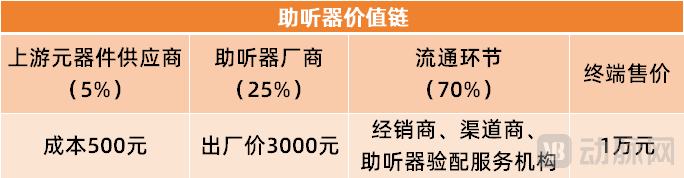
It is worth noting that hearing aids are not only high in product pricing, but the service costs in their distribution channels are also significant. Specifically, if the ex-factory price of a hearing aid is around 3,000 yuan, its retail price will reach 10,000 yuan. Of this, 70% of the cost is tied up in the distribution process.
This is primarily because the six major groups sell hearing aid products bundled with services such as fitting, meaning patients must pay for a package that includes hearing tests, fitting services, and the hearing aid device itself to truly benefit from the convenience of hearing aids. Taking the mature U.S. market as an example, patients purchasing hearing aids are required to have them fitted and prescribed by a doctor (audiologist).
For the six major groups, their first-mover and financial advantages have enabled them to establish numerous hearing aid fitting centers or secure extensive offline fitting channels. By bundling products with fitting services, they have significantly raised the entry barriers in the hearing aid industry.
In fact, with the widespread development of technology, innovative companies have already made breakthroughs in hearing aid technology, and an increasing number of enterprises have achieved similar advancements. However, due to restrictions imposed by distributors and policies, patients and users find it difficult to purchase hearing aid products from these innovative companies.
To address this issue, the U.S. FDA announced in 2022 the establishment of a new category of over-the-counter (OTC) hearing aids for individuals with mild to moderate hearing loss. OTC hearing aids remain classified as medical devices and require FDA authorization. However, unlike traditional prescription hearing aids from the six major manufacturers, OTC hearing aids do not require a physician’s prescription and can be purchased directly through brick-and-mortar stores or online e-commerce platforms. Furthermore, OTC hearing aids do not require fitting services by an audiologist; patients can conduct hearing tests via smartphones or other methods and use the results to purchase or configure their hearing aids.
Following the policy announcement, a large number of companies entered the OTC hearing aid market. For example, in September 2022, consumer electronics giant Sony announced a partnership with WSA, a renowned Danish hearing aid manufacturer, to co-develop OTC hearing aids for promotion in the U.S. market. Meanwhile, innovative companies such as Eargo and Lexie Hearing also entered the hearing aid market, rapidly launching their OTC hearing aid products.
As more players enter the market, hearing aid prices in the United States have finally come down. Currently, the price range for over-the-counter (OTC) hearing aids in the U.S. has dropped to $99–$3,000, significantly lower than the previous average price of $4,700. Meanwhile, OTC hearing aid prices continue to decline, with many new entrants attracting users through even more competitive pricing.
In the Chinese market, a large number of enterprises have achieved technological breakthroughs and entered the hearing aid sector. For instance, innovative companies such as Jinhao Medical, United Imaging Microelectronics, Zuodian Technology, Boyin Hearing, Zhitian Hearing Aids (Zhiting Technology), Haikadi, Nanjing Tianyue, Lingtong Technology, New Sound Technology, Xiaowei Health, Aikosound Hearing Aids, Jiuyi Medical, and Aiting Technology have all overcome key technical barriers in hearing aids and launched their own products. In addition to medical innovation enterprises, tech giants such as Tencent, iFlytek, and Xiaomi have also entered the hearing aid market, following in the footsteps of Apple and Sony.
With the entry of numerous innovative enterprises and tech giants, China’s hearing aid market is expected to undergo dramatic changes.
Under the monopoly of the six major hearing aid groups, China's hearing aid penetration rate is less than 5%.
In addition to high prices and corporate monopolies, factors such as market education, consumer attitudes, product competitiveness, and sales channels have also limited the penetration rate of hearing aids.
First, hearing aids represent a medical sector with strong consumer attributes, yet market education remains insufficient. Although hearing aids share similar characteristics with prescription glasses, reading glasses, and dental implants, most patients have limited awareness of hearing loss compared to the high attention given to ophthalmic and oral health conditions that significantly impact quality of life. Hearing loss is often perceived as a natural consequence of aging, resulting in low prioritization and weak willingness to purchase.
Second, there is a lack of cost-effective products in the market, leading to a polarized industry landscape. Currently, only two types of products are available: low-end products with extremely low prices and high-end imported products with exorbitant prices. Low-end products offer inferior performance and may even cause loss of patients’ residual hearing, while high-end products are prohibitively expensive, typically costing over RMB 10,000, and require replacement every three to five years. This significantly dampens patients’ willingness to purchase and use hearing aids.
It should be noted that channel partners such as hearing aid fitting centers, characterized by a smaller customer base and lower purchase frequency, tend to promote higher-priced imported hearing aid products to maintain gross profit margins.
Third, there are few domestic hearing aid fitting centers and other retail outlets, resulting in insufficient fitting service capacity. Statistics show that the number of hearing aid fitting stores in China is limited and they are primarily distributed in first- and second-tier cities, whereas 55% of China’s elderly population resides in rural areas. This means that hearing aid distribution channels fail to achieve broad user coverage.
Fortunately, with the entry of tech giants, these pain points are being transformed.。
First, tech giants such as Tencent, Xiaomi, Apple, and iFlytek bring massive traffic with them. Their entry into the field will help the hearing aid market break out of its niche, raising awareness of hearing loss and hearing aids among more patients and their children, and driving rapid growth in the hearing aid market.
Previously, these tech giants had already conducted preliminary demonstrations in sectors such as heart rate monitoring and sleep tracking. After Apple, Xiaomi, Huawei, and other industry leaders launched smartwatches and health bands equipped with features for monitoring heart rate, sleep, blood oxygen levels, and blood pressure, the entire health monitoring market expanded significantly. Moreover, it was not only the products of these tech giants that achieved impressive sales; offerings from other companies within the industry also garnered substantial attention, realizing significant growth in both revenue and profits.
The hearing aid market has begun to reap the benefits of increased traffic. For instance, Zhitin Technology, invested in by Hanxing Venture Capital under Xiaomi, launched its Zhiting 32-channel smart hearing aid on the Xiaomi Youpin platform for crowdfunding. During the campaign, online sales surpassed 5.21 million units, making it a blockbuster product in the industry. During the 2023 “618” shopping festival, Iflytek’s series of smart hearing aids topped the sales charts in the hearing aid category on both JD.com and Tmall. In the first quarter of 2023, sales of hearing aids under Boyin Hearing experienced a year-on-year growth of over 225%.
Secondly, the entry of tech giants has attracted more players to the market, intensifying competition in the hearing aid industry and leading to the emergence of cost-effective products.
For example, ZuoDian Technology has launched multi-channel in-the-ear hearing aids, with prices ranging from 899 to 1,699 yuan depending on the number of channels (16/24/34/48). Taking its 16-channel model as an example, the device utilizes a 16-channel imported chip that accurately identifies and enhances human speech, thereby improving overall sound quality. Additionally, the product achieves intelligent noise reduction through various technical algorithms, including WORC dynamic range compression and ANR adaptive noise cancellation. Specifically, it can separate multiple audio sources, provide intelligent compensation for human voice, eliminate environmental noise, automatically suppress feedback whistling, and process sudden abnormal sounds, thereby meeting the diverse needs of patients.
For another example, ZhiTing Technology recently launched a highly cost-effective product: the ZhiTing RIC 2.0 Pro Max. According to the introduction, the product utilizes an advanced 12-nanometer process chip designed by Tsinghua University Research Institute, with a sound sampling rate of up to 96,000 times per second. The captured audio is distributed across 80 channels for frequency band processing.
The algorithm employed by this product was co-developed by Zhitian Technology and Tencent’s Tianlai Team. It leverages high-speed computation across 432 neural network nodes to separate noise from human speech, suppressing background noise while amplifying vocal signals. The device is also equipped with high-power balanced armature drivers to enhance mid-to-high frequency audio performance, addressing hearing loss up to 95 dB and meeting the amplification needs of users with profound hearing impairment.
Overall, the product’s acoustic specifications benchmark against international brands, while its level of intelligence is far ahead. In terms of price, however, this product costs only RMB 6,980 per unit, compared to RMB 29,800 per unit for international brands—just one-quarter of the latter’s price, offering exceptional cost-effectiveness.
Finally, the accelerated development of innovative technologies is enabling small and medium-sized enterprises (SMEs) to break through the channel barriers monopolized by the six major hearing aid groups. To address the monopoly over distribution channels held by these six giants, innovative companies have carved out a new path by leveraging technological innovation to establish online sales channels.
For instance, innovative hearing aid brands such as Xinsheng Technology, Aikesound, and Zuodian Technology have developed mobile apps or mini-programs that enable patients to self-test their hearing and complete hearing aid fittings. Meanwhile, Tencent Tianlai has launched the “Tencent Tianlai Remote Hearing Service Platform,” which allows audiologists and hearing-impaired users to connect with a single click via Tencent Meeting. With just a smartphone, hearing-impaired users can complete the fitting process at home. Currently, this platform is fully open to all hearing aid manufacturers and upstream chip providers.
Supported by online channels, the purchasing process for hearing aids has been streamlined, and the cost of use has been reduced. Currently, a growing number of patients with mild to moderate hearing impairment are showing willingness to purchase and use hearing aids.
However, online channels also have certain drawbacks. Hearing aids are not ordinary consumer electronics; they must be matched to each patient’s specific hearing loss profile, professionally fitted and adjusted, and patients must be trained in their use and maintenance. Furthermore, as most hearing aid users are elderly individuals who are often unfamiliar with software applications, unable to undergo remote fitting, or incapable of adjusting parameters within the app, these challenges significantly impact the purchase and usage of hearing aids, requiring companies to devise effective solutions.
Perhaps for this reason, most domestic hearing aid companies currently adopt a dual-channel strategy combining online and offline services. For instance, iFlytek utilizes its “Spark Intelligent Fitting Specialist” to assist users with remote (online) fittings, while also partnering with Boyin Hearing to provide professional offline fitting services.
Previously, iFlytek partnered with Boyin Hearing to provide users with O2O hearing aid fitting solutions. Specifically, after purchasing iFlytek’s hearing aid products online, users can schedule appointments for professional fitting services at Boyin Hearing. It is reported that at Boyin Hearing’s specialized stores, users will receive comprehensive hearing health services, ranging from hearing assessments and hearing aid adjustments to post-purchase maintenance and care.
Among the major announcements made by several tech giants, the news that Apple’s headphones have been significantly modified to function as hearing aids has undoubtedly attracted the most attention. However, industry insiders have stated, “The transformation of Apple’s headphones into hearing aids does not pose a significant threat to professional hearing aids.”
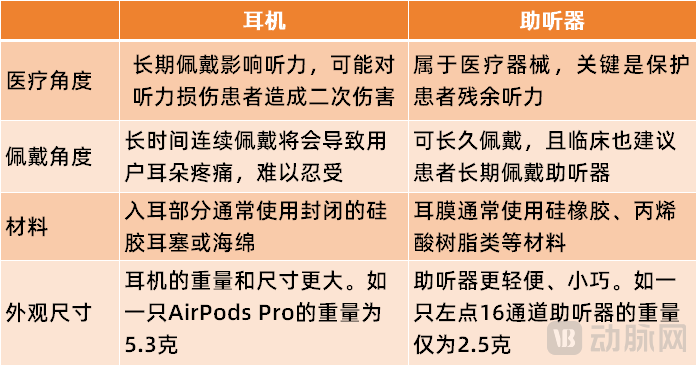
(Differences Between Headphones and Hearing Aids, Table by VCBeat)
Although headphones share certain similarities with hearing aids and can even replicate some of their functions, hearing aids must account for additional characteristics beyond mere sound amplification, including materials, aesthetics, and wearing comfort.
From a medical perspective, wearing headphones is a significant factor contributing to hearing loss. Prolonged use of headphones may cause secondary harm to patients with existing hearing impairment. Hearing aids, in contrast, are classified as medical devices, with their primary function being the preservation of patients’ residual hearing.
In terms of wearability, prolonged continuous use of in-ear headphones can cause unbearable ear pain for users. In contrast, hearing aids are designed for long-term wear, and clinical guidelines recommend that patients wear them consistently to facilitate the brain’s gradual transition from a “hearing-loss mode” to a “normal listening mode with amplification.”
This is primarily due to significant differences in hardware aspects such as materials, appearance, and dimensions.
In terms of materials, the in-ear portion of headphones typically uses sealed silicone ear tips or foam, which can create a more occluded ear canal and easily cause a feeling of fullness or blockage during prolonged wear. In contrast, the in-ear component of hearing aids utilizes more breathable, hypoallergenic materials and can be custom-fitted to the ear canal, offering superior comfort.
In terms of physical dimensions, headphones are heavier and bulkier, placing a greater burden on the ears during wear, whereas hearing aids are lighter and more compact. For instance, a single AirPods Pro weighs 5.3 grams, while a single Zuodian 16-channel hearing aid weighs only 2.5 grams, a significant difference.
An anonymous industry insider commented, “Apple is like Zhan Ying, who brought massive traffic to the Go community without taking a single cent in prize money. It has generated significant attention for hearing aids and driven up penetration rates, but it is not expected to capture many actual hearing aid users.”