

Greatbatch Inc. Files IPO Prospectus, Pivoting from Cardiac Pacemakers to Neural Stimulation Technologies

Greatbatch
Developer and Manufacturer of Implantable Medical Devices and Electrochemical Battery Components
In 1957, Medtronic manufactured the first portable external cardiac pacemaker, causing a sensation in the industry.
However, in real-world practice, significant drawbacks of this pacemaker have been identified. Because the device is worn externally and connected to the heart via leads that penetrate the skin, users are prohibited from engaging in any water-related activities, including bathing. Additionally, users must apply antimicrobial agents to the exit site daily to prevent infection.
Consequently, since its market launch, this product has not been viewed favorably by Medtronic, which has even marginalized it.It was not until the emergence of Wilson Greatbatch that cardiac pacemakers gained clinical recognition.Greatbatch, the child of an ordinary carpenter, saved tens of thousands of heart disease patients with his invention of the cardiac pacemaker. He was ultimately inducted into the National Inventors Hall of Fame and received the National Medal of Technology and Innovation as well as the MIT Lifetime Achievement Award.
Following the conclusion of the collaboration with Medtronic,He also founded his own company, Wilson Greatbatch Ltd., specializing in the research and development of cardiac pacemakers and associated devices.
Developed the First Implantable Cardiac Pacemaker in a Warehouse
Greatbatch had been interested in radio technology since childhood. As a teenager, he successfully built his own shortwave radio receiver and passed the amateur radio license examination at the age of 16. Later, with government funding, he attended Cornell University to study in the Department of Electrical Engineering.
During his university years, he collaborated with psychology students to install monitoring devices on over 100 sheep at a farm, tracking their blood pressure, heart rate, and brainwaves during experiments to facilitate the study of animal behavior. By chance, while installing monitors on the experimental sheep at the farm, Greatbatch encountered two surgeons. During a meal together, the doctors casually mentioned complete atrioventricular block. Patients with this condition experience irregular heartbeats, which can lead to shortness of breath and, in extreme cases, loss of consciousness or death. The primary cause of this condition is the failure of natural electrical impulses from the upper chambers of the heart (the atria) to reach the lower chambers or ventricles. Well-versed in radio technology, Greatbatch jokingly remarked, “That’s just a signal transmission problem.”
This conversation did not attract Greatbatch’s attention, as he was still a layman in the life sciences at the time. It was not until after graduation, when Greatbatch joined the Department of Electrical Engineering at the University at Buffalo as an assistant professor, that things took a turn for the better.
During his tenure as an assistant professor, Greatbatch frequently participated in activities organized by the Biomedical Engineering Society. At these events, he collaborated with physicians on multiple occasions to address clinical challenges through engineering solutions. In one such collaboration, while helping a physician design a circuit capable of recording heart rate, he inadvertently installed an incorrect resistor. Upon powering the circuit, it generated curved pulses lasting 1.8 milliseconds, followed by a one-second pause, before repeating the cycle.
Greatbatch speculated that this might be the pulse needed to improve complete atrioventricular block.In 1958, he attempted to build a cardiac pacemaker using two transistors and, with the assistance of two surgeons, implanted it into a dog’s heart. The heart indeed began to beat under the control of the pacemaker.
Buoyed by this success, Greatbatch began experimenting with materials such as electrical tape and solid epoxy resin to enhance the pacemaker’s water resistance, thereby enabling its implantation into the human body. To continue his research on pacemakers, Greatbatch chose to resign from the University at Buffalo and conduct his R&D work in his home garage.Over the course of two years, he developed more than 50 cardiac pacemakers with varying materials and power outputs in his warehouse.
In 1960, Greatbatch and his physician friend attempted to implant cardiac pacemakers in ten patients; among the initial recipients, one young man remained alive thirty years after the implantation.
Collaborating with Medtronic to Drive the Commercialization of Implantable Cardiac Pacemakers
News of Greatbatch’s successful development of an implantable cardiac pacemaker spread rapidly. Medtronic, which had just encountered setbacks in its cardiac pacemaker pipeline, immediately extended an olive branch to Greatbatch.In 1961, Medtronic obtained an exclusive license from Greatbatch to begin manufacturing and marketing implantable cardiac pacemakers.
By 1965, cardiac pacemakers had become the accepted treatment for complete atrioventricular block. Through collaborative research and development with Greatbatch, Medtronic gradually grew into a global leader in the field of cardiac stimulation and defibrillation.
However, defects emerged in Greatbatch’s products a few years later: the zinc-mercury batteries used in its cardiac pacemakers had a capacity that lasted only two years, requiring patients to undergo another surgery to replace the batteries after that period.
Greatbatch improved the battery and also purchased, in his personal capacity, the patent rights to the lithium-iodine battery design invented by Catalyst Research Corp.However, in 1970, Greatbatch terminated its licensing agreement with Medtronic due to a divergence of opinions on battery design.
Establishing an Independent Venture to Pioneer the Neuromodulation Sector
After the termination of the agreement, Greatbatch established its own company.Wilson Greatbatch Ltd, specializing in the development and production of batteries for pacemakers.
For a long period, Wilson Greatbatch Ltd. aimed to develop pacemaker batteries with a lifetime lifespan. It was not until Greatbatch ventured into nuclear energy that the company developed the world’s first lithium-powered battery. Capable of lasting more than ten years, this battery addressed the critical issue of frequent battery replacements in implantable cardiac pacemakers and became the gold standard for pacemaker batteries. With this invention, Wilson Greatbatch Ltd. emerged as one of the leaders in the field.
In 1990,Wilson Greatbatch Ltd. nearly monopolized the production of batteries for all cardiac pacemakers, directly manufacturing 60% of the batteries in this field, while another 30% were produced under license from the company.
Subsequently, building on its expertise in cardiac pacemaker batteries, Wilson Greatbatch Ltd. expanded into batteries for other medical devices, such as implantable cardioverter-defibrillators, drug delivery systems, and neurostimulators, thereby accumulating substantial market resources and capital. From 1990 to 2000, Wilson Greatbatch Ltd. acquired multiple medical device companies, assembled several advanced technical teams, and secured comprehensive product pipelines, embarking on a strategic transformation following its initial public offering (IPO) in 2000.
Wilson Greatbatch Ltd. subsequently developed devices for treating epilepsy and implantable devices for treating depression, while actively researching and developing neurostimulation devices in the fields of pain management, drug delivery, and urinary incontinence. All these products were powered by Wilson Greatbatch Ltd.’s batteries, which became a significant competitive advantage.
In 2005, to better promote its new product pipeline, the company decided to drop “Wilson Greatbatch,” a name closely associated with cardiac pacemakers, and was officially renamed Greatbatch Inc., making significant strides in the field of neurostimulation.
Three domestic companies have already received approval for their related products.
It has been nearly 70 years since Greatbatch invented the implantable cardiac pacemaker, and this device has become the primary method for interventional treatment of arrhythmias.
According to the team from Beijing Anzhen Hospital,"Current Status and Treatment Advances of Arrhythmia in China"Studies have shown that China became a country with a high burden of arrhythmia in 2020, and the total number of patients with atrial fibrillation (AF) in China is expected to exceed 8 million by 2050. This has also led to a rapid increase in the number of pacemaker implantations in China, from 38,768 cases in 2010 to 82,779 cases in 2018.
From the perspective of product types, pacemakers currently on the market are mainly classified into single-chamber, dual-chamber, and triple-chamber devices, with the primary differences lying in the number and placement locations of the electrode leads.
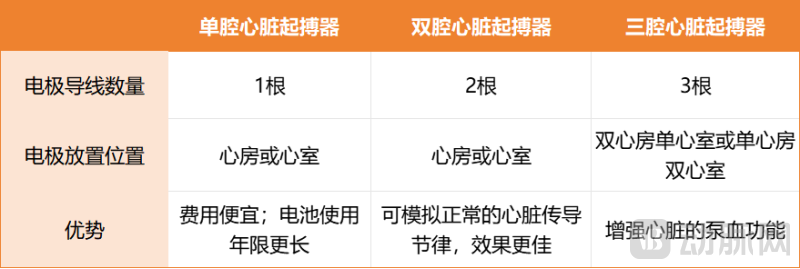 Differences Among Three Common Types of Cardiac Pacemakers
According to NMPA data (as of September 13, 2024), there are currently only domestic companies with approved cardiac pacemaker products.Lifetech Scientific (Shenzhen) Co., Ltd., Lepu Medical Technology (Beijing) Co., Ltd., and MicroPort CRM Medical Devices (Shanghai) Co., Ltd.Three companies.
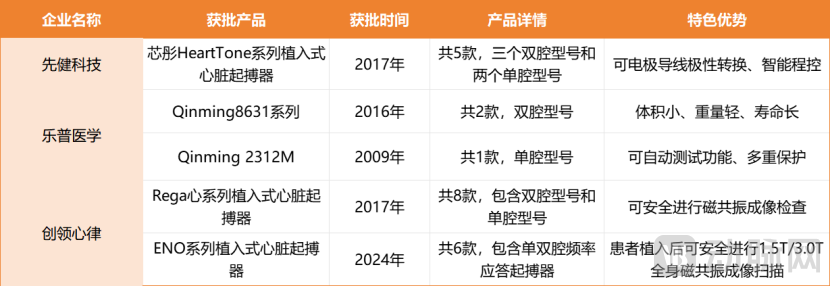 Approval Status of Domestically Produced Cardiac Pacemakers
From the perspective of regulatory approvals, China’s cardiac pacemaker sector has achieved a leap from reliance on imports to possessing independent intellectual property rights. This transition has not only broken the barrier from non-existence to existence but also steadily advanced technologically toward high-quality and sophisticated levels. Although no domestically produced three-chamber cardiac pacemakers have been approved to date, continuous advancements in technological innovation and growing medical demands will undoubtedly drive new iterations of domestically produced cardiac pacemakers.