

China's Domestic Ultrasonic Scalpel Industry Enters a Make-or-Break Phase Amid Intense Market Consolidation
“Barring any surprises, more than half of domestic (ultrasonic scalpel) brands are set to ‘die’ next year.”
When VCBeat recently surveyed frontline practitioners in the ultrasonic scalpel industry, the most common response was that the sector is undergoing growing pains.The prevailing consensus is that domestic brands will undergo a major reshuffle in the next two years.(Note: Ultrasonic scalpels are categorized into ultrasonic hemostatic scalpels and ultrasonic bone scalpels; this article discusses only ultrasonic hemostatic scalpels.)
“I believe that the true first year of domestically produced ultrasonic scalpels in China will be next year. After the industry undergoes a rigorous selection process, only the outstanding brands will remain in the game.” This was stated by Feng Qingyu, Chairman of Qingdao Jianxin Medical Technology Co., Ltd. (hereinafter referred to as “Jianxin Medical”).
Zhang Tao, founder of Ansukang, believes that from 2013, when the first domestic ultrasonic scalpel received regulatory approval in China, to 2023, Chinese brands achieved a breakthrough from nothing to something over approximately a decade. Moving forward, domestic brands are entering a new phase of transitioning from mere existence to excellence.
Half Seawater, Half Fireworks. On paper, the domestic ultrasonic scalpel market in China witnessed rapid sales growth in 2023. According to data recently released by a market research firm, the volume of domestically produced ultrasonic scalpels (excluding handpieces) has surged rapidly, breaking the monopoly previously held by imported products. However, when VCBeat consulted industry frontline professionals to explore the drivers behind this growth, insiders candidly stated that the actual market temperature is not as promising as the figures suggest.
Based on feedback from multiple sources,After more than a decade of catch-up, Chinese-made ultrasonic scalpel manufacturers are now at a critical juncture, confronting real challenges and addressing genuine problems.
What are these genuine challenges and real-world problems? What kind of segmentation is the domestic ultrasonic scalpel industry in China actually undergoing? How will it evolve in the future? In response, VCBeat combines relevant data with frontline industry observations to shed light on these questions.
As a high-frequency energy surgical device, the ultrasonic scalpel emerged in the 1950s, began to be used clinically in the 1980s, gradually replaced mechanical scalpels and electrosurgical units, and has been developed for 70 years to date.
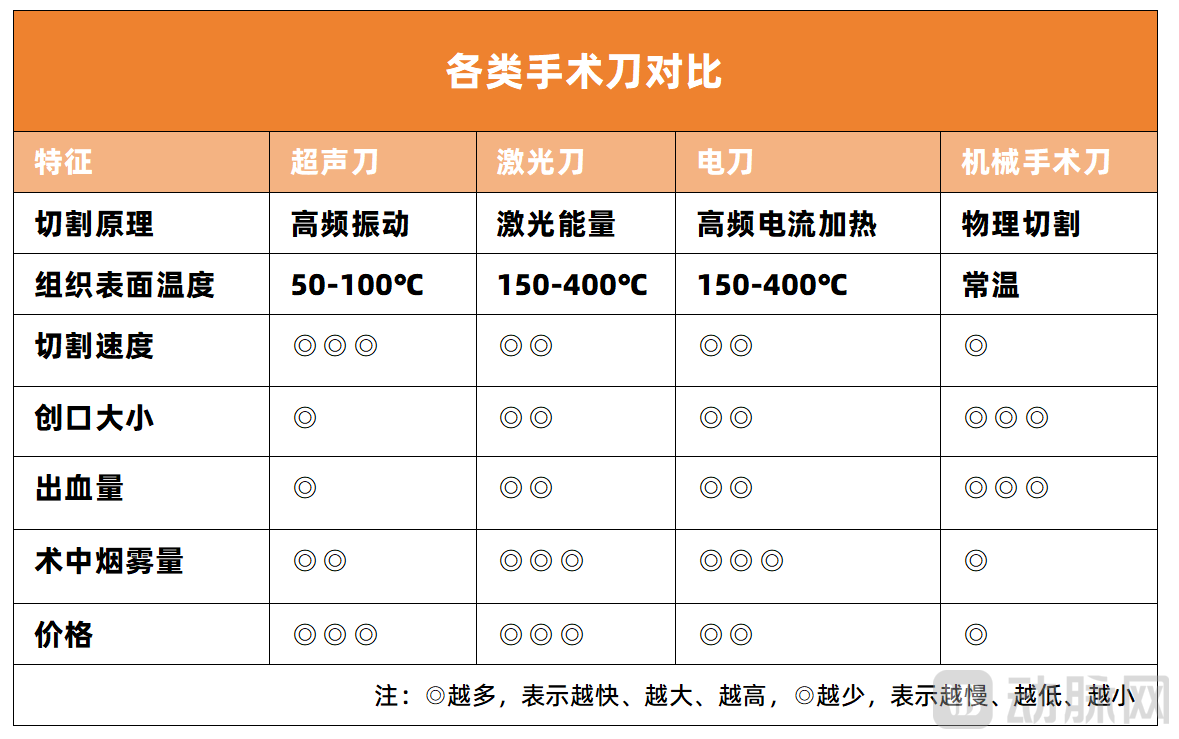
Based on differences in working principles, ultrasonic scalpels are classified into two types: suction-type and cutting-type ultrasonic scalpels.. Clinically, cutting-type ultrasonic scalpels are the most common. Their core mechanism leverages the ultrasonic effect and high-frequency mechanical vibration of the tip to cut and dissect tissue, allowing surgeons to operate in limited visual fields; they are frequently used in laparoscopic surgeries. Ultrasonic surgical scalpels can simultaneously achieve tissue cutting and coagulation while minimizing thermal injury.
Suction-assisted ultrasonic scalpels utilize high-energy ultrasonic oscillations to fragment target tissue, which is then emulsified by irrigation fluid and removed via negative pressure suction. This device is most effective for tissues with high water content and low collagen content, such as the brain and liver, while having minimal effect on tissues rich in collagen, such as blood vessels and fascia.
In terms of application scenarios, ultrasonic scalpels have been adopted across more than ten departments, including plastic surgery, gynecology, urology, thoracic surgery, hepatobiliary surgery, gastrointestinal surgery, head and neck surgery, otolaryngology, and pediatric surgery., covering dozens of surgical procedures including uterine fibroid surgery, abdominal aortic aneurysm repair, rectal tumor resection, appendectomy, hemorrhoidectomy, and adrenalectomy.
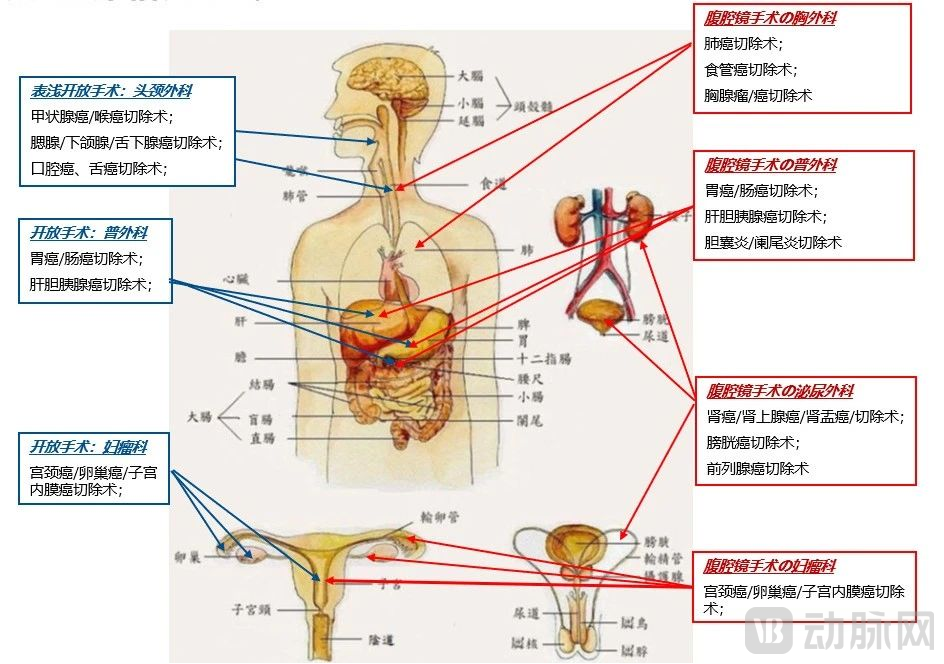
▲ Clinical Application Scenarios of Ultrasonic Scalpels Image Source: Kangji Capital
Driven by its significant role in clinical practice, the market size of ultrasonic scalpels in China has continued to grow. According to the "Report on Energy-Based Surgical Devices in China" released by VCBeat Institute, the growth rate of China’s ultrasonic scalpel market is significantly higher than that of the global market. The market size exceeded RMB 12.5 billion in 2021, with the compound annual growth rate (CAGR) from 2020 to 2025 estimated at 24.9%.
“In the ultrasonic scalpel industry, Johnson & Johnson is the leading enterprise, and its products have long been regarded as the ‘gold standard.’ The vast majority of products on the market are imitations or innovations based on this ‘gold standard,’” Zhang Tao, founder of Ansukang, told VCBeat. “However, we believe that strictly adhering to Johnson & Johnson’s standards can actually constrain corporate innovation. In light of this, we are exploring a new path.”
VCBeat’s analysis reveals that, from the perspective of product design,The ultrasonic scalpel industry has currently split into two major camps.
One category is console-based ultrasonic surgical systems, with representative companies including Johnson & Johnson, Jianxin Medical, Houkai Medical, SinoMicro, Anhe Galil, Mindray, and Yinuokang. Taking Johnson & Johnson’s products as an example, the ultrasonic scalpel system consists of several components, including the main unit, transducer handpiece, ultrasonic blade, and foot pedal. This approach currently represents the industry mainstream and is the area with the most accumulated expertise.
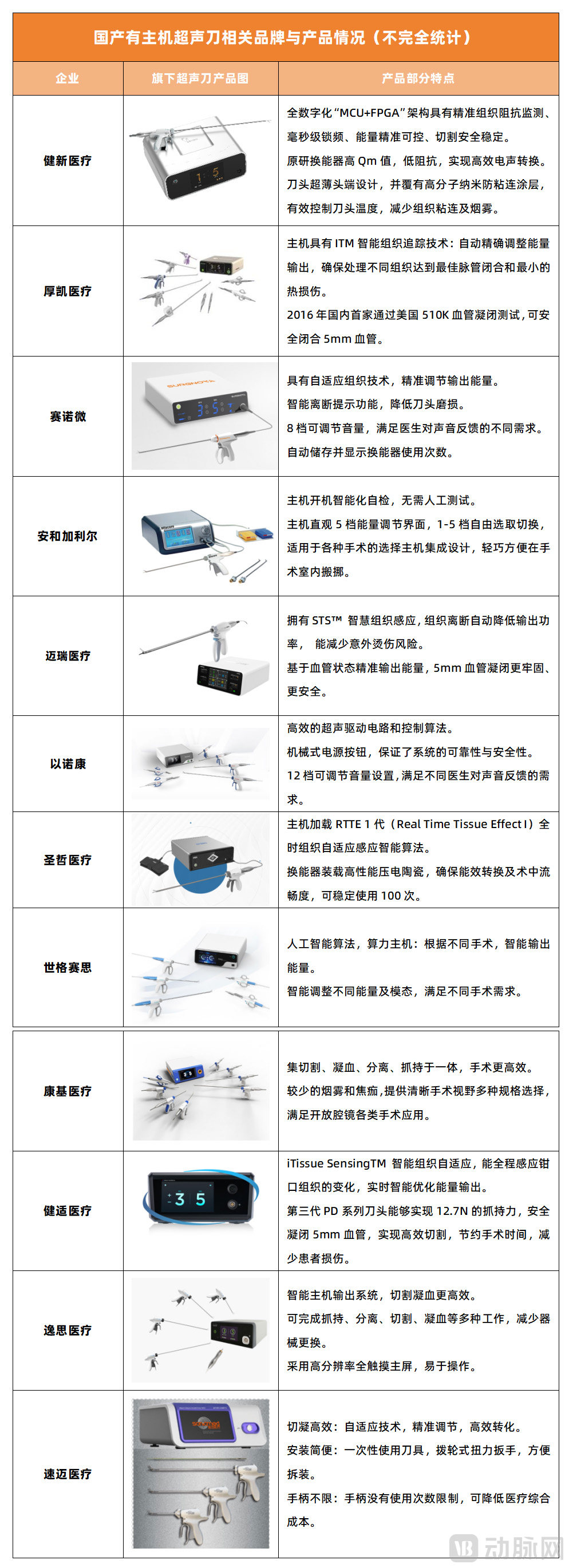
▲Image and source: respective company websites
Another category is host-free ultrasonic scalpels., with representative companies including Covidien (US) and Ansuokang. Specifically, the host-free ultrasonic scalpel design eliminates the need for a separate console by integrating all functions into the handpiece. This design reduces hospital procurement costs and simplifies operational workflows in clinical settings.
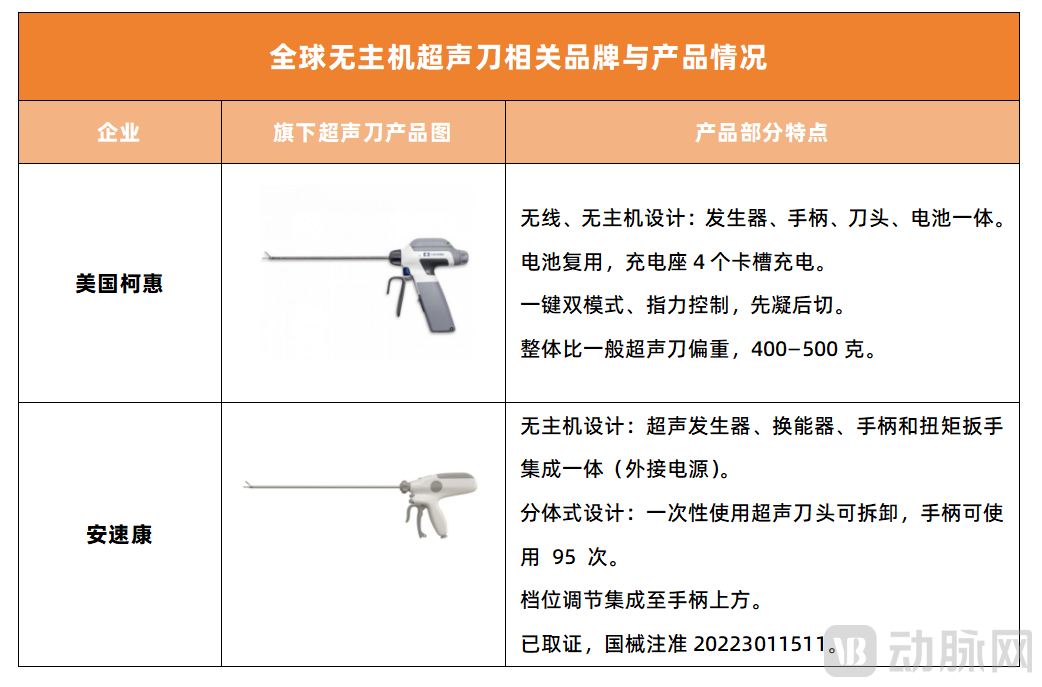
▲Image and source: Company official websites and Kangji Capital
“Currently, there are certain variations in how each manufacturer defines this system, but we believe that an ultrasound system should not be viewed in isolation by examining its individual components separately.” According to Zhang Tao, founder of Ansukang, the full name of an ultrasonic scalpel is “Ultrasonic Soft Tissue Cutting and Hemostasis System” or “Ultrasonic Soft Tissue Surgical System.” The common characteristics underlying these terms are: first, they are based on ultrasound technology; second, they constitute a system rather than a single component or part; and third, they are interdisciplinary products integrating mechanics, electronics, and ultrasound. “Viewing the product in a fragmented manner can indeed constrain corporate innovation.”
However, regardless of the technological path chosen, industry experts interviewed believe that for innovative companies in the ultrasonic scalpel sector,The core remains returning to clinical value and mass production implementation—this is the key to whether a company can successfully execute its business model.
“Recently, the ultrasonic scalpel sector has undergone significant changes, with many companies going out of business. This is mainly due to two reasons: first, there are considerable technical challenges, leading to numerous shortcomings in practical applications; second, mass production has not been achieved in industrialization, with major issues in the supply chain,” said an industry insider who requested anonymity.
Technically, some domestically produced ultrasonic scalpels suffer from issues such as main unit failures, unstable fluctuations in transducer frequency and impedance, and handpiece malfunctions, when compared with imported brands.
Taking the transducer tip as an example, domestic ultrasonic scalpels exhibit a higher blade breakage rate than foreign competitors, which is closely related to manufacturing support capabilities and corporate technology development processes.
Moreover, the transducer, a critical component of ultrasonic surgical systems, is hailed as the “eyes” of these systems. Currently, few domestic brands have achieved breakthroughs in transducer technology. According to industry insiders, no more than three manufacturers in China are capable of independently developing original transducers.
Meanwhile, according to VCBeat, most domestic manufacturers in China are still at the stage of R&D and production of ultrasonic scalpel tips, with few companies focusing on comprehensive R&D.
“In the field of ultrasonic surgical devices, Johnson & Johnson holds advantages in multiple aspects, including the generator, transducer, and handpiece, demonstrating strong overall competitiveness,” said Feng Qingyu, Chairman of Jianxin Medical. “I believe the reason domestic brands struggle to compete on par with Johnson & Johnson is that ultrasonic surgical systems are highly complex and involve numerous disciplines. Start-up companies often lack the necessary multidisciplinary infrastructure, which constitutes a true technical barrier. This is particularly evident in the significant gap in stability and consistency during mass production, representing the real dilemma faced by domestic ultrasonic surgical products.”
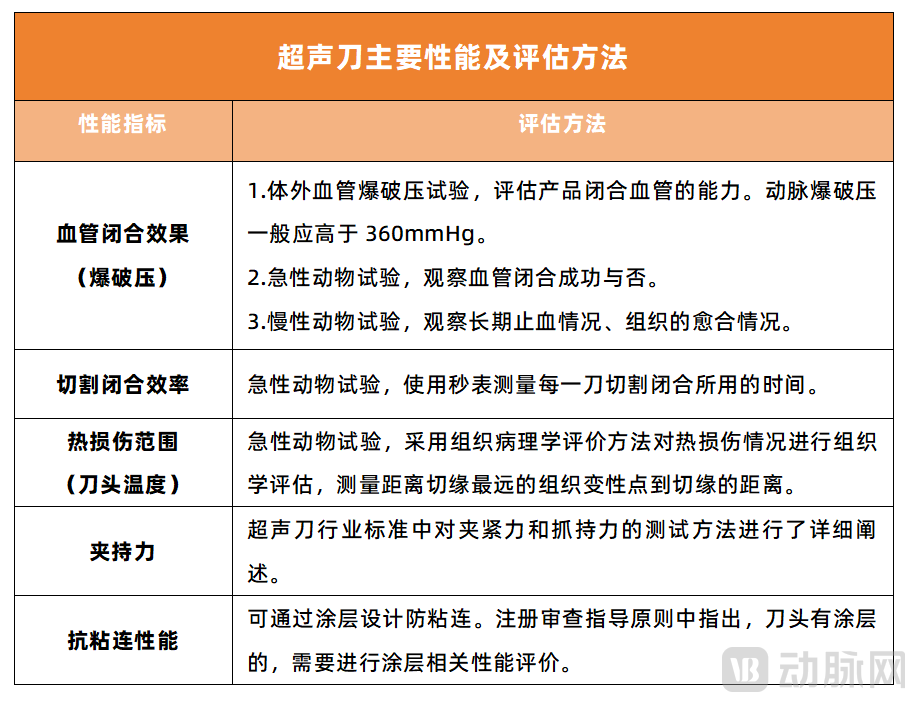
▲ Source: Kangji Capital
In terms of industrialization, the supply chain of the ultrasonic scalpel industry is a significant factor hindering the further development of current domestic brands, particularly in the production of transducer tips, where domestic manufacturing still faces a chaotic situation.
In this regard, Feng Qingyu shared an example with VCBeat: Previously, Yichao Medical, a subsidiary of Jianxin Medical, collaborated with a small manufacturer. The agreement specified the processing of 6-mm titanium rods, but the delivered goods included 5.5-mm rods. “This slight deviation causes a change in the cross-sectional area of the tool tip during machining. Although the impact appears minimal on the surface, it affects the vibration frequency during use.”
Therefore, if supply chain issues are not resolved, product quality control will become problematic, ultimately making it difficult for the company to achieve large-scale shipments.
It is not difficult to see that domestically produced ultrasonic scalpels face two main challenges: first, the interdisciplinary nature of the technology makes it difficult to achieve high-quality performance; second, supply chain constraints hinder large-scale mass production.
Furthermore, Zhang Tao, founder of Ansukang, believes that the gap between domestic brands and leading multinational corporations is still reflected in three aspects.First, product design philosophy; second, manufacturing processes; and third, quality control.“Overall, product design is a critical determinant of a product’s subsequent quality, cost, performance, and other key factors. Product design involves numerous considerations; once flaws emerge in the design phase, they can only be mitigated later on but never completely eradicated. Manufacturing processes and quality control are two sides of the same coin; deficiencies in either aspect will preclude the production of high-quality products.”
Behind Every Challenge Lies an Opportunity. Amid the industry’s growing pains, numerous domestic innovative brands have begun to exert their efforts to address the aforementioned issues.
On the R&D front, brands are placing increasing emphasis on building multidisciplinary teams. For instance, Jianxin Medical currently boasts a professional R&D team spanning acoustics, optics, electronics, and mechanics, along with a domestically leading core acoustic component design team.
Another example is Sinowei, founded in 2015. The company has established an R&D center in Beijing that houses more than ten laboratories covering electronics, mechanics, optics, acoustics, robotics, animal tissue studies, and reliability testing, staffed by multidisciplinary R&D engineers.
On the supply chain front, Jianxin Medical has adopted a strategy of diversified collaboration with multiple internationally renowned enterprises and listed companies to build a robust R&D, production, operations, and supply chain management system. This includes partnering with leading international contract manufacturers to establish high-end medical device R&D and manufacturing centers, thereby ensuring tangible product commercialization. Currently, Jianxin Medical has jointly established the “High-End Medical Device R&D and Manufacturing Center” with FULIAN Yukang Medical Technology (Shenzhen) Co., Ltd., a subsidiary of Foxconn Industrial Internet Co., Ltd. Leveraging a “full-stack” R&D and manufacturing model and collaborative innovation, the center provides original “product-level” solutions to the global market.
Houkai Medical, headquartered in Wenjiang, has established an R&D center and manufacturing base for new products and projects in Chengdu. It is reported that the first phase of its manufacturing base has an annual production capacity of 600,000 units, while the second phase will reach an annual capacity of 1.5 million units.
“In the coming phase, for the entire industry to develop the capability to compete with multinational corporations, it must address quality issues. Product performance, quality, stability, and consistency must be of a sufficiently high standard,” said Zhang Tao, founder of Ansukang.
Feng Qingyu, Chairman of Jianxin Medical, also stated, “China does not lack innovation; what it lacks are high-quality products—specifically, those that are consistent, stable, safe, and effective.”
Undoubtedly, after the market shakeout, Chinese ultrasonic scalpel brands that face challenges head-on will usher in greater development.
With Continuous Innovation by Domestic Ultrasonic Scalpel Brands, How Can They Capture a Larger Market Share?
In response, the industry generally recognizes two viable paths: first, aligning with the trend of domestic substitution by winning bids in centralized procurement to accelerate market share capture; second, launching a globalization strategy to sell innovative products overseas.
Regarding centralized procurement, winning a bid helps innovative enterprises rapidly penetrate the market. Taking the 2022 centralized procurement results for ultrasonic scalpel heads by the alliance of 16 provinces and cities, including Guangdong, as an example, this procurement covered more than 50% of the Chinese market and population, with the highest price reduction for selected products reaching 93%. In terms of agreed procurement volumes for ultrasonic scalpels, domestically produced ultrasonic scalpel heads accounted for 62% of the total procurement volume, indicating that domestic alternatives have largely replaced imported products in the mid-to-low-end segment.
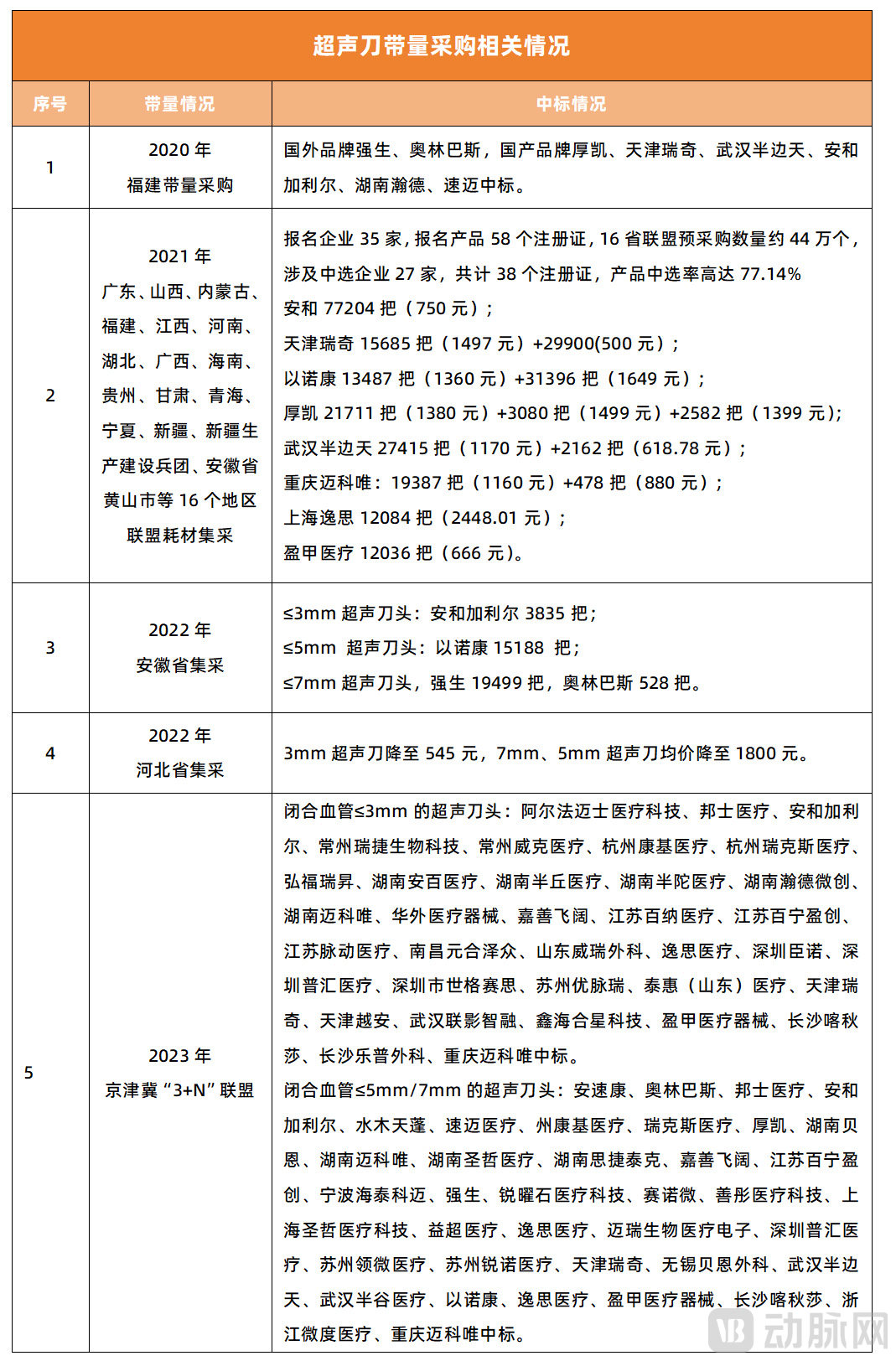
▲Source: Publicly available information on the internet
Taking Ansukang as an example, its ultrasonic scalpel products obtained the Class III medical device registration certificate issued by the National Medical Products Administration in November 2022 and officially launched sales in the second quarter of 2023. As of the first half of 2024, the number of hospitals that won bids in centralized procurement exceeded 100, and the total number of hospitals where the product was adopted surpassed 200.
Recently, the new round of centralized procurement by the Ultrasound Scalpel Alliance officially came into effect: The Chongqing Municipal Healthcare Security Administration issued the “Notice from the Office of the Chongqing Municipal Healthcare Security Administration on Implementing the Results of the Volume-Based Joint Procurement of Ultrasonic Scalpel Heads under the Sichuan-Chongqing Alliance,” formally implementing the selected results starting September 10. In early September, the Shenzhen Public Resource Trading Center once again solicited public comments on the “Draft for Comments on the Follow-up Procurement Documents for the Centralized Volume-Based Procurement of Ultrasonic Scalpel Heads and Pre-filled Catheter Irrigators upon Expiration of the Previous Agreement.”
In terms of global expansion, innovative enterprises including Yisi Medical and Sainuowei Medical have all launched globalization strategies and are selling Chinese-made medical devices to the global market.
Of course, breakthroughs in research and development continue.Recently, the 7mm ultrasonic scalpel independently developed by Sainowei has officially received a Class III medical device registration certificate from the National Medical Products Administration (NMPA) after review, becoming the first domestically produced 7mm ultrasonic scalpel approved for market launch in China.
“Ultrasonic scalpel tips are categorized by functional attributes into different groups, specifically 3 mm, 5 mm, and 7 mm. Currently, only a handful of companies in the market offer ultrasonic scalpels with sealing tips capable of handling ‘large blood vessels’ (≤7 mm),” a senior industry investor told VCBeat. “Therefore, the approval of the 7 mm ultrasonic scalpel demonstrates the continuous evolutionary capability of domestic brands. Some Chinese innovative enterprises are also actively positioning themselves in this area, providing significant support for further import substitution and global expansion in the future.”
Meanwhile, it is understood that the National Key R&D Program special project “Intelligent Dual-Engine Dynamic Hybrid Energy Surgical System,” led by Jianxin Medical, has completed registration testing and animal experiments. This system can not only be applied to the sealing of large blood vessels up to 7 mm in diameter but also explores hybrid energy output combining ultrasonic and electrical energy, with the capability to dynamically adjust power output.
“The product can automatically identify tissue types and dynamically output a hybrid of two energy levels based on tissue characteristics and tissue energy response curves. With only one type of consumable, it enables intelligent tissue identification and fully automated multi-modal energy delivery according to the recognition results, bringing intelligent ‘on-demand adaptability’ to clinical surgery.”。”Feng Qingyu, Chairman of Jianxin Medical, stated that this is also one of the future development directions for energy-based surgery, including ultrasonic scalpels.
As we advance into the future, a new landscape is unfolding in the ultrasonic surgical device industry, with Chinese innovative brands holding great promise.
(This article received strong support from Zhang Tao, founder of Ansukang; Feng Qingyu, Chairman of Jianxin Medical; and two industry insiders who wished to remain anonymous. We extend our sincere gratitude to all of them.)
References:
1. “In-Depth Analysis of the Surgical Ultrasonic Scalpel Industry and Technology” — Research for Practical Application
2. “Report on Energy-Based Surgical Devices in China” – VCBeat