

European Cardiovascular Giant Biotronik, Behind Multiple 'World-First' Innovations, Shifts Strategy Amid Core Business Sale and IPO Filing

BIOTRONIK
Developer of Cardiac Rhythm Management and Vascular Intervention Medical Technologies
March 2024, Medical Device CompanyBiotronik Se & Co.KG(hereinafter referred to as: BIOTRONIK) has launched the world’s only approved complete conduction system pacing solution for left bundle branch area pacing, including the Selectra 3D delivery catheter, Solia S leads, and the Amvia pacemaker series.
Compared with traditional cardiac pacemakers, this system can simulate the natural ventricular activation sequence, achieve more physiological ventricular contraction, reduce atrioventricular reentrant conduction, and lower surgical risks as well as the likelihood of postoperative discomfort in patients.
However, in January of the same year, BIOTRONIK announced plans to sell its core pipeline for €1 billion, aiming to alleviate its current debt burden of approximately €600 million.
Since its founding in 1963, BIOTRONIK has been at the forefront of medical innovation, introducing numerous “first-of-their-kind” products and leading technological advancements in the cardiovascular field.How Will BIOTRONIK Further Strategize Its Path of Innovation in the Future?
Germany’s First Implantable Cardiac Pacemaker Developed
In 1963, physicist Max Schaldach and electrical engineer Otto Franke developed at the Technical University of BerlinThe First German-Made Cardiac Pacemaker PIP-3。
Three years after the debut of the world’s first implantable cardiac pacemaker, the PIP-3 boasts superior performance. Reportedly, this pacemaker is renowned for its low energy consumption and lightweight design. For implantable cardiac pacemakers, lower energy consumption translates to extended battery life, reducing the frequency of battery replacements and minimizing patient risk. Meanwhile, the reduced weight alleviates the burden on patients, facilitating natural cardiac contraction and preventing excessive workload.
In late 1963, this cardiac pacemaker was implanted in a human patient for the first time and functioned successfully. This achievement earned the two researchers both reputation and funding, leading them to establish BIOTRONIK in the same year to focus on pacemaker research.
At that time, as the only company besides Medtronic capable of manufacturing implantable cardiac pacemakers, BIOTRONIK quickly captured the German market. Its developedDiplos 03 was the first dual-chamber cardiac pacemaker at that time., capable of simultaneously sensing and pacing both the atria and ventricles, thereby achieving a pacing function that more closely mimics the natural beating pattern of the human heart. Furthermore, this product represented the advanced state of cardiac pacemaker technology at the time, propelling the evolution of cardiac pacemakers toward dual-chamber systems.
Driven by the strong sales of this product, BIOTRONIK quickly gained a foothold in the European market and began expanding into Europe, South America, and Asia, while also establishing a new manufacturing facility in Lake Oswego, Oregon, USA.
Launching Multiple “First-of-Its-Kind” Products in the Cardiac Pacemaker Field
Diplos 03 brought BIOTRONIK stable, objective returns and enhanced its reputation. However, the Diplos 03 also suffered from a series of issues, including short battery operation time and limited battery life. Meanwhile, as the market for cardiac pacemakers continued to expand, it became increasingly difficult for BIOTRONIK to maintain its competitive position with only a single product.
Schaldach, Professor of Biomedical Engineering at the University of Erlangen-Nuremberg...marked a turning point for BIOTRONIK.
Professor Schaldach believed that BIOTRONIK needed to expand its product pipeline, but only after solidifying its market position in the cardiac pacemaker sector. Therefore, upon joining BIOTRONIK, he first led his team in improving the circuitry of the Diplos 03, significantly enhancing the performance and stability of the pacemaker.
Advanced processing circuits enable more precise control of pacemaker operation, ensuring stable pacing performance under various complex conditions. Furthermore, these modules feature higher integration and lower power consumption, thereby extending the battery life of the pacemaker.
Following the Diplos 03, the team also developed multiple models of cardiac pacemakers. For instance, in 1995, it launchedThe First “Empathic” PacemakerBecause Diplos 03 cannot adjust its frequency according to the patient’s needs, it fails to fully meet those needs when the user is exercising or emotionally aroused. To address this issue, the team introduced closed-loop stimulation technology. Closed-loop stimulation technology modulates and optimizes cardiac activity based on neural information. This technology can detect the patient’s physical activity, psychological state, and emotional changes, and adjust the patient’s heart rate accordingly.
Based on this, the team has developedInos PacemakerBy simulating healthy sinoatrial node function through closed-loop stimulation technology, the Inos pacemaker ensures that patients maintain an optimal heart rate during operation, providing stable and appropriate heart rate support even during mental activities or emotional fluctuations. This technology also marks the beginning of personalized medicine for implantable cardiac pacemakers.
In 2003, BIOTRONIK launchedGermany's First Implantable Pacemaker with Cardiac Resynchronization Therapy (CRT) Technology, is the world's first cardiac pacemaker capable of remote monitoring. Physicians can assess patients' current health status based on data transmitted by the pacemaker, thereby enabling early detection of potential issues or abnormalities, such as arrhythmias and worsening cardiac function.
In 2009, BIOTRONIK launched the thenThe World's Smallest Implantable Cardiac Pacemaker, but the battery life can last for more than ten years. To this day, BIOTRONIK remains deeply committed to the cardiac pacemaker sector and continues to launch groundbreaking innovative products.
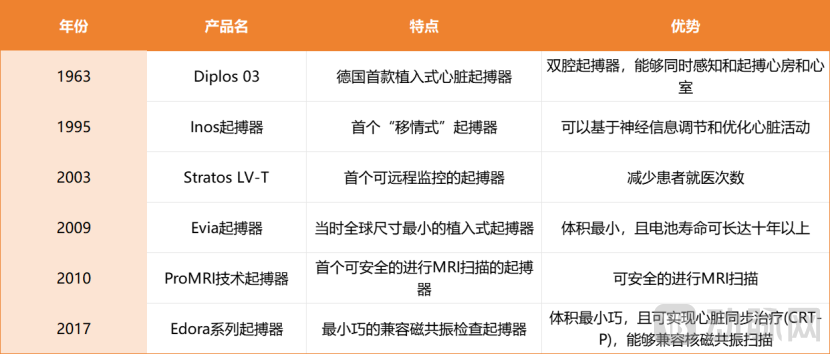 BIOTRONIK’s Landmark Cardiac Pacemaker
Defibrillators, Stents, and Patient Management: Multiple Pipelines Advancing in Parallel
Beyond cardiac pacemakers, Professor Schaldach led his team in embarking on new explorations.
For the first direction of expansion, Professor Schaldach chose areas related to cardiac pacemaker technology.ImplantableCardioverter-Defibrillator. Like the implantable cardiac pacemaker developed by BIOTRONIK, this product also needs to be implanted into the subcutaneous tissue of the patient's chest. However, unlike a pacemaker, an implantable cardioverter-defibrillator (ICD) must deliver an electrical shock to the heart within seconds to restore normal rhythm, thereby correcting tachyarrhythmias and reducing the incidence of sudden cardiac death.
During the early-stage R&D of Diplos 03, the team had accumulated extensive experience in the development of implantable electronic components, and product durability was enhanced through circuit improvements. Consequently, in 1993, BIOTRONIK launchedPhylax 06 Implantable DefibrillatorIt is reported that this was Germany’s first implantable defibrillator at the time, and also the smallest implantable defibrillator in the world at that time.
The compact design of the Phylax 06 makes its implantation procedure more convenient than conventional surgeries. Its smaller incision also facilitates postoperative recovery and reduces the sensation of a foreign body after surgery. Additionally, like other implantable cardioverter-defibrillators (ICDs), the Phylax 06 provides 24-hour monitoring of the patient’s cardiac status. Upon detecting malignant arrhythmias such as ventricular tachycardia or ventricular fibrillation, it immediately initiates therapeutic interventions. Unlike traditional ICDs that rely solely on high-energy shocks, the Phylax 06 employs a tiered therapy approach. It first attempts to terminate the arrhythmia through anti-tachycardia pacing (ATP); only if this fails does it automatically deliver an electrical shock for defibrillation. This strategy ensures prompt patient care while minimizing the risk of overtreatment, thereby reducing adverse reactions and potential long-term complications.
Following its market launch, Phylax 06 received a favorable response. Given the technical similarities between implantable cardioverter-defibrillators (ICDs) and implantable cardiac pacemakers, this product pipeline has also become a key focus area for BIOTRONIK.
In 2010, BIOTRONIK launched the world’s first implantable defibrillator with comprehensive atrial diagnostic capabilities. Two years later, another innovation emergedThe World’s First Implantable Cardioverter Defibrillator Enabling Patients to Undergo Magnetic Resonance Imaging Scans
In addition, BIOTRONIK has launched the AlCath Gold ablation catheter with a gold-tipped electrode, the Pulsar-18 self-expanding stent compatible with 4F systems, and the Orsiro hybrid drug-eluting stent with a bioresorbable coating, establishing itself as a leader in the coronary field.
Around 2010, BIOTRONIK began expanding into the field of monitoring devices. For instance, it developed CardioMessenger Smart, its first home-based patient monitoring device, which transmits data from patients’ pacemakers or implantable cardioverter-defibrillators (ICDs) to their physicians. Subsequently, its Renamic programming software obtained Class II (highest risk) certification under the European Medical Device Regulation (MDR), making BIOTRONIK the first company worldwide to achieve this certification.
In 2020, BIOTRONIK further expanded its service focus to target the patient population. The company launched a dedicated mobile application for patients with implanted devices, enabling them to communicate with clinical staff and thereby facilitating greater patient engagement in their own treatment.
Domestic Products Have Entered the Special Review Procedure
Currently, BIOTRONIK boasts an extensive product portfolio and advanced technologies in the field of cardiovascular therapy, offering a comprehensive suite of solutions that span from treatment to follow-up monitoring and patient services. In recent years, with the robust growth of China’s cardiovascular health sector and a surge in market demand, domestic companies have also risen to the occasion, showcasing their innovative capabilities in the marketplace.
Taking domestically produced implantable cardioverter-defibrillators (ICDs) as an example. Many Chinese manufacturers, similar to BIOTRONIK, have expanded their product pipelines from implantable pacemakers to include implantable cardioverter-defibrillators. However, according to data from the National Medical Products Administration (NMPA) (as of September 2024), no domestically produced implantable cardioverter-defibrillators have yet received regulatory approval, and these products remain in the research and development stage.
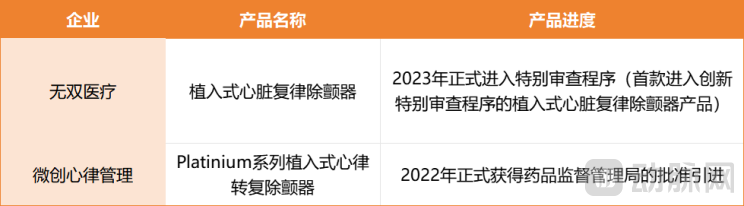 Progress of Domestic Implantable Cardioverter Defibrillator Products
Most domestic companies are concentrated in the field of external defibrillators, such as JiuXin, MaiBang, and Yuwell.
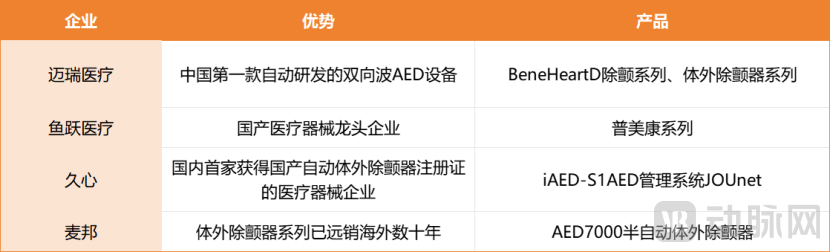 Progress of Domestic External Defibrillator Products
Due to the late start of implantable cardioverter-defibrillators in China and the high technical barriers in this field, no independently developed related products have been approved yet. However,Wushuang Medical has entered the special review process, with approval just around the corner., marking a critical step forward in technological breakthroughs and independent innovation in this field in China.
In the future, domestic substitution in the field of implantable defibrillators is no longer a distant prospect. Chinese manufacturers are poised to deliver more advanced and safer therapeutic options for cardiovascular disease patients worldwide.