

Evensa Biotech Advances Three Stem Cell Therapies into Clinical Trials for Degenerative Diseases and Achieves Full-Chain Intellectual Property Coverage

S-Evans Biosciences
Cell Storage, Cell Therapy, and Cell Drug R&D Developer
In 2009, U.S. President Obama signed into law the removal of restrictions on federal funding for human embryonic stem cell research. Since then, scientists in the United States, Europe, Canada, Japan, South Korea, China, and other countries have accelerated their research into cell technologies.
In the same year, a company named S-Evans Biosciences was established in Hangzhou, becoming the first technology enterprise to settle in Hangzhou Future Sci-Tech City. The founder, Dai Linghua, initially worked at a provincial government agency before resigning to venture into the business world and establish Guotai Education Group. By chance, while evaluating projects abroad, she was exposed to the field of biomedical cell therapy and recognized that it would develop into one of the key industries of the future. According to her recollection, at a press conference held at the Hyatt Hotel in August 2009, S-Evans Biosciences successfully secured licensing rights for six exclusive patented technologies from Cryo-Cell, a U.S.-listed stem cell company. This move attracted significant market attention at the time and even triggered a notable surge in Cryo-Cell’s stock price on the same day.
Notably, S-Evans Biosciences chose to establish its headquarters in the Future Sci-Tech City. At that time, as one of China’s four major overseas innovation parks, the Future Sci-Tech City was undergoing rapid development and received significant attention from the Organization Department of the Provincial Party Committee. The direct involvement of the Organization Department in its management provided resident enterprises with a uniquely favorable policy environment and development opportunities. Furthermore, Dai Linghua’s deep emotional ties to the Yuhang district, combined with the overseas backgrounds of the technical collaborators within the project team, collectively contributed to S-Evans Biosciences’ decision to select the Future Sci-Tech City as the cradle for its inception.
More importantly, S-Evans Biosciences’ decision aligned perfectly with the global wave of stem cell technology development. Six months after the company’s establishment, as the Obama administration lifted the ban on stem cell research, global stem cell research and applications entered a phase of rapid growth. By adopting a preemptive strategic layout, S-Evans Biosciences gained a first-mover advantage in this field.
S-Evans Biosciences has increased its investment and begun to expand sample sources, storing stem cells derived from umbilical cords, placentas, dental pulp, and adipose tissue. The company applied for and received approval from relevant Zhejiang provincial authorities to establish the Zhejiang Provincial Mesenchymal Stem Cell Bank. It conducts research on stem cell therapies for refractory diseases, including clinical applications for liver cirrhosis, interstitial pneumonia, amyotrophic lateral sclerosis, and premature ovarian insufficiency, becoming the first enterprise in the province to initiate the construction of a stem cell resource bank.
From 2013 to 2016, S-Evans Biosciences’ core business primarily focused on stem cell storage. During this period, the company collaborated with over 30 Grade-A tertiary hospitals in China to provide immune cell therapy for cancer treatment, cumulatively treating approximately 10,000 cancer patients.
Currently, S-Evans Biosciences operates one of the largest comprehensive mesenchymal stem cell banks in Zhejiang Province in terms of scale and storage capacity. It is among the first national high-tech enterprises in Zhejiang to conduct research on cell therapy for major diseases, a recognized “Specialized, Refined, Differential, and Innovative” (SRDI) enterprise in the province, and the builder of the Zhejiang Regional Cell Preparation Center. Additionally, it is the issuing authority for the Zhejiang Provincial Local Standard “Human Mesenchymal Stem Cell Bank.”
Targeting Unmet Clinical Needs in Degenerative Diseases, Three Stem Cell Drugs Approved for Clinical Trials
From 2016 to 2017, the Chinese government issued policies such as the Administrative Regulations on Clinical Research of Stem Cells and the Technical Guidelines for the Research and Evaluation of Cell Therapy Products, classifying cells as drugs for regulatory purposes. In 2022, China’s 14th Five-Year Plan for Bioeconomy Development explicitly called for advancing frontier biotechnological innovations, including the development of new technologies such as gene diagnosis and therapy, stem cell therapy, and immune cell therapy. These favorable policy initiatives, exemplified by the 14th Five-Year Plan, have created a conducive regulatory environment for the industry’s new development paradigm and presented new opportunities for the translation and commercialization of innovative cell technologies and products.
Since 2017, S-Evans Biosciences has been engaged in the research and development of cell-based therapies. In light of the high investment, long development cycles, and inherent uncertainties associated with drug R&D, the company has sought to identify relatively safe and feasible entry points among numerous potential directions. First, drawing on successful international precedents, it ensures that selected projects are grounded in robust scientific foundations and supported by preliminary exploratory results. Second, prioritizing drug safety above all else, the company strives to choose therapeutic approaches that pose minimal risk to humans, feature well-defined mechanisms of action, and have gained broad recognition within the industry.
In terms of sample source selection, S-Evans Biosciences places particular emphasis on safety, utilizing newborn umbilical cords as a safer, contamination-free source of stem cells. Compared with traditional bone marrow-derived mesenchymal stem cells (BM-MSCs), umbilical cord-derived mesenchymal stem cells (UC-MSCs) share most biological characteristics with BM-MSCs but exhibit superior performance in proliferative capacity, colony-forming unit-fibroblast (CFU-F) formation, CD106 and HLA-I expression, and neural induction differentiation potential. Furthermore, mesenchymal stem cells (MSCs) have been proven to possess immunosuppressive effects with fewer adverse reactions, making them suitable for treating autoimmune diseases or inflammatory skin conditions, such as graft-versus-host disease (GvHD), lupus erythematosus, systemic scleroderma, and rheumatoid arthritis.
Subsequently, S-Evans Biosciences carefully selected three core pipelines from the initially identified 56 R&D pipelines, targeting acute respiratory distress syndrome (ARDS), atopic dermatitis (AD), and active inflammatory bowel disease (IBD). Dai Linghua specifically noted that S-Evans Biosciences is actively advancing the clinical research of three stem cell drug candidates, aiming at markets not yet characterized by intense “involution,” with the goal of addressing therapeutic challenges in various degenerative diseases.
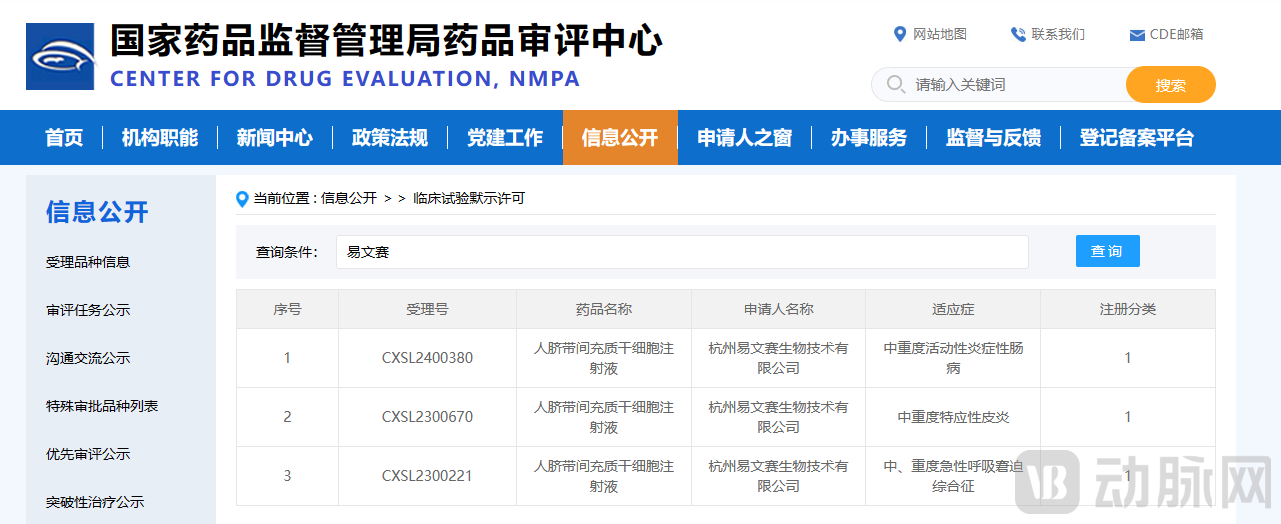
S-Evans Biosciences’ IND Application Approved; Image Source: Center for Drug Evaluation, National Medical Products Administration
Acute respiratory distress syndrome (ARDS) is commonly triggered by bacterial or viral infections, sepsis, severe trauma, acute pancreatitis, or drug reactions. In intensive care units (ICUs), approximately 10% of patients are affected by ARDS, with up to 23% of those requiring mechanical ventilation. The mortality rate among critically ill patients exceeds 40%, highlighting both the high fatality rate and significant societal burden. Furthermore, the increasing frequency of public health emergencies, such as the COVID-19 pandemic, has enhanced public acceptance of biological therapies for pulmonary diseases, thereby adding market potential to this project.
Atopic dermatitis (AD), also known as atopic eczema, is a common chronic, relapsing, and inflammatory skin disease characterized by pruritic eczematous lesions, impaired skin barrier function, overactivation of type 2 helper T cell (Th2) immunity, and elevated serum immunoglobulin E (IgE) levels. AD has a particularly high incidence in children. Over the past three decades, the prevalence of AD in industrialized countries has increased two- to threefold, with incidence rates reaching 10%–30% in children and 2%–10% in adults. AD not only affects patients’ skin health but may also lead to complications such as rhinitis and allergic asthma. Patients with moderate-to-severe AD often experience sleep disturbances, anxiety, and skin pain, resulting in a significant decline in quality of life.
The pathophysiology of atopic dermatitis (AD) is complex. The current mainstream view holds that its pathogenesis is associated with three key factors: dysfunction of the epidermal barrier, cutaneous immune abnormalities—particularly Th2-type immune activation—and dysbiosis of the skin microbiome. Among these, skin inflammation lies at the core of AD’s pathogenic mechanism. Although conventional treatments, such as monoclonal antibody therapies, can alleviate symptoms, they are unlikely to achieve a cure and impose a significant economic burden. In contrast, stem cell therapy holds promise for addressing AD from its root causes. Administered via localized injections, this approach offers a favorable safety profile with minimal side effects. It is poised to become an innovative therapeutic strategy in this field and to capture early-mover advantage in the market.
Inflammatory bowel disease (IBD) is a chronic, progressive intestinal disorder characterized by recurrent episodes and lifelong involvement, primarily comprising two subtypes: ulcerative colitis (UC) and Crohn’s disease (CD). The pathogenesis of IBD may be associated with factors such as genetic predisposition, immune dysfunction, gut microbiota dysbiosis, and disruption of the intestinal mucosal barrier; however, the specific etiology and pathogenic mechanisms remain incompletely elucidated. Over the past two decades, the number of patients seeking medical care for IBD has risen rapidly. Nevertheless, conventional therapeutic regimens yield suboptimal outcomes in some patients, and there is currently no universally effective pharmacological treatment.
In June 2023, S-Evans Biosciences received approval from the National Medical Products Administration (NMPA) for its Investigational New Drug (IND) application for human umbilical cord mesenchymal stem cell injection targeting acute respiratory distress syndrome (ARDS). In December of the same year, its stem cell drug for Alzheimer’s disease (AD) was approved to enter clinical trials. On August 28, 2024, the IND for a new human umbilical cord mesenchymal stem cell injection indicated for inflammatory bowel disease (IBD) was approved. To date, all three drug candidates from S-Evans Biosciences have successfully entered clinical development.
Full-Chain Intellectual Property Coverage and Self-Sustaining Capabilities to Expand the Biomanufacturing Market
Dai Linghua believes that, as biologics, stem cell drugs demonstrate a clear safety advantage over traditional chemical drugs, with no toxic side effects. Furthermore, umbilical cord-derived mesenchymal stem cells have become an ideal choice due to their superior druggability. The quantity of stem cells extracted from a single umbilical cord is sufficient to support multiple treatments for more than 5,000 patients, theoretically meeting the therapeutic needs of a large patient population while enhancing the sustainable supply and treatment efficiency of the drug. Additionally, during the research and development of cell-based therapies, S-Evans Biosciences has achieved full intellectual property coverage across the entire industry chain, encompassing umbilical cord collection, preparation, transportation, and quality control. This characteristic ensures the innovation and uniqueness of its products and lays a solid foundation for subsequent market promotion.
Furthermore, given the relatively small number of developers of similar drugs currently on the market, S-Evans Biosciences enjoys a first-mover advantage in specific therapeutic areas such as atopic dermatitis. Meanwhile, benefiting from its long-standing collaborations with major Grade A tertiary hospitals, where hospital directors and department heads advocate for an integrated model of industry, academia, and research, S-Evans Biosciences has been able to accelerate clinical trials while successfully securing numerous major provincial, municipal, and even national-level scientific research projects. This positions the company to achieve rapid gains in both social and economic benefits in the future.
In terms of downstream products, S-Evans Biosciences has leveraged its mature cell technology applications to expand into markets such as PCC for bone and joint health, Meipo Tongyan biotechnology, cellular immune regulation, stem cell-based wellness and anti-aging, as well as the research, development, and production of cell-derived cosmetics.
Currently, S-Evans Biosciences has established an integrated industry-academia-research platform system comprising the Zhejiang Provincial S-Evans Institute of Cell-Based Drugs and Products, the Zhejiang Provincial Key Laboratory of Cell-Based Drugs and Applied Technologies, and the Zhejiang Regional Cell Preparation Center. The company possesses R&D equipment valued at over RMB 30 million, holds nearly 40 patents, stores more than 10,000 samples of various stem cells, and has provided treatments to over 10,000 patient visits for tumor therapy. It has collaborated with numerous prestigious institutions, including the Chinese Academy of Sciences, Zhejiang University, Tsinghua University, Chongqing University, the University of Science and Technology of China, and Fudan University, jointly undertaking four National 863 Program projects and one key special project under the National Key R&D Program of the Ministry of Science and Technology. Additionally, it has undertaken nearly 30 projects at provincial, municipal, and district levels.
Recently, S-Evans Biosciences has been engaged in the research and development of iPSC-derived therapeutics. The company has invested in two subsidiaries to conduct preclinical studies on CAR-NK cell drugs derived from induced pluripotent stem cells (iPSCs), with an Investigational New Drug (IND) application expected within two years. Additionally, the company is in discussions with Almirall, a globally renowned pharmaceutical company specializing in dermatology, to jointly advance the development of cell-based therapies using stem cells for moderate-to-severe atopic dermatitis.