

Artificial Heart Covered by National Health Insurance: Million-Dollar Device Now Reimbursable as Companies File IPO Prospectus
Recently, the Beijing Municipal Healthcare Security Administration announced a significant beneficial policy, including implantable left ventricular assist device (LVAD) installation surgery (including LVAD and catheter fixation devices, i.e., "artificial heart") in the Class A reimbursement scope of Beijing's medical insurance. Currently, four hospitals, including Beijing Anzhen Hospital, Fuwai Hospital of the Chinese Academy of Medical Sciences, Beijing Chaoyang Hospital, and Peking University Third Hospital, can already provide patients with artificial heart transplant surgeries covered by medical insurance.
VCBeat (WeChat ID: vcbeat) has learned that Guangdong Province had previously included artificial heart implantation surgery in its medical insurance coverage. In addition, certain areas in Shaanxi and Jiangsu provinces have also begun implementing medical insurance reimbursement policies for artificial hearts.
In the past, the cost of the artificial heart device alone for implantation surgery could reach as high as RMB 700,000–900,000. When hospitalization and surgical fees were included, the total expense often exceeded one million yuan, imposing a heavy financial burden on most patients. Before being covered by medical insurance, domestic manufacturers made efforts to alleviate patients’ economic pressure through various channels, including public welfare funds, commercial insurance, and social donations, achieving cost reductions of approximately 10% to 30%. With artificial heart implantation surgery now included in Beijing’s Category A medical insurance reimbursement list, patients’ financial burden is expected to be significantly reduced.
The Beijing Municipal Healthcare Security Administration recently announced that artificial heart therapy will be included in the Category A reimbursement list. This move not only significantly alleviates the financial burden on patients but also injects new momentum into the further development of the artificial heart industry.
First, this policy will enable more patients to afford the cost of artificial heart surgery, thereby significantly expanding market demand.Currently, the demand for artificial heart implantation in China is growing rapidly. According to 2023 data from the Hospital Quality Monitoring System (HQMS), hospitalizations for heart failure exceeded 14 million, accounting for 18% of all hospitalizations for cardiovascular diseases. Industry experts estimate that the number of patients with advanced-stage heart failure in China has surpassed 500,000, while only a few hundred donor heart transplantations are performed annually, indicating that clinical needs remain far from being met.
Left Ventricular Assist Device (LVAD) Implantation, as an Alternative to Heart Transplantation, Has Significantly Improved Survival Rates in Patients with End-Stage Heart Failure. Data from the National Center for Cardiovascular Diseases shows that from 2017 to September 2024, a total of 908 implantation procedures using four models of left ventricular assist devices (LVADs) were performed across 132 hospitals nationwide, with the number of procedures showing a year-on-year increase. This change in Beijing’s medical insurance policy is expected to further accelerate the growth in surgical volume and drive the expansion of the domestic artificial heart market.
Furthermore, the inclusion of artificial hearts in medical insurance will also drive the development of the entire industry chain.With the growth in market demand, upstream core component suppliers in the artificial heart industry will usher in new development opportunities. Domestic enterprises have made significant progress in the field of core components for fully magnetically levitated artificial hearts, achieving localization. Taking Kaici Medical as an example, the company has successfully overcome technical challenges associated with full magnetic levitation and is capable of providing advanced fully magnetically levitated motors to downstream medical device manufacturers. Kaici Medical has also pursued platform-based development, extending its fully magnetically levitated technology to multiple fields, including pharmaceuticals and microelectronics.
This decision by the Beijing Municipal Healthcare Security Administration represents a significant boon to the artificial heart industry, signaling that the domestic market for artificial hearts is poised for further expansion. Meanwhile, it also sends a positive signal for the future inclusion of artificial hearts in China’s national medical insurance coverage.
With the Beijing Municipal Healthcare Security Administration including artificial heart therapy in the Class A reimbursement category, multiple domestic enterprises are expected to benefit.
Currently, five left ventricular assist device (LVAD) products have been approved in China, originating from four domestic companies and one foreign company. These products exhibit significant differences in their technological approaches and indications for use.
Artificial Heart Products Already Launched in China
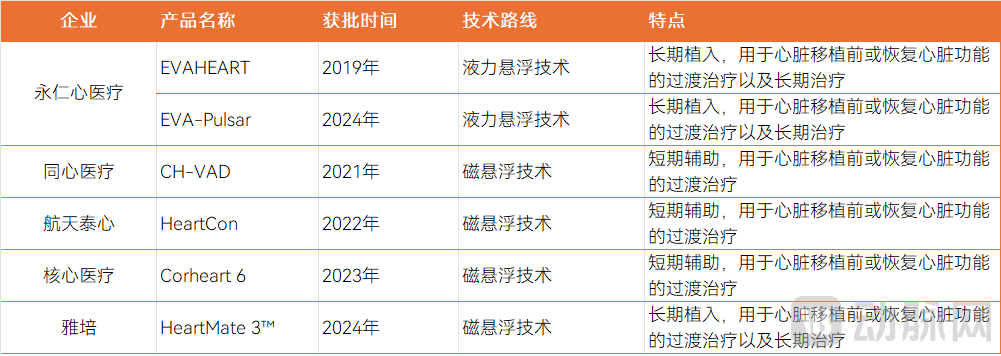
Data source: National Medical Products Administration, public information
In terms of technological pathways, artificial heart technology has undergone an iterative evolution from pulsatile pumps to axial-flow/mechanical pumps, and further to hydrodynamic and fully magnetically levitated pumps, with continuous optimization in device size, surgical invasiveness, and hemocompatibility. Currently, hydrodynamic suspension and magnetic suspension technologies have emerged as the two mainstream technical approaches.
Hydrodynamic levitation technology utilizes fluid to suspend and stabilize the rotor of a blood pump. It reduces mechanical friction through fluid flow and pressure. This technology enables physiological pulsatility, allowing patients to retain a palpable pulse after implantation and maintain a relatively normal physiological blood flow pattern.
Magnetic levitation involves sensing the rotor’s position within its permanent magnetic field using sensors (or self-induction), adjusting the electromagnetic field through a series of electronic circuit devices to control the rotor’s six degrees of freedom, thereby achieving levitation across five degrees of freedom and enabling rotational operation at the center of the chamber.
Full magnetic levitation achieves zero mechanical friction, ensuring smooth blood flow without damaging blood cells and reducing the risk of complications.
Zheng Shijie, General Manager of Kaici Medical, stated: “The key technologies of the fully magnetically levitated artificial heart—specifically the rotary blood pump—include a rotor design with no physical support, enabling the rotor to levitate in air without reliance on any medium; and direct active electromagnetic drive, which ensures stable rotor rotation and real-time adjustment.”
The key challenges in developing fully magnetically levitated products lie in the following: electromagnetic poles generate electromagnetic fields, while permanent magnets produce permanent magnetic fields. The superposition of these two nonlinear fields results in a complex, variable, and unstable hybrid magnetic field. To achieve stable levitation and rotation, it is necessary to decouple this hybrid magnetic field by distinguishing between levitation forces and rotational forces, and to implement real-time control. Decoupling the levitation and rotational forces from the hybrid magnetic field constitutes a major technical challenge. Additional challenges include minimizing device size and power consumption, as well as reducing heat generation.
The second major difference is the scope of application. Currently, among approved products, two from Yongrenxin Medical and Abbott are suitable for long-term implantation.
LVADs are indicated for three scenarios: 1. Bridge to transplant (BTT); 2. Bridge to recovery (BTR); 3. Destination therapy (DT).
Due to the high costs and time-consuming nature of long-term clinical trials, manufacturers often prioritize conducting short- to medium-term clinical trials. After the product passes these short- to medium-term trials and obtains market access, manufacturers begin commercial sales. Subsequently, through long-term follow-up studies, if the product continues to demonstrate favorable outcomes after prolonged implantation, the manufacturer may apply to regulatory authorities for a product indication expansion, extending its approved use from short-term to long-term applications.
Long-term implantation requires the accumulation of clinical data over an extended period, as well as validation of efficacy and safety.Taking Abbott as an example, its HeartMate 3 was launched in 2018 and has accumulated clinical data over a longer period, enabling its approval for long-term implantation in China. As other domestic companies’ products remain on the market for extended periods, their indicated uses are expected to expand in the future.
Despite the large number of market participants, the artificial heart market still holds immense growth potential. Product approval is merely the first step toward industrialization; subsequent commercialization must address challenges such as patient education, product accessibility, and patient management.
Yongrenxin Medical told VCBeat that the diagnosis and treatment of heart failure is one of the most complex areas in the medical field, requiring multidisciplinary collaboration and comprehensive patient management. Artificial hearts impose extremely high demands on postoperative patient management, including regular follow-ups, complication management, and device adjustments. Patient management is crucial for improving survival rates and quality of life. Yongrenxin Medical has established a professional team with clinical expertise to provide patient management services.
China’s healthcare system still lacks a family doctor framework to provide implant management for patients, which places higher demands on the service capabilities of artificial heart companies. Furthermore, artificial heart implantation surgeries are currently performed primarily at large provincial and municipal central hospitals; many hospitals have yet to develop this surgical capability, indicating that market education efforts still need to be strengthened.
Since the 1920s, the concept of the artificial heart has undergone a century-long journey of development, marked by countless challenges and advancements. Even so, the medical and industrial sectors continue to collaborate in their efforts to develop more advanced artificial heart technologies.
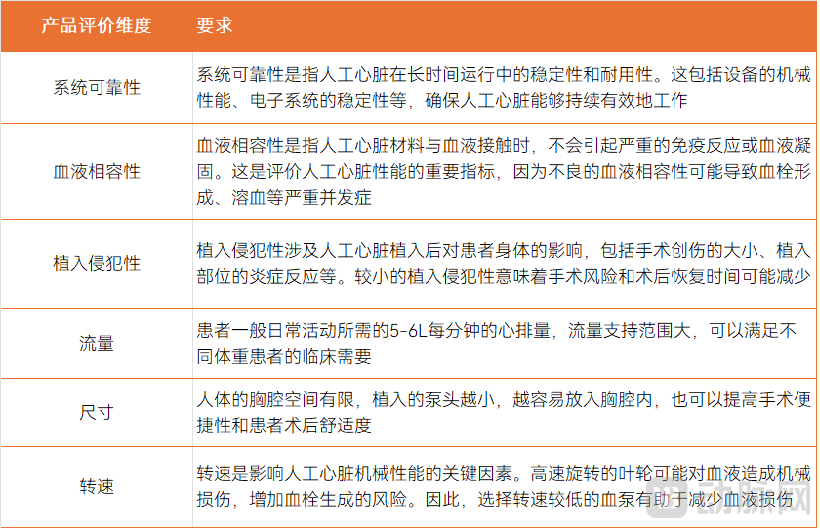
Enhancing blood compatibility is one of the core directions in the development of artificial heart technology. With the widespread clinical application of long-term implantation of artificial hearts, the requirements for their long-term blood compatibility are becoming increasingly stringent. Blood contains a large number of blood cells, and contact with artificial surfaces may lead to cell damage. Additionally, the shear stress generated during the operation of artificial hearts can cause blood damage, thereby triggering serious complications such as hemolysis, thrombosis, and stroke. Domestic companies have successively launched new-generation products to improve blood compatibility.
Tongxin Medical has recently launched its next-generation artificial heart, BrioVAD™. Building upon the previous generation Cifu® VAD (Model: CH-VAD), this product incorporates multiple technological innovations that enhance portability of the external components, significantly improve system performance, optimize blood compatibility, and feature more compact and lightweight external hardware. The BrioVAD™ Investigational Device Exemption (IDE) application has been approved by the U.S. FDA.
Yongrenxin Medical’s next-generation artificial heart, EVA-Pulsar™, features a redesigned architecture that retains the advantages of high flow rates and pulsatile blood flow while significantly reducing device size. The EVA-Pulsar™ innovatively incorporates Bioflow vascular technology, eliminating the traditional metal cannula extending deep into the left ventricle and thereby reducing the risk of thrombosis associated with metallic tips.
Another major direction is to improve the effectiveness of artificial heart implantation. Zheng Shijie stated, “From a mechanical performance perspective, flow rate and pressure are core performance metrics. Pressure and flow rate are complementary; if clinical requirements are not met, insufficient blood supply may occur. A wide flow support range can meet the clinical needs of patients with varying body weights. Secondary considerations include size, portability, and other factors. In these areas, next-generation artificial hearts are undergoing gradual optimization.”
Looking ahead, supported by health insurance policies, a maturing industrial chain, and improved clinical management systems, China’s artificial heart industry is expected to enjoy broader development prospects.
Hu Shengshou | Surgical Treatment of Heart Failure in China Enters the Era of Artificial Hearts
Data on the Diagnosis and Treatment of Heart Failure in China, 2024——Chinese Circulation Journal