

Ethicon Files IPO Prospectus Highlighting Global Leadership in Surgical Sutures and Launch of World’s First Dual-Sided Hemostatic Agent ETHIZIA

Ethicon
Surgical Instrument Design and Manufacturer
A slender medical suture is not only a common material in surgical procedures but also a vital link connecting health and recovery. With a long and storied history, sutures have evolved from simple ancient materials to modern high-tech products, reflecting the rapid advancement of medical technology.
In ancient times, materials such as linen, hair, and silk were used as sutures. Over time, suture materials have undergone revolutionary changes. In modern society, medical sutures have developed into a diverse range of products, including catgut sutures, polymer sutures, and collagen sutures.
Among the many suture brands, Ethicon has consistently remained at the forefront of the industry. Over the past seven decades, Ethicon’s introduction of multiple pioneering medical suture products has not only enhanced the safety and efficacy of surgical procedures but also opened up new possibilities for patient recovery.
From Sutures to Success: Now the World’s Largest Suture Manufacturer
The story began in 1949, when Ethicon was established as a subsidiary of Johnson & Johnson. Its product portfolio primarily included two major series of synthetic sutures—absorbable and non-absorbable—as well as stainless steel needles, meeting the growing demands of customers in the surgical field. Particularly after World War II, Ethicon’s global market share for suture products rose from 15% to over 70%, with its share in the U.S. market exceeding 80%, making it the world’s most comprehensive manufacturer of sutures.
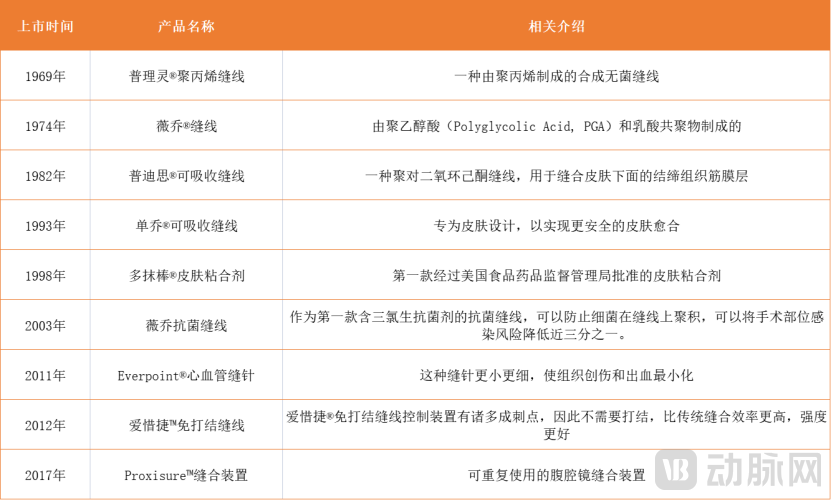
Selected Suture Products Under Ethicon
To date, Ethicon has launched a range of medical suture-related products, including PROLENE® Polypropylene Sutures, VICRYL® Sutures, PDS® Absorbable Sutures, MONOCRYL® Absorbable Sutures, and DERMABOND® Skin Adhesive.
In the field of non-absorbable sutures, Ethicon’s products, such as PROLENE®, ETHIBOND®, ETHILON®, and MERSILK®, are widely used globally for their superior quality and performance.
Taking Prolene® polypropylene suture as an example, this non-absorbable suture is made of polypropylene and exhibits excellent biocompatibility, without causing allergic reactions or other adverse effects. Moreover, Prolene® polypropylene suture features high strength and durability, can withstand significant tension, is resistant to breakage, and effectively secures and approximates tissues.
In terms of absorbable suture offerings, Ethicon provides products such as VICRYL®, MONOCRYL®, and PDS II®. Among these, VICRYL® sutures are made from a copolymer of polyglactin 910 (polyglycolic acid and lactic acid). This material is gradually hydrolyzed and absorbed within the human body, eliminating the need for a second surgical procedure to remove the sutures, thereby reducing the postoperative burden on patients.
Ethicon has not limited itself to the iterative advancement of absorbable and non-absorbable technologies; instead, it has keenly identified surgical infection control as a critical medical challenge.The launch of Dermabond® topical skin adhesive in 1998 marked Ethicon’s formal entry into a new frontier of research and development focused on the antimicrobial properties of sutures. This innovation not only enhanced the physical strength of wound closure but, more importantly, effectively reduced the risk of surgical site infections (SSI) by providing an immediate microbial barrier.
Official in vitro data disclosed by Ethicon indicate that when used in conjunction with deep dermal sutures, Dermabond® skin adhesive enhances wound closure strength, provides a microbial barrier against bacteria capable of infecting the surgical site for at least 72 hours, and can even inhibit certain drug-resistant bacteria, such as methicillin-resistant Staphylococcus aureus (MRSA).
In the 21st century, Ethicon further increased its R&D investment in antimicrobial sutures. In 2003, Ethicon launched “VICRYL Plus Antibacterial Suture.” With its unique antimicrobial mechanism, this suture effectively inhibits bacterial colonization on the suture material, further reducing the incidence of surgical site infections and providing a safer and more efficient suturing solution for the global medical community.
In summary, from the high strength and durability of Prolene® polypropylene sutures, to the excellent absorbability of the Vicryl® suture series, to the rapid healing and antimicrobial properties of Dermabond® skin adhesive, as well as the subsequent launch of additional antimicrobial sutures, every innovation by Ethicon has been breaking through technical challenges in suture technology.
Acquisition of GATT Technologies B.V. and Launch of the World’s First Dual-Sided Hemostatic Agent
November 2023,Ethicon Announces CE Approval for Its Hemostatic Patch—ETHIZIA. ETHIZIA is the first and only hemostatic patch with equally active and effective hemostatic matrices on both sides, indicated for visceral traumatic bleeding excluding cardiovascular and nervous systems.
Notably, the technological backbone of ETHIZIA stems from the Dutch company GATT Technologies B.V. In fact, Johnson & Johnson invested in GATT Technologies B.V. as early as 2020 and successfully acquired it in 2022, further solidifying its leading position in the medical technology sector.
ETHIZIA stands out in the field of hemostasis primarily due to its integration of the proprietary NHS-Pox technology from GATT Technologies B.V. This technology achieves highly effective bilateral hemostasis by uniformly coating gelatin patches with N-hydroxysuccinimide (NHS)-functionalized poly(2-oxazoline) (referred to as NHS-Pox). It not only effectively manages severe bleeding but also remains compatible with anticoagulant therapy requirements.
Compared with traditional NHS-PEG polymer hemostatic technologies, NHS-Pox technology features an NHS group content more than four times that of PEG, enabling ETHIZIA to achieve stronger tissue adhesion and faster hemostasis, while also demonstrating excellent anticoagulant properties and maintaining high efficacy in interactions with blood, body fluids, and water.
Furthermore, ETHIZIA demonstrates high clinical adaptability. Its NHS ester, activated by the NHS-Pox side chain, exhibits exceptional stability, allowing for the adjustment of the number of tissue-adhesive groups and the biodegradation rate according to specific clinical needs, or even achieving complete non-degradability. This characteristic endows ETHIZIA with remarkable flexibility during surgical procedures, effortlessly accommodating filling, rolling, stretching, trimming, and custom shaping, thereby significantly enhancing surgical efficiency and patient safety.
Ethicon disclosed that clinical studies demonstrated ETHIZIA achieved rapid hemostasis within 30 seconds in 80% of enrolled patients, a speed that is on average six times faster than current leading fibrin sealants.
Breaking the Monopoly of Foreign Enterprises: Domestic Companies Begin to Exert Their Strength
In the fiercely competitive global landscape of the suture industry, Johnson & Johnson’s Ethicon, Medtronic Covidien, and B. Braun have firmly secured the top three positions in the global market, leveraging their robust technological capabilities, deep market expertise, and extensive brand influence.
Refocusing on the Chinese market, international brands such as Ethicon, Medtronic, and B. Braun continue to hold a significant advantage in the mid-to-high-end segment.. However, with the development of China's medical industry, domestic suture manufacturers such as Shandong Kanglida, Shanghai Tianqing Biomaterials, Jiangsu Yuyue Medical, Qingdao Naisike Medical Materials, and Jiangxi Longteng Bio are gradually emerging as innovative enterprises.
Taking Jiaxiu® Pure Natural Absorbable Collagen Suture Material, produced by Hunan Ranyuan Company, as an example, this suture material is a pure natural absorbable collagen suture extracted from the tail tendons of coypus and manufactured using physical and biological processing methods. It exhibits excellent biocompatibility, with a collagen content as high as 93%. In the body, it is degraded by collagenase into small-molecule peptides and amino acids, which are absorbed by the organism to promote healing, leaving no chemical residues.
Meanwhile, the suture is completely absorbed and degraded within 8–15 days in vivo. This degradation process occurs synchronously with the proliferation and healing of human fibroblasts, thereby ensuring appropriate tension at the incision site during healing while preventing the mechanisms that lead to scar tissue formation, ultimately achieving scarless healing.
Overall, although domestic enterprises still lag behind international giants in product quality, technological innovation, and brand recognition, they have secured a substantial share of the low- to mid-end market by leveraging cost advantages and a deep understanding of the local market, while continuously challenging the mid- to high-end segments. Domestic companies are steadily increasing their R&D investment, enhancing product quality, and strengthening brand building, striving to stand out in the fiercely competitive market.