

Peking Union Medical College Hospital Licenses Frameless Neuronavigation Patent for RMB 1.1 Million Plus 5% Royalty to Suzhou Xinhang MedTech
Recently, Peking Union Medical College Hospital announced that, withRMB 1.1 million and a 5% sales commission over 10 yearsProposed transaction price, “A Reference-Free Registration Method and System for Neuronavigation”Transferred to Suzhou Xinhang Intelligent Medical Technology Co., Ltd. The transaction completed its public notice period on September 24.
Suzhou Xinhang Intelligent Medical Technology Co., Ltd. is a subsidiary of Yutu Medical. The latter is a leading operator of medical research achievement transformation ecosystems in China, providing one-stop, end-to-end solutions for medical translation to hospitals and enterprises by building an ecosystem for the transformation of medical research achievements.
In Episode 4, “Breaching the Cranial Cavity,” of the documentary *Two Hundred Years of Surgery*, functional neurosurgeons from Capital Medical University performed neuromodulation surgery on a Parkinson’s disease patient who remained awake and interactive, guided by precise navigation and electrophysiological localization systems. The technology employed by the surgeons is known as neuronavigation, often referred to as the “GPS of the brain.”
Neuronavigation technology, also known as frameless stereotactic navigation technology or image-guided surgery technology, is a precise localization technique that establishes an image-guided space based on preoperative imaging data such as CT and MRI. It utilizes optical (or magnetic) tracking systems to real-time track and display the positional relationship between surgical instruments and brain tissues or lesions.
In simple terms, surgeons previously had to rely solely on experience when operating on the complex, fragile, and densely innervated brain. Neuronavigation technology, however, provides a real-time map that guides surgical instruments to avoid surrounding normal tissues such as blood vessels and nerves, thereby significantly enhancing the accuracy and safety of the procedure.
The application of neuronavigation technology can be traced back to 1947, when an American physician performed the first stereotactic neurosurgical procedure on a human brain. Using a self-designed, highly precise stereotactic frame and ventriculography to identify intracranial targets, he pioneered the use of navigation in human surgery.
Neuronavigation systems typically comprise imaging, localization, and display modules. With advancements in multidisciplinary fields such as artificial intelligence and robotics, these systems are evolving toward greater precision, real-time capability, and intelligence. It has become possible for surgeons to perform brain surgery using a “GPS”-like guidance system.
From the perspective of application scenarios, neuronavigation technology can perform various complex neurosurgical procedures, such as deep brain stimulation (DBS) implantation and minimally invasive surgery, with high precision, efficiency, and safety. By reducing intraoperative collateral damage, it facilitates rapid postoperative recovery for patients, significantly minimizes manual operational errors, and lowers surgical risks.
Fueled by favorable national policies strongly supporting the development of innovative medical devices, exemplified by surgical robots, and compounded by the crisis of cerebrovascular diseases driven by population aging, neurosurgical robots will play an increasingly important role in clinical practice.
In 1997, the Department of Neurosurgery at Huashan Hospital Affiliated to Fudan University introduced the first Medtronic StealthStation neuronavigation system. This introduction marked the beginning of the application of neuronavigation technology in the field of neurosurgery in China and demonstrated its potential for commercialization.
In the following years, Chinese companies began to independently develop neuronavigation systems. For example, Shenzhen Anke Company developed the first domestically produced surgical navigation system, ASA-610V, two years later, marking an enhancement in China's independent research and development capabilities in the field of neuronavigation technology.
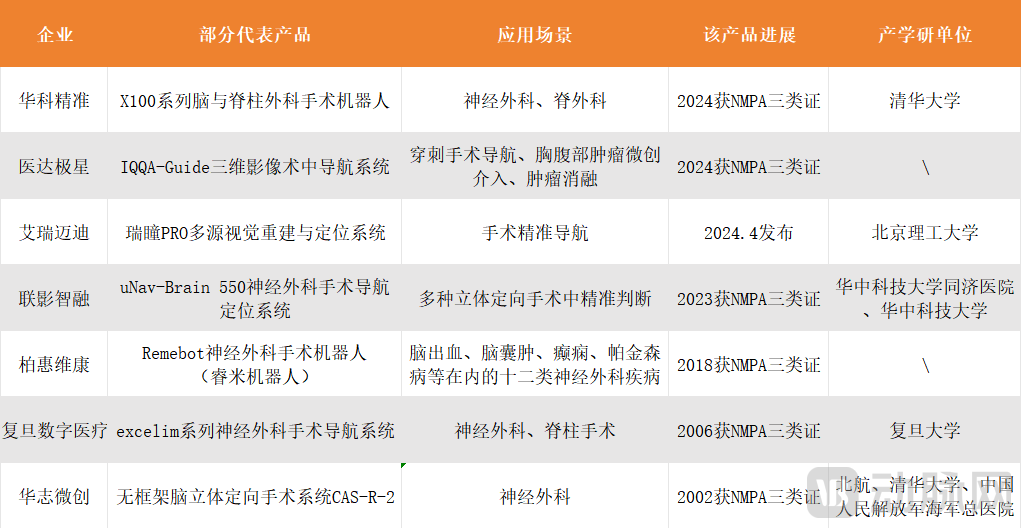
With continuous technological advancements and market expansion, a number of competitive enterprises have emerged in China in the fields of neuronavigation and neurosurgical robotics, such asUpperHaifudan Digital Health, Huake Jingzhun, Airi Madi, Yida Jixing, Bohui Weikang, Huazhi Minimally Invasive, United Imaging Zhirongetc. These enterprises have not only advanced the localization of neuronavigation technology but also enhanced the performance and precision of neurosurgical robotic systems through continuous innovation and R&D, thereby providing safer and more effective solutions for neurosurgical procedures.
In July 2024, United Imaging Intelligence secured nine patents in a single day, covering areas such as surgical instruments, intelligent medical imaging, and medical surgical robotic systems and devices. Among these, multiple patents focus on enhancing the performance of surgical robots, including improvements in operational stability, precision, and intelligence.
In August 2024, the IQQA-Guide 3D Image-Guided Intraoperative Navigation System, developed by Yida Jixing, obtained the Class III medical device certification from the National Medical Products Administration (NMPA). With a wide range of application scenarios, it assists surgeons in achieving precise localization and resection of intracranial lesions during neurosurgical procedures.
On September 12, the X100 series, China’s first brain and spine surgical robot independently developed by Huake Jingzhun, also received approval from the National Medical Products Administration (NMPA) for market launch. This product is also China’s first domestically produced all-in-one system that simultaneously integrates three functionalities: robotic positioning for neurosurgery, navigation for neurosurgery, and robotic positioning for spinal surgery.
Since 2022, domestically produced neurosurgical robots have continuously introduced innovative models. Products such as Huake Jingzhun’s Q300 series and SR1-1 micro-surgical robots, Baihui Weikang’s RM-50DOU, and United Imaging Intelligence’s uNav-Brain 550 have gained widespread market recognition upon their launch.
According to data from Zhongcheng Shuke,In 2023, the procurement amount for neurosurgical navigation systems and surgical robots in Chinese public medical institutions reached RMB 324 million. Among this, the winning bid amount for neurosurgical surgical robots was as high as RMB 202 million. Domestic neurosurgical surgical robots, represented by Huake Jingzhun and Baihui Weikang, outperformed imported products, accounting for 98.30% of the market share.
It is worth noting that the integration of industry, academia, and research is a crucial pathway for driving technological innovation and development in this field.
Huake Jingzhun, in collaboration with Tsinghua University, has achieved independent research, development, and manufacturing of neurosurgical robots; Aimeddy is an innovative enterprise incubated by Beijing Institute of Technology; HuaZhi Micro-Invasive originated from the national “863 Program” project jointly undertaken by Tsinghua University, the Navy General Hospital, and Beihang University, while Liu Da, founder of柏惠维康 (Plusthink), also spent several years pursuing his master’s and doctoral degrees at Beihang University; United Imaging Intelligence, Tongji Hospital affiliated with Huazhong University of Science and Technology, and Huazhong University of Science and Technology collaborated in 2021 on the “Research and Development Project for Complete 3D Image-Navigated Surgical Robot Systems,” marking United Imaging’s formal entry into the surgical robotics sector.
In addition to neurosurgery, orthopedics is also a major application scenario for surgical navigation technology in China.
As one of the earliest companies in China to focus on surgical robots, Tinavi Medical Technologies went public on the STAR Market in 2020, becoming the first listed surgical robot company in the country. On September 14, Tinavi announced that its “Lumbar Pedicle Screw Placement Surgical Planning Software” had recently received a Class III medical device registration certificate issued by the National Medical Products Administration (NMPA). This product is intended for use in conjunction with specific orthopedic surgical navigation and positioning systems to formulate intraoperative surgical plans for lumbar pedicle screw internal fixation in adult patients.
Driven by its outstanding performance in surgical procedures, the market size for surgical navigation continues to expand. According to market data compiled by Bizwit Research & Consulting, the global surgical navigation system market reached RMB 74.978 billion in 2022.
From a competitive standpoint, the major players in the global surgical navigation system market include Medtronic, Brainlab, GE HealthCare, Stryker, and B. Braun. The top five manufacturers worldwide hold more than 75% of the sales market share, with North America accounting for the largest portion of the market. Meanwhile, multinational corporations are also advancing their localization strategies in China. In September, the Intuitive Fosun Ion Bronchial Navigation Operation Control System was successfully installed at Shanghai Chest Hospital, marking its first commercial deployment in China.
But the giants also face strong competition from China's local innovation forces.According to relevant statistics, as of January 2024, China had more than ten companies specializing in orthopedic surgical robots, with a cumulative total of 38 orthopedic surgical robot models approved for market entry. Among these, 27 models were from domestic brands and 11 from imported brands. The products cover multiple sub-sectors, including abdominal surgery, orthopedics, neurosurgery, vascular intervention, and dental implantology. Surgical robots are exhibiting an explosive growth trend.
Currently, surgical navigation systems, which originated in neurosurgery, have expanded into orthopedics, otolaryngology, plastic surgery, pulmonary diagnostics and treatment, labor monitoring, and interventional oncology, benefiting an increasing number of patients.