

Recombinant Collagen Protein Boom: Imminent Surge in Class III Medical Device Approvals?
Listed companies are experiencing rapid growth, primary market investment and financing activities are vibrant, and product and technological breakthroughs are frequent... The recombinant collagen market is entering an explosive growth phase.
In the first half of 2024, Jinbo Bio’s recombinant humanized type III collagen lyophilized fiber brand, “Wei Yi Mei,” achieved robust sales, driving the company’s revenue to RMB 603 million, a year-on-year increase of 90.59%. Its net profit attributable to shareholders after deducting non-recurring gains and losses reached RMB 304 million, surging by nearly 200% year on year. Giant Biogene reported total revenue of RMB 2.54 billion in the same period, up 58.2% year on year. In terms of both revenue scale and growth rate, it has surpassed Imeik, one of the three major hyaluronic acid players.
In the primary market,Amid the broader challenge of difficult financing, the recombinant collagen sector has seen a total of 13 financing and investment deals from 2023 to present, with half occurring in 2024. Notably, companies such as Junhemeng and Xiangya Biology have each completed two consecutive rounds of financing since 2024.Investors bullish on recombinant collagen include not only specialized healthcare investment firms such as Mingfeng Capital and Qianji Capital, but also industrial capital players like Tonghua Dongbao. Meanwhile, several financing rounds have seen individual transaction amounts exceed RMB 100 million, reflecting the capital market’s confidence in the recombinant collagen sector.
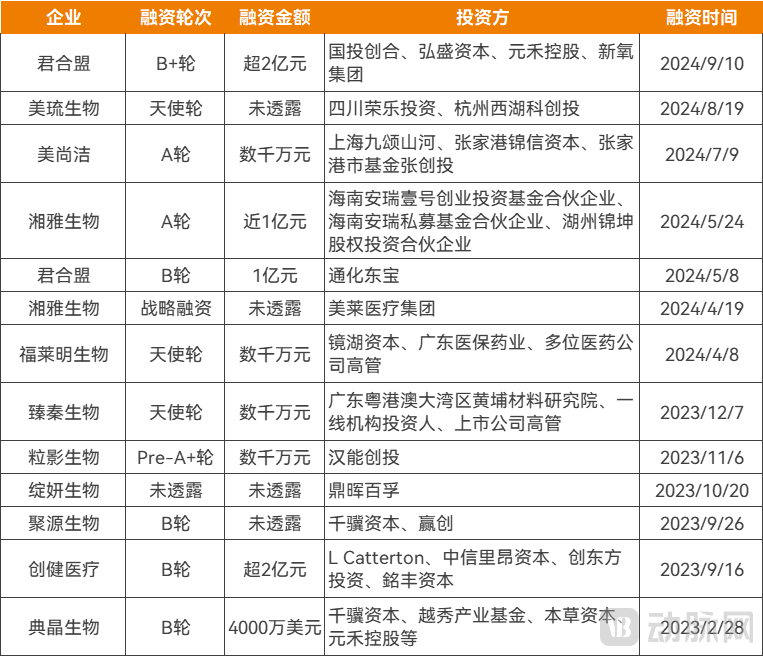 Investment and Financing Events in the Recombinant Collagen Sector Since 2023, Source: VCBeat Orange Database
Since the 1970s, animal-derived collagen has been applied in the treatment of facial contour deformities. However, its use is limited by scarce supply, short duration of effect in vivo, and immunogenicity concerns. In recent years, with advancements in recombinant protein technology, recombinant collagen has demonstrated significant market potential by addressing multiple limitations associated with animal-derived collagen.
Currently,The impressive performance of listed companies and the frequent capital support received by innovative enterprises are both driven by the powerful momentum of recombinant collagen in product and technological innovation.
In terms of end products, although Class III medical devices remain scarce—with only two products from Jinbo Bio approved for market entry—numerous companies are catching up. Based on publicly disclosed R&D progress, a peak in regulatory approvals is expected from late 2024 to 2025. Regarding raw materials, companies such as Junhemeng, Dongwan Biotechnology, and Trautec Medical have overcome technical challenges and made significant breakthroughs in the research, development, and mass production of recombinant human collagen.Breakthroughs in products and technologies of recombinant collagen across different categories and types mean that more diverse application scenarios can be developed in the future.
Medical aesthetics is one of the hottest fields for the application of recombinant collagen.
Currently, a large number of Class II medical devices containing recombinant collagen have been approved, particularly dressings, patches, and gels designed to promote wound healing after aesthetic procedures. Due to higher technical barriers and more stringent review and approval processes, Class III devices suitable for injectable fillers remain scarce.
In April 2024, L'Oréal’s skincare brand SkinCeuticals launched its “Platinum Research” collagen injection, namely Recombinant Humanized Type III Collagen Solution for Injection. This marks the second recombinant collagen implant product to be marketed in China, following Jinbo Bio’s “Wei Yimei” introduced in 2021.
In fact, the “Boyan” collagen injection also comes from Jinbo Bio.
In 2023, Jinbo Bio established a strategic partnership with L'Oréal, marking its first entry into L'Oréal's supply chain and achieving sales of recombinant collagen raw materials to the company. In August 2023, the National Medical Products Administration (NMPA) approved Jinbo Bio’s innovative medical device registration application for Recombinant Humanized Type III Collagen Solution for Injection. Subsequently, SkinCeuticals commercialized this product under the brand name "Boyan."
Registration information from the National Medical Products Administration (NMPA) indicates that, apart from differences in physical form, the two products “Wei Yimei” and “Boyan” share similar core ingredients and intended uses. Both utilize recombinant humanized type III collagen as the raw material and are administered via injection into the facial dermis to correct dynamic forehead wrinkles, including glabellar lines, forehead lines, and crow’s feet.
However, the two products have been differentiated in the market. Currently, “Wei Yimei” has been subdivided into two major series: the “Zhizhen” Face-Lifting Injection (10 mg specification), which primarily targets facial anti-aging, and the “Jichun” Collagen Injection (4 mg specification), which is mainly used for periocular anti-aging treatments. Following its launch, the “Boyan” Collagen Injection remains in the early stages of commercialization, with no further segmentation by application area implemented in the market at this time.
In other words,Although the core technology and ingredients originate from the same company, and the products are registered by the same entity, the two major brands “Wei Yi Mei” and “Bo Yan” have implemented differentiated marketing strategies to foster a healthier market landscape.
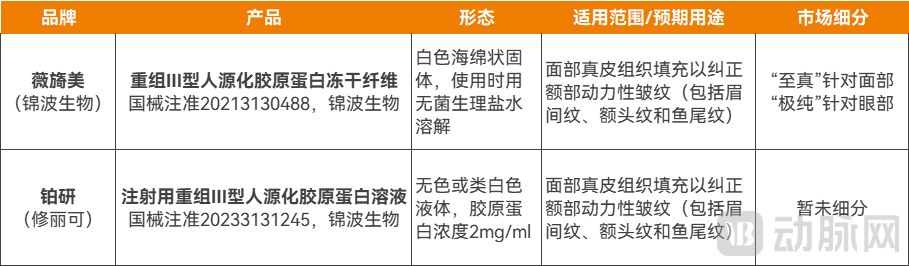 Two Recombinant Collagen Class III Medical Devices Currently on the Market; Source: National Medical Products Administration, Public Reports
It is also understood that the “Boyan” collagen injection is SkinCeuticals’ first Class III medical device product.
In recent years, the domestic medical aesthetics market has introduced a variety of products and technologies, including Ellansé (the “Girl Needle”), Sculptra (the “Baby Face Needle”), and botulinum toxin, injecting vitality into innovation among Chinese enterprises. AndIn the field of recombinant collagen, multinational giants are optimistic about China’s independently developed technologies, raw materials, and products. The introduction of a domestic product as their first Class III medical device underscores the market position of China’s original innovative technologies in this sector. Whether latecomers will continue to attract the favor of multinational corporations remains to be seen.
In addition to Jinbo Bio, numerous other companies have entered the medical aesthetics field of recombinant collagen and are investing in the research and development of Class III medical devices. Based on the R&D progress or overall plans announced by these companies for the first half of 2024, a peak period for product approvals is imminent.
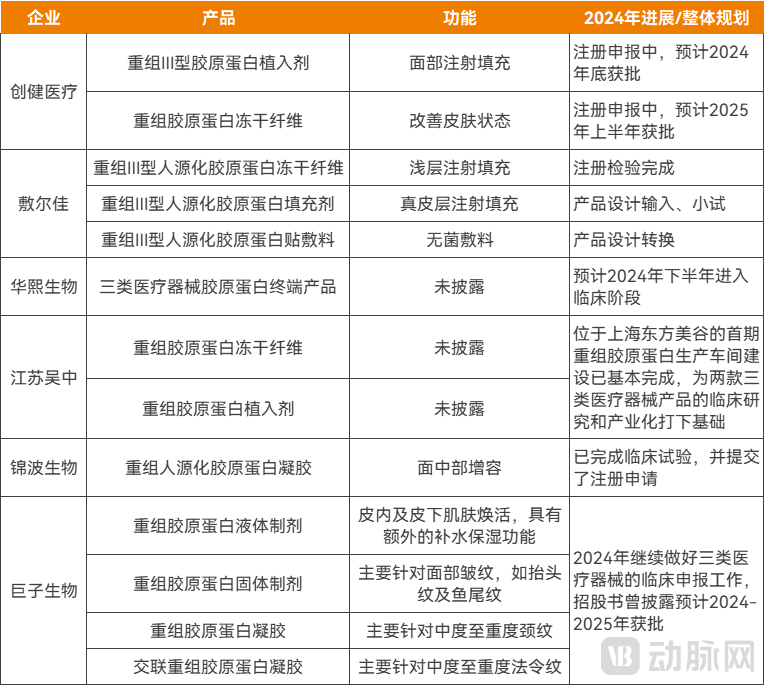 Progress or Plans for the R&D of Class III Medical Devices Based on Recombinant Collagen in Medical Aesthetics, Source: Company Financial Reports and Prospectuses
Currently, Trautec Medical’s recombinant type III collagen implant is undergoing registration review, with approval expected by the end of 2024; its recombinant collagen lyophilized fibers are anticipated to receive approval in the first half of 2025.
As a leading hyaluronic acid enterprise, Bloomage Biotechnology has been aggressively expanding its layout in recombinant collagen raw materials and products in recent years. Its independently developed Class III medical device collagen end-products are expected to enter the clinical trial phase in the second half of 2024.
In terms of independent research and development, Jiangsu Wuzhong is advancing the preclinical R&D of recombinant collagen lyophilized fibers and recombinant collagen implants. In the first half of 2024, the construction of the company’s initial recombinant collagen production workshop, located in Shanghai’s Oriental Beauty Valley, was essentially completed and entered the final commissioning and validation phase, laying the foundation for clinical studies and industrialization of its two Class III medical device products.
Giant Biogene disclosed four Class III medical device products based on recombinant collagen in its prospectus, including liquid formulations, solid formulations, and gels, which are scheduled to obtain Class III medical device registration certificates from 2024 to 2025 according to the overall plan.
Marubi Co., Ltd. has also disclosed that it will launch a Class III certified medical aesthetic product featuring recombinant collagen mesotherapy injections in 2026, and introduce recombinant collagen filler-based medical aesthetic products in 2028.
In the startup sector, Junhemeng’s recombinant human type III collagen has seen multiple Class II medical device applications filed, with preclinical studies for Class III medical devices currently underway. Meishangjie has combined recombinant collagen with recombinant fibronectin to create a microcapsule formulation, and is expected to obtain Class III medical device certification for filler implants in early 2026.
Since 2021, Jinbo Bio has achieved rapid performance growth by leveraging its exclusive products, effectively dominating the market for recombinant collagen-based medical aesthetic injections. Currently, other companies are racing to accelerate their R&D and regulatory registration processes. Based on publicly disclosed timelines, if subsequent procedures proceed smoothly, a peak in regulatory approvals is expected from late 2024 to 2025.
Xu Kui, CEO of Junhemeng, believes that as an emerging enterprise, the bottlenecks in the large-scale production processes for recombinant collagen have been resolved. The greater challenge lies in market insights; it is necessary to identify which products on the market have room for substitution and to develop a product matrix with various formulations and series, thereby conducting targeted brand building and marketing promotion.
A review of the indications for products under development by various companies shows that most are focused on improving skin condition and facial injection-based fillers, without specifying particular treatment areas. However, some companies, such as Giant Biogene, have defined specific treatment sites for their pipeline products, including those targeting moderate to severe nasolabial folds and moderate to severe neck lines.
“HiTi” (compound sodium hyaluronate solution for injection), a product under Imeik, is the first Class III medical device in China approved by the National Medical Products Administration (NMPA) for correcting moderate to severe neck wrinkles. Among numerous hyaluronic acid products, “HiTi” has gained widespread popularity among medical aesthetic institutions and consumers due to its precise positioning in neck wrinkle treatment, becoming a blockbuster product. As Imeik’s core product, “HiTi” has long benefited from market advantages, making a significant contribution to the company’s performance growth.
Drawing on the product strategy of “HiTi,” following Jinbo Bio, recombinant collagen injection products could still emerge as another blockbuster to offset their later market entry, provided they go beyond emphasizing safety and efficacy to achieve more precise segmentation of treatment indications from both functional and marketing perspectives, thereby addressing unmet market demands.
As multiple end-user products geared up for launch, recombinant collagen raw materials made significant strides in both quantity and technology in 2024, providing strong momentum for further innovation and R&D of end-user products.
According to the information on the registration of master files for raw materials of medical devices by the National Medical Products Administration,As of August 22, 2024, a total of 34 recombinant collagen raw material products have completed registration, with as many as 23 registered in 2024.
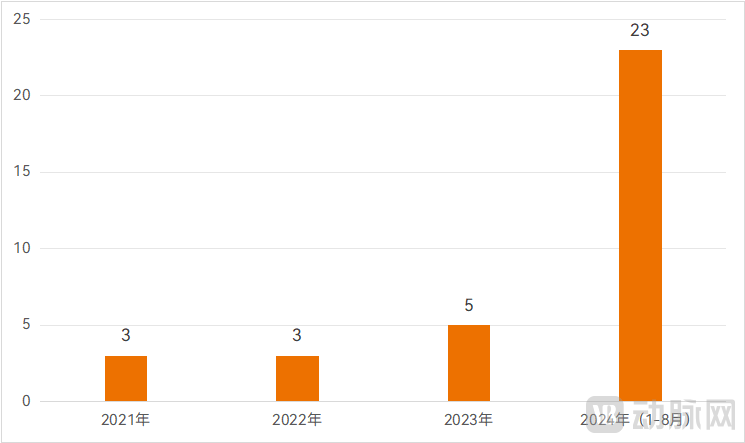
Registration of Master Files for Recombinant Collagen Raw Materials in the Past Four Years; Source: National Medical Products Administration
Recombinant collagen faces challenges such as controlling enzymatic reactions during expression, making it difficult to balance high purity, low antigenicity, and high expression levels; consequently, the advancement of large-scale mass production has been relatively slow.
Previously, companies such as Jinbo Bio, Juyuan Bio, and Trautec Medical had already achieved significant scale in the production and sales of raw materials. For instance, Juyuan Bio has an annual production capacity of 20 tons of pure recombinant collagen, serving clients across international cosmetics, food, and medical device manufacturers. It also maintains reserves of Type IV, Type V, and Type XVII recombinant collagen, which are scheduled for phased commercial production.
Currently, a cohort of startups is rapidly advancing their mass production processes. Within less than six months, Liying Bioscience has successfully achieved the expression, purification, and scaled mass production of various types of triple-helix collagen across multiple cell expression systems. Meiliu Bioscience’s first-generation recombinant humanized collagen offers significant cost-reduction advantages and has already attained mass production capability. Meanwhile, the development of its second-generation human-like collagen product—designed with AI-optimized sequences and featuring functions for skin wound repair and medical aesthetic injections—is progressing smoothly.
In 2024, a large number of raw materials completed their Drug Master File (DMF) registrations, indicating that more companies have achieved mass production capabilities for these ingredients, thereby providing more options for end-product research and development.
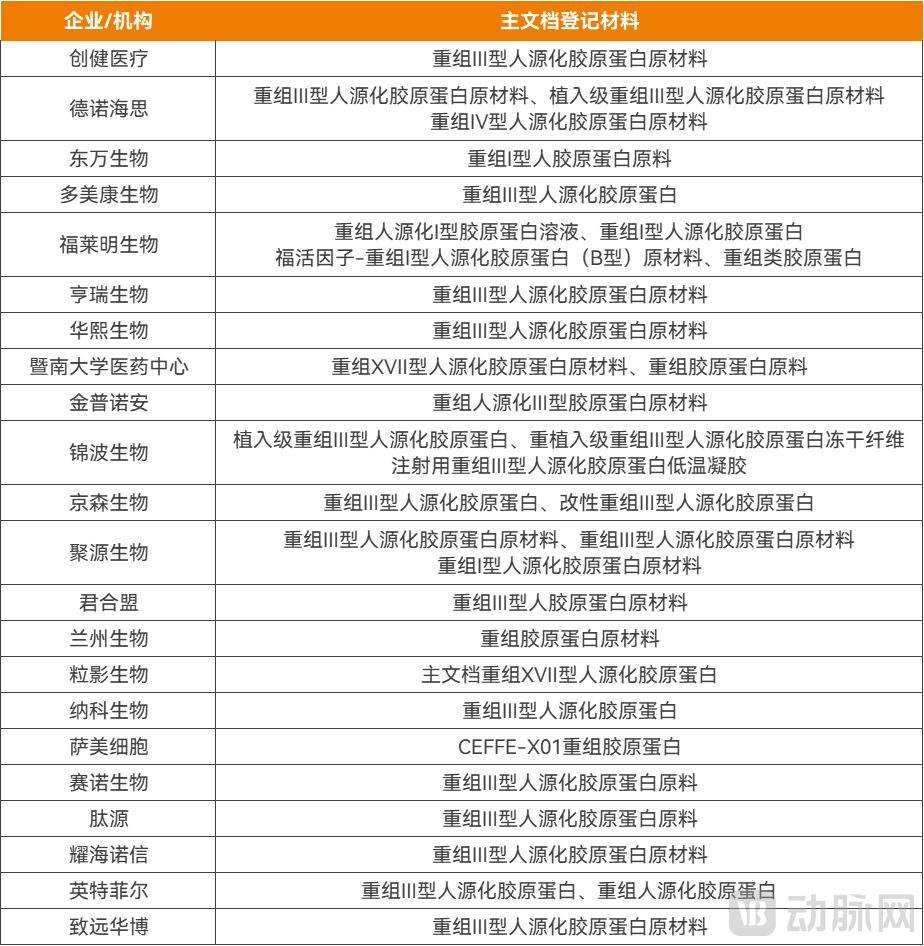 Companies and Products That Have Completed Registration of Master Files for Raw Materials of Medical Devices, Source: National Medical Products Administration
In accordance with the National Medical Products Administration’s “Guiding Principles for the Nomenclature of Recombinant Collagen Biomaterials,” recombinant collagen biomaterials are categorized into three major types: recombinant human collagen, recombinant humanized collagen, and recombinant collagen-like protein. Over the past two years, recombinant humanized collagen has witnessed the most rapid development, and it currently accounts for the largest number of master file registrations.
In 2024, the recombinant human collagen industry took a significant step forward, with key milestones including technological and industrialization advancements by Junhemeng and Dongwan Bio in the field of recombinant human collagen., the two companies successively completed the medical device master file registration for recombinant human type III collagen raw materials and recombinant human type I collagen raw materials.
Recombinant human collagen is a full-length amino acid sequence encoded by specific type genes of human collagen, prepared using DNA recombinant technology, and possesses a triple-helix structure. “ItsTechnical bottlenecks primarily exist in two aspects: first, whether the amino acid sequence is fully identical to that of human collagen, which relates to its biological activity in vivo; and second, whether it can self-assemble into a triple-helix structure in vitro, which is critical for its physical support function in vivo. Recombinant human collagen exhibits superior biological activity and supportive properties, making it crucial for both medical aesthetic injectable fillers and high-end devices for serious medical applications."Chen Xiaochao, Product Director at Junhemeng, told VCBeat."
Junhemeng Announces Completion of Pilot Production for Large-Scale Fermentation and Purification of Recombinant Human Collagen, Achieving Stable Expression in a 20-Ton Fermentation System with Each Batch Yielding 1–1.5 kg of High-Purity Recombinant Human Collagen Raw Material
Public information further indicates that Dongwan Biotech has obtained recombinant human collagen products spanning multiple types, including Type I, Type II, Type III, Type IV, Type X, and Type XVII. The company has established an integrated industrial chain covering research and development, manufacturing, and marketing in the healthcare sector, while simultaneously deploying its presence in both innovative medical and consumer healthcare fields.
Trautec Medical’s latest findings, released in 2024, also demonstrate that the technical expert team at Trautec Research Institute has developed a Type III recombinant human collagen whose amino acid sequence is identical to that of natural human collagen and which possesses a native triple-helix structure, thereby enabling industrial-scale production.
Furthermore, in August 2024, Giant Biogene was granted an invention patent for recombinant human type XVII collagen. Type XVII collagen differs from many other common types by possessing a highly distinctive molecular structure: its amino acid sequence is composed of both “non-G-X-Y regions” and “G-X-Y regions.” It is generally believed that the G-X-Y regions of collagen are closely associated with the formation of its triple-helix structure and its biological activity, while the non-G-X-Y regions serve only a supportive role. This invention breaks with this traditional understanding and can be applied in areas such as scalp care, hair care, and facial care.
Technological breakthroughs in recombinant collagen across different categories and types enable end products to support a wider range of application scenarios. Various raw materials each have their own strengths in terms of performance support, cost, and application maturity, allowing them to play corresponding roles at different levels such as consumer skincare, medical aesthetics, and healthcare, thereby jointly promoting market growth.
Beyond medical aesthetics, mature products such as gels, dressings, and ointments made from recombinant collagen have been clinically applied to treat skin burns, wounds, dermatitis, acne, and genitourinary syndrome of menopause (GSM), demonstrating significantly superior efficacy compared with conventional therapies.
What Are the Additional Application Scenarios for Recombinant Collagen in the Long Term?
Xu Kui, CEO of Junhemeng, explained that the primary function of collagen in the human body is to support various tissues and organs, helping them maintain their structural integrity and shape. Therefore, as a novel alternative to animal-derived collagen, recombinant human collagen has numerous specialized applications in serious medical care, such as skin wound repair, ophthalmic artificial corneas, dental bone grafting, and bone defect restoration.
Studies have indicated that recombinant collagen has been formulated into gels, sponges, dressings, lyophilized powders, injections, implants, and oral preparations, and is being explored for applications in hemostasis, wound repair, corneal injury, gynecological disorders, bone defects, cardiovascular diseases, cancer, and anti-aging.Recombinant collagen has demonstrated significant reparative and therapeutic effects in corresponding animal disease models, providing a stronger theoretical foundation for future clinical applications.
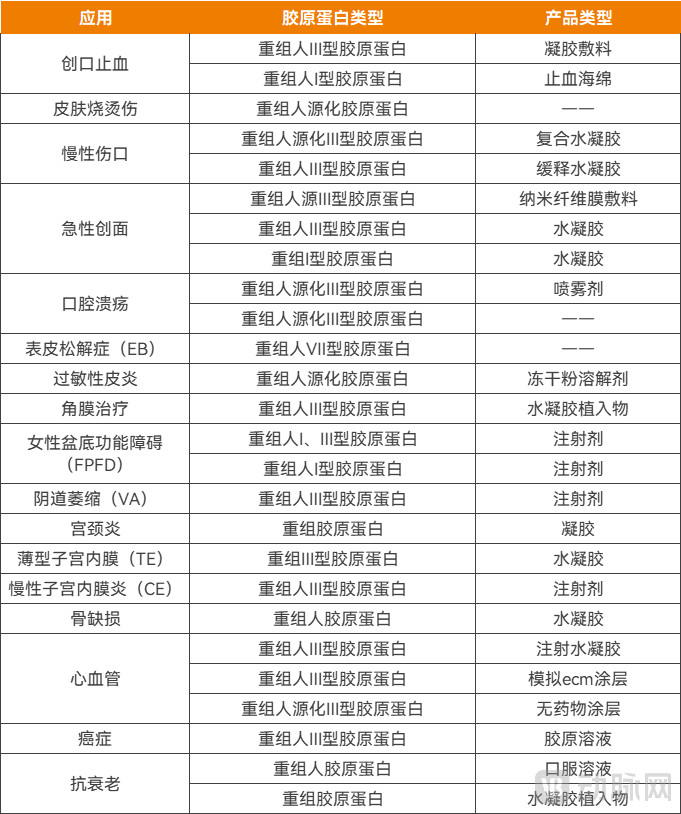
Exploratory Applications of Recombinant Collagen in Animal Disease Models, Source: "Progress in Biochemistry and Biophysics"
Recently, VCBeat Research Institute released"2024 Recombinant Collagen Industry White Paper" (Click to view the original text)It also provides an outlook on the application prospects of recombinant collagen.
Of course, the research and development as well as application of recombinant collagen products also need to address numerous challenges. For instance, most recombinant collagen products and raw materials currently available on the market are Type I and Type III, whereas among the identified collagens, types are classified based on characteristics such as amino acid sequence, structure, and function.At least 28 types。Future R&D applications can focus on disease-specific collagen types to more precisely meet practical needs. Meanwhile, the formulations of recombinant collagen also require further exploration to accommodate the treatment requirements of a broader range of diseases.
Encouragingly, a large number of industry players are accelerating the mechanistic validation and product development of recombinant collagen for broader medical applications.
Since 2024, Jinbo Bio has conducted research on new materials based on Type III, Type V, Type VII, and Type XVII collagen for various indications, with primary applications in hair care, oral health, dermatology, and other fields. In addition to medical aesthetics and gynecology, Dongwan Bio’s pipeline of innovative medical devices also covers orthopedics, ophthalmology, artificial skin, 3D printing, and artificial blood vessels. Xiangya Bio has also invested in the research, development, and industrialization of medical device products in areas such as artificial skin, cultured cartilage, and cardiovascular stents.
Specifically regarding its product pipeline, Dianjing Biologics is developing a biosynthetic cornea made from recombinant human type III collagen. This product has the potential to become the world’s first biosynthetic cornea based on recombinant human type III collagen for the treatment of corneal blindness, thereby serving as an alternative to human donor corneas.
Overall,The recombinant collagen industry remains in its early stages, with substantial room for growth across basic research, product development, and market expansion. Currently, China’s recombinant collagen technologies and applications hold a leading position globally, laying a solid foundation for future development.To better observe market trends, VCBeat will continue to track and analyze products, technologies, channels, and markets with key advancements in recombinant collagen.
Special thanks to Xu Kui, CEO of Junhemeng, and Chen Xiaochao, Product Director, for their strong support of this article.
References:
Hu Huan, Li Yunlan, Zhang Hong, Wang Jian, Wang Liwen, Liu Qian, Cheng Ningwen, Zhang Xinyue. Application of Recombinant Collagen in Biomedicine [J/OL]. Progress in Biochemistry and Biophysics.