

JD Health Global Medical AI Innovation Competition Concludes Successfully with Over 10,000 Submissions from 1,284 Teams

JD Health
Internet Medical and Health Service Platform Provider
Recently, the finals of the “JD Health · Global Medical AI Innovation Competition,” hosted by the Chinese Association for Artificial Intelligence (CAAI) and co-hosted by JD Health, were held in Beijing. After rigorous screening through preliminary rounds, semifinals, and code reviews, 20 teams advanced to the finals. Following intense on-site competition and strict evaluation by industry experts, the winning teams were ultimately determined.

20 Teams Engage in Fierce Competition; Pitch Presentations Demonstrate Significant Innovative Value
In recent years, with the rapid advancement of technology, the application of artificial intelligence (AI) in the healthcare sector has become increasingly widespread, gradually transforming the landscape of traditional medical services. From disease diagnosis to the formulation of treatment plans, and from patient management to the allocation of medical resources, the integration of AI technology has not only improved the efficiency of healthcare delivery but also significantly enhanced the patient experience.
Against this backdrop, since its launch in June of this year, the competition has attracted active participation from universities, research institutions, enterprises, and individuals worldwide. A total of 1,556 contestants formed 1,284 teams, submitting over 10,000 entries in cumulative submissions.

As an industry-leading innovative healthcare service provider, JD Health has been closely monitoring innovative applications of artificial intelligence. Currently, leveraging its “Jingyi Qianxun” medical large language model as the technological foundation, JD Health has developed a comprehensive matrix of products and solutions tailored for consumers, medical experts, healthcare institutions, and corporate partners, thereby achieving the most extensive scenario expansion and business layout for large language models in the industry. For this competition, JD Health has established two key themes—“Intelligent Algorithms for Sleep Monitoring” and “Innovative Applications of Medical Large Language Models”—drawing on its profound expertise in AI innovation and deep insights into industry needs.

In the realm of sleep monitoring, although traditional polysomnography devices are accurate, they tend to cause significant physical and psychological disturbance to patients, hindering their widespread adoption in home settings. JD Health aims to leverage this competition to solicit more comfortable and convenient alternative technologies for detecting apnea and hypopnea, thereby improving patient experience and enhancing the diagnostic efficiency of sleep disorders.
In the final round, participating teams showcased outstanding algorithmic models for sleep apnea detection, demonstrating the significant potential of their technological innovations in terms of both accuracy and efficiency. These models not only excelled in accurately identifying apnea events but also made remarkable progress in real-time monitoring and user-friendliness. Notably, some of the top-performing models have been compressed to the kilobyte (KB) level, enabling seamless deployment on various wearable devices. The demonstrations by the contestants comprehensively leveraged multiple technical approaches, including deep learning and signal processing, providing robust support for improving sleep health management and disease prevention.

In terms of innovative applications of large medical models, JD Health recognizes the immense potential of large model technology in the healthcare sector. By encouraging participants to leverage cutting-edge large model technologies to develop innovative solutions tailored to the specific needs of general users, JD Health aims to promote the optimized allocation of medical resources, enhance the quality and efficiency of healthcare services, achieve personalization and intelligence, and meet users’ healthcare needs.
In this final competition, participating teams presented highly innovative solutions integrating healthcare with large language models (LLMs). These outstanding achievements included an electronic medical record quality control and generation platform based on multimodal large models, the FEET foot monitoring system, an LLM Agent-based model for long-term diabetes management, and a deep learning-powered skin cancer recognition system. These innovative applications not only demonstrate the broad prospects of technology in the healthcare sector but also provide novel approaches to improving diagnostic and treatment efficiency, optimizing patient experience, and strengthening disease management.
Unearthing More Top Talent to Drive Technological Advancement in the Healthcare Industry
The academic judges for the finals of this competition comprised distinguished experts in the field, including Wang Wenbo, Vice Chairman of the Chinese Association for Artificial Intelligence (CAAI) and Vice President of Beijing University of Posts and Telecommunications; Qiao Junfei, Director of the CAAI Popular Science Working Committee and Vice President of Beijing University of Technology; Han Jungong, Tenured Professor in the Department of Automation at Tsinghua University and a Changjiang Scholar; Liu Yu, Deputy Secretary-General of the CAAI Special Committee on Intelligent Integration and Visiting Professor at Tsinghua University; Shi Shumin, Deputy Secretary-General of CAAI, Deputy Director of the Special Committee on Natural Language Understanding, and Associate Professor at Beijing Institute of Technology; and Qiao Hui, Member of the CAAI Special Committees on Metaverse Technology and Intelligent Optical Imaging, and Associate Professor in the Department of Automation at Tsinghua University. The industry judges consisted of technical and business experts from JD Health. Together, they conducted on-site evaluations of the competing teams. They provided comprehensive and in-depth analyses of the teams’ projects, offering valuable feedback and recommendations.
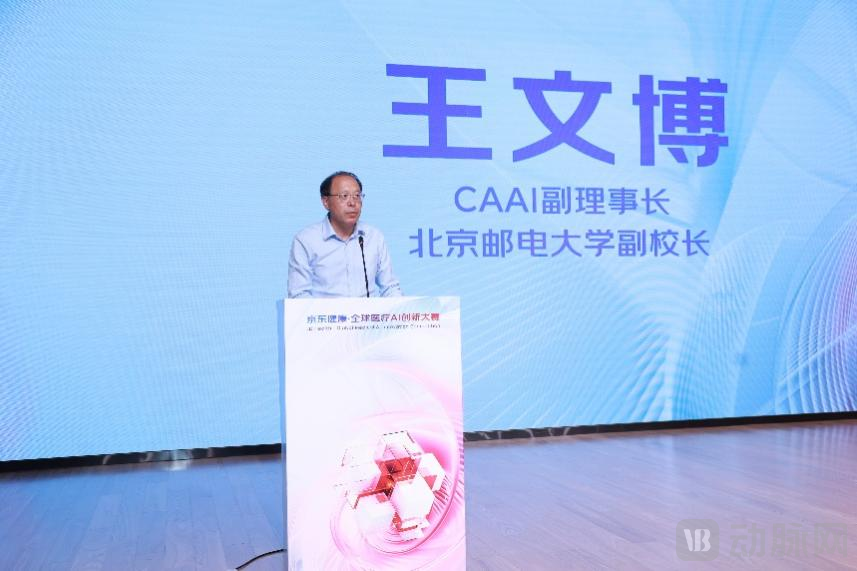
Wang Wenbo, Vice President of Beijing University of Posts and Telecommunications, stated that each participating team in this competition demonstrated exceptional innovation and solid technical expertise, representing the future hope of the medical AI field. He expressed his hope that all participants would maintain their passion for and pursuit of technology, continuously explore the infinite possibilities of medical AI, and become a core force leading the development of medical AI.
Jin Enlin, CEO of JD Health, stated that this competition has established an open and collaborative platform for AI innovators in China, stimulating the wisdom and creativity of practitioners and helping to address the current challenges and pain points facing the healthcare industry. He expressed hope that more individuals will join this highly promising field, affirming JD Health’s commitment to working with all stakeholders to create greater value for society and the industry.
Looking ahead, the application prospects of AI in the healthcare sector are boundless. With continuous technological advancements and deeper integration, AI is poised to play an increasingly vital role in disease prevention, diagnosis, treatment, and patient management. JD Health will continue to collaborate with partners across industry, academia, and research to promote high-quality development in the healthcare industry and contribute greater wisdom and strength to the cause of human health.
The competition also received strong support from partners including Duoen Medical, Haishi Hainuo, Biostime, inne, Cofoe, Omron, Natural Doctor, and Xiaomi.