

Profound Cellular Defects Drive Early Skeletal Muscle Pathogenesis in Duchenne Muscular Dystrophy: Insights from a Non-Human Primate Model
On September 20, 2024, the research article titled “Profound cellular defects attribute to muscular pathogenesis in rhesus monkey model of Duchenne muscular dystrophy,” jointly completed after years of dedicated efforts by Professor Chen Yongchang and Academician Ji Weizhi’s team at Kunming University of Science and Technology and Professor Hu Ping’s team at Guangzhou Laboratory, was published in Cell. Using non-human primate disease models, this study revealed for the first time that combined defects in multiple cell types are a key cause of early skeletal muscle lesions and abnormal regeneration during the initial stages of Duchenne muscular dystrophy (DMD). This finding provides new insights and perspectives into the early pathogenesis of DMD and drug development. Professor Chen Yongchang, Academician Ji Weizhi from Kunming University of Science and Technology, and Professor Hu Ping from Guangzhou Laboratory served as co-corresponding authors. Ren Shuaiwei, a Ph.D. candidate at the Institute of Primate Translational Medicine, Kunming University of Science and Technology; Associate Researcher Fu Xin from the Spine Center of Xinhua Hospital affiliated with Shanghai Jiao Tong University School of Medicine; Bai Raoxian, a Ph.D. candidate at the Institute of Primate Translational Medicine, Kunming University of Science and Technology; and Postdoctoral Fellow Guo Wenting were co-first authors of this research paper.
Duchenne Muscular Dystrophy (DMD) is an X-linked recessive genetic disorder primarily affecting skeletal muscle, caused by mutations in the Dystrophin gene located on the X chromosome. DMD predominantly affects boys, who typically begin to exhibit progressive muscle weakness between the ages of 2 and 4, with most succumbing to cardiopulmonary failure in their 20s or 30s. Current clinical management of DMD relies mainly on corticosteroids, which are associated with significant side effects. Additionally, gene therapies based on exon skipping and micro-dystrophin protein replacement have been approved for market; however, these treatments are prohibitively expensive, and their therapeutic efficacy warrants further investigation.
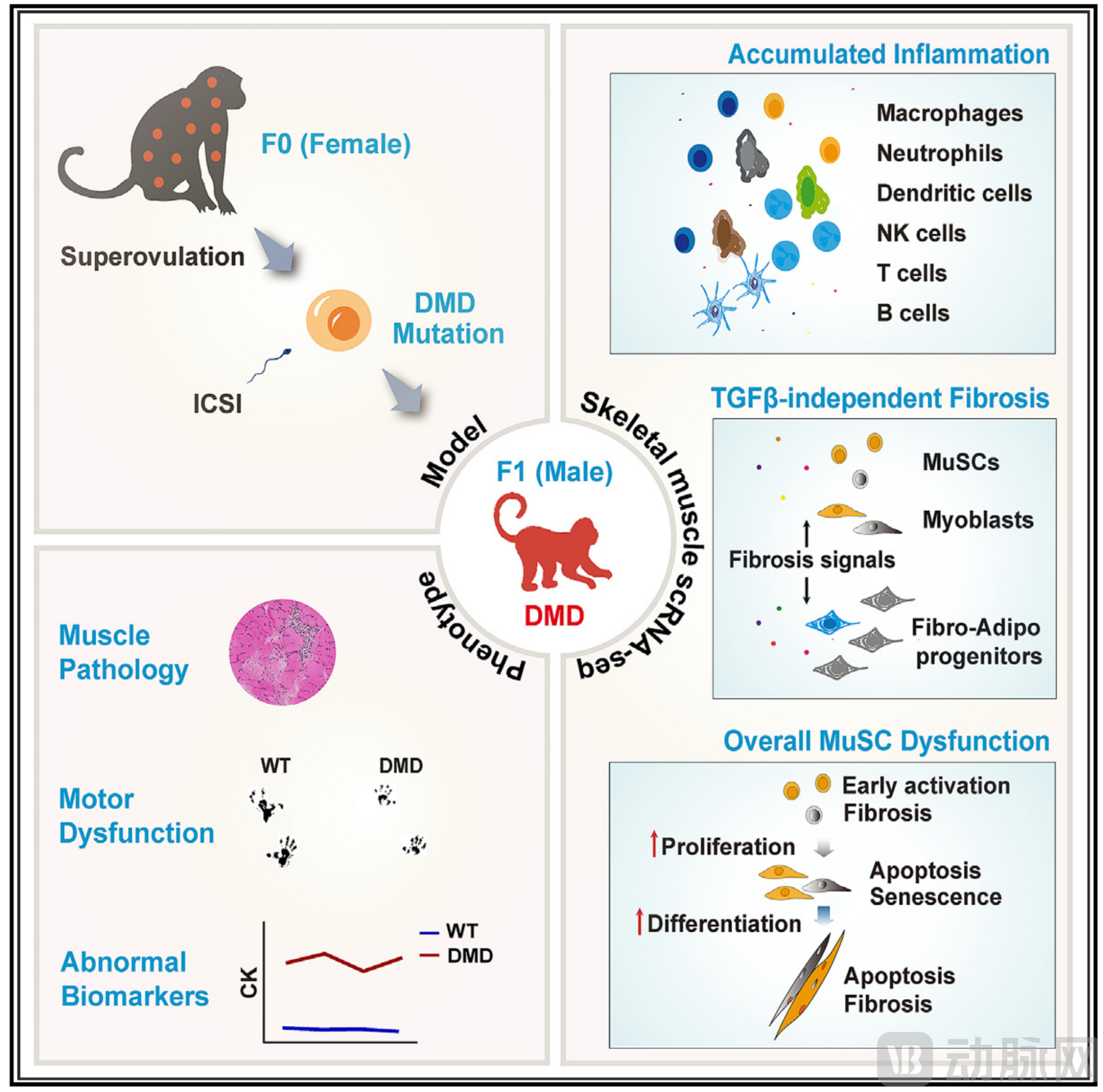
Animal models are essential tools for studying disease mechanisms and drug development; however, existing DMD animal models, such as those in mice, dogs, and pigs, fail to adequately recapitulate the disease progression observed in DMD patients. After years of effort, the team led by Chen Yongchang and Ji Weizhi at Kunming University of Science and Technology successfully generated the F1 generation of a DMD cynomolgus monkey model. The male hemizygous mutants in this model mimic the genotype of DMD patients and exhibit progressive pathological changes similar to those seen in clinical cases.
Based on the DMD macaque model, the teams of Hu Ping/Fu Xin and Chen Yongchang/Ji Weizhi investigated the pathogenic mechanisms underlying the early stages of Duchenne Muscular Dystrophy (DMD). Leveraging single-cell sequencing technology, the research team discovered for the first time that muscle degeneration in the early phase of DMD primarily manifests as alterations in the microenvironment and cellular composition of skeletal muscle tissue. These changes mainly involve immune cells, fibro-adipogenic progenitors (FAPs), and muscle stem cells (MuSCs); the fate transitions of these mononuclear cells are critical to disease progression in early-stage DMD.
The discovery of pathogenic mechanisms has simultaneously provided new perspectives for drug development in Duchenne muscular dystrophy (DMD): the dramatic increase in immune cells exacerbates the microenvironment for muscle cell survival, suggesting that suppressing inflammatory responses is crucial in DMD treatment. Studies in DMD monkey models have shown that fibrosis mediated by fibro/adipogenic progenitors (FAPs) is independent of the TGF-β pathway, offering a new direction for novel drug development. More importantly, functional defects in skeletal muscle stem cells lead to impaired muscle repair, indicating that DMD is a stem cell disorder. Consequently, developing cell therapies or interventions targeting skeletal muscle stem cells represents a key direction for future research.