

Vicarious Surgical Unveils Cost-Effective Single-Port Surgical Robot Backed by Bill Gates

Vicarious Surgical
VR Surgical Robot Developer
In 1966, the American science fiction adventure film *Fantastic Voyage* was released.
The story follows a Soviet scientist who, after defecting to the United States, is left critically ill due to cerebrovascular damage. To save his life, five American doctors are miniaturized to microscopic size and injected into the scientist’s body. Piloting a miniature submarine through his bloodstream, they navigate the vascular system in an attempt to repair the damaged cerebral blood vessels.
With its novel concept and depiction of the internal landscape of the human body, this film broke new ground in science fiction cinema, deeply inspiring three medical professionals: Adam Sachs, Sammy Khalifa, and Dr. Barry Greene. Aiming to enable surgeons to navigate procedures with the same ease portrayed in the film, they have dedicated themselves to advancing laparoscopic surgery to a higher level of development.
Through the efforts of three co-founders, Vicarious Surgical was established in 2014. Headquartered in Waltham, Massachusetts, USA, the company is dedicated to developing novel minimally invasive surgical robots that enable physicians to perform minimally invasive procedures with 3D visualization and precise control. Its core product, the Vicarious Surgical robotic system, focuses on achieving abdominal access and visualization through a single port, delivering a surgical experience that makes surgeons feel as if they have been teleported inside the patient’s body.
Currently, surgeons are constrained by standard laparoscopic tools that are linear, have limited flexibility, and require multiple incisions. Some robotic platforms feature bulky architectures and fixed-wrist technology, while others, although utilizing a single-incision approach, suffer from insufficient grasping force and large incision sizes. Vicarious Surgical is dedicated to addressing these challenges. By integrating advanced micro-robotics, computer science, and 3D visualization technologies, the company has developed a new category of intelligent, cost-effective single-port laparoscopic surgical robots.
“Miniaturization” is one of the core tenets of Vicarious Surgical, primarily reflected in its surgical incisions. The Vicarious Surgical robotic system accesses the patient’s abdomen through a single port, requiring only an incision smaller than a dime to insert the camera and two robotic surgical instruments. Specifically,Vicarious Surgical’s surgical robot is designed so that all robotic movements are performed inside the patient through a 1.5-cm incision, while enabling incisions as small as 1.2 cm.. Once the robotic arms are inserted into the patient’s body, the camera and instrument arms are precisely adjusted and configured to enable easy control by the surgeon.
This endows the robot's robotic arm with three major advantages during operation:
First, multi-port laparoscopic surgical robots typically require multiple incisions, with different instruments inserted through each. The external components of these instruments may interfere with one another, limiting the robot’s range of motion. In contrast, Vicarious Surgical performs all robotic movements internally through a single 1.5-cm incision, thereby avoiding interference between external devices and providing greater degrees of freedom in movement.
Second, the multiple incisions and instruments used in multi-port laparoscopic surgical robots can make the surgical field extremely crowded, increasing the difficulty of surgeon manipulation and the risk of collisions. In contrast, the single-incision design of the Vicarious Surgical robotic system reduces crowding in the surgical field, allowing surgeons to operate the robot with greater freedom and lowering the risk of collisions;
Third, by enabling opening and closing through a single small incision, Vicarious Surgical simplifies trocar placement and accelerates the surgical procedure.
Currently, disposable instruments require a 1.8 cm incision; therefore, Vicarious Surgical is developing and expects to launch disposable instruments that require only a 1.5 cm incision.
At the core of Vicarious Surgical’s innovative technology is its proprietary decoupled actuator, which enables the company to redesign single-port robots and provide nine degrees of freedom for each arm. The robot features 28 sensors on each arm and can replicate the surgeon’s natural upper-limb movements.
Generally, standard laparoscopic instruments are straight and have limited flexibility. Some robotic instruments address this limitation by incorporating “wrists.”Vicarious Surgical’s surgical robot redefines robotic motion, featuring three built-in joints with fully articulated wrists, elbows, and shoulders.Its movements feel natural while providing precise control and unique grasping or anatomical capabilities, suitable for any surgical approach. This design enables the robot to rotate and reposition in any direction, allowing surgeons to operate across multiple dimensions—downward, laterally, upward, and even backward.

The Vicarious Surgical robotic system not only enables the wrist-like instruments to be inserted into the patient’s abdominal cavity but also simulates the surgeon’s natural elbow and shoulder movements during surgery, thereby enhancing the robot’s flexibility and range of motion while improving operational precision. Meanwhile,The robot can approach the same target from any angle through movement within the trocar center.This multi-axis motion capability enables the robot to reposition itself at any location within the abdominal cavity and flexibly place trocars, thereby ensuring full accessibility and operability throughout the entire abdomen.
One of Vicarious Surgical’s innovations is its camera. It features four degrees of freedom, enabling lateral and vertical movement, rotation, as well as insertion and retraction. Compared with current surgical robotic systems that offer limited lateral and vertical viewing capabilities,Vicarious Surgical’s robotic system can rotate 180 degrees, with camera movements as natural as a human turning their head, enabling visualization of the entry site into the patient.Furthermore, Vicarious Surgical integrates its miniature ultra-high-definition cameras and robotic arms with virtual reality technology. This provides the robotic system with comprehensive 360° visibility. The Vicarious Surgical robot delivers advanced stereoscopic imaging of patient anatomy through immersive 3D visualization.
Furthermore, this immersive 3D visualization is paired with precision hand controllers designed to mimic open surgical instruments, featuring nearly weightless ergonomic controls. Vicarious Surgical’s robotic system offers precise control for grasping and dissection, allowing surgeons to feel as though they are performing natural hand movements during operations. This enables them to focus on executing the surgery rather than devoting their primary attention to controlling the robot.
The design of Vicarious Surgical’s surgical robot fully accounts for the needs of healthcare facilities and staff, with its installation, disassembly, mobility, and storage features specifically engineered to better meet the requirements of care teams.
Generally, endoscopic surgical robots consist of three components: the surgeon console, the patient-side surgical platform, and the video processing system; however, Vicarious Surgical has simplified this architecture.Its surgical robot system consists of only two components: a multifunctional robotic base and a VR console with an auxiliary display. Both units are compact and portable, occupying less than half the space and costing less than half as much as existing robotic solutions.
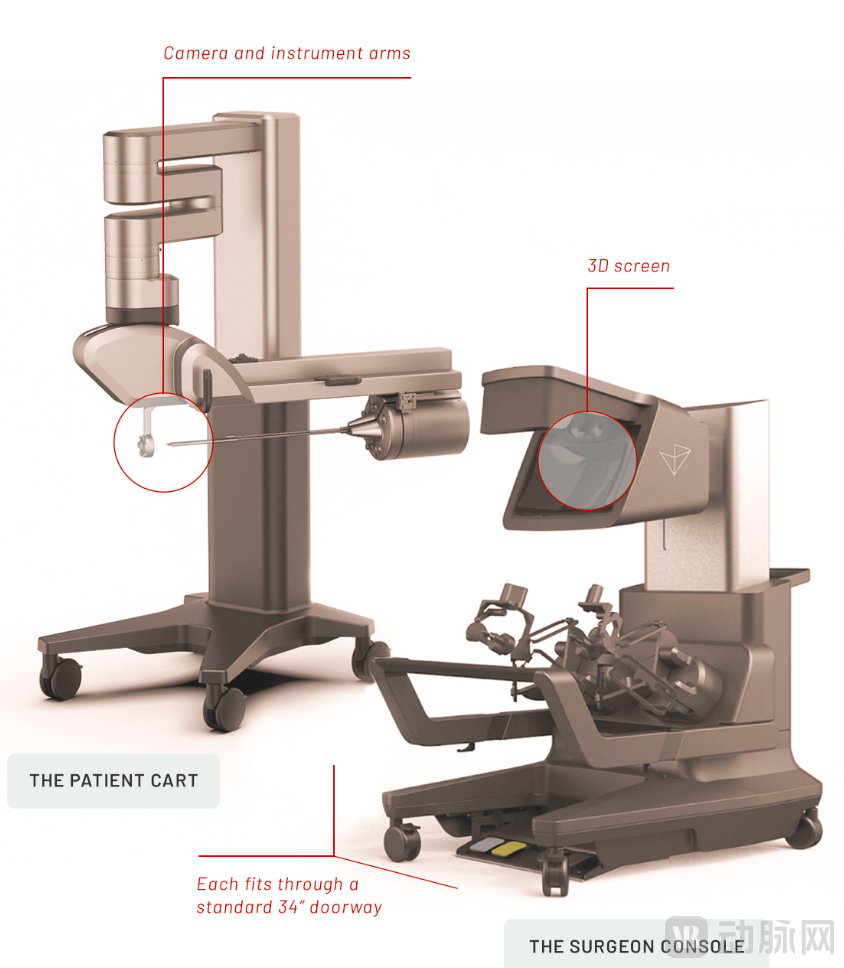
Vicarious Surgical Surgical Robot
Vicarious Surgical’s surgical robot is highly cost-effective and easy to integrate, making it highly accessible to the majority of hospitals and surgical centers. This design facilitates patient-centered procedures, streamlines workflows, and saves operating room space and training time. Equipped with advanced sensing, data collection, and artificial intelligence, the system enables surgeons to avoid errors, perform real-time measurements, and automate suturing.
Currently, the Vicarious Surgical surgical robot has received FDA Breakthrough Device Designation.。
As early as the initial stages of its development, Vicarious Surgical’s growth prospects were widely recognized.In its 2019 Series A financing round, Vicarious Surgical announced the completion of an additional $10 million in funding led by Bill Gates’ Gates Frontier.Furthermore, Vicarious Surgical has attracted numerous prominent investors, such as Innovation Endeavors (founded by former Google CEO Eric Schmidt) and AME Cloud Ventures (founded by Yahoo! co-founder Jerry Yang). Additionally, BD, one of the world’s largest and most renowned medical technology companies, also participated in the investment.
Meanwhile, Vicarious Surgical has also attracted the addition of senior industry experts. For instance, on January 29, 2024,Vicarious Surgical Announces Appointment of Former Olympus Executive Randy Clark as PresidentClark has over 20 years of experience in the medical device industry and has played a pivotal role in the development, manufacturing, and commercialization of multiple innovative medical device solutions throughout his career. Previously, he spent 15 years at Olympus Corporation, where he served as President and a member of the Board of Directors.
According to Frost & Sullivan data, in 2020, laparoscopic surgical robots accounted for 68.2% and 75% of all surgical robots globally and in China, respectively, making them the category with the highest commercial value among surgical robots currently.
According to Frost & Sullivan, the number of laparoscopic robots installed in China is projected to exceed 2,000 units by the end of 2026, representing a tenfold increase from 2020. The Chinese market for laparoscopic surgical robots is expected to grow from USD 318 million in 2020 to USD 2.315 billion in 2026, at a compound annual growth rate (CAGR) of 39.2%. Given the applicability of laparoscopic robots across multiple specialties—including urology, gynecology, thoracic surgery, and general surgery—coupled with the substantial demand for minimally invasive procedures driven by China’s large population base, the growth potential for domestically produced laparoscopic surgical robots is highly certain.
From the perspective of product categories, laparoscopic surgical robots can be divided into two major types: multi-port and single-port. Multi-port robots perform surgical treatments through multiple incisions, offering operational convenience and a broad surgical field of view. Single-port surgical robots utilize a highly integrated robotic arm equipped with four manipulators, corresponding to the four-arm design of multi-port robots. By requiring only a single incision, single-port robots minimize trauma and accelerate recovery, providing greater advantages for surgeries conducted in highly focused, confined spaces.
 Comparison Between Single-Port and Multi-Port Laparoscopic Surgical Robots
Currently, the landscape of laparoscopic surgical robots in China is characterized by “one dominant player and several strong competitors,” with both single-port and multi-port laparoscopic robotic systems having received NMPA approval.

Endoscopic Surgical Robots Currently Approved by the NMPA (Source: NMPA Official Website)
Among them, Beijing Shurui Robot Co., Ltd. independently developed the Shurui®Single-Port Laparoscopic Surgical System (SR-ENS-600): A Snake-Arm Single-Port Laparoscopic Surgical Robot Utilizing World-First Technology. In June 2023, the SurgeriBot single-port laparoscopic surgical robot received market approval from the National Medical Products Administration (NMPA) for use in urological laparoscopic procedures.Becoming the first in China and the second globally available endoscopic single-port surgical system.
Jingfeng Medical's Jingfeng®The single-port laparoscopic surgical robot received NMPA market approval in November 2023. Since then,Jingfeng Medical becomes the first company in China and the second globally to master core technologies for both multi-port and single-port laparoscopic surgical robots, with both products approved and launched on the market.. Edge Medical®The SP1000 single-port laparoscopic surgical robot has successfully completed the first robotic-assisted radical hysterectomy for cervical cancer in China, marking the debut of a domestically produced single-port laparoscopic surgical robot in Class IV surgeries, as well as the first robotic-assisted total hysterectomy using a single-port laparoscopic surgical robot in China.
In addition, many domestic innovative enterprises are actively entering the field. For instance, the surgical laparoscopic robot system developed by Suzhou Wisent Medical Robot Co., Ltd. has passed the full-performance testing for “Endoscopic Surgical Instrument Control Systems” at the Beijing Institute of Medical Device Testing, and product registration is progressing steadily.Its surgical robot is capable of utilizing advanced minimally invasive surgical instruments and consumables, such as staplers and energy-based surgical products. Furthermore, its visual system features prominent highlights and possesses multiple technological barriers., including high-definition imaging, advanced image processing algorithms, 3D visualization and depth perception, intelligent surgical navigation, and high stability, which can provide a precise, real-time, and stable surgical field of view, thereby enhancing the safety and efficacy of surgical procedures.