

LTS Lohmann Therapie-Systeme AG: Pioneering Global Leader in Transdermal Drug Delivery with €4M Deal for Asenapine Patch
Livzon
Comprehensive Export-Oriented Pharmaceutical Supplier

LTS Lohmann Therapie-Systeme
Pharmaceutical Technology Developer
On July 3, 2020, Livzon Pharmaceutical Group announced that it had entered into an exclusive licensing and collaboration agreement with LTS Lohmann Therapie-Systeme AG (“LTS”). Under the terms of the agreement, LTS granted Livzon Pharmaceutical and its affiliates an exclusive, royalty-bearing, sublicensable license for €4 million, enabling them to co-develop and commercialize asenapine transdermal patches for the treatment of schizophrenia in mainland China, Hong Kong, and Macau.
As the technology transferor, LTS, founded in 1984, is a company specializing in drug delivery system services. It is reported that LTS has extensive experience in the field of transdermal drug delivery systems and has successfully developed and manufactured nearly half of the products approved by the FDA, becoming a leader in the markets for transdermal therapeutic systems and oral films.
A Leader in the TTS and OTF Markets, Driven by Drug Delivery Systems
As a B2B partner in the pharmaceutical industry, LTS does not sell any proprietary branded products; it focuses exclusively on leveraging its expertise in developing innovative drug delivery systems, specializing in the transdermal application of new drugs, such as Transdermal Therapeutic Systems (TTS) and Oral Thin Films (OTF).
Among these, Transdermal Therapeutic Systems (TTS) represent a drug delivery method in which medication is applied directly to the skin, absorbed through it, and distributed systemically via the bloodstream. Over the past three decades, TTS, as an innovative drug delivery approach, has significantly simplified patients’ treatment processes. The drug is released from the patch, sequentially diffusing through the stratum corneum, epidermis, and dermis, before ultimately entering the capillary circulation and reaching the target site.
LTS’s TTS technology ensures optimal dosing of active ingredients and is suitable for drug molecules with a molecular weight of less than 500 g/mol; to date, 12 active ingredients have been successfully commercialized using LTS’s technology.。
For patients, LTS’s transdermal therapeutic system (TTS) patches prioritize a safe, reliable, precise, and pain-free drug administration experience, making them particularly suitable for children, the elderly, and patients requiring complex care. For pharmaceutical companies, LTS technology enhances the efficacy of active substances with low oral bioavailability, enables controlled drug release to avoid peak concentrations, and allows for easy dose adjustment by modifying the patch area. Furthermore, by bypassing hepatic first-pass metabolism, the loss of active substances is reduced, potentially significantly lowering the required amount of active pharmaceutical ingredient (API) compared to tablets or solutions.
Oral Thin Film (OTF) technology is another innovation from LTS, enabling rapid drug absorption through the oral mucosa directly into the bloodstream.. It is understood that OTF technology is suitable for thin films with a size between 2 and 10 cm² and a thickness of only 20 to 500 µm, which can be single-layer or multi-layer systems, in which the active substance can be dissolved, emulsified, or dispersed. The advantage of OTF technology lies in its rapid release of active substances, providing patients with a safe, reliable, precise, and painless method of drug administration, while avoiding the first-pass effect and improving bioavailability.
LTS’s OTF technology provides patients with a discreet and convenient method of drug administration, making it particularly suitable for busy individuals, children, the elderly, and patients requiring complex care. For pharmaceutical companies, OTF technology not only enhances bioavailability but also potentially reduces the required amount of active ingredients, allows for controlled dosing, improves patient compliance, and offers greater opportunities for product differentiation, enabling the development of innovative and attractive medicinal products.
Acquisition of Sorrel to Enter the Field of Subcutaneous Injection of Large Molecules
On April 20, 2023, LTS announced the acquisition of the Sorrel wearable injection device business from Eitan Medical in Israel, expanding its drug delivery modalities into the subcutaneous injection sector and providing pharmaceutical clients with comprehensive delivery solutions ranging from superficial to deep administration, including epidermal, intradermal, and subcutaneous routes.。
Following the acquisition of Sorrel’s wearable injection device business, LTS rapidly launched the SorrelTM wearable device, an innovative on-body delivery system (OBDS) designed for large-volume and high-viscosity formulations to meet the needs of patients and pharmaceutical companies.
It is understood that, through its wearable design and digital integration, the platform not only provides rich data to the pharmaceutical ecosystem but also helps patients better adhere to their medication regimens.
In terms of patient services, the Sorrel™ platform’s intuitive operability and pre-filled, pre-loaded features greatly simplify the usage process—requiring only peel, apply, and activate steps—thereby eliminating the need to handle needles and medications. This optimizes the patient experience and improves treatment adherence. Furthermore, the platform’s electromechanical “pull” mechanism protects sensitive biologics, while its ultraviolet disinfection function simplifies the loading of primary containers at the point of care.
In drug development, the Sorrel™ platform provides connectivity features to collect product improvement and compliance data. It offers a broad volume range from 1 mL to over 50 mL, is container-agnostic, and seamlessly integrates into existing filling processes. Software-controlled infusion profiles deliver unlimited flexibility, while the platform design reduces development time and costs, granting customers greater agility throughout the development process. Furthermore, tactile, auditory, and visual smart indicators ensure successful and safe drug administration, and nearly painless needle deployment further enhances the user experience.
In 2024, LTS launched a new semi-automated commercial production line and announced global manufacturing capabilities to support the market expansion of the Sorrel™ wearable device.To further enhance its global manufacturing capabilities, LTS also announced plans to expand Sorrel™ production to Western markets, closer to its customers in North America and Europe. The first expansion project is currently underway, with additional production sites under consideration.
A $10 Billion Market: Opportunities and Challenges Coexist
According to the latest report released by Research and Markets in March 2024, titled “Global Medical Transdermal Patches Market: Analysis by Type, Application, Distribution Channel, Region, and Forecast to 2029,” the global medical transdermal patches market was valued at USD 7.88 billion in 2023 and is projected to reach USD 10.33 billion by 2029. The market is expected to grow at a compound annual growth rate (CAGR) of approximately 5% during the forecast period from 2024 to 2029.
Europe is a globally significant market for pharmaceutical R&D, manufacturing, and distribution. Currently, the European pharmaceutical market accounts for more than 30% of the global market share. Leading industry giants include Switzerland’s Novartis and Roche, Denmark’s Novo Nordisk, France’s Sanofi, as well as the UK’s AstraZeneca and GlaxoSmithKline, and Germany’s Bayer, Merck, and Boehringer Ingelheim. Europe also holds a pivotal position in the field of topical formulations. Statistics show that among originally developed transdermal patch products already on the market, European pharmaceutical companies account for 37% of the global total.
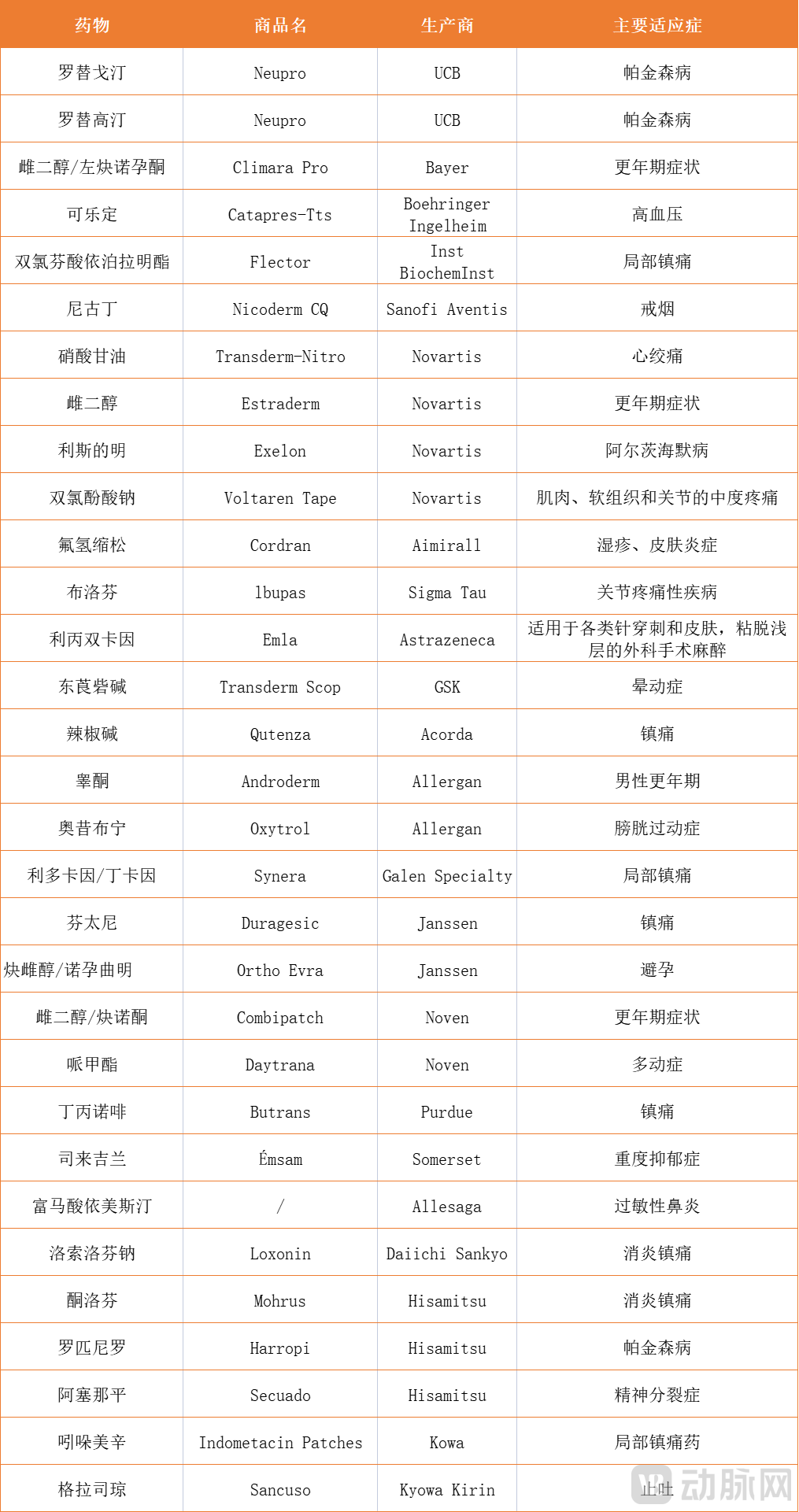 Selected Transdermal Patch Products Marketed in Europe and Other Countries (Data Source: Transdermal Technology Innovation Alliance, TTIA)
Due to their complex manufacturing processes, significant R&D challenges, and high technical barriers, many companies already engaged in the transdermal formulation sector continue to face numerous issues, such as difficulties in product development, bottlenecks in excipient supply, failures in pilot-scale scale-up, challenges in establishing production lines, and high development costs.
Particularly in China, the transdermal drug delivery industry developed relatively late, with products dominated by traditional plasters, resulting in low levels of industry and market maturity. Leading Chinese manufacturers of cataplasm patches, represented by Taide Pharmaceutical, have embarked on a research and development path transitioning from imitation to innovation. Currently, Taide has established three major technological platforms for topical formulations—cataplasm patches, hot-melt adhesives, and solvent-based adhesives—securing a first-mover advantage in speed and pursuing a strategy of “innovative plus generic patches.” Management projects that by 2027, Taide will have built the world’s largest product portfolio of topical formulations, continuously expanding its patch pipeline each year.
Currently, the research and development of transdermal formulations in China is entering a new era, characterized by dosage form innovation for existing drugs and expansion into incremental markets through new indications and therapeutic areas. It is anticipated that Chinese enterprises will successively launch transdermal products across multiple fields, including cardiovascular diseases, central nervous system disorders, anti-inflammatory and analgesic treatments, and allergic diseases.