

Da Vinci Surgical Robot Faces Price Plunge and Declining Installations in China Amid Rising Domestic Competition

Edge Medical
Developer of Robot-Assisted Minimally Invasive Surgical Systems

Sagebot
Surgical Robot Developer

Intuitive
Surgical Robot Developer

MedBot
Surgical Robot Developer
Da Vinci’s Price Drops Significantly After Local Production, Marking a New Shift in the Surgical Robot Market
On September 19, 2024, Gary Guthart, Global CEO of Intuitive, attended the 36th International Business Leaders’ Advisory Council for the Mayor of Shanghai. Public information indicates that his previous appearance in China was in October 2023, when the domestically produced da Vinci surgical robot was officially unveiled. The global CEO has been making frequent appearances in China recently.
Frequent public appearances not only demonstrate the company’s emphasis on the Chinese market but also reflect the gradually intensifying competitive pressure in China, necessitating greater investment of effort.
According to data from Intuitive Surgical’s earnings conference calls for the first and second quarters of 2024, the number of da Vinci surgical robot installations in China declined year over year. In the first half of 2024, there were 24 da Vinci surgical robot installations in China, compared with 34 during the same period in 2023, representing a year-over-year decrease of nearly 30%. Although the decline in installations was partly attributable to delays in equipment tendering and procurement processes, the rise of domestic competitors is also a factor that cannot be overlooked.
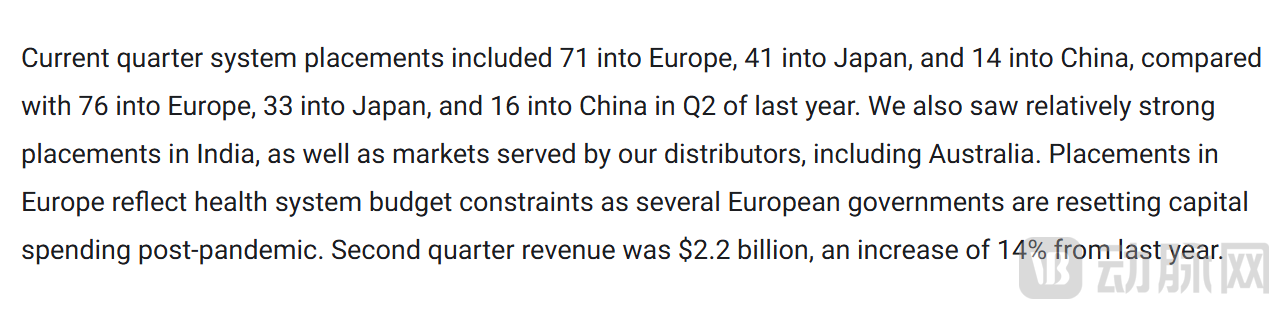
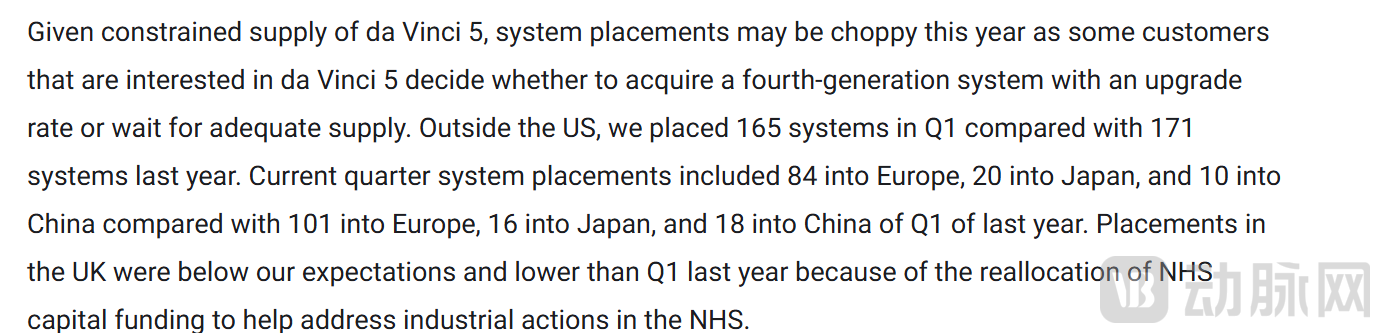
Intuitive Surgical, Inc. 2024 Q1 & Q2 Earnings Call Data
To cope with competitive pressure, the prices of domestically produced Da Vinci systems have frequently dropped to ultra-low levels. The price range for the Da Vinci IS4000CN model has fallen from RMB 19 million to RMB 13 million, with the lowest winning bid price being half that of the imported version.
Recent Winning Bid Prices for the Da Vinci Surgical Robot
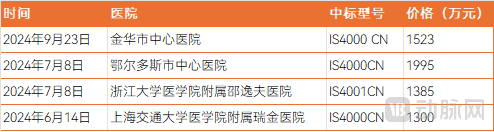
Data Source: Chinese Government Procurement and Bidding Network
Domestic endoscopic surgical robot brands have begun to compete head-to-head with the da Vinci Surgical System in the newly installed market within two years of their commercial launch.
Three domestic brands are primarily exerting pressure on Intuitive’s business in the Chinese market: MedBot (Toumai laparoscopic surgical robot), Edge Medical (MP1000), and Sizherui Medical (Kangduo Robot). Among domestic brands, these three companies lead in the number of successful bids for laparoscopic surgical robots.
According to the semi-annual report of MedBot, the Toumai laparoscopic surgical robot achieved 7 commercial installations in the first half of the year, bringing the cumulative number of commercial installations in China to 20. In addition, overseas orders exceeded 10 units.
The other two companies have not publicly disclosed specific installation figures. According to incomplete statistics compiled by VCBeat from public tender data on the China Government Procurement Network and other publicly available sources, as of September 2024, the cumulative number of winning bids for Kangduo surgical robots was 14 units, while Edge Medical’s MP1000 system secured 11 winning bids. (These figures are based solely on publicly available data and do not represent total installations.)
A key highlight of the business model for laparoscopic surgical robots lies in the subsequent sales of surgical arms and consumables, with the volume of surgeries performed after installation directly driving recurring consumable revenue. According to Frost & Sullivan, in 2021, the market size for equipment in China’s laparoscopic surgical robot market was RMB 1.61 billion, while the markets for consumables and services were valued at RMB 1.41 billion and RMB 190 million, respectively. Consumables and services together accounted for half of the total market, underscoring the importance of post-installation surgical volume.
How do domestic brands of laparoscopic surgical robots perform in terms of utilization rates? According to publicly available statistics, as of March 2024, the Toumai surgical robot had completed 2,000 procedures, with domestic consumables revenue reaching RMB 3 million in the first half of the year, and the number of surgeries growing rapidly. In August 2024, Edge Medical announced that the clinical procedure volume of its multi-port surgical robot had officially surpassed 4,000 cases. This indicates that domestic brands of laparoscopic surgical robots have been validated by the market in terms of product stability and reliability.
However, the average annual surgical volume per da Vinci surgical robot system in hospitals reaches approximately 1,000 procedures, indicating that there is still room for growth in the surgical volume of domestically produced laparoscopic surgical robots.
Currently, Intuitive Surgical primarily sells its fourth-generation product in China—the imported and domestically produced versions of the da Vinci Xi system. In terms of product functionality and performance, there is still a certain gap overall between domestic endoscopic surgical robots and the da Vinci surgical robot. Meanwhile, products from domestic brands are in a stage of rapid iterative development, striving to catch up.
Comparison of the Functions of Major Domestic Laparoscopic Surgical Robots
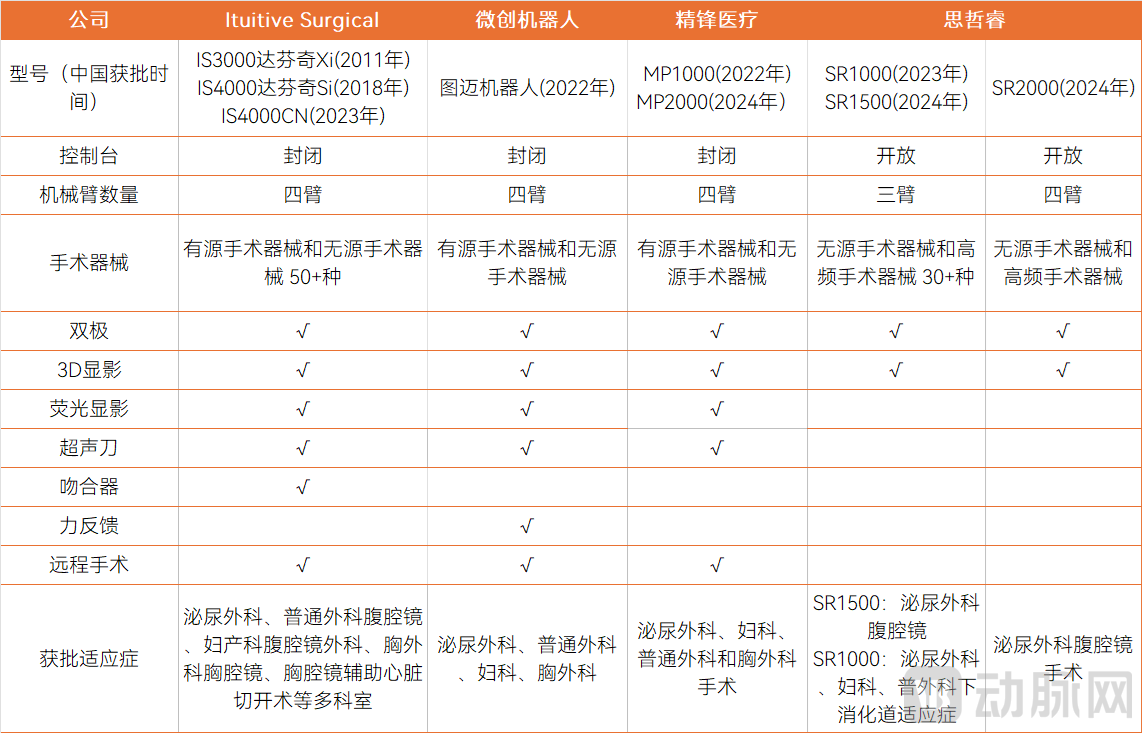
This gap is mainly reflected in the following four aspects:
In terms of compatible surgical instruments, domestic laparoscopic surgical robots support fewer types than the da Vinci system.Surgical robots are compatible with both active and passive instruments. The da Vinci surgical robot supports up to 50 types of instruments, including advanced minimally invasive surgical devices such as ultrasonic scalpels and staplers. Taking staplers as an example, the da Vinci system is equipped with the SureForm da Vinci Linear Cutter Stapler, which allows the primary surgeon to operate independently. It automatically monitors tissue thickness within the jaws and adjusts pressure accordingly, eliminating the need for an assistant to manipulate the stapler through an auxiliary port. In contrast, the robotic arms of most domestically produced surgical robots can only manipulate basic tools such as scissors, forceps, and graspers to perform simple movements. Achieving high-precision stapler operations requires further technological breakthroughs in precision design, drive technology, multi-degree-of-freedom control, and intelligent feedback systems for these robotic arms.
Domestically produced imaging systems still need to improve their performance.Apart from Intuitive Surgical’s da Vinci 3D fluorescence endoscope, the dedicated 3D fluorescence endoscopes offered by other surgical robot manufacturers still lag behind mature mainstream brands in terms of reprocessability, image quality, and service life. Since 2014, the da Vinci Xi system has featured 3D imaging and fluorescence imaging capabilities, providing more stereoscopic images and enabling real-time visualization and assessment of blood vessels, blood flow, and tissues during surgery. This area is also a key focus for domestic companies to catch up; some Chinese enterprises have already launched laparoscopic surgical robots with fluorescence imaging capabilities, such as Edge Medical and MedBot.
It is reported that domestic surgical robot companies are collaborating with endoscope manufacturers to jointly optimize imaging presentation capabilities. For instance, in addition to being compatible with its proprietary 3D endoscopy system, Kangduo Robot has specifically designed open, dedicated interfaces to ensure compatibility with mainstream international 3D endoscopy systems from Karl Storz and Olympus.
Domestic brands of laparoscopic surgical robots cover fewer indications.The da Vinci Surgical System has been applied in China for many years, covering a broader range of indications. In contrast, domestically produced surgical robots are still in the stage of expanding their indications. Domestic surgical robots are typically first deployed in urology and gynecology, as these two specialties have higher penetration rates in China. As domestic surgical robots expand into multiple specialties, they are poised to capture greater market share from the da Vinci Surgical System.
Expanding Indications Is the Key Strategy for Future Growth of Domestically Produced Laparoscopic Surgical Robots. In explaining their rationale for adopting single-source procurement, several hospitals in China that have purchased the da Vinci Surgical System stated that the da Vinci Surgical System is the only imported or domestically produced endoscopic surgical control system currently registered and approved for marketing in China that can be simultaneously used across multiple departments, including urological surgery, general laparoscopic surgery, gynecological and obstetric laparoscopic surgery, thoracoscopic surgery, and thoracoscopy-assisted cardiotomy. There are no other comparable products available in the domestic market. Domestically produced laparoscopic surgical robots need to obtain approval for additional indications before they can hope to enter a larger market.
In terms of surgical robotic arm design, four-arm surgical robots are capable of performing more complex procedures. The SR1000 multi-robot system, developed by the Chinese company Sizherui Kangduo, adopts a three-arm solution. This design choice stems from the observation that in clinical practice, surgeons using the four-arm da Vinci Surgical System typically utilize only three arms to manage costs. The fourth arm is primarily intended for tissue retraction, a task that can be performed by an assistant during surgery. To reduce costs, the SR1000 has opted for a three-arm configuration.
To narrow the gap with the da Vinci system, domestic brands of laparoscopic surgical robots are not only addressing their weaknesses but also exploring differentiated pathways.
Domestic brands of laparoscopic robots are the first to introduce force feedback-related features.During laparoscopic robotic surgery, surgeons lose natural haptic feedback and must rely solely on visual cues to estimate force. Incorporating force sensing can further enhance surgical safety. The primary technical approach for implementing force sensing in laparoscopic surgical robots involves encapsulated force sensors. The key technical challenges lie in achieving high precision and reliability, while also ensuring miniaturization and integration, as well as adaptability to the surgical environment.
MedBot’s Toumai® robotic system is equipped with a haptic perception and presentation component known as Force Presentation. This year, Intuitive Surgical’s latest generation product, the da Vinci 5, has also achieved haptic feedback functionality. Leveraging sensors and advanced algorithms, the da Vinci 5 can capture and transmit in real time the forces exerted by surgical instruments on tissues during procedures. This refined force sensing and feedback mechanism enables surgeons to perform more precise maneuvers, significantly enhancing surgical safety and outcomes. This product has not yet been approved for market launch in China. The Toumai robotic system remains the only laparoscopic surgical robot with haptic feedback capability available in China.
Another major advantage of domestically produced surgical robots compared to the da Vinci Surgical System lies in their exploration of remote surgery capabilities.Domestic brands of endoscopic surgical robots have made more attempts in the field of remote surgery. Remote surgery requires extremely low communication latency and highly stable data transmission; any delay or connection interruption could lead to imprecise surgical maneuvers, or even jeopardize patient safety. During the procedure, large volumes of real-time images and sensor data need to be transmitted. High-resolution image transmission and real-time transmission of haptic feedback signals are crucial for the precision and safety of the surgery.
Domestic endoscopic surgical robot brands have successfully performed intercontinental surgeries. Leveraging the dual advantages of low latency and high reliability, Edge Medical’s remote surgery system employs strategies such as “multi-network integration,” “encrypted transmission,” and “dual-console control” to ensure the smooth execution of remote procedures. The system has been applied in remote surgeries across urology, gynecology, and general surgery, achieving intercontinental remote operations. MedBot has also conducted nearly 200 remote surgeries both domestically and internationally.
The aforementioned differentiations are all at the functional level. Domestic companies are also exploring structural designs that differ from those of the da Vinci Surgical System.
Domestic companies Ruilong Surgical and Hedong Medical are developing modular surgical robots and split-bed surgical robots, creating clearly differentiated products compared to integrated surgical robots represented by the da Vinci system.
The distinguishing feature of a modular surgical robot system is that each robotic arm is mounted on an independent cart, allowing it to be positioned at various locations beside the operating table as needed during surgery. Compared with integrated surgical robots, this design offers greater flexibility and degrees of freedom, enabling the surgical robot to better accommodate diverse surgical requirements.
To cope with the pressure from domestic competitors, the da Vinci surgical robot has achieved local production in China, obtained the registration certificate for domestic medical devices, and realized localization. In terms of price, the domestically produced version of the da Vinci system has also seen a significant reduction, bringing it close to the pricing of domestic brands.
Furthermore, the global launch of the da Vinci 5 has once again widened the gap with competing products, offering superior computing power and an enhanced digital experience. Historically, regulatory approvals for previous da Vinci surgical robot models in China have lagged behind overseas markets by three to four years. Therefore, the da Vinci 5 is expected to be launched in China within three years, which will also exert new pressure on domestic brands to accelerate their product iterations.
Currently, laparoscopic surgical robots are experiencing the best market opportunities in history. The downgrade in the regulatory category for configuration certificates and the increase in planned quotas have led to a significant surge in installation volumes.
Opportunities from policy support are expected to expand further, as national policies provide strong guarantees for the development of domestically produced laparoscopic surgical robots. For instance, the recent notice issued by the National Development and Reform Commission (NDRC) and the Ministry of Finance, titled “Several Measures to Intensify Support for Large-Scale Equipment Renewal and Consumer Goods Trade-In,” plans to allocate approximately RMB 300 billion in ultra-long-term special sovereign bonds to support the upgrading of medical equipment. This round of medical equipment renewal is expected to stimulate demand for surgical robots. The “Implementation Plan for Promoting Equipment Renewal in the Healthcare Sector in Hubei Province,” issued by the Hubei Provincial NDRC, explicitly states support for hospital configuration upgrades, including high-end medical equipment such as surgical robots. This indicates that domestically produced surgical robots will have greater market opportunities during this equipment renewal and upgrade process.
Overseas markets will also bring new opportunities. Chinese-branded laparoscopic surgical robots have achieved remarkable success in the international market. For instance, MedBot has successfully realized overseas sales by leveraging its global distribution channels. With the growing global demand for high-end medical equipment and the strengthening technological capabilities of domestically produced surgical robots, the competitiveness of Chinese brands in the international market continues to rise.
The continuous introduction of favorable industrial policies, the maturation and upgrading of domestic supply chains, and the accelerated release of clinical demand have collectively created multiple tailwinds for the development of China’s laparoscopic surgical robot market. Domestic brands are gradually emerging as notable contenders; however, establishing a competitive landscape where they can stand on equal footing with international rivals will require further refinement of their core competencies. The business model of laparoscopic surgical robots dictates that this is a market testing long-term competitiveness. Stable and reliable product performance, coupled with the ability to iterate products in step with technological advancements, are key to sustaining long-term competitive advantage.