

RegenHU Paves the Way for Drug Manufacturing with 3D Bioprinting: From Skin to Pharmaceuticals

RegenHU
Developer of Bioprinting Tools
In the 1990s, 3D printing emerged, not only shortening manufacturing processes but also reducing the costs of small-batch and personalized production. Decades later, an American scholar modified a HP printer and used living cells as "ink," achieving 3D bioprinting for the first time. In 2009, the first commercial 3D bioprinter appeared on the market, paving the way for 3D bioprinting to transition from the laboratory to the marketplace.
During this period, many 3D bioprinting companies emerged in large numbers.RegenHUIt is also a member of this group. In 2019, RegenHU launched its first 3D bioprinter capable of printing realistic skin models to assist patients requiring skin grafts. In recent years, RegenHU has been exploring the use of 3D bioprinting for drug manufacturing, offering new solutions for drug development and production.
Became a Representative Enterprise in the Field with Two Products
The story of RegenHU dates back to 2007, a time when no 3D bioprinters were yet commercially available, and bioprinting companies were just beginning to fill the gaps in medicine and research.
That year, Swiss serial entrepreneur Marc Thurner also set his sights on this emerging sector. In his view,Regenerative medicine will be a new direction full of opportunities in the future. In the future, 3D printing technology will be able to interact with cells and biomaterials to fabricate tissues and organs that mimic natural physiological functions.
However, at that time, there were no cases demonstrating that 3D-printed cells and tissues could survive and be functional. Even Professor Thomas Boland, hailed as the “Father of Bioprinting,” merely arranged cells, culture medium, serum, and their mixtures into specific patterns and observed the viability of the printed cells.
It was precisely this seemingly impractical idea that led Marc Thurner to assemble a group of researchers equally enthusiastic about 3D bioprinting, thereby founding RegenHU.
After 2 years,They successfully launched their first product—the BioFactory bioprinter with 8 print heads.This device can simultaneously print eight different types of cells and scaffold materials, making it highly suitable for constructing complex three-dimensional structures. It enables precise control over the deposition location and volume of bioinks, thereby facilitating the establishment of biomimetic microstructures and allowing for the localized delivery of bioactive factors and drugs to regulate local tissue growth and development.
In 2017,RegenHU Launches New Generation Product: 3DDiscovery EvolutionUnlike BioFactory, 3DDiscovery Evolution is a bioprinting platform equipped with 11 printing technologies to accommodate various user requirements. Furthermore, it integrates more than ten biofabrication techniques, including pneumatic extrusion, piezoelectric inkjet, screw extrusion, and electrospinning, significantly expanding the range of processable biomaterials.
To date, RegenHU has launched only these two hardware products, yet they have shone brightly in fields such as regenerative medicine and drug development. To this day, RegenHU remains a representative enterprise in the field of 3D bioprinting.
"Printed 'Artificial Skin' Has Entered Clinical Trial Phase"
Marc Thurner, founder of RegenHU, once believed that the advent of 3D bioprinting would drive the development of regenerative medicine. Following the team’s development of BioFactory, the company shifted its focus toward regenerative medicine.
In 2015,A research team has utilized BioFactory to 3D-print a three-dimensional model of an in vitro blood-to-air tissue barrier.Compared with manual construction, tissue cells printed by BioFactory exhibit more uniform growth and can rapidly form layered structures, creating tissue architectures composed of distinct cellular layers. Such three-dimensional models not only more closely resemble authentic human anatomy and accurately simulate the “blood-oxygen barrier” response, but also offer greater efficiency, safety, and cost-effectiveness. This research ultimately achieved breakthrough results and was published in Nature.
In addition to printing experimental tissues, BioFactory can also bioprintBone Conduction Scaffold Structure. Such products are primarily applied in the field of vertical alveolar bone augmentation in dentistry. Vertical bone augmentation is a surgical technique used to reconstruct the height of the alveolar bone in the vertical direction, which is critical for the success of dental implants. Based on current technology, dental implant surgery cannot be performed when there is insufficient alveolar space. This significantly impacts the quality of life for patients with periodontal disease and alveolar bone atrophy.
Using BioFactory, researchers have printed porous scaffolds composed of tricalcium phosphate and hydroxyapatite for bone cell growth. In sheep cranial defect models, these scaffolds demonstrated robust vertical bone regeneration, with new bone formation exceeding that of standard materials by more than fourfold, highlighting their potential in bone tissue engineering. The study was published in *Clinical Oral Implants Research*.
Furthermore, BioFactory enables skin printing for skin transplantation and cardiac model printing for drug testing. Currently, BioFactory has achieved the printing of various tissues and organs, including skin, cartilage, bone, and blood vessels, which can be utilized for a wide range of tissue repair and regenerative applications.
This is even more true for the 3DDiscovery Evolution, which offers more comprehensive functionality; multiple products manufactured using this system have been approved for market entry through collaborations with other enterprises.
Swiss company CUTISS previously collaborated with RegenHU., leveraging 3DDiscovery Evolution printing technology, denovoSkin has been launched. This product involves obtaining a biopsy sample from the patient’s own healthy skin and generating a skin graft based on that sample. Since the patient’s own tissue serves as the “bioink” for printing the graft, there is virtually no risk of rejection during transplantation, thereby reducing scarring and the likelihood of subsequent reconstructive surgeries. Additionally, it significantly reduces the need to harvest large amounts of healthy skin, minimizing intraoperative discomfort and postoperative recovery time, thus improving patients’ quality of life.
A similar collaboration involves Switzerland’s CUTISS AG. Using the 3DDiscovery Evolution system, the team has printed artificial skin that mimics the dermal-epidermal structure of natural skin, enabling the treatment and coverage of extensive burn wounds. In July 2024, this product completed Phase II clinical trials, in which artificial skin was implanted in 23 patients, yielding favorable results.
3D-Printed Tablets: Delivering Personalized Drug Delivery Systems
In recent years, in addition to tissue and organ printing, RegenHU products have also been applied in drug discovery and tablet printing.
Drug development is a significant application scenario for current 3D bioprinting. For instance, Novartis utilizes the 3DDiscovery Evolution system to generate muscle tissue models for drug testing and disease research. Researchers can simulate muscle function and pathological changes in vitro, thereby gaining a better understanding of the mechanisms underlying muscle diseases and evaluating new therapeutic approaches.
Tablet printing is a completely new direction.Currently, RegenHU’s 3D bioprinting technology has enabled the customization of drug delivery systems with specific dimensions, shapes, and drug release profiles.Meanwhile, this technology enables rapid prototyping and customized design, and has been applied to the development of personalized treatment regimens. It supports high active pharmaceutical ingredient (API) loading and the integration of multiple active ingredients into a single personalized solid dosage form, thereby addressing challenges associated with complex drug formulation and delivery.
Previously, GlaxoSmithKline collaborated with the University of Nottingham to generate 3D-printed ropinirole tablets for the treatment of Parkinson’s disease using 3D bioprinting technology, thereby validating the feasibility of this approach. In terms of operational capabilities, RegenHU’s products have demonstrated unique technical advantages in this field. For instance, its 3D bioprinters support personalized design, can be equipped with up to five print heads, and allow for the integration of various printing technologies. Configurations can be modified to meet the evolving needs of projects. Furthermore, RegenHU’s printers enable stable process reproducibility and high-quality mass production.
In addition to hardware innovation, RegenHU has also integrated AI into its systems. It is reported that RegenHU’s 3D bioprinters are equipped with proprietary SHAPER software, specifically designed for biological modeling. Users can construct their own 3D biological models in just three steps, covering design, layout, control of printing positions, and multi-material printing sequences. This approach accelerates the efficiency of tablet printing, reduces manual operations, and minimizes human error.
Multiple domestically produced 3D bioprinting devices have been approved
In 2023, RegenHU won both the iF Design Award and the Red Dot Design Award of the Year, garnering international attention. Meanwhile, domestically produced bio-3D printing equipment has also made significant progress in technological innovation and applications in recent years.
For instance, Wang Xiujie’s team at the Institute of Genetics and Developmental Biology, Chinese Academy of Sciences, collaborated with Professor Wang Changling’s team at the University of Manchester in the United Kingdom and Professor Liu Yongjin’s team at Tsinghua University to creatively retrofit a six-axis robotic arm into a biological 3D printer (a six-axis robotic bioprinter). This technology overcomes the planar layering limitations of traditional biological 3D printing, providing a more viable solution for the in vitro fabrication of complex tissues and organs.
Beyond the research sector, domestic companies are also shining in the industrial arena. Currently, enterprises capable of researching, developing, and manufacturing 3D bioprinting equipment includeHangzhou Janus Biotechnology Co., Ltd., Saina Digital Medical, Yizhi Technology (Shanghai) Co., Ltd.etc.
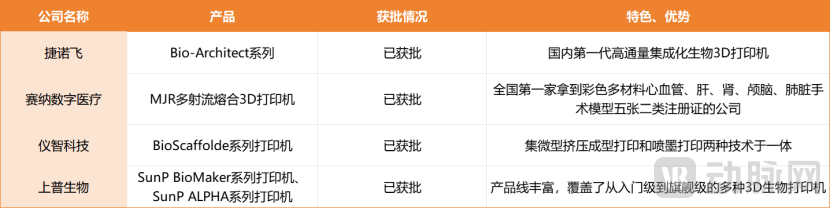 Overview of Domestic 3D Bioprinting Companies
Technological innovations have also led to breakthroughs in commercial collaborations. Taking Cellink (Jienofei) as an example, the company collaborated with research teams to successfully print small-scale human ear cartilage tissues and liver units, achieving a cell viability rate of over 90% and sustaining viability for four months. Furthermore, it jointly established the “High-Throughput 3D Bioprinted Asian Skin Model Joint Laboratory” with Proya Group, promoting the application of 3D bioprinting technology in the safety and efficacy evaluation of cosmetics. Additionally, Cellink’s products play a significant role in areas such as drug screening and biomedical research.
Domestic 3D bioprinting technology continues to achieve breakthrough accomplishments, with its application potential in the medical field becoming increasingly evident. As the technology advances, domestically produced 3D bioprinting is expected to be applied in more clinical areas in the future.