

Sun Yat-sen University Licenses Silk-Based Microneedle Drug Delivery Patent for Growth Hormone to Hanxing Medical for RMB 100,000
On September 24, Sun Yat-sen University issued an announcement proposing to transfer the patent titled “Preparation Method of Silk Fibroin Sustained-Release Microneedles for Rapid Separation of Growth Hormone,” with a proposed transaction price of RMB 100,000.
This patent was jointly developed by a team of experts from Sun Yat-sen University specializing in pharmaceutics, biomedical materials, and drug delivery systems, including Zeng Xiaowei, Yang Li, Liu Qingyun, Yang Yao, and Gao Nansha. Among them, Professor Zeng Xiaowei is a senior researcher in this field who has long been committed to promoting innovation and development in pharmaceutics, biomedical materials, and drug delivery systems.
The invention patent proposed for transfer herein represents a significant achievement by Professor Zeng Xiaowei and his team in the field of drug delivery.This patent proposes a novel preparation method for producing silk fibroin sustained-release microneedles containing growth hormone with rapid separation characteristics. These microneedles not only enable painless, convenient self-administration but also significantly enhance the stability and efficacy of growth hormone, thereby reducing dosing frequency and the risk of potential allergic reactions in patients.
Innovative Silk Fibroin Sustained-Release Microneedles: A Convenient, Efficient, and Painless Drug Delivery Solution
Microneedles are a subcutaneous drug delivery method featuring micron-scale fine structures. Drugs primarily enter the skin through microchannels formed after penetrating the stratum corneum, thereby enhancing transdermal permeation. While penetrating the stratum corneum, microneedles do not stimulate pain nerves, allowing drugs to reach specified depths and be absorbed by the capillary network. This approach effectively improves drug delivery efficiency and patient compliance.
Another major advantage of microneedles lies in their mild fabrication conditions, which help protect the incorporated drugs from degradation and preserve their therapeutic efficacy. This benefit is particularly pronounced when substances with excellent biocompatibility and biodegradability, such as silk fibroin, are incorporated into the microneedles. Silk fibroin not only enables long-term stable preservation of bioactive agents within dry silk films but also allows for controlled drug release rates by modulating the content of β-sheet structures, demonstrating significant potential in addressing the challenges associated with long-acting growth hormone formulations.
Professor Zeng Xiaowei’s team invented rapidly separable silk fibroin microneedles for sustained release of growth hormone, leveraging this very property of silk fibroin.Upon contact with dermal interstitial fluid, the microneedles rapidly generate bubbles, facilitating the separation of the base layer from the needle shafts. This process retains the growth hormone-loaded tip layer within the skin, thereby enabling sustained drug release.. This administration method is not only autonomously painless but also significantly reduces the dosing frequency for patients, thereby improving compliance and effectively addressing the issue of frequent injections required by current sustained-release growth hormone therapies.
Compared with separable microneedles without foaming agents, rapidly separable microneedles for sustained-release growth hormone not only significantly shorten the separation time between the microneedle shaft and the base layer, reducing skin contact time, but also greatly enhance drug loading capacity and delivery efficiency. Furthermore, using silk fibroin as a carrier improves the stability of growth hormone, maintaining its activity for one month at room temperature.
This invention also employs an integrated centrifugation-based preparation technique, which simplifies the manufacturing process and facilitates scale-up production.This not only reduces production costs but also helps bring this innovative technology to market more quickly, benefiting more patients.
Domestic Microneedles Transitioning to Biopharmaceuticals
According to an analysis by NewSight Industry Research Center, microneedle drug delivery technology is demonstrating significant development potential across multiple medical fields, including oncology, ophthalmology, anesthesia, and dentistry. Globally, the development trajectory of microneedle technology is exhibiting a trend toward diversification.
Among them,Western countries are more inclined to apply it in the fields of biopharmaceuticals and medical devices, exploring its potential in treating complex diseases.For example, the U.S. formulation giant ALZA developed the Macroflux microneedle transdermal drug delivery technology for the delivery of growth hormone-releasing factor (GRF) and parathyroid hormone PTH1.
In contrast,Although China’s microneedle market started relatively late, it has prioritized applications in the medical aesthetics sector and is gradually expanding into the fields of medical devices and pharmaceutical R&D.. Judging from the development trajectory of China’s microneedle market, most microneedle technology companies have chosen to first enter the two mature markets of lifestyle beauty and professional salon-based aesthetics, generating cash flow to support subsequent R&D and innovation in medical devices and pharmaceuticals.
For example, Qinglan Bio established three fully automated production lines in Shenzhen in 2020, with an annual capacity of nearly 150 million microneedle drug-delivery patches. Its product portfolio spans multiple areas, including dissolvable microneedle patches for freckle removal and wrinkle reduction, as well as patches for weight loss and hair growth, and has gained extensive access to cosmetic sales channels such as beauty salons. Meanwhile, Qinglan Bio is actively advancing research into the application of microneedles in the vaccine field and engaging in in-depth collaborations with biopharmaceutical companies.
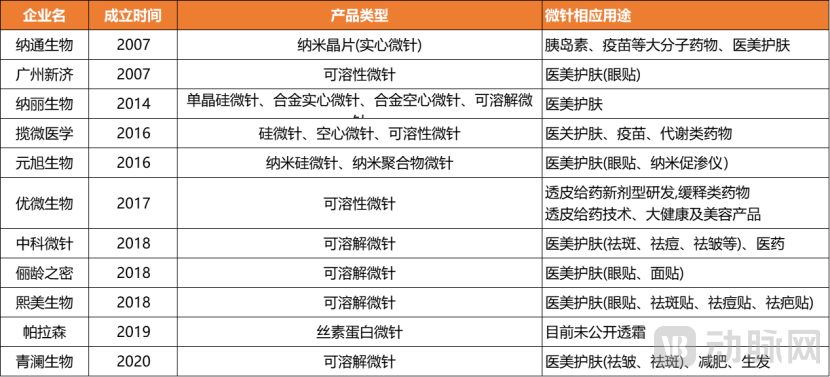
Some Domestic Microneedle Companies
Moreover, an increasing number of domestic microneedle companies are attempting to transition toward the biopharmaceutical sector. Among them, Zhongke Microneedle has developed a proprietary next-generation polymer microneedle drug delivery technology platform, with applications spanning vaccines that enhance immune responses and vaccination coverage, immunotherapeutic agents requiring improved targeting, biologics necessitating repeated injections, as well as pediatric and dermatological medications. Xinji Pharmaceutical is also advancing multiple microneedle-based drug projects, including those involving peptides and large-molecule biological proteins, vaccine drugs, and small-molecule compounds.
As Xu Bai, CEO of Natong Bio, emphasized in an interview with VCBeat: “Although we started in the field of medical aesthetics, our ultimate goal is undoubtedly to address medical issues.” As an innovative drug delivery method, microneedle technology is demonstrating its unique advantages and significant application prospects in both the global and Chinese markets. With continuous technological development and innovation, microneedle technology is poised to bring greater benefits to more patients in the future.