

Why This Niche Medical Device Sector Boasts 90% Localization and 90% Gross Margins
As of now, the gross profit margins of dural (spinal) patch products from multiple listed companies have all exceeded 90%. This is truly surprising, given that this sector has undergone multiple rounds of centralized procurement and has a domestic production rate exceeding 90%.
Since 2020, volume-based procurement (VBP) of dural (spinal) patches has been implemented in 24 provinces. Among them, the VBP programs for dural (spinal) patches carried out in provinces such as Anhui, Hebei, Henan, and Jiangsu have achieved average price reductions of 70%–90%.
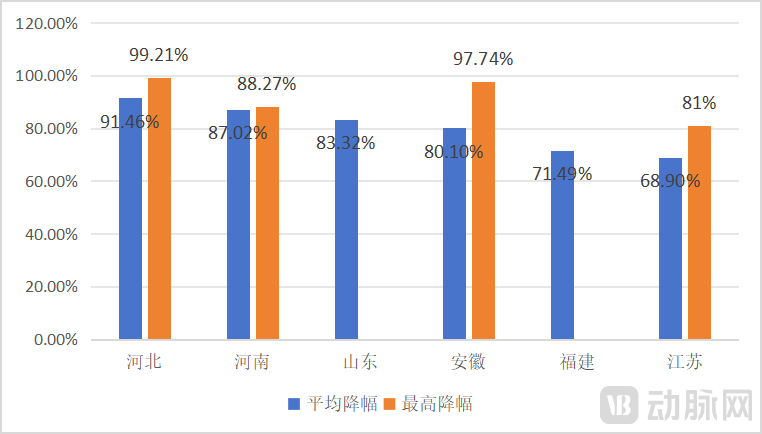
(Statistics on Price Reductions in Volume-Based Procurement of Dural (Spinal) Patches, Data Source: Yilian Smart Cloud)
Taking the 2021 centralized procurement of three categories of medical consumables conducted in Hebei Province as an example, the average price of dural (spinal) patches decreased from RMB 16,000 to approximately RMB 1,000, representing an average reduction of 91.46% and a maximum reduction of 99.21%.
Moreover, dural (spinal) patches represent a rare sector in China where domestic substitution has been largely achieved. According to data from LeadLeo Research Institute, the localization rate of artificial dural (spinal) patches in China reached 90% in 2020, with major manufacturers including MicroPort MedBot, Guanhao Biotech, Zhenghai Biotechnology, BaiRen Medical, Tianxinfu, and WorldMed.
It is worth noting that multiple rounds of centralized procurement, coupled with a high rate of domestic production, have not turned the dural (and spinal) patch market into a red ocean. The latest financial reports from several listed companies indicate that the current gross profit margin for dural (and spinal) patches stands at approximately 90%.
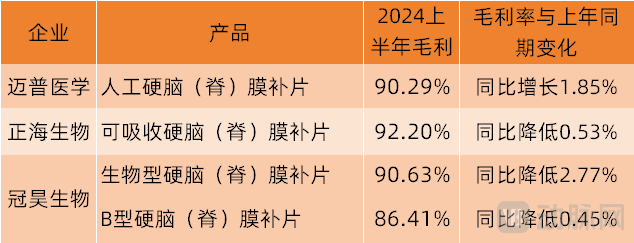
(Data source: corporate financial reports)
Meanwhile, Medprin has also emerged as a beneficiary of the volume-based procurement (VBP) policy. In 2023, provinces and municipalities including Anhui, Jiangsu, Liaoning, Henan, and Shaanxi successively launched VBP programs for dural (spinal) patches, with Medprin successfully winning bids in all of these procurements. Benefiting from this, the company’s revenue from artificial dural (spinal) patch business reached RMB 69.1193 million in the first half of 2024, representing a year-on-year increase of 36.68%, while the gross profit margin stood at 90.29%, up by 1.85 percentage points year on year.
What Exactly Is the Market for Dural (Spinal) Patches? How Do They Sustain Gross Margins Above 90% Over the Long Term? Is It Still Worthwhile for Innovative Companies to Enter This Space?
Dural (Spinal) Patch is primarily used for the repair or replacement of dural (spinal) defects.
It is understood that the dura mater (and spinal dura) is a double-layered membranous tissue located between the skull and brain tissue, serving to protect the brain and prevent cerebrospinal fluid from coming into contact with the external environment. Injury to the dura mater (or spinal dura) can lead to persistent cerebrospinal fluid leakage, resulting in serious complications such as pseudomeningocele, nerve root entrapment, intracranial hemorrhage, meningitis, intracranial infection, and even death.
Clinically, the primary causes of dural defects include traumatic brain injury, cranial surgery, tumor erosion, and inflammation. In surgical practice, physicians often intentionally incise the dura mater during the diagnosis and treatment of various brain and spinal disorders to perform specific therapeutic or diagnostic procedures, such as diagnostic lumbar puncture, therapeutic puncture, resection of intradural tumors or cysts, and selective shunting.
With improved disease awareness, advancements in surgical instruments, and increased payment capacity, brain disorders such as cranial tumors, traumatic brain injury, and cerebral hemorrhage are increasingly treated through surgical interventions. According to the China Health Statistical Yearbook, approximately 900,000 craniotomies were performed in China’s neurosurgery departments in 2022.This means that the number of patients with dural defects continues to increase, leading to a corresponding rise in demand for dural (spinal) patch grafts.。
According to the latest research by market research firm QYR, the sales revenue of China's dural (spinal) patch market reached RMB 1.007 billion in 2022 and is projected to reach RMB 1.841 billion by 2029, with a compound annual growth rate (CAGR) of 8.23% from 2023 to 2029.
Despite high growth rates, high gross margins, and a high localization rate, the dural (spinal) patch industry has not become a red ocean market. This is primarily due to certain barriers to entry in the dural (spinal) patch market.
First, dural (spinal) patches belong to a high-tech industry characterized by multidisciplinary integration and knowledge intensity, with substantial technical barriers. For instance, the animal-derived medical biomaterial technology platform established by Guanhao Biotech has undertaken more than twenty national and local key scientific and technological projects. Its “High-Tech Industrialization of Regenerative Biomembranes” project was included by the National Development and Reform Commission in the National Demonstration Projects for High-Tech Industrialization.
Zhenghai Biotech is rooted in the field of regenerative medicine. Building on its acellular technology, the company has vertically expanded into three technological platforms: biomaterials with natural or biomimetic scaffold structures, factor technologies with induced regenerative functions, and stem cell technologies. Supported by these three core technologies, Zhenghai Biotech has achieved comprehensive research coverage of the three key elements of regenerative medicine: scaffold materials, bioactive factors, and seed cells.
Second, dural (spinal) patches present a high talent barrier. This industry integrates multiple disciplines, including clinical medicine, materials science, biomedical engineering, and mechanical engineering, requiring substantial support from interdisciplinary professionals with composite expertise. Moreover, professionals in these related fields require extensive skills training and the accumulation of production practice experience. For new market entrants, it is difficult to recruit and cultivate a talent team with core competitiveness in a short period, resulting in a relatively high barrier to entry.
Third, dural (spinal) patches present high channel barriers. It is understood that hospitals limit the number of companies eligible to bid for similar products, and there is significant uncertainty regarding whether tendering processes will be initiated. Products already listed in hospital formularies create certain market channel barriers against later entrants. Meanwhile, multiple dural (spinal) patch products have been launched, with a high rate of domestic production, low product costs, and distinct first-mover advantages.
Under the influence of multiple factors, the dural (spinal) patch market, as a single-product segment valued at RMB 1 billion, faces limited competition and remains a blue-ocean market.
It is understood that dural (spinal) patches are sheet-like materials used to repair defects in the dura mater and/or spinal dura. Based on material composition, they can be classified into autologous tissue repair materials, allogeneic repair materials, xenogeneic biological repair materials, and synthetic materials.
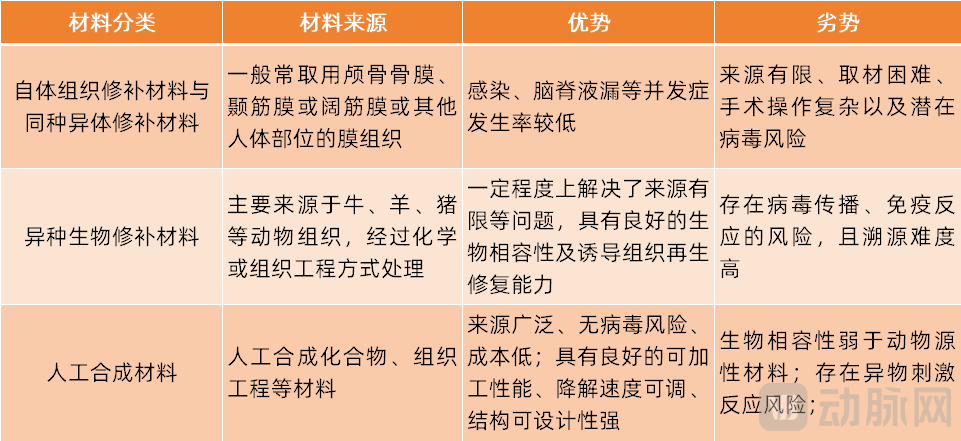
(Table by VCBeat)
Among them,Autologous tissue repair materials utilize the patient's own cranial periosteum, temporal fascia, tensor fasciae latae, or membranous tissues from other sites.;Allograft Patch MaterialthenDispenseOthersmembranous tissue.These two types of materials offer the advantages of good biocompatibility and low incidence rates of complications such as infection and cerebrospinal fluid leakage. However, their sources are limited, harvesting is difficult, surgical procedures are complex, and there is a potential risk of viral transmission.
For example, the allogeneic acellular dermal dura (spinal) mater patch launched by Jieya Laifu utilizes proprietary patented technology and retains an intact human-derived basement membrane. It offers advantages such as physiological repair effects, in situ tissue reconstruction, suitability for both suturing and adhesion, excellent biocompatibility, and superior surgical handling. Notably, the market introduction of this product fills the gap in domestically available human-derived dural patches in China.
Xenogeneic repair materials are primarily derived from animal tissues such as those of cattle, sheep, and pigs., and are treated through chemical or biological methods to possess certain extensibility and elasticity. The emergence of such materials has, to some extent, addressed the limited availability of autologous and allogeneic repair materials. However, xenogeneic biological repair materials typically carry risks of viral transmission and immune reactions.
However, with advancements in regenerative medicine, tissue engineering, and composite materials, innovative companies have overcome technical barriers to develop xenogeneic repair materials with lower risks by reducing immune rejection and inflammatory responses through specialized processing of animal tissues.
For example, the absorbable dural (spinal) membrane patch launched by Zhenghai Biotech is derived from acellular dermal matrix of bovine dermis. By employing physical and chemical methods, the animal epidermis and cellular components are thoroughly removed without damaging the original spatial structure, thereby retaining only the natural extracellular matrix within the dermis. Compared with traditional xenogeneic biomaterials for repair, this product demonstrates superior biocompatibility and tissue conformability, and has achieved satisfactory clinical outcomes.
For another example, the dural (spinal) biological patch launched by BioRegen is a bilayer biological membrane prepared from acellular bovine pericardial matrix and carboxymethyl chitosan via lyophilization, representing an international first. This product combines carboxymethyl chitosan with acellular bovine pericardial matrix to enhance degradation properties and biocompatibility, thereby preventing cerebrospinal fluid leakage, reducing tissue adhesion, and effectively guiding tissue regeneration.
Synthetic materials have emerged with the development of materials science.Compared with other materials, synthetic materials offer advantages such as abundant sources, no risk of viral transmission, low cost, and ease of processing and design. However, synthetic materials also have limitations: they exhibit poorer biocompatibility than animal-derived materials and may cause foreign body reactions.
With the development of new materials such as absorbable, biodegradable, and regenerative medicine materials, synthetic materials are increasingly being used in dural (spinal) patches. For example, multinational giants such as B. Braun and Johnson & Johnson have launched dural (spinal) patch products made from synthetic materials; innovative domestic companies such as Medprin Regenerative Medical Technologies and World Medical Surgical Devices have also introduced related products.
Among these, Medprin’s independently developed dural (spinal) membrane patch is made from polylactic acid (PLA) and fabricated using bio-additive manufacturing technology. This process achieves a micro-bionic structure of synthetic materials, featuring a three-dimensional microfibrous scaffold similar to that of the human dura mater. Polylactic acid-based synthetic materials are biodegradable and suitable for human use, offering excellent watertightness.
Overall, products made from different materials vary in their degradation characteristics, tensile strength, usage features, biocompatibility, and clinical outcomes, as well as in flexibility, anti-adhesion properties, and adhesiveness. At present, in the domestic market for dural (spinal) patches, animal-derived materials account for more than 80% of the market share, making them the mainstream products, while synthetic materials account for less than 20%.
In the more mature European market, the proportion of synthetic materials has exceeded 50%. Data shows that in 2019, the sales volume of dural substitutes in this region reached 36,600 units, among which 17,200 units were of biological origin, accounting for 47.10%; and 19,400 units were synthetic materials, accounting for 52.90%.
It is foreseeable that in the domestic market, synthetic biomaterial dural (spinal) patches will accelerate their penetration and gradually capture a certain share of the market.
Currently, the mainstream dural substitute products in the domestic market are primarily supplied by companies such as Tianxinfu, Guanhao Biotech, Zhenghai Biomaterials, Medprin Regenerative Medical Technologies, and BaiRen Medical, which collectively account for over 92% of the market.
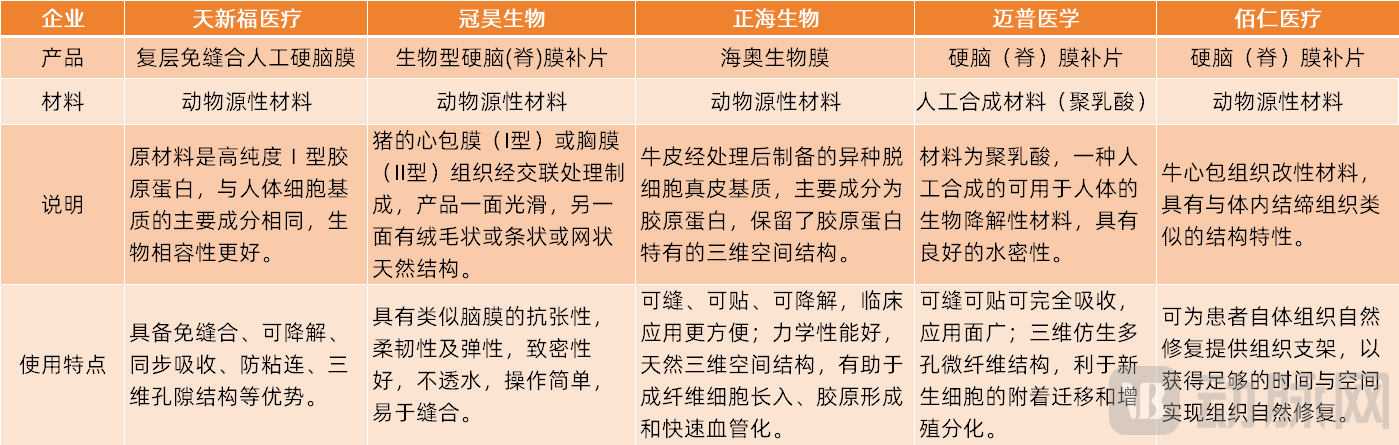
(Mainstream Products on the Market)
Among them, Tianxin Fu’s artificial dural substitute has been exported to more than ten countries worldwide, with a cumulative clinical implantation volume exceeding 3 million units, ranking among the top in the global market.
It is reported that Tianxinfu launched a multi-layered, suture-free artificial dura mater in 2021. The product is made from high-purity type I collagen, which shares the same primary component as the human extracellular matrix, thereby offering superior biocompatibility. Tianxinfu has also employed specialized processing techniques to create a three-dimensional porous structure in the product, facilitating tissue repair. Owing to its material and structural design, the product degrades and is absorbed by the body once tissue repair is complete, enhancing safety. Additionally, the product boasts outstanding advantages, including excellent flexibility, watertightness, suture-free application, reparative and reconstructive capabilities, and effective isolation properties.
Guanhao Biotech’s Type B Dural (Spinal) Membrane and Biological Dural (Spinal) Membrane Patch are also animal-derived materials, with their primary sources being porcine and bovine visceral membranes. Taking the Type B Dural (Spinal) Membrane as an example, the raw material for this product is bovine visceral membrane that has undergone sterilization and tissue engineering processing using Guanhao Biotech’s proprietary technology.
In terms of performance, this product exhibits tensile strength comparable to that of the dura mater, along with excellent elasticity, flexibility, and density. It is capable of withstanding the suturing (tensile) forces exerted by various types of sutures. Furthermore, the product offers advantages such as superior biocompatibility, strong mechanical compliance, high safety profile, the ability to induce in situ regeneration of tissues and organs, synchronized rates of regeneration and material degradation, and ease of suturing.
Another major product in the domestic market is HaiAo Bio-Membrane, launched by Zhenghai Biotechnology. It is a xenogeneic (bovine) acellular dermal matrix, with collagen as its main component. This product is manufactured through proprietary tissue engineering techniques, undergoing rigorous and effective decellularization, as well as inactivation of viruses and other pathogens, followed by lyophilization. No chemical cross-linking agents are added during the production process, making it a purely natural biomaterial.
Clinically, this product is sutureable, adhesive, and biodegradable, offering greater convenience in clinical applications. Meanwhile, it possesses the unique natural three-dimensional spatial structure of collagen, which facilitates fibroblast ingrowth, collagen formation, and rapid vascularization, thereby enabling the repair of dural defects. Furthermore, the product exhibits favorable mechanical properties; even after softening through immersion, it retains a certain degree of strength and toughness, along with adhesiveness, providing robust support.
In addition to the aforementioned products, a dural (spinal) patch made from synthetic materials has gained significant market favor. Developed and launched by MicroPort MedBot, this dural product is created using bio-additive manufacturing technology combined with synthetic materials. It features a unique three-dimensional biomimetic porous microfibrous structure that closely resembles the microscopic architecture of natural human dura mater, thereby facilitating the attachment, migration, proliferation, and differentiation of new cells. The raw materials consist of biodegradable synthetic polymers with excellent biocompatibility. Compared to animal-derived acellular matrix materials available on the market, this product offers superior biosafety and effectively mitigates risks such as viral transmission.
It is reported that Medprin has also independently developed a new generation of dural (spinal) patch product, “Ruikang.” While maintaining the biomimetic structure of the product, Ruikang significantly enhances softness through innovative application of its material system. This improvement allows for better conformity to brain tissue, easy folding under endoscopy, convenient delivery, and effortless deployment, ensuring uniform and comprehensive coverage of dural defects to meet the requirements of clinical endoscopic surgeries.
Bairen Medical’s dural (spinal) patch, made from modified bovine pericardial tissue, features structural properties similar to those of connective tissues in the human body. It serves as a scaffold for the patient’s autologous tissue regeneration, providing sufficient time and space for natural tissue repair, thereby ensuring that the repaired soft tissue is indistinguishable from the original healthy tissue.
It is worth noting that although various types of dural patches are currently available on the market, product differentiation is diminishing. This trend has made products increasingly susceptible to homogeneous competition. Meanwhile, the number of newly launched dural patch products in recent years has been limited, with declining levels of innovation; consequently, differences in R&D efforts among companies are not significant.
This is not to say that products on the market are nearing perfection. In fact, existing dural patches still present multiple postoperative complications, including pain, hematoma, rejection reactions, and recurrence. These challenges represent opportunities for innovative products. Companies capable of addressing these specific issues are certain to gain market recognition and favor.