

ITM Isotope Technologies Munich SE Files for IPO Following €180M+ Pre-IPO Round Led by Temasek, BlackRock, QIA and Honghui Fund
ITM Isotope Technologies Munich
Developer of Radiopharmaceuticals and Radioisotopes

HighLight Capital
Medical Investment Firms

Temasek
Investment Company

Qatar Investment Authority
National Wealth Fund

ATHOS(AT Newtec)
Early- to Mid-Stage Investment Institutions
Recently, HLC announced the completion of its pre-IPO investment in ITM Isotope Technologies Munich SE (hereinafter referred to as “ITM”), a global platform company specializing in radiopharmaceuticals. This investment represents a significant strategic move by the HLC team in the field of radiopharmaceuticals, leveraging its professional expertise in global innovative drugs and the CXO sector. The total amount of this financing round exceeded €180 million, with participation from funds managed by institutions including Temasek, BlackRock, the Qatar Investment Authority (QIA), ATHOS, and HLC.
The HLC team stated that it will continue to seize development opportunities in the radiopharmaceutical industry, accelerate its layout in this emerging field, establish deep collaborations with portfolio companies, and provide enhanced empowerment services. This strategy aims to support the rapid global growth of the radiopharmaceutical sector while ensuring portfolio diversity and robust returns.
ITM, founded in Munich, Germany in 2004, is one of the world’s largest producers of medical radioisotopes and a leading radiopharmaceutical biotechnology company that integrates research and development, production, and supply—a distinction held by only a few companies globally. With over two decades of deep expertise in the R&D and production of radioisotopes and radiopharmaceuticals, ITM boasts a seasoned R&D team and has established a robust global supply network for medical radioisotopes. Furthermore, the company has a diverse pipeline of innovative radiopharmaceuticals under development, covering both tumor diagnosis and therapy. Its radioligand conjugate (RDC), ITM-11, is currently undergoing Phase III clinical trials.
“One-Stop Shop” in the Field of Radiopharmaceuticals
Since its inception, ITM has been dedicated to the research and development of next-generation precision tumor-targeted radionuclide theranostics. Since 2005, the company has maintained a long-term strategic partnership with the Technical University of Munich (TUM), fostering close collaboration across a range of projects. Notably, ITM’s headquarters is located on the TUM campus, featuring GMP-compliant laboratories specifically designed for the manufacturing of next-generation radiopharmaceuticals. These facilities include cleanrooms and dedicated hot cells for GMP radiolabeling, classified up to Grade A. Furthermore, leveraging its proximity to the FRM-II neutron source and Munich Airport, ITM enjoys superior logistical capabilities, enabling delivery within 24–48 hours across Europe and within 72 hours to overseas destinations.
In 2007, ITM’s subsidiary, ITM Medical Isotopes GmbH (formerly ITG Isotope Technologies Garching GmbH, hereinafter referred to as ITM Solucin GmbH), was established with the aim of developing and producing radioisotopes for diagnostic and therapeutic applications. In 2009, ITM developed its flagship product, carrier-free Lutetium-177 for medical use, which received marketing authorization from the European Medicines Agency (EMA) in 2015, under the brand name EndolucinBeta.®(n.c.a. lutetium-177). This product is not used directly for the treatment of patients, but rather for radiolabeling specific carrier molecules for use in targeted radionuclide therapy of severe and refractory cancers. EndolucinBeta®(n.c.a. Lutetium-177) is also the first carrier-free Lutetium-177 pharmaceutical product to obtain marketing authorization in the European Union.
In 2010, ITM launched a new generation of non-metallic germanium-68/gallium-68 generators. The gallium-68 produced by these generators enables molecular imaging via PET/CT/MR and is used for tumor diagnosis. In the following years, ITM Group continuously optimized the engineered mass production of isotopes and gradually evolved into a “one-stop shop” in the field of radiopharmaceuticals.
2018, TOCscan®(Gallium-68) approved for market launch, marking another step forward for ITM in leading the development of next-generation theranostic drugs for neuroendocrine tumors. TOCscan®(Gallium-68) is EndolucinBeta®(n.c.a. lutetium-177) diagnostic companion product, a ready-to-use radiopharmaceutical that ensures high-quality PET images. The product has received marketing authorization in Germany, Austria, and France.
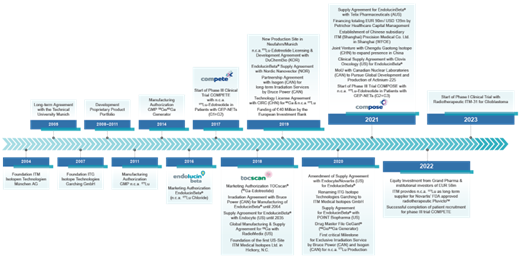
ITM Development History, Image Source: ITM Official Website
Currently, ITM and its subsidiaries have established GMP manufacturing capabilities and a robust global supply network, including innovative, state-of-the-art platforms for medical radioisotopes and generators, designed for next-generation targeted cancer diagnosis and therapy.
In September 2024, ITM appointed Andrew Cavey as CEO to lead the company’s growth and further solidify its leadership in innovation in radiopharmaceutical therapy. Mr. Cavey holds a degree in Life Sciences and Medicine from the University of Oxford and a Master of Public Health from Harvard University, bringing extensive industry experience. Prior to joining ITM, Andrew served as Senior Vice President and Global Program Leader for Hematology, Oncology, and Cell Therapy at Bristol Myers Squibb (BMS). Previously, Mr. Cavey was the Global Program Leader for Prostate Cancer at Novartis, where he co-led Novartis’s radioligand therapy development strategy and spearheaded the clinical development of the nuclear medicine pipeline, securing regulatory approvals for multiple radiopharmaceuticals in the United States and Europe.
Strengthening Partnerships to Optimize Supply Chain Segments
ITM’s product portfolio spans pharmaceuticals, equipment, and services, corresponding to radiopharmaceuticals and medical radioisotopes, radiolabeling and quality control equipment, and GMP-compliant radiolabeling services.
Lutetium-177 is currently the most promising and market-dynamic theranostic radionuclide for targeted radiotherapy. It can be used to prepare radiopharmaceuticals with tumor-targeting capabilities for both diagnostic and therapeutic purposes. In recent years, it has been widely applied in research and clinical practice of targeted radionuclide therapy in developed countries in Europe and the United States, achieving favorable outcomes.
Lutetium-177 can be produced via two methods, yielding carrier-added Lutetium-177 and no-carrier-added Lutetium-177, respectively. Compared with carrier-added Lutetium-177, no-carrier-added Lutetium-177 contains extremely low levels of the long-half-life impurity 177mLu, with a specific activity exceeding 3000 GBq/mg. It offers advantages such as reduced consumption of precursor compounds for labeling, extended shelf life of radiolabeled drugs, and easier disposal of radioactive waste. Therefore, no-carrier-added Lutetium-177 holds broader prospects for clinical application.
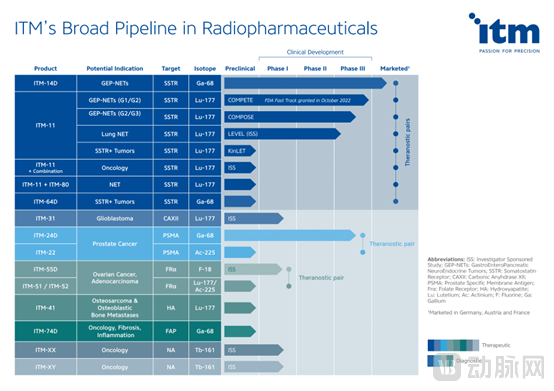
ITM Pipeline, Image Source: ITM Official Website
The radionuclide-drug conjugate (RDC) ITM-11, which uses carrier-free lutetium-177 as its radionuclide, has naturally become a focal product of interest to multiple stakeholders.
ITM-11, currently in Phase III clinical trials, is a radiopharmaceutical drug conjugate (RDC) that leverages radionuclide conjugation technology to target and treat gastroenteropancreatic neuroendocrine tumors (GEP-NETs). This drug conjugates carrier-free Lutetium-177 with a somatostatin analog, enabling targeted destruction of tumor cells by binding to somatostatin receptors (SSTRs) highly expressed on the surface of GEP-NETs. Compared to currently used carrier-added Lutetium-177 products, carrier-free Lutetium-177 offers higher specific activity and purity, generates fewer long-half-life impurities during production, and results in lower radioactive contamination. The product has received orphan drug designation from both the FDA and the EMA.
Meanwhile, ITM is also strengthening the supply chain for medical isotopes by expanding its commercial partnerships.
In April 2019, ITM Isotope Technologies Munich signed a strategic cooperation agreement with United Imaging Healthcare to collaborate in areas such as marketing, sales, imaging, and related products. Also in 2019, it entered into a cooperation agreement with China Isotope & Radiation Corporation for the large-scale GMP-compliant production of germanium-68/gallium-68 generators and carrier-free lutetium-177. As the partnership deepened, the two parties signed a joint venture agreement in 2021, committing to the domestic supply of next-generation theranostic medical isotopes.
Notably, in early 2022, Grand Pharma announced that the Group had subscribed for new shares in Germany’s ITM Isotope Technologies Munich SE for €25 million (approximately RMB 179 million), representing 1.31% of its enlarged share capital.
Therefore, Grand Pharma has obtained the exclusive rights to develop, manufacture, and commercialize three globally innovative RDC drugs developed by ITM in the Greater China region, including: 1) TOCscan for the diagnosis of gastroenteropancreatic neuroendocrine tumors®; 2) ITM-11 for the treatment of gastroenteropancreatic neuroendocrine tumors; 3) ITM-41 for the treatment of bone metastases from malignant tumors. This equity acquisition will deepen the further cooperation between Grand Pharma and ITM, and also serves as a successful case of in-depth collaboration between upstream and downstream enterprises in the domestic and international radiopharmaceutical industry.
Pain Points in the Upstream and Midstream Sectors Are Prominent; ITM Builds Supply Advantages Through Self-Sustaining Capabilities
The Radiopharmaceutical Financing Boom Continues to Rise. In 2023, the number of primary market financing deals in the radiopharmaceutical sector accounted for 2.2% of all innovative drug sector deals, while the compound annual growth rate (CAGR) of this proportion over the past five years (2019–2023) reached 26.9%. Since 2023, the total value of primary market financing deals in the global radiopharmaceutical sector has reached $980 million, a 42.9% increase from 2022, with early-stage to Series A rounds constituting a significant share.
ITM has also attracted significant attention in the primary market, having completed multiple rounds of financing.
HLC, a new-round investor in ITM Isotope Technologies Munich, believes that the radiopharmaceutical market is currently in its early stage of rapid growth and will enjoy sustained high prosperity driven by the surge in therapeutic radiopharmaceuticals.
According to Fortune Business Insights, the global radiopharmaceutical market is projected to expand from USD 8.4 billion in 2023 to USD 30.4 billion by 2030, with this high growth rate primarily driven by the rapid scale-up of therapeutic radiopharmaceuticals. The market size for therapeutic radiopharmaceuticals stood at USD 2.4 billion in 2023 and is expected to exceed USD 20 billion by 2030. Taking Novartis’s Pluvicto as an example, its peak annual sales are anticipated to reach USD 3–4 billion.
Therefore, RDC is considered one of the most promising development directions in the field of targeted radionuclide therapy.
The structure of Radiopharmaceutical Drug Conjugates (RDCs) is similar to that of Antibody-Drug Conjugates (ADCs), coupling precision-targeting molecules (monoclonal antibodies, peptides, or small-molecule ligands) with radionuclides via linkers and chelators. RDCs leverage antibody- or small molecule-mediated specific targeting to deliver radionuclides to the target site, thereby concentrating the radiation emitted by radioisotopes locally within the tissue. This mechanism exhibits a low propensity for drug resistance. RDCs are ushering in an era of precision targeted theranostics for radiopharmaceuticals, creating substantial growth opportunities in the radiopharmaceutical market.
Furthermore, due to their radioactive nature, radiopharmaceuticals face high barriers in terms of regulatory approvals, capital investment, and talent acquisition across the production of active pharmaceutical ingredients (APIs), manufacturing of radiopharmaceuticals, and their storage and distribution. The extremely stringent time-sensitivity requirements further exacerbate these challenges. Consequently, radiopharmaceutical companies capable of achieving scaled, full-industry-chain integration across the upstream and midstream segments are particularly scarce, significantly constraining the development of the downstream radiopharmaceutical market.
Specifically, the raw materials for most existing therapeutic radionuclides rely on a limited number of nuclear reactors worldwide. The production process involves a series of complex steps, making it difficult for midstream radiopharmaceutical companies to achieve large-scale mass production. These companies not only need to hold patented technologies for medical radionuclide production but also maintain stable, long-term collaborations with multiple upstream suppliers; otherwise, they lack supply chain advantages.
Taking Novartis’s blockbuster radiopharmaceutical, Pluvicto, as an example, it received FDA approval in March 2022 for the treatment of prostate-specific membrane antigen (PSMA)-positive metastatic castration-resistant prostate cancer, becoming the world’s first PSMA-targeting radioligand therapy (RLT). In its first full year on the market, Pluvicto achieved impressive sales of $980 million. Due to substantial demand, Pluvicto’s production capacity was once insufficient. Furthermore, because the radionuclide lutetium-177 used in Pluvicto has a half-life of only a few days, it cannot be stockpiled in advance, which has also limited the broader clinical application of Pluvicto. In addition, in June 2024, RayzeBio, a subsidiary of Bristol Myers Squibb (BMS), announced that it had suspended enrollment of new patients in the Phase III clinical trial of its radiopharmaceutical RYZ101, primarily due to a shortage of actinium-225, the radionuclide used in RYZ101. It has become a widespread consensus within the industry that shortages in upstream radionuclide supply are constraining industrial development.
In contrast, ITM has cultivated deep expertise in the medical isotope industry chain for many years, enabling autonomous supply of key raw materials. Currently, ITM has become one of the world’s largest producers of medical isotopes and is successfully transitioning from a manufacturing enterprise into a platform company in the radiopharmaceutical sector, integrating production, R&D, and supply chain operations.