

Smart Exoskeletons for Seniors: The 'Walking Miracle' Device Gains Traction in Booming Elder Care Market
As a series of national population policies are introduced and implemented, the public has gained an increasingly tangible awareness of the aging process. Driven by the urgency stemming from demographic shifts, the silver economy and the elderly health industry are seizing new market opportunities in addressing population aging.
Smart technology, as one of the efficient means to safeguard the health of older adults, has become an inevitable trend. The 14th Five-Year Plan for National Development of Aging Undertakings and the Elderly Care Service System proposes promoting the technological and intelligent upgrading of products for older adults; specifically, it calls for the development of exoskeleton-based rehabilitation training, assessment and training for cognitive impairment, communication training, and incontinence rehabilitation training.
Among these factors, mobility has a direct impact on the physical and mental health, social participation, and overall quality of life of older adults. As a popular intelligent product, exoskeleton robots can help elderly patients with disabilities regain walking function or provide enhanced assistance, thereby delivering value across multiple dimensions—including rehabilitation therapy, health maintenance, and daily living—earning them the reputation as a “miracle device for walking.”
In the 1960s, lower-limb exoskeleton technology began to emerge, initially for military applications and later gradually adopted in the field of rehabilitation therapy, with research abroad preceding that in China. Since the 1980s, the development and application of exoskeleton robots have garnered widespread global attention, achieving comprehensive advancement across the medical, industrial, and military sectors.
The actuation technology of exoskeleton robots directly impacts product performance and wearability, and is also a critical factor influencing their future development.
In recent years, the iteration of drive systems has propelled the development of exoskeleton robots: building upon traditional drive technologies, new actuation techniques have emerged utilizing novel actuators such as pneumatic artificial muscles, electroactive polymers, and magnetorheological fluids; furthermore, flexible/variable-stiffness actuators have been developed based on conventional actuators. These innovations in drive technology have simultaneously provided researchers both in China and abroad with new avenues for investigation.
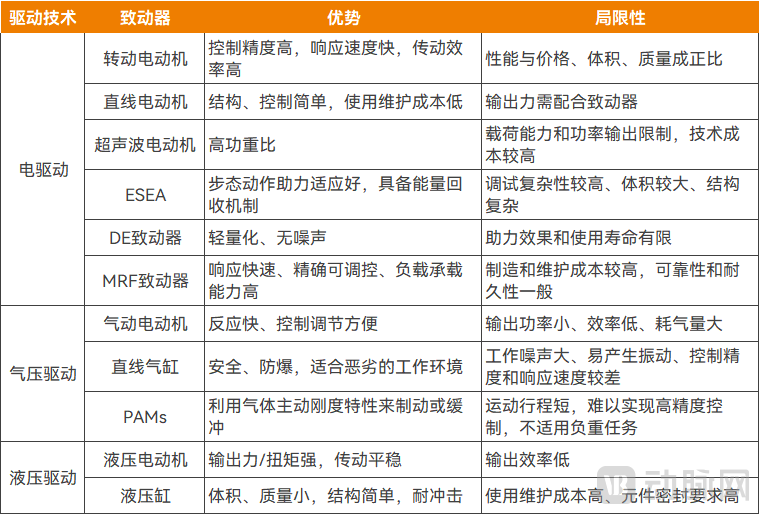
Summary of Drive Technologies and Actuators for Exoskeleton Robots, Including Their Advantages and Disadvantages; Source: Chinese Journal of Medical Equipment
Several representative exoskeleton robots have been applied in the medical field abroad, particularly for rehabilitation training.
ReWalk, a lower-limb exoskeleton robot developed by the Israeli company Lifeward (formerly ReWalk Robotics, which announced its name change to Lifeward in September 2024), is designed for patients with spinal cord injuries, incomplete paraplegia, stroke, and other conditions, helping them regain walking ability. It is the world’s first exoskeleton robot to receive FDA clearance. The ReWalk system primarily consists of a robotic gait device connecting the hip and knee joints on both sides, an external battery pack, a wireless mode selector, and sensors.
EksoNR is an exoskeleton robot developed by Ekso Bionics in the United States, designed for the rehabilitation of patients with stroke, spinal cord injury, and acquired brain injury—including injuries resulting from trauma, aneurysms, brain tumors, hypoxia, or other conditions. The indications for EksoNR have also been expanded to include multiple sclerosis.
In addition, companies such as Japan’s Cyberdyne, Switzerland’s Hocoma, the United States’ Parker Hannifin, New Zealand’s Rex Bionics, and South Korea’s Samsung have also launched multiple exoskeleton robots.
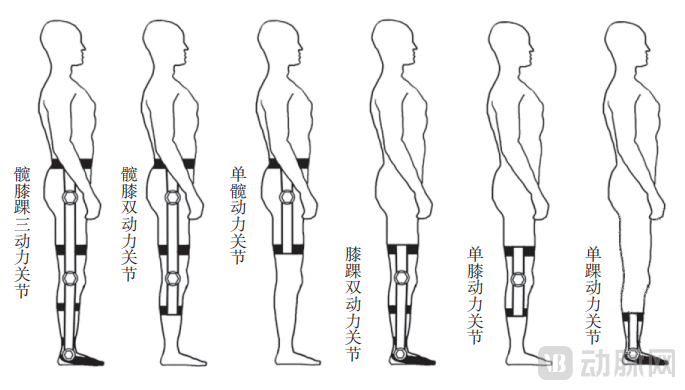
Lower Limb Exoskeleton Robots with Different Actuated Joints, Image Source: "Journal of Biomedical Engineering"
Globally, exoskeleton robots have played a pivotal role in facilitating rehabilitation training for elderly individuals with declining motor function, thereby enhancing their mobility and quality of life. Meanwhile, rapid technological iterations are driving these products toward greater mechanization and intelligence.
Although the research, development, and application of exoskeleton robots in China started relatively late, with increased investment in scientific and technological R&D, advancements in robot manufacturing technologies, and the strategic presence of multinational corporations in the Chinese market,In ChinaA number of innovative exoskeleton robotics companies have emerged, with their products applied to various rehabilitation training programs.
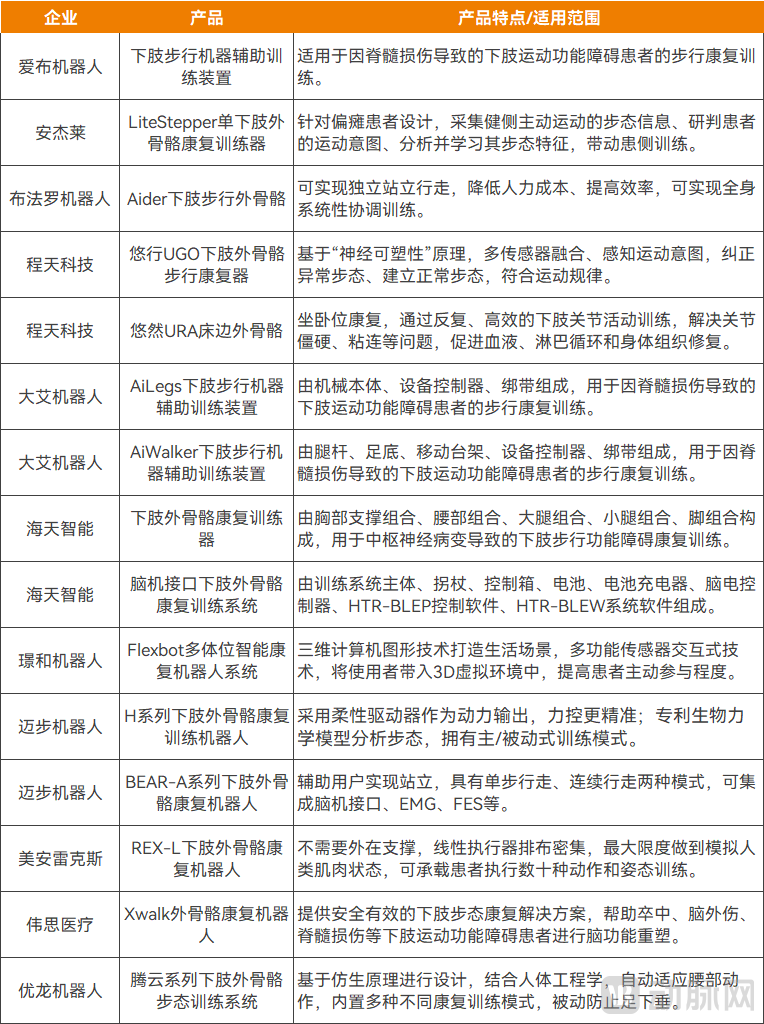
Some Rehabilitation Exoskeleton Products Approved as Class II Medical Devices in China, Source: National Medical Products Administration, Official Websites of Various Companies
The causes of motor dysfunction are numerous, and the treatment modalities required by patients vary. Taking lower-limb exoskeleton robots as an example, these devices primarily assist patients with standing and walking. The powered joints mainly include the hip, knee, and ankle, enabling flexion and extension at the hip joint, flexion and extension at the knee joint, and dorsiflexion and plantarflexion at the ankle joint. Overall, lower-limb exoskeleton rehabilitation robots primarily serve toGait Correction,Enhanced assistance, movement compensation, and other effects.
In terms of gait correction, lower-limb exoskeleton robots have been widely applied in rehabilitation medical institutions. Their main features include multiple active joints and advanced sensing and intention recognition technologies.These devices focus on gait correction while preventing secondary injuries and rigid mechanical friction. Their core design lies in accurately identifying the patient's movement status and providing safe corrective forces.
Among these products, the UGO rehabilitation exoskeleton launched by Chengtian Technology is designed for patients with lower-limb motor dysfunction caused by spinal cord injury, stroke, lower-limb muscle weakness, or other neurological disorders. Based on the principle of “neuroplasticity,” the product employs multi-sensor fusion to detect movement intentions, correct abnormal gait patterns, and restore normal gait.
Angeles’ LiteStepper single-leg exoskeleton rehabilitation trainer is specifically designed for hemiplegic patients, assisting them in conducting rehabilitation training for the affected lower limb. The device collects gait data from the active movements of the patient’s unaffected side, interprets movement intent, and analyzes and learns their gait characteristics, thereby guiding the affected side through motor relearning rehabilitation exercises that are synchronized with the unaffected side.
Maibu Robotics’ H-Series Lower Limb Exoskeleton Rehabilitation Training Robot utilizes patented flexible actuators for power output and provides dorsiflexion assistance through its proprietary patented powered ankle joint. By facilitating repetitive flexion and extension exercises with assistance, it corrects foot drop and foot inversion, enhances balance, and rectifies abnormal gait patterns.
In terms of power assistance, the product is primarily designed to assist elderly individuals with limited mobility due to muscle weakness, particularly those who can walk independently without external support; for elderly patients experiencing muscle strength decline or those undergoing post-fracture rehabilitation, the design emphasizes providing additional force support.
For example, Fourier Intelligence’s ExoMotus M4 can assist patients with various types of lower-limb motor impairments in achieving early standing and gait training, providing correct sensory input during the early stages of rehabilitation to inhibit the formation of abnormal gait patterns.
The core features of assistive augmentation products include light weight, long battery life, and precise gait recognition capabilities, which can be achieved through a lightweight flexible exoskeleton design.
For instance, Siyi Intelligence’s EasyWalk lower-limb soft exoskeleton helps address gait impairments in patients with stroke, traumatic brain injury, and other conditions. The product features a soft structure, weighs only 3 kg, is concentrated at the waist for easy donning, and avoids the forced mechanical gait patterns associated with traditional rigid exoskeletons.
In terms of motor compensation, the product is primarily designed for paraplegic patients who have completely or partially lost their motor function, compensating for their impaired mobility through the device's movement capabilities.Such devices prioritize safety and stability in their design, accommodate patients’ mobility needs in daily life, and strive to simulate a natural gait.
Taking the Aider robot launched by Buffalo Robotics as an example, the product enables independent standing and walking. It can be used for gait training, lower limb motor training, limb coordination training, strength training, cognitive training, and postural control training, thereby facilitating systematic whole-body coordination training. It is suitable for patients with paraplegia or quadriplegia resulting from conditions such as syringomyelia, myelitis, and spinal cord injury.
In recent years, rehabilitation exoskeleton robots have actively explored technological integration to facilitate product upgrades and iterations, thereby further enhancing their safety, efficacy, and intelligence.
Brain-computer interface (BCI)-based exoskeleton systems translate motor intentions into control signals for the exoskeleton, enabling patients to perform movements driven by the device. This approach provides richer sensorimotor feedback, enhances neural plasticity in terms of structure and function, and achieves intention-driven closed-loop feedback, thereby offering a novel therapeutic strategy for the rehabilitation of lower-limb motor function.
Virtual reality (VR) and augmented reality (AR) technologies can create immersive virtual environments or overlay the virtual world onto real-world settings, thereby serving as a bridge between the digital realm and physical scenarios. When applied to exoskeleton-based rehabilitation, these technologies integrate rehabilitation training systems into real-world environments, providing users with authentic and diverse interactive experiences. This approach is particularly suitable for home-based rehabilitation settings where there is no intervention from rehabilitation therapists.
Furthermore, with the continuous advancement of artificial intelligence (AI) technology in recent years, AI has been applied to exoskeleton robots to assist patients in functional walking and gait training, as well as to evaluate the safety, tolerability, and efficacy of walking function. Consequently, the research and development of intelligent robots capable of deep learning has become an inevitable trend. For instance, Aibu Robotics has developed an intelligent exoskeleton robot based on AI algorithms, featuring specialized training modes to help patients achieve comprehensive neurological rehabilitation.
Therefore,Frontier technologies such as brain-computer interfaces, artificial intelligence, virtual reality, and augmented reality are gradually being integrated into the research, development, and manufacturing of exoskeleton robots. This integration enables exoskeleton robots to truly function as intelligent wearable devices that operate in coordination with or parallel to the user, with the aim of enhancing physical capabilities and executing predefined movements.
Overall, as China’s population aging deepens, and against the backdrop of an overall shortage of rehabilitation and nursing resources, exoskeleton rehabilitation robots can help improve the efficiency and quality of rehabilitation for the elderly within medical institutions.Elevation。With the implementation of a series of aging-related policies, including the deferred retirement policy, older adults are placing greater emphasis on functional rehabilitation for mobility, further expanding industry opportunities.
Against this backdrop, the application scenarios for exoskeleton robots are rapidly expanding from medical institutions to home settings, where they are used during the mid-to-late stages of rehabilitation or as daily ambulation aids to help patients better restore function, reintegrate into society, and prevent recurrence. Currently, multiple companies have deployed home-based rehabilitation exoskeleton robots,Consumer-grade mobility aids,Addressing issues related to personal rehabilitation training and daily ambulation.
Among them, Chengtian Technology has launched the UGO Rehabilitation Exoskeleton Personal Edition, designed for personal rehabilitation use in community and home settings. The device features a mechanical fixation and strap-based protection design, with manual scale adjustments based on the user’s body parameters. It is easy to operate, allowing non-professionals to assist users with donning and operation after brief training.
Siasun Robot’s lower-limb exoskeleton trainer can also be used in home settings, under regular communication between the user and professional physicians or therapists, to help hemiplegic patients stimulate active participation of the affected limbs and improve their daily living standards. It also assists patients in correcting abnormal gait patterns, foot inversion/eversion, and foot drop, improves weight distribution between both legs, increases ground contact time on the affected side, and enhances walking speed.
Clearly, exoskeleton rehabilitation robots hold significant application value in assisting the elderly in transitioning from disease recovery to a state of health. Meanwhile, exoskeleton technology has been widely adopted in labor-intensive sectors such as industry and logistics, alleviating the physical burden on workers during prolonged tasks and reducing issues like lumbar muscle strain. For instance, Taixi Intelligence’s active waist-hand exoskeleton robot provides intelligent assistance to the user’s thighs, waist, and hands; Aoshang Intelligence’s exoskeleton robots cover the upper limbs, waist, lower limbs, and full body, and the company has also launched “thousand-yuan-level” exoskeleton products; Maibao Intelligence’s products have penetrated multiple fields, including industrial logistics, automotive assembly, and domestic services.
Therefore, for elderly individuals who continue to engage in physical labor, industrial exoskeleton robots can also play a role in maintaining health. It is understood that Japan, as one of the countries with the highest levels of population aging globally, has seen the development of exoskeleton robotics primarily driven by social demands arising from its aging demographic. In Japan, industrial giants have placed equal emphasis on medical and industrial applications in their research and development of exoskeleton products. Beyond medical applications aimed at assisting the elderly and people with disabilities, many companies are also targeting industrial applications while filing patents, specifically leveraging exoskeleton technology to reduce the physical burden on workers during operations.
Exoskeleton robots share technological commonalities across medical and industrial applications, and a synchronized development strategy can enhance R&D efficiency.However, domestic companies have yet to extensively engage in integrated R&D that bridges medical and broad industrial applications. As population aging and labor shortages become increasingly prominent, addressing elderly rehabilitation while also tackling health maintenance in work environments—tailored to the physiological characteristics of older adults—holds promise as a key pathway for the further expansion of the exoskeleton robot market.
However, it is important to note thatExoskeleton robots are generally expensive, with prices in the global market ranging from tens of thousands to millions. The cost of core components and end-product pricing has become a major factor constraining the commercialization of exoskeleton robots. In addition, regardless of the scenario, most elderly people have limited understanding of exoskeleton devices, which also hinders product adoption to some extent.
Of course, exoskeleton robots are also applied in rehabilitation training for children and other corresponding diseases, which will not be discussed in this article.
For the aging population, market demand for exoskeleton robots is already a certainty. In the future, with advancements in technology and increased consumer spending power and willingness, will it be possible to achieve “one exoskeleton per person” among elderly individuals with mobility impairments or reduced physical function due to disease, thereby enabling them to enjoy a better quality of life in their later years?This also depends on the industry’s ability to reduce product costs through continuous technological iteration, further validate product safety and efficacy, and enhance target populations’ awareness of exoskeleton products.
References:
Association Between Labor Force Participation and Healthcare Service Utilization Among Middle-Aged and Older Adults: Health Status as a Mediating Variable
Population Studies: Current Status, Characteristics, and Trends of Labor Force Participation Among the Young-Old in China
Biomedical Engineering: Classification and Current Application Status of Lower Limb Exoskeleton Rehabilitation Robots
Technological Advances: Research Progress and Trends in Lower-Limb Exoskeleton Robots
Medical and Healthcare Equipment: Research Progress on Drive Technologies for Wearable Exoskeleton Robots