

Accelerating Medical AI Development: MATLAB Integrated with NVIDIA Holoscan for High-Efficiency Workflows
NVIDIA
Artificial Intelligence Computing Service Provider
AI is fundamentally transforming healthcare and is increasingly seen as poised to achieve within the next decade biological advances that were originally expected to take the entire 21st century, including curing rare diseases. The integration of AI has evolved from an optional add-on in medical application scenarios to a necessity, thereby raising the bar for the development and responsiveness of medical AI solutions.
As one of the largest providers of foundational AI computing power, NVIDIA has been continuously refining its AI ecosystem to offer developers a faster and more high-performance development environment. In May this year, NVIDIA partnered with MathWorks to integrate MATLAB—the most widely used programming and computing platform—into the NVIDIA Holoscan platform. This integration will significantly accelerate the progress of medical AI development, thereby enabling medical device developers to leverage advanced AI technologies more rapidly.
Currently, the most mature applications of medical AI remain in the field of imaging, including computer-aided diagnosis based on medical images, 3D surgical planning and navigation, and even robotic-assisted surgery.
These real-time medical AI systems all follow a similar processing workflow: data is first acquired via sensors, then processed through the data domain, and finally visualized to support human decision-making. The core of their application development lies in optimizing the low-latency pipeline from sensors to display devices, which involves the integration of multiple algorithms, including signal processing, ISP tuning, image enhancement, and AI computation.
NVIDIA has built NVIDIA Holoscan, a sensor data processing platform founded on architectural goals of performance, usability, and production readiness, to deliver real-time data insights that help streamline the development and deployment of AI and high-performance computing (HPC) applications.
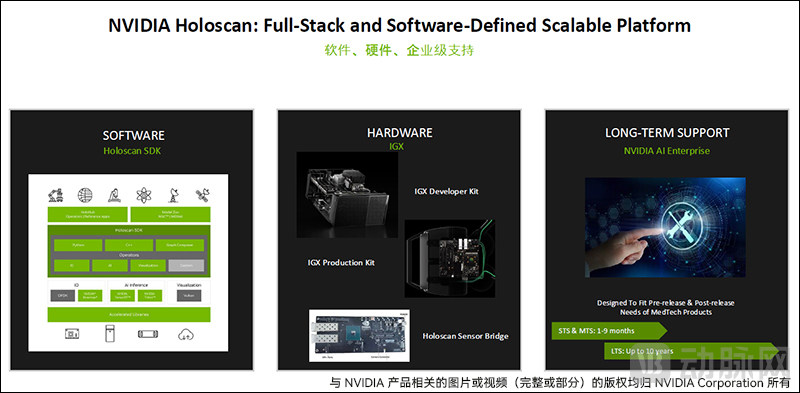
The NVIDIA Holoscan platform primarily consists of three components: software, hardware, and services. The most critical component is the NVIDIA Holoscan SDK, which provides developers with a low-code, high-performance development environment, enabling them to build workflows using APIs such as MATLAB, Python, or C++. It is currently the only single platform that integrates data movement, accelerated computing, real-time visualization, and AI inference while ensuring application performance, thereby reducing complexity and accelerating time-to-market.
NVIDIA Holoscan supports a variety of NVIDIA AI hardware platforms to meet diverse requirements for power, size, cost, computing, and configuration. In terms of services, NVIDIA Holoscan also provides full-stack service support with a 10-year lifecycle for the medical device industry through NVIDIA AI Enterprise, catering to the specific characteristics of this sector.
At every step of the sensor processing pipeline, NVIDIA Holoscan delivers optimized performance while minimizing development complexity.
During the sensor data processing stage, the NVIDIA Holoscan Sensor Bridge can convert sensor signals into network signals and directly input them into the GPU memory of the computing platform, thereby enhancing the system’s real-time performance and scalability. Traditional hardware-dependent signal processing can also be implemented through software development leveraging GPU computing. MATLAB enables faster conversion of algorithmic concepts into GPU code and Holoscan application modules.
Meanwhile, it achieves an ultra-low latency of just 10 ms even under demanding conditions of 4K resolution at a 240Hz refresh rate, and is equipped with a transmission latency measurement tool capable of capturing complete end-to-end latency data for video processing applications. Furthermore, developers can access AI reference workflows via NVIDIA Holoscan to meet the requirements of medical video streaming applications such as endoscopy and ultrasound imaging.
Since its launch, NVIDIA Holoscan has seen multiple successful applications in the medical AI sector. For instance, with the support of NVIDIA Holoscan, Moon Surgical’s surgical robot obtained EU CE certification within 18 months.
Nevertheless, GPU-based AI algorithms still face challenges in high-performance deployment. This is because achieving acceleration with NVIDIA’s AI accelerator cards requires compiling commonly used MATLAB code into CUDA programs that can directly operate on the GPU. Historically, this process has relied on manual programming, which is time-consuming and prone to errors. Additionally, the difficulty in selecting from numerous candidate algorithms further increases development costs.
To address this issue, NVIDIA has partnered with MathWorks to integrate MATLAB into NVIDIA Holoscan, featuring over 1,000 built-in functions that enable developers to directly leverage NVIDIA GPUs within MATLAB. As a result, developers no longer need to perform manual compilation or possess CUDA programming expertise; instead, they can use GPU Coder to automatically generate optimized CUDA code from MATLAB scripts and Simulink models.
The generated code includes CUDA kernels for the parallelizable portions of deep learning, embedded vision, and signal processing algorithms. It is portable across all NVIDIA GPUs, can be automatically deployed on cloud, desktop, and embedded GPUs, and can leverage high-performance optimization libraries such as NVIDIA TensorRT to achieve superior performance. Developers can also integrate the generated CUDA code into their projects as source code or static/dynamic libraries and compile it for NVIDIA GPUs.
GPU Coder can also analyze the generated CUDA code to identify performance bottlenecks and potential optimization opportunities. Bidirectional linking enables developers to trace between MATLAB code and the generated CUDA code. Furthermore, developers can verify the numerical behavior of the generated code through Software-in-the-Loop (SIL) and Processor-in-the-Loop (PIL) testing.
All of these will significantly reduce development complexity and time. According to developers at NASA, MATLAB and GPUs can shorten the analysis time for wind tunnel tests—from 40 minutes in the past—to under one minute.
Currently, GPU Coder has been widely adopted. M&R Technology used GPU Coder to automatically generate CUDA code, accelerating simulations of digital human models in medicine.
PPG (photoplethysmography) is an optical technique for measuring changes in blood vessel volume and is widely used in heart rate, heart rate variability, respiration, and blood oxygen saturation monitoring. Previously, the design iteration and validation of PPG systems required volunteer participation, which was time-consuming and labor-intensive. M&R Technology developed a computational human body model that employs ray-tracing algorithms to simulate PPG signals, but this process takes several hours.
By developing custom algorithms and leveraging libraries such as cuBLAS, M&R Technology automatically generates CUDA code and performs performance optimization using GPU Coder, accelerating algorithm execution by hundreds of times. Depending on the data volume, GPU acceleration reduces processing time from hours to minutes or even seconds, significantly enhancing development efficiency.
In addition, a wider range of medical application scenarios and medical devices can be accelerated and AI-enabled through GPU Coder. From 14:00 to 15:00 on October 11, technical and industry experts from NVIDIA and MathWorks will provide a comprehensive overview of the NVIDIA Holoscan sensor data processing platform, the NVIDIA IGX™ industrial-grade edge AI platform, and the integration of MATLAB with the NVIDIA Holoscan platform, while also discussing how to rapidly transform conceptual prototypes into product designs.
In addition, technology and industry experts will share opportunities for free hands-on practice with GPU Coder in the development of medical applications. These include the rapid GPU deployment and optimization of dehazing algorithms based on dark channel prior for endoscopy, the deployment and optimization of feature point matching for rigid laparoscopic images on embedded platforms, and the use of GPU acceleration for ultrasound signal beamforming and performance optimization in medical ultrasound.
Packed with valuable insights—a must-attend for medical AI developers. Scan the QR code below to register for the conference.

For more information on NVIDIA’s healthcare AI solutions, please contact Synnex International Product Manager: Hai-Gen Peng, 13924582380, Email: williampeng@synnex.com.tw