

QiHuan ZhiHang Reduces Pharma IP Screening Costs and Time by 90% with Proprietary AI-PASA Algorithm
“No patents, no new drugs.” Accompanying this reality are risk factors such as patent disputes, restrictions on patent application, and patent litigation. Patents also serve as a Damocles’ sword hanging over all pharmaceutical companies, possessing the powerful ability to determine their “fate.” As nations and industries place increasing emphasis on intellectual property rights, major patent disputes in the pharmaceutical sector occur from time to time.Accurately forecasting patent risks in a cost-effective manner has become a critical concern for pharmaceutical companies throughout the entire lifecycle, from initial R&D to product launch and commercialization.
Current pharmaceutical patent screening, analysis, and agency services are primarily focused on intellectual property law firms, specialized patent agencies, and certain third-party enterprises such as contract research organizations (CROs).This is a labor-intensive industry with extremely high professional barriers, yet it remains knowledge-intensive.On the one hand, the screening and analysis of pharmaceutical patents require practitioners to possess both domain knowledge in medicine and pharmacy, as well as the analytical and evaluative capabilities of patent attorneys, resulting in high labor costs. On the other hand, patent screening and subsequent analysis involve extensive repetitive manual work, leading to significant costs and often failing to ensure timeliness.
Furthermore, although pharmaceutical patent information constitutes public data, it imposes stringent requirements on database construction. High-quality databases containing detailed information such as patent compound structures are prohibitively expensive, while conventional databases often suffer from incomplete coverage and inaccuracies. Moreover, traditional semantic search and classification code-based retrieval are prone to omissions and matching errors in pharmaceutical patent searches, making it difficult to achieve high-throughput compound screening and other related tasks through manual efforts alone.
Shanghai Qihuan Zhihang Pharmaceutical Technology Co., Ltd. (hereinafter referred to as “Qihuan Zhihang”) is an AI technology company specializing in pharmaceutical patent data analysis. The company’s proprietary AI platform for the pharmaceutical patent domain, AI-PASA, empowers the entire pharmaceutical patent lifecycle with intelligence and automation, providing clients with low-cost, high-precision patent analysis and consulting services.
“AI-PASA is akin to the upgrade of traditional craftsmanship to automated, intelligent industrial production lines, leveraging AI computing power to liberate repetitive and meticulous tasks in pharmaceutical patent analysis, thereby saving time, effort, and costs,” stated Mou Chen, Co-founder of Qihuan Zhihang, in an interview with VCBeat. He added that Qihuan Zhihang aims to enable pharmaceutical companies, law firms, and related third-party service providers to apply intellectual property more conveniently, quickly, and cost-effectively, while using AI empowerment to mitigate risks associated with human error.
AI-PASA, Qihuan Zhihang’s proprietary AI-assisted patent search and analysis algorithm. Leveraging exclusive OCR (Optical Character Recognition) technology, it directly extracts key patent information—including text, molecular structures, and compound structures—from publicly available patent data, converts multi-format data into standardized patent documents, and evaluates infringement risk by algorithmically comparing these standardized documents with client technologies to generate an infringement risk rating.
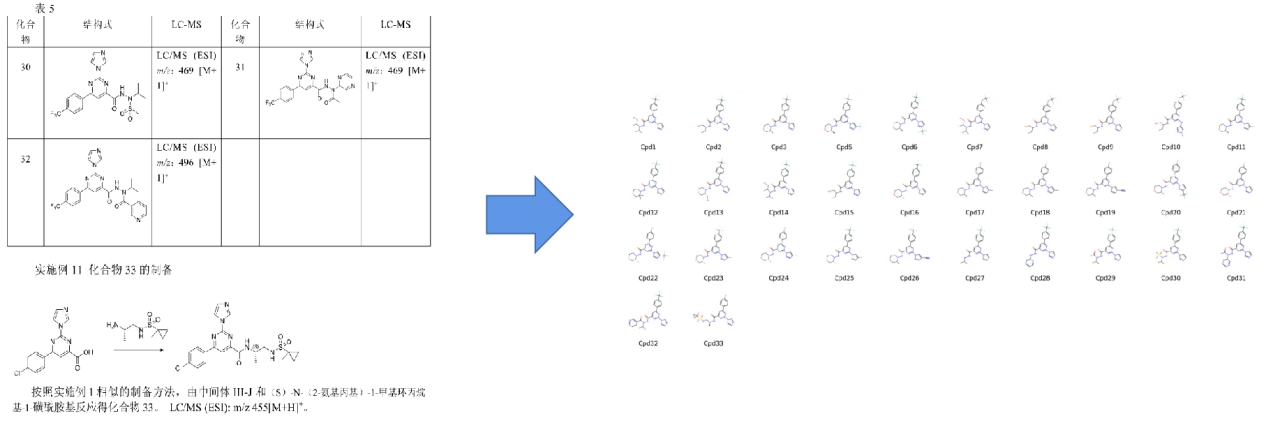
OCR Recognition and Compound Standardization of AI-PASA
Taking FTO (Freedom to Operate) as an example, Qihuan Zhihang leverages the AI-PASA platform to significantly reduce the time and labor costs associated with patent searches and preliminary data processing, lowering both price and delivery time to one-tenth of the original.Meanwhile, for large-scale candidate compounds, Qihuan Zhihang enables high-throughput FTO analysis of relevant patents.
The underlying logic and algorithms of the AI-PASA platform are derived from the founding team of Qihuan Zhihang’s “China Partners”: Mou Chen, a Master of Biochemistry from Fudan University with over 10 years of experience in pharmaceutical CROs; Li Huanran, a Ph.D. from Shanghai Jiao Tong University with 10 years of experience in pharmaceutical intellectual property; and Li Jian, a Ph.D. from Fudan University with 10 years of IT industry experience.
Currently, the AI-PASA platform is applicable to small-molecule drugs, antibodies/ADCs, RNA/mRNA therapies, cell and gene therapies, peptide-based therapeutics, and more, covering both innovative drugs and generic medicines.
Specifically, the Qihuan Zhihang team will precisely design search strategies based on client needs, and validate and supplement them using multiple patent infringement analysis methods.For instance, in the case of small-molecule drugs: ring spectrum comparison—calibrating the ring structures of all patented compounds and test compounds to generate spectra for comparison; Markush generic formula comparison—generating multiple combinatorial fragments based on the patented Markush generic formulas and performing sequential comparisons using computer programs; and visualized structural difference comparison—AI-PASA can automatically rotate molecules for alignment and highlight differential functional groups.
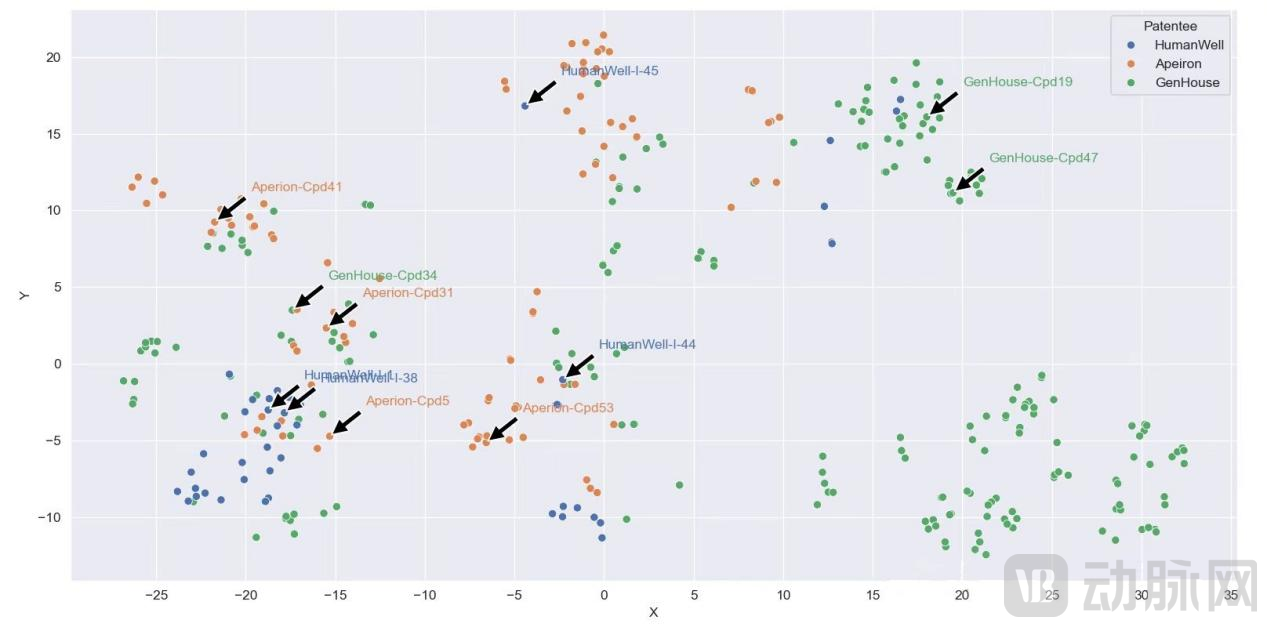 AI-PASA visualizes all compounds from three patents, where the distance between two points represents the similarity of the corresponding molecules.
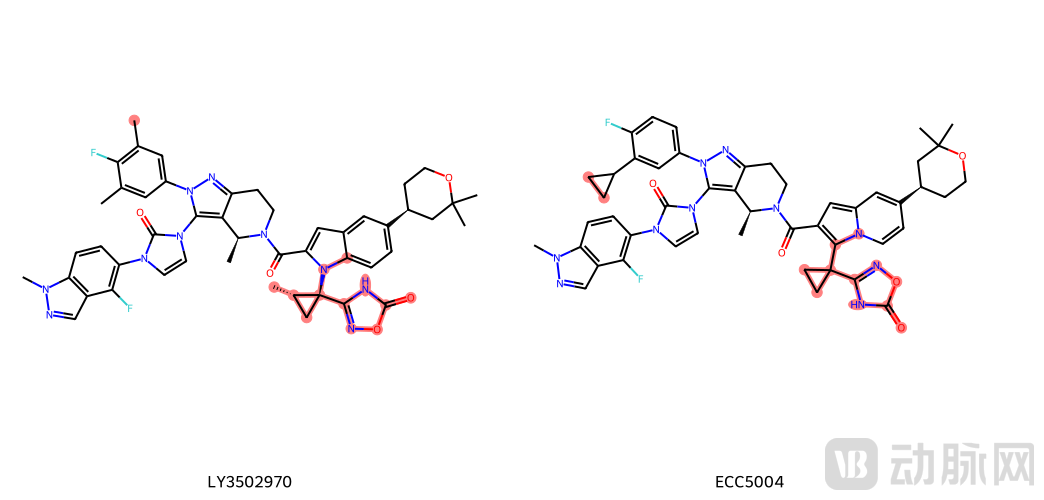
Visual Comparison of Structural Differences
Li Huanran noted, “Traditional manual comparison is time-consuming and labor-intensive, and may be subject to significant human error. AI-PASA leverages calculations from multiple diverse models that complement and cross-validate one another, thereby achieving multi-layered computational verification. If discrepancies arise among the conclusions of different models, we proceed to a manual review stage.” This approach of multi-layered computation and comparison is integrated throughout the entire workflow of AI-PASA, ensuring the accuracy of data results.
With a significant reduction in FTO costs, pharmaceutical patent screening will become more accessible to innovative drug companies. By substantially shortening the cycle and lowering the cost of patent data extraction, QiHuan ZhiHang aims to safeguard pharmaceutical companies throughout the entire process—including R&D, manufacturing, and commercialization—across multiple stages, thereby mitigating risks.
“At Qihuan Zhihang, clients can identify patent risks associated with early-stage compounds at a relatively low cost. In the past, such services were difficult to deliver through traditional law firms or intellectual property agencies due to high labor costs and resource constraints. However, for pharmaceutical companies, the absence of patent screening and protection during the process of narrowing down hundreds of compounds to candidate clinical projects would result in substantial losses.”Li Huanran emphasized that Qihuan Zhihang can fill the gap in patent screening for innovative pharmaceutical companies during their early stages.
Mou Chen noted that some clients of Qihuan Zhihang do not necessarily require comprehensive patent search and analysis services; for instance, they may only need identification and standardization of patented compounds, similarity ranking of patent sequences, and generalization of small-molecule generic formulas.In these areas, the low-cost AI-PASA platform can provide customers with flexible, stage-specific services.
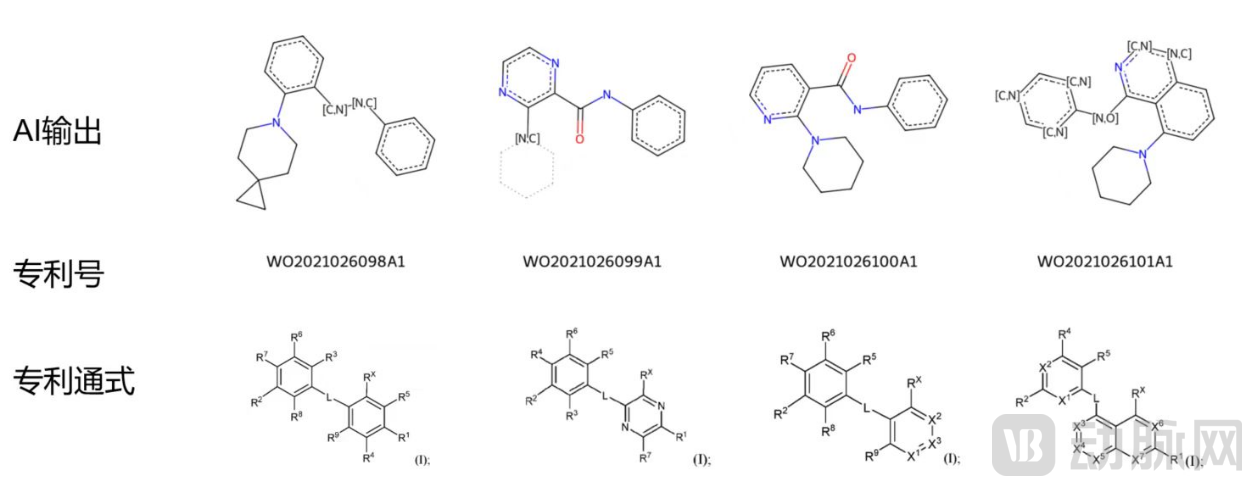
AI-PASA's Generalization of Patent Generic Formulas
“One of Qihuan Zhihang’s strategic positions is to provide outsourced services for third-party companies,” said Mou Chen. The newly founded Qihuan Zhihang is currently exploring a variety of collaboration models. In addition to partnering with pharmaceutical companies, it is actively engaging in cooperation with CROs, law firms, and investment consulting firms. “The core of AI-PASA is to assist stakeholders in the pharmaceutical intellectual property sector by handling repetitive tasks where AI can achieve higher accuracy.”
Those who can better leverage AI tools and integrate them more effectively with industrial practices will secure the informational high ground. As a consulting services firm, Qihuan Zhihang adheres to an asset-light, small-team entrepreneurial path.Since its inception, Qihuan Zhihang has launched the “Patent Discourse” WeChat Official Account, facilitating resource connectivity through pharmaceutical patent analysis, patent information compilation, and sharing of patent cases.Currently, Qihuan Zhihang aims to connect with more intellectual property professionals, pharmaceutical companies, and other relevant stakeholders to build an AI-enabled ecosystem for pharmaceutical intellectual property around the AI-PASA platform.
In the future, Qihuan Zhihang will deepen its expertise in the field of pharmaceutical intellectual property, optimizing the existing computational logic and processes of the AI-PASA algorithm to achieve faster analysis with lower computational power. Meanwhile, Qihuan Zhihang aims to collaborate with clients to thoroughly explore key areas where AI can accelerate efficiency and enhance productivity, actively improving the applicability of AI-PASA. The company strives to gradually evolve into an AI technology enterprise that liberates professionals from tedious and inefficient tasks, thereby enhancing the efficiency of patent screening for pharmaceutical companies.