

Nami Surgical Secures $4M Funding to Accelerate Commercialization of High-Performance, Miniaturized Ultrasonic Surgical Device

Nami Surgical
Developer of Miniaturized Ultrasound Medical Devices
In May 2024, Nami Surgical announced that it had secured an investment of up to $4 million. This funding undoubtedly provides a strong boost to the innovative company, which is dedicated to the research and development of high-performance medical ultrasound equipment.According to Nami Surgical, the funds will be primarily used to further advance the research and development as well as market promotion of its first revolutionary product—the Nami S™ Mini Ultrasonic Scalpel.
Nami S™, the flagship product of Nami Surgical, represents a qualitative leap in performance compared to traditional ultrasonic scalpels. By employing advanced ultrasonic frequency conversion technology, it enables the blade tip to generate more stable and efficient mechanical vibrations, thereby significantly reducing damage to surrounding tissues while ensuring cutting precision.
Born during the rapid growth phase of ultrasonic surgery, it took three years to launch its first product.
Nami Surgical, established in 2021, develops compact ultrasonic medical devices for surgical applications and supports medical device companies in driving innovation within the field of ultrasonic surgery. Notably, influenced by multiple factors including the global COVID-19 pandemic, the market for ultrasonic scalpels has demonstrated strong growth potential. According to research data from QYResearch, the global market size for ultrasonic scalpels reached approximately RMB 20.1 billion in 2022 and is projected to grow to RMB 35.2 billion by 2029, representing a compound annual growth rate (CAGR) of 8.5% during this period.
Against this market backdrop, Nami Surgical successfully launched the Nami S™, a high-performance, miniaturized ultrasonic surgical scalpel, after three years of development.
In fact, as an advanced medical device, the ultrasonic scalpel operates by converting electrical current into mechanical vibrations via an ultrasonic frequency generator, causing the metal blade to vibrate at high frequencies. This vibration frequency typically reaches up to 55.5 kHz, which induces vaporization of tissue water, rupture of protein hydrogen bonds, and cell disintegration, thereby forming a viscous coagulum. Meanwhile, the frictional heat generated by the vibrations, combined with the compressive effect from tissue clamping, enables rapid completion of both cutting and hemostasis in a single process, significantly enhancing surgical efficiency and safety.
To further enhance the performance of ultrasonic scalpels,Dr. Nico Fenu, founder of Nami Surgical, dedicated himself to the “ultrasonic surgery” project during his postdoctoral fellowship, striving to integrate miniature ultrasonic surgical instruments with robotics to drive further innovation in surgical techniques.
Meanwhile, Dr. Rebecca Cleary, another co-founder, has also achieved remarkable success in the application of ultrasound technology. During her doctoral studies at the University of Glasgow, she focused on the use of ultrasonic needles for bone penetration. Her outstanding research earned her the R.W.B. Stephens Award and the Dr. Alan Stirling Brown Award, both presented by Elsevier at the International Congress on Ultrasonics (ICU).
Miniaturized Ultrasonic Scalpel for Faster and Safer Procedures
As the flagship product of Nami Surgical,Nami S™ is the first miniaturized, ultrasonic scalpel-compatible robotic dexterous joint. Its enhanced precision and flexibility enable surgeons to easily handle various complex and delicate surgical tasks, thereby significantly improving surgical success rates and accelerating patient recovery.
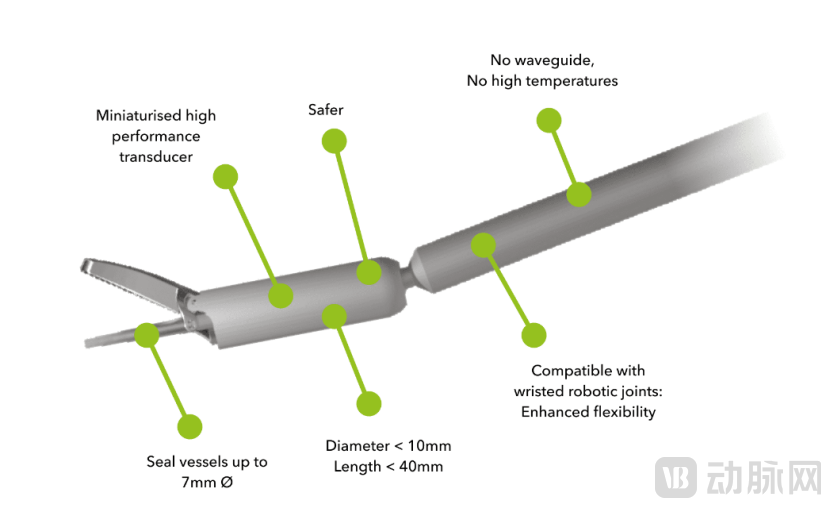
Nami S™ Product Image, from the Official Company Website
The core advantage of Nami S™ lies in its compact yet powerful robotic wrist. This design not only enables easy integration with various surgical robots but also significantly enhances surgical flexibility and maneuverability. Meanwhile, as a critical tool in modern surgery, the ultrasonic scalpel’s versatility, precision, and safety are perfectly embodied in the Nami S™. This surgical instrument can effortlessly cut and coagulate soft tissue while effectively sealing vessels up to 7 mm in diameter, providing surgeons with a broader and more flexible range of surgical options.
In the robotic wrist of Nami S™, the ultrasonic scalpel is seamlessly integrated to form a cohesive unit. When the device is not powered on, its blade functions like a conventional manipulator, allowing surgeons to perform various delicate maneuvers with ease. Upon activation, the ultrasonic scalpel rapidly engages, leveraging its unique high-frequency vibration and thermal effects to assist surgeons in critical procedural steps such as cutting and hemostasis.
Domestic Ultrasonic Scalpel Industry Enters a “Do-or-Die” Phase
Driven by its critical role in clinical applications, the market size of ultrasonic scalpels in China continues to expand. According to the "Report on Energy-Based Surgical Devices in China" released by VCBeat Research Institute, the growth rate of China’s ultrasonic scalpel market is significantly higher than that of the global market. The market size exceeded RMB 12.5 billion in 2021, with the compound annual growth rate (CAGR) from 2020 to 2025 estimated at 24.9%. These figures not only reflect the widespread adoption of ultrasonic scalpels in China’s healthcare market but also indicate substantial future development potential in this field.
In the ultrasonic scalpel industry, Johnson & Johnson, as the market leader, has long been regarded as the "gold standard" for its products.. However, with the continuous development of the market, an increasing number of companies have begun to innovate upon Johnson & Johnson’s foundation in search of breakthroughs. Consequently, from the perspective of product design, the current ultrasonic scalpel industry has formed two major camps: one comprises console-based ultrasonic scalpels, represented by companies such as Johnson & Johnson, Jianxin Medical, and Houkai Medical; the other consists of console-free ultrasonic scalpels, represented by companies such as Covidien (USA) and Ansukang. Console-based ultrasonic scalpels currently dominate the industry, while console-free models integrate all functions into the handpiece, thereby reducing hospital procurement costs and simplifying operational procedures.
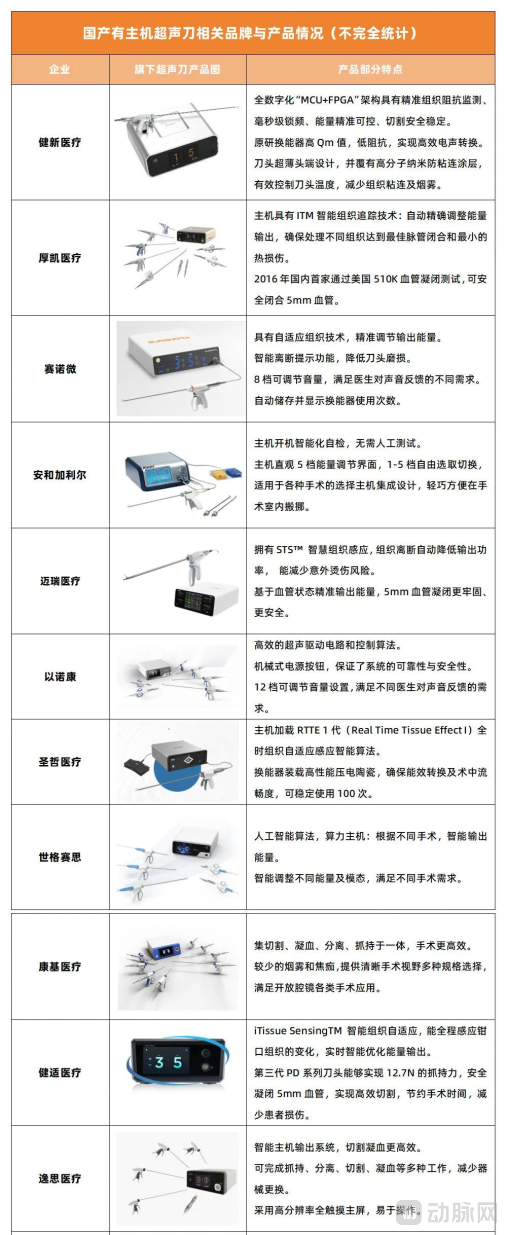
However, regardless of the technological pathway chosen, the core focus for innovative companies in the ultrasonic scalpel sector must remain on clinical value and scalable mass production. Only by genuinely addressing clinical challenges and achieving large-scale manufacturing can these companies establish a viable business model.
Technically, some domestically produced ultrasonic scalpels still have certain issues compared to imported brands, such as main unit failures, unstable fluctuations in transducer frequency and impedance, and handpiece malfunctions. Among these, the blade breakage rate is higher than that of foreign competitors, which is closely related to manufacturing support capabilities and technical development processes. Furthermore, as a critical component of ultrasonic scalpels, transducer research and development also faces significant challenges. According to industry insiders, there are currently no more than three manufacturers in China capable of independently developing original transducers.
To address these challenges, Chinese ultrasonic scalpel manufacturers need to continuously strengthen technological innovation and R&D investment, thereby enhancing product quality and performance.. At the same time, it is also necessary to strengthen collaboration with clinical institutions and gain a deep understanding of clinical needs in order to develop ultrasonic surgical devices that better meet these requirements. Only in this way can Chinese manufacturers of ultrasonic surgical devices stand out in the fiercely competitive market and achieve sustainable growth and expansion.