

Annual HIFU Procedure Volume Surges Over 44% as Non-Invasive Tumor Therapy Enters High-Growth Phase
In the current complex and volatile global economic and investment landscape, there is always considerable curiosity about business leaders who dare to venture into frontier industries. In late August, Li Ka-shing, who had been out of the public eye for some time, addressed reporters via video link and announced a donation of medical equipment valued at $6 million to the Li Ka Shing Faculty of Medicine at The University of Hong Kong, featuringHigh-Intensity Focused Ultrasound (HIFU)U.S. Innovative Medical Devices for Clinical Research on Non-Invasive Treatment of Liver Cancer.
This incident quickly attracted attention and discussion both within and outside the industry. Beyond the question of why this technology prompted Li Ka-shing, known for his reclusive lifestyle, to publicly endorse it, VCBeat also seeks to delve into the industry’s core issues: the origins of high-intensity focused ultrasound (HIFU) technology, its specific applications, and China’s current position in this cutting-edge field.
First, it is important to clarify that high-intensity focused ultrasound (HIFU) technology is not a “brand-new” innovation. Looking at the global market, international giants such as GE and Philips, along with innovative focused ultrasound companies introduced by the Li Ka-shing Foundation, have all actively participated in the development of the focused ultrasound industry. In China, companies represented by Chongqing Haifu have also been deeply engaged in this field for many years.
Driven by both established and emerging players, the focused ultrasound industry is exhibiting robust growth. According to Grand View Research, the global high-intensity focused ultrasound (HIFU) market was valued at approximately USD 1.23 billion in 2023, with a projected compound annual growth rate (CAGR) of 7.06% from 2024 to 2030. Furthermore, driven by the rising prevalence of cancer and other chronic diseases, along with the increasing adoption of minimally invasive procedures, HIFU technology is poised for even broader market prospects.
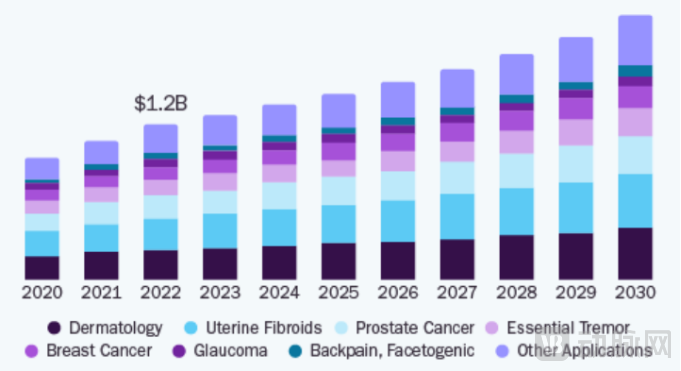
Global High-Intensity Focused Ultrasound Market Size, Source: Grand View Research
Established in the United States in 2006, the Focused Ultrasound Foundation (FUSF) is one of the most influential non-governmental organizations in the field of focused ultrasound. Its 2024 annual report indicates that there were over 1,200 treatment sites worldwide as of 2023. However, according to the Focused Ultrasound Foundation’s estimates, there are potentially 10,000 treatment sites globally if the market reaches saturation.In other words, the high-intensity focused ultrasound (HIFU) industry is currently on the eve of an explosive growth phase, with only about 10% of its market potential having been tapped.
Driven by the accelerated product development pace of domestic and international enterprises, the impetus of new technologies and industrial policies, and the growing education and awareness of this non-invasive therapy among medical professionals and patients, the high-intensity focused ultrasound (HIFU) market is entering a new phase of development opportunities.
In terms of regulation, the 2024 Annual Report of the Focused Ultrasound Foundation noted that 42 regulatory agencies worldwide have approved a total of 395 focused ultrasound-related projects, indicating the initial formation of an industrial scale. Moreover, growing evidence suggests that the field is transitioning from a primarily science-based research environment to a commercialization phase, with more products expected to receive approval and enter clinical use in the near future.
China has long prioritized the field of focused ultrasound as a strategic direction for national and local development. In particular, the “14th Five-Year Plan” for the Development of the Medical Equipment Industry not only affirms that China’s focused ultrasound therapy systems have reached an internationally advanced level, but also proposes the development of high-performance therapeutic equipment, such as high-efficiency ultrasound devices, within key priority areas.
From the perspective of market demand, as the global population ages, the incidence of chronic diseases and malignant tumors rises, and patients place greater emphasis on quality of life, the demand for non-invasive or minimally invasive treatment modalities will continue to grow. The Focused Ultrasound Foundation also points out that focused ultrasound technology is currently in various stages of research and development for 171 different clinical indications or disease treatments, and this number is rapidly increasing.
Li Ka-shing once summarized his more than 50 years of business experience in a public talk: “When a new phenomenon emerges and only 5% of people are aware of it, act quickly—that is the opportunity. Being early means gaining the first-mover advantage, regardless of the industry. When 50% of people know about it, just be a consumer. When more than 50% are aware, there’s no need to even look.”
Amid the current surge in investment in “hard tech,” the focused ultrasound industry, as a rising star, has attracted widespread attention from the capital market. Li Ka-shing’s latest move not only demonstrates his consistently keen market insight but also represents a forward-looking and precise investment at a time when the industry is on the verge of explosive growth.
A review of the developmental trajectory of high-intensity focused ultrasound (HIFU) technology reveals that American scholars, represented by Lynn and the Fry brothers, proposed the scientific concept in the 1930s and 1940s of performing non-invasive surgery on internal tissues from outside the body using focused ultrasound; however, technical bottlenecks remained unbroken.
Until 1996, at the 5th European Symposium on Sonochemistry held in Italy, the Chongqing HIFU team was the first in the world to propose"Biological Focal Region (BFR)"The concept theoretically resolved the challenge of determining therapeutic dosages for high-intensity focused ultrasound (HIFU) within biological tissues, marking a breakthrough moment for the clinical application of HIFU technology.
In 1997, the world’s first limb-sparing treatment of bone tumors using high-intensity focused ultrasound (HIFU) was performed in China. In 1998, the invention patent for extracorporeal focused ultrasound ablation technology“High-Intensity Focused Ultrasound Tumor Scanning and Treatment System” (ZL 98100283.8)Officially approved. The principle of its patented technology is described as follows: The focal zone (spatial point) of high-intensity ultrasound performs scanning motion within the body. Under the effect of high-intensity ultrasound, the tissue at this focal zone instantaneously reaches temperatures exceeding 70°C and undergoes intense cavitation-induced mechanical effects, resulting in coagulative necrosis. In this way, scanning motion performed extracorporeally can achieve the therapeutic goal of treating intracorporeal tumors.
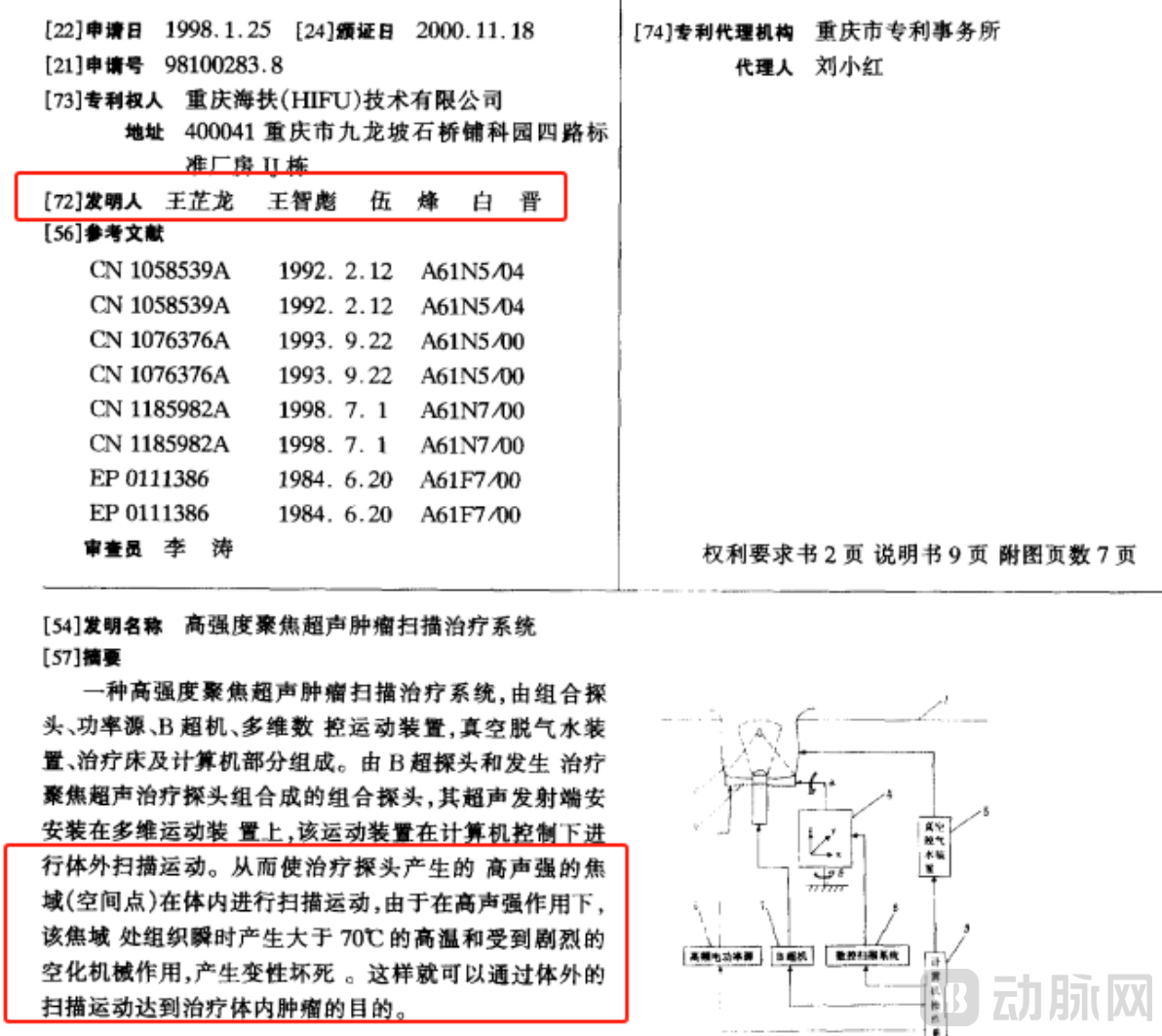
Patent Specification for High-Intensity Focused Ultrasound Tumor Scanning and Treatment System
In 1999, the world’s first extracorporeal focused ultrasound tumor treatment system—the Haifu Knife—obtained Chinese medical device registration certification, becoming the first large-scale medical equipment with fully independent Chinese intellectual property rights.
Since the beginning of the 21st century, high-intensity focused ultrasound (HIFU) technology has entered a phase of rapid development, with multiple Chinese enterprises entering this field.In 2002, the HIFU Knife device was exported to Churchill Hospital at the University of Oxford in the United Kingdom, marking the first time that a large-scale, high-end medical device “Created in China” was exported to a developed country. It received EU CE certification in 2005.
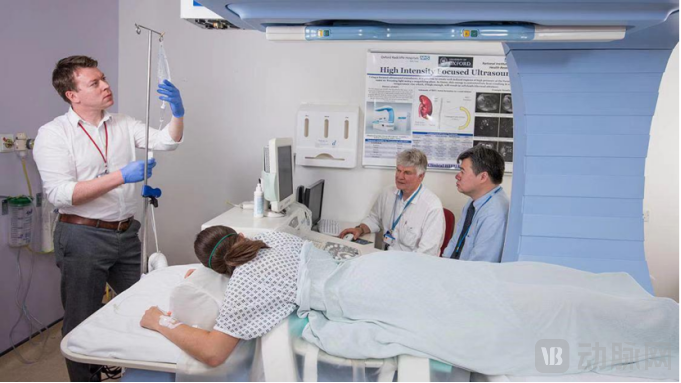
2002, HIFU Knife®Focused Ultrasound Tumor Treatment System Exported to Churchill Hospital, University of Oxford, UK
It is worth mentioning that as early as 2006, Queen Mary Hospital at The University of Hong Kong introduced the first HIFU system.®Equipment for liver cancer research and clinical treatment using high-intensity focused ultrasound (HIFU); according to media reports, it has been used to treat over 1,000 patients to date.
According to the Focused Ultrasound Foundation, a total of 31 indications for focused ultrasound devices have received regulatory approval worldwide, with nine approved by the U.S. Food and Drug Administration (FDA). Chongqing Haifu currently has 13 indications approved for clinical use in China alone, accounting for more than one-third of the global total. These indications include not only liver cancer but also malignant tumors such as bone tumors, soft tissue tumors, and breast cancer, as well as benign tumors like uterine fibroids and breast fibroadenomas.
More than ten focused ultrasound devices have been approved in the three major areas of benign and malignant tumors, common gynecological diseases, and rehabilitation and healthcare.It is reported that the new generation of Haifu Knife®The JC300 Focused Ultrasound Tumor Treatment System represents an evolution from digital to intelligent technology, achieving seamless integration with big data analytics. Its multi-dimensional surgical visualization system synchronizes the advantages of ultrasound and MRI imaging to perform three-dimensional reconstruction of lesions, thereby enabling physicians to deliver treatments with greater precision, safety, and efficacy.
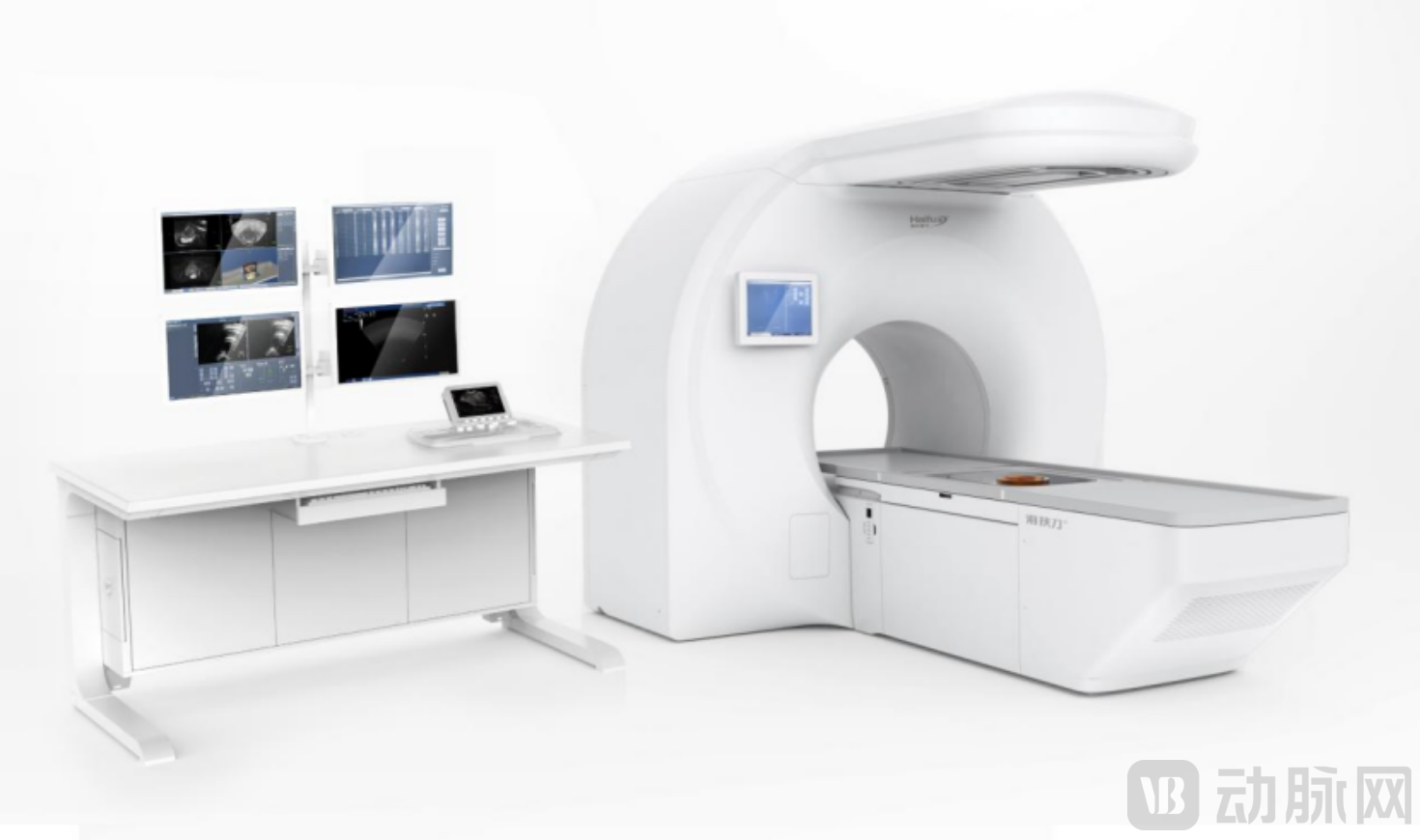
HIFU Knife®Focused Ultrasound Tumor Treatment System Model JC300
As of June 2024, China’s original Haifu Knife devices have been exported to 32 countries and regions worldwide and are in use at more than 400 hospitals globally.Within the global focused ultrasound industry, Chongqing Haifu has emerged as one of the key architects of international standards. To date, it has led the development of two industry standards and participated in the formulation of seven international standards, two national standards, and three industry standards. Among these, 11 standards have been officially released, while three are currently under development. Additionally, Chongqing Haifu has contributed to the development of eight national clinical practice guidelines and consensus statements.
In 2022, the Focused Ultrasound Foundation awarded the Chongqing Haifu Team the inaugural “Clinical Application Award” for Focused Ultrasound, recognizing their pioneering contributions to the field of focused ultrasound therapy, including basic research, development of large-scale medical equipment, clinical applications, and the establishment of industry standards.
In summary, Chongqing Haifu has played an immeasurable role in the development of the focused ultrasound industry. By collaborating with multiple platforms and research institutions, it has helped China maintain its leadership in the high-intensity focused ultrasound (HIFU) sector, establishing the country as a global hub for technological innovation in this field. Furthermore, leveraging an integrated support system combining industry, academia, research, and clinical application, Chongqing Haifu has built an industrial platform dedicated to transforming focused ultrasound technology into a universally accessible solution worldwide.
Looking ahead, focused ultrasound technology offers advantages such as low comprehensive treatment costs, short hospital stays, non-invasiveness, and minimal side effects. It aligns with the inevitable trend toward non-invasive therapies in medicine and holds broad market prospects.
Based on the current clinical applications of focused ultrasound technology,The Focused Ultrasound Foundation noted that the global treatment volume reached 141,368 in 2023, marking a rapid growth of 44% compared to the previous year, with more than half of these cases involving benign and malignant gynecological conditions.VCBeat has learned that this is currently the indication with the most extensive commercial application of Haifu Knife devices. As of June 2024, Haifu Knife had been used to treat over 300,000 patients with various benign and malignant tumors worldwide.
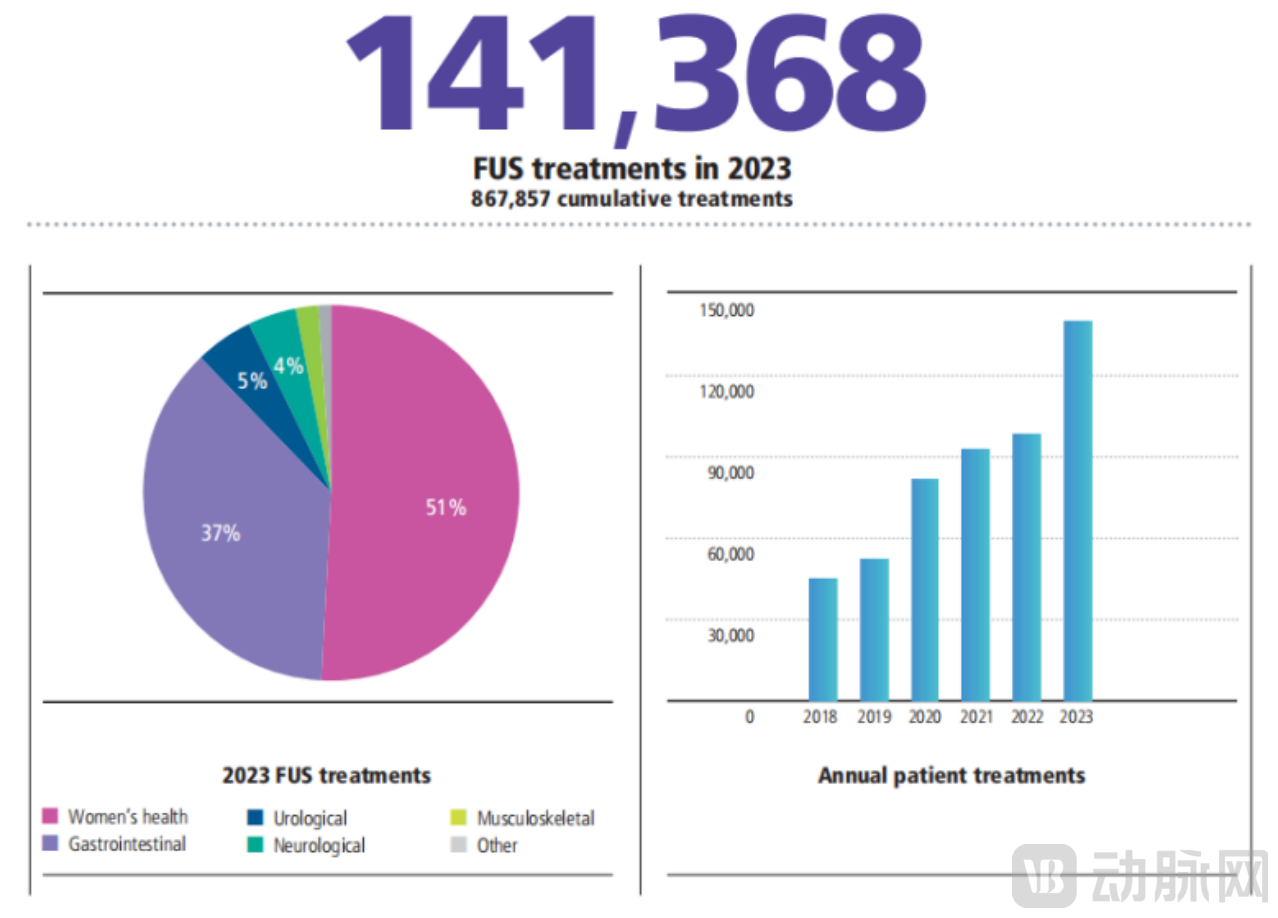
Focused Ultrasound Foundation 2024 Annual Report: Volume of Focused Ultrasound Treatments in 2023
From the bold vision of ex vivo to in vivo organ preservation therapy, to translating this disruptive technology into reality, and further to pursuing large-scale commercial application, original innovation is never achieved overnight. It requires breaking through traditional barriers, establishing new rules, and fostering new business ecosystems. Currently, the focused ultrasound sector is experiencing a period of “contention among a hundred schools of thought.” Every participant must consistently adhere to independent innovation, continuously driving technological advancement and industrial upgrading.
Guided by established industry leaders and driven by the collective efforts of innovative startups, various high-intensity focused ultrasound (HIFU) technologies continue to advance in therapeutic efficacy, application scope, and device performance. These advancements highlight significant growth potential and substantial commercial value, with expectations that HIFU will provide more patients with accessible and affordable non-invasive treatment options in the future.