Chengshi Biologics Founder Dr. Xu Shi on mRNA Veterinary Vaccines: Data-Driven Innovation and Strategic Differentiation

TheraRNA
AI-Driven mRNA Drug Developer
“My name is Xu Shi, with ‘Shi’ as in ‘honesty’ (chengshi). The name of the company I founded, Chengshi Biologics, is also a homophone for ‘honesty.’” Our interview began with this self-introduction, reminiscent of a blind date, giving me a glimpse of a unique corporate founder.

VCBeat: It is understood that Chengshi Biotechnology is a biotech company with mRNA as its primary platform. How does it differentiate itself from other mRNA companies?
Dr. Xu Shi:My original intention in returning to China to start a business was to develop biopharmaceuticals based on mRNA technology, which is why I named the company “Chengshi Biopharma.” I returned home with a dream that differed from others’. At that time, mRNA was a very new technology in China, and many companies were developing mRNA-based COVID-19 vaccines. The investment community expected these companies to become Chinese alternatives to Moderna and BioNTech. However, I believed that imitation had no future; instead, it was essential to master robust foundational technologies and pursue genuine innovation. Therefore, Chengshi Biopharma took a different path, aiming to focus on antigen design for mRNA vaccines, develop novel antigen architectures, and identify new targets and indications.
Fortunately, we have chosen the right direction. Success depends not on the size of the team, but on its expertise. Chengshi Biomedical has established an intelligent informatics team structured similarly to a small AI-driven pharmaceutical company. Through close collaboration between this intelligent informatics team and our biological R&D team, our vaccine development success rate exceeds 70%, significantly higher than the 5–10% average success rate of traditional vaccine development. This indeed represents the core corporate value of Chengshi Biomedical. While there are many CRO companies specializing in AI, as an in-house team, we possess a deeper understanding of drugs and vaccines. By adopting the PDCA (Plan-Do-Check-Act) “Deming Cycle” approach, we continuously engage in R&D, rapidly validate results, and iterate at high speed, achieving commendable outcomes.
VCBeat: The 70% success rate you just mentioned seems somewhat exaggerated. It is understood that the success rate for innovative drugs and novel vaccines, across a series of experiments from small animals to humans, does not exceed 10%. Why are you confident in citing a figure of 70%? Chengshi Biomedical should live up to its name by being honest (laughs).
Dr. Xu Shi:(Laughter) You are referring to the progression from mice to humans, whereas I am discussing the transition from rodent models to target animal species. This is because Nanjing Chengshi Biomedical Technology Co., Ltd. is currently advancing its series of veterinary vaccine products at a rapid pace. In rodent models, we have already observed that mRNA vaccines can successfully block infections caused by various bacteria and viruses. Our veterinary vaccine products are ultimately targeted at pets, as well as economic animals such as poultry, cattle, sheep, pigs, and fur-bearing animals. The veterinary vaccines developed by Nanjing Chengshi Biomedical Technology Co., Ltd.—including those for canine distemper, duck Tembusu virus disease, bovine mastitis, and Mycoplasma hyopneumoniae in pigs—have demonstrated excellent efficacy in trials involving target animal species. We anticipate launching large-scale clinical trials in economic animals within the next few months to just over a year.
VCBeat: Many mRNA companies we have contacted started with human vaccines or drugs before pivoting to veterinary vaccines. Why did you choose to focus on animals from the outset?
Dr. Xu Shi:Let me show you two images first.
//As he spoke, Dr. Xu typed some characters on his computer. After about a minute, two AI-generated images appeared.//
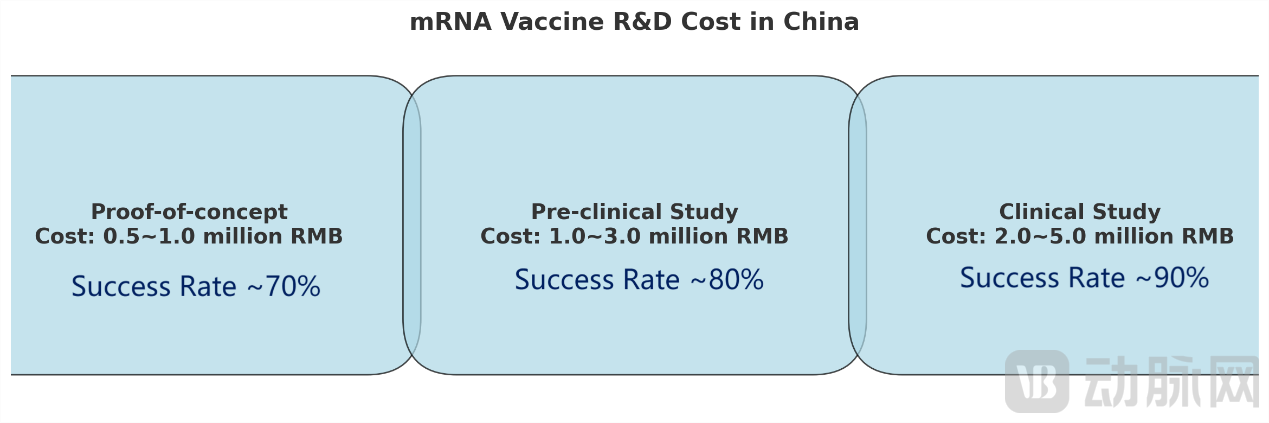
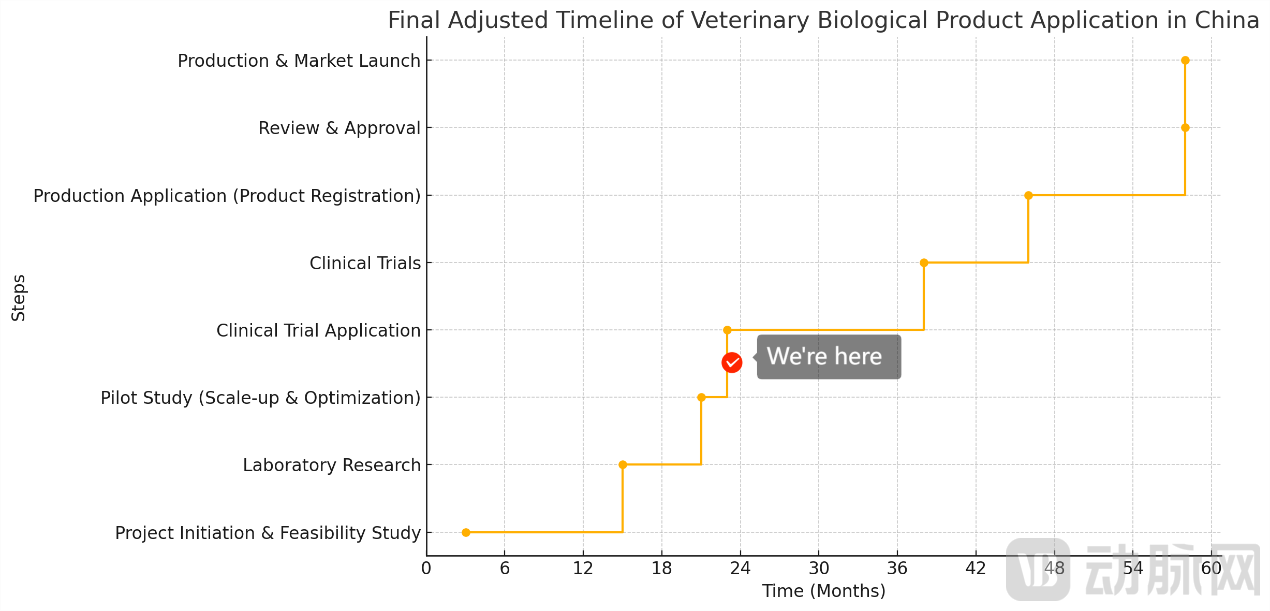
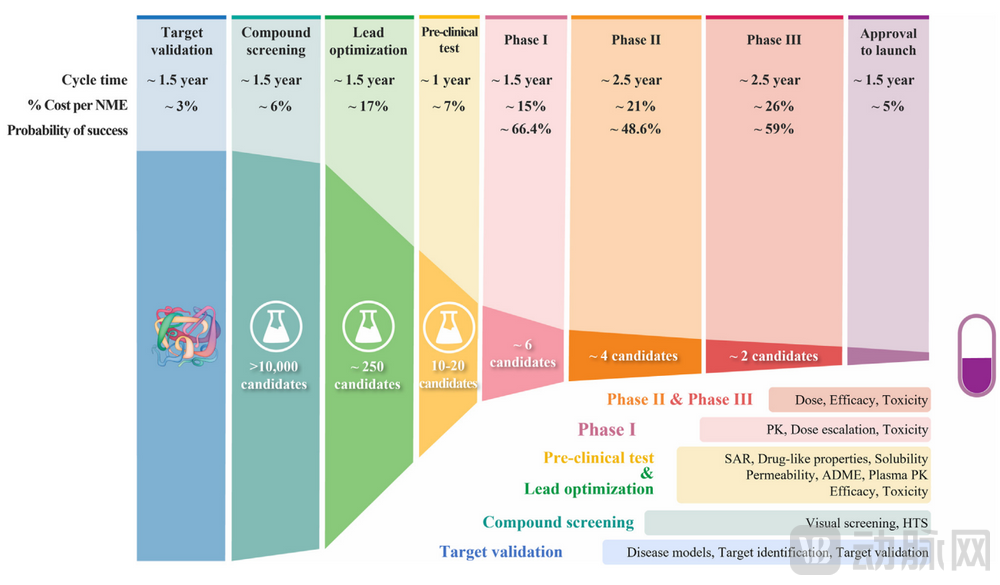
The first chart illustrates the development cycle of animal vaccines, which takes approximately five years from early-stage research to commercialization. In contrast, the overall development cycle for human vaccines typically spans 10–12 years. As shown here, the R&D cost for veterinary vaccines amounts to only a few million RMB, which is several orders of magnitude lower than the hundreds of millions often required for human vaccines and pharmaceuticals.
Let’s examine the success rates. During the proof-of-concept phase, driven by AI technology and our continuous experimentation and iteration, the success rate of proof-of-concept experiments reaches as high as 70%. Once breakthroughs are achieved in challenge studies using target animals prior to formal clinical trials, the vaccine’s success rate rises to 80%. Upon entering clinical trials for the final product, the success rate can exceed 90%.
In more professional terms, the transition from model animals to target animals enables faster proof-of-concept and clinical trials, lower costs, and higher success rates.
VCBeat: As shown in the chart, Chengshi estimates that developing an animal vaccine requires approximately five years and an investment of several million RMB, with a success rate exceeding 70%. Why have other mRNA companies failed to recognize this opportunity? If everyone becomes aware of it, won’t this market turn into a red ocean as well?
Dr. Shi Xu:As I stated at the outset, we possess two core competitive advantages that are difficult for other companies to replicate quickly. First, our AI team enables us to rapidly develop and screen a broader portfolio of product candidates. Second, we have mastered mRNA vaccine development technology for drug-resistant bacteria—a capability not yet held by competitors—allowing us to leverage this platform to launch a wide range of vaccines. Furthermore, our highly efficient internal communication has accelerated our progress, securing us both first-mover advantage and technological leadership.
VCBeat: How do you view the current difficulty in securing financing for the biopharmaceutical industry?
Dr. Shi Xu:First, this is a real phenomenon, and we need to face it with a positive and optimistic attitude. I believe there are two main reasons for the difficulty in financing within the biopharmaceutical industry: On one hand, the external environment has undergone some changes. The Federal Reserve’s interest rate hikes have created an unfavorable macroeconomic climate, causing hot money to diminish or even disappear. This has reduced the amount of capital available in the market, made investors more cautious and less willing to take risks, which is not conducive to financing in the biopharmaceutical sector. Of course, we have also seen recent news about interest rate cuts, which sends a positive signal. On the other hand, previous pharmaceutical business models are not well-suited for innovative drugs. The volume-based procurement (VBP) policy is inconsistent with past models, affecting the profitability and valuations of biopharmaceutical companies. Moreover, tighter IPO regulations have made it more difficult for investment institutions to exit, leading to greater caution in investing. This situation is unlikely to change in the short term, making financing in the biopharmaceutical industry even more challenging.
VCBeat: You have a knack for hitting the nail on the head. So, do you think it is difficult for Chengshi Biomedical to secure financing?
Dr. Xu Shi:"It’s difficult—of course it’s difficult!" (Laughs heartily) "If I said it wasn’t difficult, you’d accuse Nanjing Chengshi Biomedical Technology Co., Ltd. of not being 'Chengshi' (honest)."
We, too, operate within this broader context. Many people hold the stereotype that veterinary vaccines are low-priced and unprofitable. However, this perception is precisely at odds with reality: numerous companies, both domestically and internationally, have successfully gone public by leveraging veterinary vaccine products. Moreover, the distinct advantage of the veterinary vaccine market lies in its stable growth—after all, if you consume braised beef and Dongpo pork knuckle this year, you are unlikely to stop eating them next year. The compound annual growth rate (CAGR) of China’s veterinary vaccine market approaches 8%, and unlike the human vaccine market, it is not constrained by birth rates or existing population size. What I wish to emphasize is that Nanjing Chengshi Biomedical Technology Co., Ltd. should focus on executing its core responsibilities well and persist in doing what is right, until the investment community recognizes our company as a unique and distinctive player.
First, Chengshi Biotechnology has adopted a distinctive corporate strategy and organizational structure, which serves as both an advantage and a challenge. On one hand, it reduces competition; on the other, it has led some investment institutions to approach the validation of its business model with caution. Nevertheless, this uniqueness has also attracted investment firms willing to explore new frontiers, and we are deeply grateful to our investors.
Secondly, we are optimistic about the potential of veterinary vaccines. Although many investment institutions have reservations about the animal health industry, Nanjing Chengshi Biomedical Technology Co., Ltd. has demonstrated the feasibility and profitability of veterinary vaccines through robust experimental data. Veterinary vaccines not only allow for rapid validation of a company’s business model but also feature low costs and quick profitability. This success is also attributable to our company’s positive work environment and proactive communication style.
Third, this represents an extension of our strategy. Our current and future pipeline will not be limited to animal vaccines; we will also innovatively leverage clinical data from large-animal vaccines to support the development of future human vaccines, thereby effectively reducing experimental risks and costs. Evidence demonstrates that there are certain similarities between human and veterinary vaccines. Nanjing Chengshi Biomedical Technology Co., Ltd. plans to utilize its veterinary vaccine platform and data to accelerate the development of future human vaccine products.
The most important point is that we are truly honest, letting data speak for itself and basing all communication on facts.
VCBeat: What detours has Chengshi Biomedical taken, or what mistakes has it made?
Dr. Xu Shi:(After hesitating for about five seconds) This question is somewhat sudden and difficult to answer. (After thinking for another half minute or so) What I would like to say is that Chengshi Biomedical did make some mistakes during its development. One of them was the selection of certain vaccine products, which may not have been optimal in retrospect. Even though our products have a disruptive advantage in potency, competitors with lower potency but cheaper prices could still negatively impact our marketing efforts. Therefore, in our subsequent product planning, we paid special attention to areas with strong market demand and limited competition. Our current approach is much more mature compared to two years ago.
Another shortcoming lies in external collaborations. The outcomes of partnerships with certain universities have been less than satisfactory, primarily because the management capabilities of our partners fall significantly short of our expectations. It is also worth noting that the reliability of student experimental data remains a concern requiring attention.
To address these shortcomings, we promptly implemented measures.
In terms of vaccine portfolio selection, we place greater emphasis on exploring blue-ocean markets to avoid homogeneous competition in red-ocean sectors. We strive to identify truly disruptive products that address unmet clinical needs.
// As he spoke, Dr. Xu operated the computer for a brief moment and displayed another chart, illustrating the distinction between routine technological updates and disruptive technological innovations //
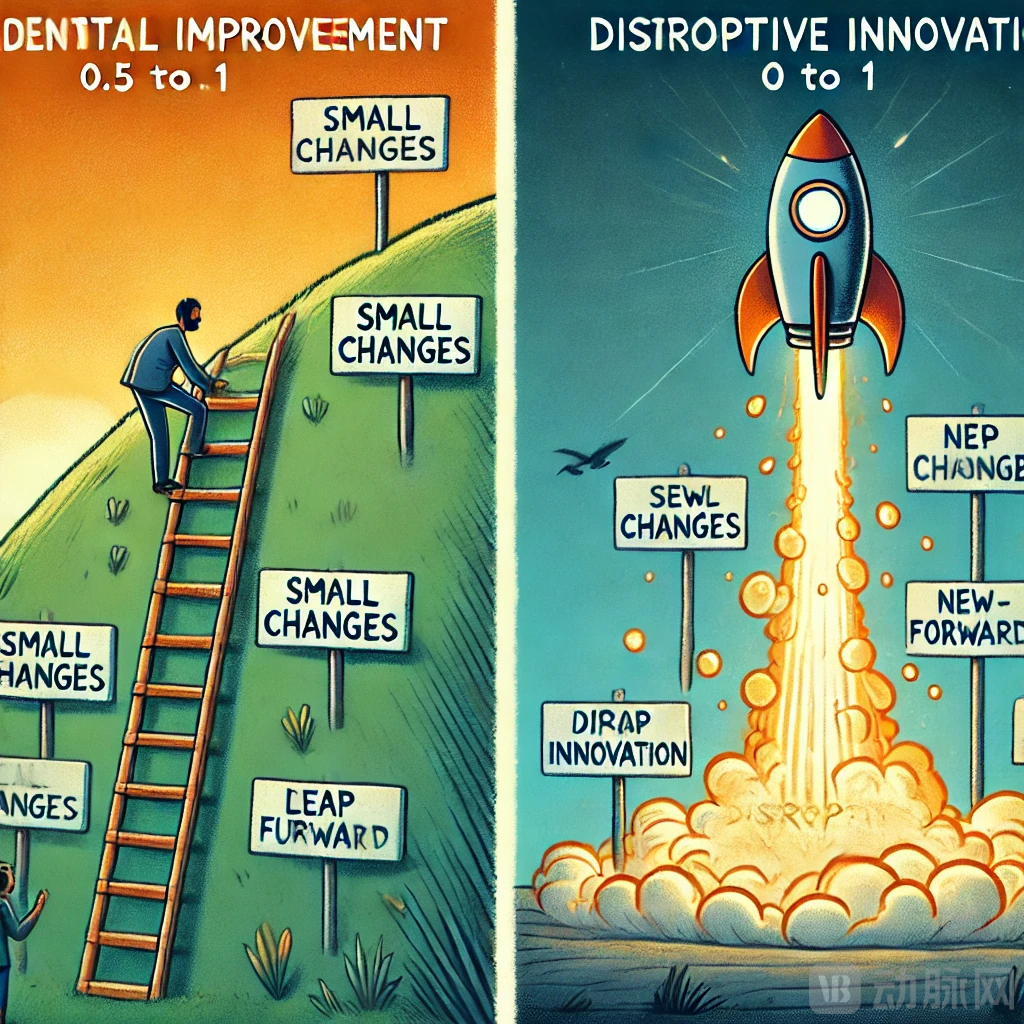
We previously leveraged mRNA technology to enhance existing veterinary vaccines, representing an incremental improvement. However, we now prioritize disruptive innovation, delivering novel solutions for unmet medical needs. While the journey from 0 to 1 presents challenges, it also offers the greatest potential rewards.
In terms of external collaborations, we are more cautious in selecting our partners. Prior to collaboration, we conduct in-depth assessments of their needs and expectations to ensure a clear consensus on the cooperation model. Meanwhile, we strengthen the management and oversight of our partners, enhance communication efficiency, and ensure the reliability of experimental data.
Fortunately, all partners who have engaged in in-depth collaboration with us have continued to move forward hand in hand. This is because Chengshi Biotechnology maintains a highly proactive, open, and prudent approach in seeking strategic cooperation opportunities. External collaborations must address real-world challenges and ensure mutual benefit and win-win outcomes, thereby enabling sustainable, long-term partnerships.
VCBeat: It is often said that fundraising is difficult because biotech companies must first clearly articulate how they intend to utilize the funds. How does Chengshi Biomedical allocate its capital?
Dr. Shi Xu:First, although Chengshi Biotech is primarily an mRNA pipeline-focused company, it is also offering certain services as a side endeavor to generate additional revenue. Many people joke that there are few genuine “clients” left nowadays (laughter), with all biotech firms striving to find ways to earn some income.
Domestic CROs and biopharmaceutical companies often face challenges in generating antibodies through animal immunization due to the difficulty of purifying certain target proteins. Our mRNA immunization service effectively addresses this challenge. Practical experience has demonstrated that mRNA immunization can fully replace traditional protein-based immunization, yielding high-affinity antibodies at the nanomolar (nM) level even against complex membrane proteins such as GPCRs. We have successfully completed over 140 projects, with a 70% client retention rate, a testament to our strong reputation.
Within the next year, if our bacterial vaccines demonstrate favorable results in animal studies, we can license the technology to pharmaceutical companies to initiate the development of corresponding human vaccines. In particular, mRNA vaccines targeting drug-resistant bacteria such as Streptococcus, Staphylococcus, and Enterobacteriaceae can achieve an integrated “offense and defense” capability, serving both preventive and therapeutic purposes for chronic bacterial infections. This represents a significant opportunity.
Meanwhile, we place great emphasis on return on investment (ROI) in our spending, striving for ultimate cost-effectiveness. For instance, we minimize proof-of-concept costs by even raising some animals (chickens and pigs) in-house to reduce experimental expenses. The company’s financial structure is highly transparent, with expenditures concentrated in only a few areas: personnel, animal husbandry, process development, and office operations; virtually no other costs are incurred. Any relatively significant expenditure or external collaboration undergoes thorough justification to ensure rational allocation of funds and absolute financial compliance.
We have clear targets: to achieve RMB 10 million in revenue in 2025 and RMB 30 million in 2026, thereby reaching break-even and achieving self-sustaining operations.
VCBeat: Let me ask you one last question. Have you considered the possibility that Chengshi Biomedical might fail?
Dr. Shi Xu:Certainly. Charlie Munger once said, “All I want to know is where I’m going to die, so I’ll never go there.” This statement holds profound wisdom. In my view, businesses may face crises in two key areas: funding and management. First, cash flow is the lifeline of any enterprise; therefore, companies should not rely solely on financing to secure funds. To generate robust cash flow, Chengshi Biomedical has consistently prioritized revenue and profit growth while implementing effective cost-control measures. Second, as a company expands, it encounters distinct managerial challenges. The management approaches required for a 30-person firm differ significantly from those needed for companies with 100, 300, or even more employees. Chengshi Biomedical recognizes that maintaining a positive corporate culture is crucial. We adopt phased management, tailoring our strategies to each stage of development. Meanwhile, we prioritize building a reserve of successor talent to ensure continuity. Furthermore, strengthening corporate culture cultivation—by fostering a supportive work environment and shared values—contributes significantly to the company’s sustainable development.
Had time not been so pressing, VCBeat feels it could have continued its conversation with Dr. Xu for another hour or two. Before departing, Dr. Xu presented the reporter with a copy of “Short Song Style” (Duan Ge Xing), handwritten by himself. His calligraphy is upright and powerful, seemingly echoing the pronunciation of “Chengshi” (which means “honesty” in Chinese). “Green are your collars, long do I ponder. Bleat the deer, feeding on wild mugwort.” These lines also reflect the exacting standards that Nanjing Chengshi Biomedical Technology Co., Ltd. and Dr. Xu Shi uphold regarding collaboration and talent acquisition. We look forward to jointly creating a prosperous tomorrow through collective efforts within the industry.
Columnist: Xiao Bo
A veteran who has navigated the ups and downs of large multinational corporations for over two decades;
A tasteful, interesting, and medicine-savvy enthusiast;
A polymath with a background in chemistry, biology, finance, and psychology, as well as an MBA degree in strategy;
A media professional who advocates “No rat race, go further” and looks forward to the long-term sustainable development of the innovative drug industry;
My primary role is Head of Business Development at a PDMO company.
We hope to uncover the essence from a different perspective and use humor to create distance from difficulties.
Nanjing Chengshi Biomedical Technology Co., Ltd. is nearing the completion of its Series A financing round. The company has achieved significant progress across multiple domains: it has established a robust technical reserve for mRNA vaccines, with several veterinary mRNA vaccines having completed challenge studies in target animal species; a comprehensive manufacturing process system has been developed, and multiple related patents have been granted; its veterinary mRNA vaccine facility is about to pass Good Manufacturing Practice (GMP) inspection; several mRNA vaccines targeting clinically drug-resistant bacteria have demonstrated efficacy in animal models, with technical indicators ranking among the most advanced globally; and its personalized cancer therapeutic vaccine has entered the Investigator-Initiated Trial (IIT) phase, with the first patient showing a favorable response.
Nanjing Chengshi Biomedical Technology Co., Ltd. warmly welcomes investment opportunities, is open to discussing joint development and product licensing, and is actively seeking partners for clinical research. Please scan the QR code below to contact us. We look forward to engaging in in-depth discussions with you to jointly advance the development and application of innovative vaccine technologies.。