

Turn Biotechnologies Advances mRNA-Based Cellular Reprogramming Therapy TRN-001 Toward Clinical Trials with Positive FDA Feedback

Turn.bio
mRNA Drug Developer
On October 25, 2023, at the FDA Center for Biologics Evaluation and Research (CBER) Innovative Approaches to Regulating Products (INTERACT) meeting,Anti-aging company Turn Biotechnologies (hereinafter referred to as “Turn Bio”) has received positive feedback from the FDA regarding its mRNA-based cell regeneration therapy, TRN-001.
At the meeting, Turn.bio and the FDA focused their discussions on the future development direction of TRN-001. The outcomes indicated that TRN-001 has the potential to become the first therapy to repair damaged skin at the cellular level, improve skin integrity, and reduce inflammation and cellular senescence.The results of this conference indicate that Turn.bio is poised to become the first company to advance mRNA-based cellular regeneration therapies into clinical trials.
As a star enterprise in the anti-aging field, Turn.bio was founded in 2019 and is currently headquartered in Silicon Valley. The company focuses on developing mRNA drugs through epigenetic reprogramming technology, thereby repairing tissues at the cellular level to restore youthful vitality to cells and repair damage caused by the aging process.Leveraging its proprietary mRNA technology platform, ERA™, and drug delivery platform, eTurna™, Turn Bio has developed multiple candidate pipelines across therapeutic areas including dermatology, osteoarthritis and cartilage injury, immunology, ophthalmology, and muscle tissue injury. Among these, TRN-001 is advancing rapidly; it is currently in the preclinical stage and is poised to enter clinical trials.
Core Technology Platform ERA™: Efficiently Reverses Cellular Aging and Maintains Cell Characteristics
The process of reprogramming mature cells into stem cells is known as “reprogramming.” In 2006, Japanese scientist Shinya Yamanaka discovered that four transcription factors (Oct3/4, Sox2, Klf4, and c-Myc) could revert highly differentiated somatic cells into pluripotent stem cells, thereby restoring their capacity to differentiate into various cell types; this process is termed reprogramming. Reprogramming technology induces two effects: “dedifferentiation” and “rejuvenation.” Specifically, it can reprogram aging-associated epigenetic information within cells, shifting them to a state resembling embryonic stem cells. This effectively resets the epigenetic clock to zero, achieving cellular-level “rejuvenation.”
Cellular reprogramming is primarily achieved through two approaches: first, by delivering exogenous transcription factor systems into cells or animals; and second, by activating or regulating the expression of endogenous fate-determining transcription factors. In the first approach, cell-fate transcription factors can be packaged into viral vectors or mRNA and then introduced into cells or animals to deliver the desired functional effects.
Building on this foundation, Turn.bio developed ERA™, an innovative technology platform that leverages epigenetic reprogramming of aging to reverse cellular senescence, based on the licensed epigenetic reprogramming technology from Dr. Vittorio Sebastiano’s laboratory at Stanford University.
ERA™ is designed to leverage a specific mixture of transcription factor mRNAs (such as those encoding Myc, Oct3/4, Sox2, and Klf4) to switch genes on or off by modulating the transcription rate of genetic information from DNA to mRNA. This process regulates cellular function and records the “reversal” of the epigenome associated with cellular aging, ultimately restoring optimal gene expression profiles and promoting tissue regeneration.Leveraging this technology platform, Turn.bio is able to develop mRNA therapeutics for stem cell therapy to repair damaged tissues or treat age-related diseases.
It is reported that the ERA™ platform is designed to enable a safe, rapid, efficient, and tunable reprogramming process. Through the ERA™ platform, Turn Bio can deliver transcription factors to the epigenome using mRNA. In this process, Turn Bio can strictly control the timing, duration, and dosage of transcription factor entry into cells, thereby optimizing mRNA mixtures for different indications. For example, Turn Bio can add or remove specific transcription factors based on the benefits obtained by specific tissues.
Subsequently, Turn.bio can precisely deliver transcription factors to cells in a pulsed manner, gradually controlling the reprogramming process and pushing the epigenome toward a more youthful state. Each pulse drives the epigenome into a more vibrant state, steadily restoring cellular function while protecting patients.
Notably, in the process of developing innovative therapies, Turn.bio has discovered that the use of quiescent stem cells can significantly aid in the repair or replacement of specific types of damaged tissue.Among them, quiescent stem cells refer to stem cells that are in a relatively inactive state with cell cycle arrest. Numerous studies have confirmed that they possess characteristics such as low metabolic activity, long-term survival, and strong stress resistance, and play roles in tissue repair and regeneration, maintaining tissue homeostasis, and having potential for disease treatment. Therefore, before activating these stem cells, it is essential to ensure they are in a quiescent state so that they can be activated, proliferate, and differentiate at any time.
In this case,Turn.bio employs its proprietary “Artificial Niche (AN™)” technology to protect stem cells.AN™ technology integrates stem cell biology, biomolecular materials engineering, and microfabrication techniques to create novel cell culture platforms that mimic key biochemical or structural aspects of the microenvironment. Research demonstrates that muscle stem cells (MuSCs) cultured in the AN™ microenvironment exhibit enhanced engraftment, tissue regeneration, and self-renewal potential following transplantation.
In a study by Turn.bio utilizing AN™ and ERA™ technologies to restore stem cells in aged mouse models, the results demonstrated that aged muscle stem cells (MuSCs) receiving the combination therapy were able to reverse age-related muscular dysfunction, such as muscle weakness. This therapeutic effect was comparable to that achieved by transplanting MuSCs from young donors. Importantly, AN™ technology is also applicable to the culture of stem cells isolated from other tissues. It holds particular promise for tissues where quiescence is essential for maintaining stem cell function, including certain mesenchymal stem cells found in various regions and tissues such as the hematopoietic system, liver, brain, and hair follicles.
In addition,Turn.bio has also overcome the drug delivery challenge by developing a novel lipid delivery platform, eTurna™.This platform overcomes the challenges associated with traditional lipid carriers, such as instability, poor bioavailability, limited solubility, and inadequate in vivo absorption. By employing optimized nanostructured carriers, it enables the safe and effective delivery of a wide range of drugs via various administration routes. Furthermore, it can be fine-tuned and localized to target specific tissues and cells, ensuring precise drug delivery and targeting.
Multiple Pipeline Preclinical Studies Show Significant Efficacy; Core Products Are About to Enter Clinical Phase
Currently, leveraging its proprietary technology platform, Turn.bio has established a pipeline of multiple candidates spanning therapeutic areas such as dermatology, osteoarthritis and cartilage injury, immunology, ophthalmology, and muscle tissue injury.
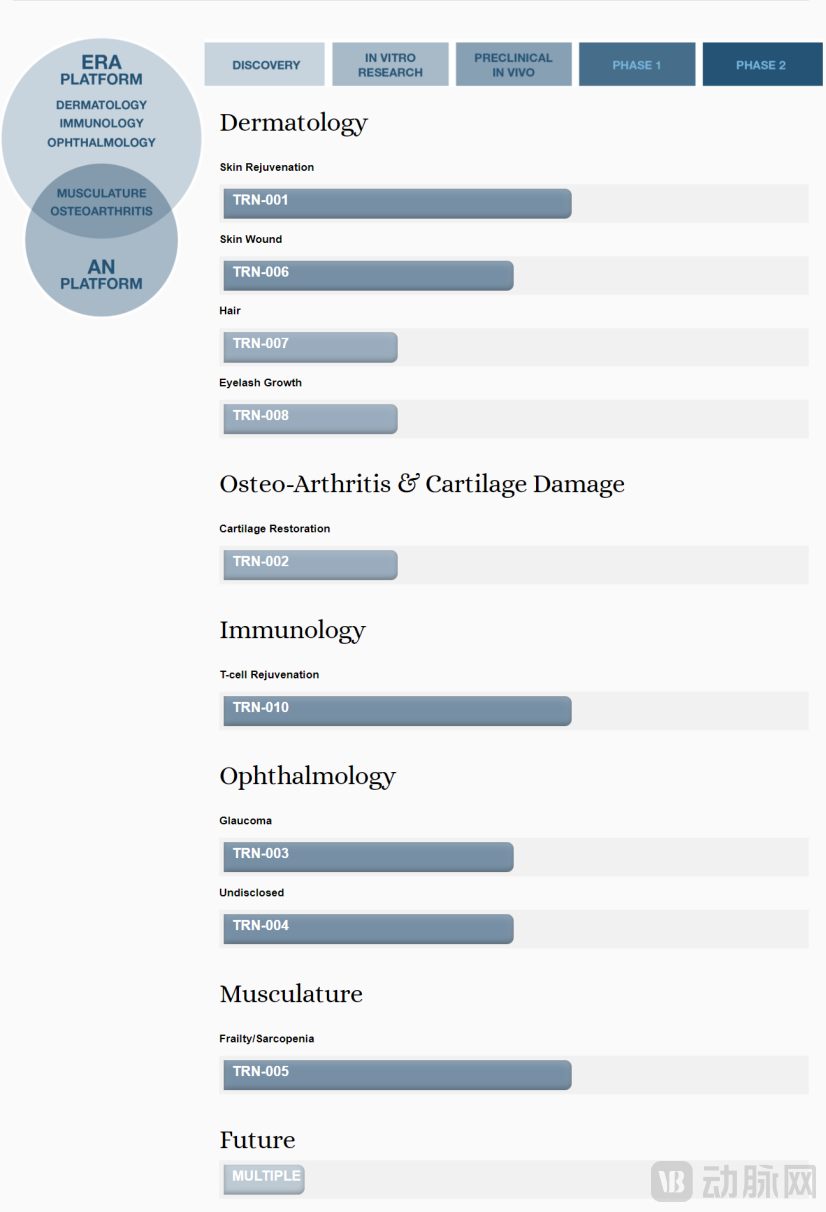 Turn Bio’s Product Pipeline. Image source: Turn Bio official website
Currently, TRN-001 is advancing rapidly. TRN-001 is a skin anti-aging drug with a unique formulation, developed to treat hair and skin conditions such as wrinkles, hair loss, scars, inflammation, wounds, and sunburn. Preclinical study results show that,TRN-001 can improve skin integrity, reduce inflammation and cellular senescence, and achieve follicular transfection to restore the hair growth capacity of hair follicles.
In the areas of osteoarthritis and cartilage injury, Turn.bio has developed TRN-002. This candidate drug repairs protective cartilage, effectively reversing joint damage and enabling individuals to resume healthier lifestyles.Preclinical study results show that TRN-002 can reduce oxidative stress and inflammation, and improve the cell division cycle and cell expansion.
In the field of age-related ocular degenerative diseases, Turn.bio has advanced two candidate products: TRN-003 and TRN-004. Among them, TRN-004 is a candidate therapeutic designed to restore vitality to ocular tissues, including corneal, limbal, and conjunctival epithelial cells, as well as corneal endothelial cells.Preclinical study results show that TRN-004 can reduce inflammation and oxidative stress, and decrease cellular senescence.
In the area of muscle tissue injury, Turn.bio is developing TRN-005, a candidate drug that can restore muscle mass and strength and reverse age-related diseases. Preclinical study results indicate that,Following TRN-005 treatment, the growth and differentiation of muscle tissue stem cells were improved, leading to accelerated muscle recovery, increased fiber thickness, and enhanced force output. Furthermore, muscles treated with TRN-005 demonstrated greater resistance to subsequent injury.
Notably, Turn.bio has also established a pipeline in cancer therapy. TRN-010 is a T cell-targeted candidate drug that can be simply incorporated into the manufacturing process of any CAR-T therapy. It epigenetically reprograms patients’ T cells to induce a more youthful functional state, thereby preventing T cell exhaustion and enhancing potency.
Turn.bio stated that restoring T cell vitality and reducing cellular exhaustion are expected to enable more elderly patients to access CAR-T therapy at a lower cost. Preclinical study results showed that,TRN-010 treatment can significantly enhance T-cell proliferation and their ability to kill cancer cells, with an increase of up to 5-fold. This means that for patients, this therapy offers greater efficacy and better tolerability.
$300 Million Partnership with South Korean Pharma Company to Co-Develop New Therapies for Eye and Ear Diseases
Since its inception, Turn.bio’s core technologies and candidate products have garnered significant favor from the market and investors. To date, Turn.bio has completed four rounds of financing, with investment from 11 prominent institutions and corporations, including Astellas Venture Management, LongeVC, and Methuselah Funds.
On May 28, 2024, Turn.bio announced that it had entered into a global exclusive license agreement with South Korean pharmaceutical giant HanAll Biopharma to jointly develop epigenetic reprogramming therapies for the treatment of ocular and auditory diseases. Under the agreement, HanAll Biopharma was granted the rights to use Turn.bio’s ERA™ technology to research, develop, manufacture, and commercialize therapeutics for ophthalmic and otologic conditions.According to the source, the transaction value of the first product could exceed $300 million.
In addition, South Korean pharmaceutical company Daewoong Pharmaceutical has also endorsed Turn.bio’s technology and R&D direction, participating in the company’s financing through investment to advance the development of anti-aging drugs.
Over 10 Companies Bet on Cellular Reprogramming, with Multiple Products Entering Clinical Stages
As one of the cutting-edge technologies for delaying aging, cellular reprogramming has currently become one of the hottest research topics in the field of anti-aging. In recent years, with continuous technological advancements and refinements, cellular reprogramming has made significant progress, offering new possibilities for delaying aging and treating age-related diseases.
Currently, numerous domestic and international companies are applying cellular reprogramming methods to develop innovative therapies for delaying aging and treating age-related diseases. These include Xinrui Regeneration, Zhongsheng Suyuan, Hode Bio, Huaxia Yuan Cell Engineering Group, Retro Bio, Altos Labs, YouthBio Therapeutics, NewLimit, AgeX Therapeutics, and Calico, the anti-aging biotechnology company founded by Google.
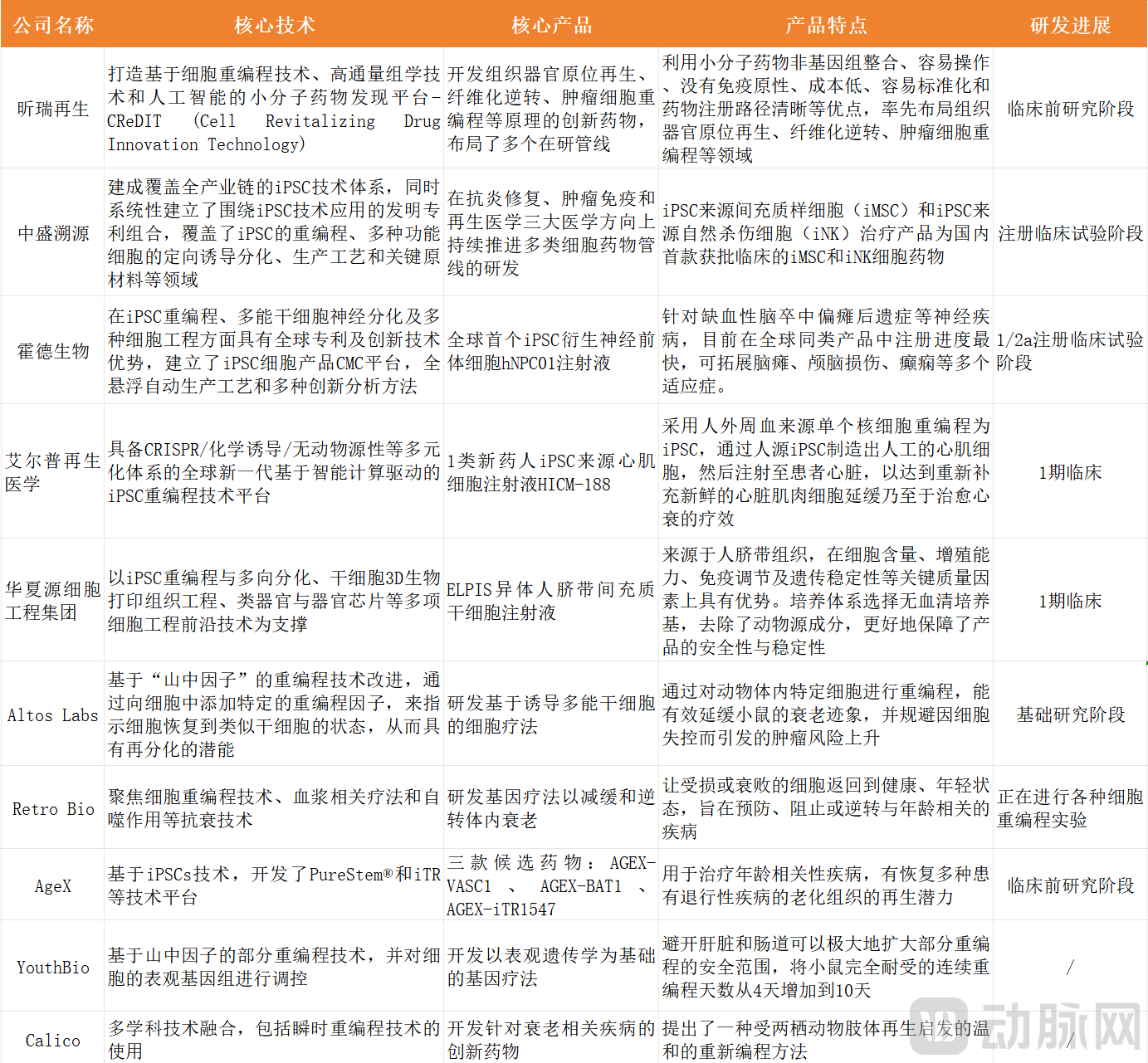 Selected Companies Deploying Cell Reprogramming Technologies (Incomplete List; No Ranking Implied)
Source: Compiled from public data; graphic by VCBeat
Currently, several companies, including Xinrui Regenerative Medicine, Zhongsheng Suyuan, and AlphaRegen, have advanced their core products into preclinical or clinical research stages, validating the potential of cellular reprogramming technology in anti-aging and the treatment of age-related diseases. Meanwhile, cellular reprogramming technology continues to evolve and innovate, with various improved methods emerging—such as transient reprogramming and partial reprogramming—that enhance both the efficiency and safety of the reprogramming process. Furthermore, cellular reprogramming technology is not only applied to in situ regeneration of tissues and organs but also extends to multiple fields, including fibrosis reversal and immunotherapy, holding promise for delivering personalized treatment regimens tailored to different disease types in the future.
However, cell reprogramming technology still faces challenges related to safety and stability in its applications.Existing research findings also indicate that cellular reprogramming technology carries pathogenic risks. In 2013, a team led by Manuel Serrano at the Institute for Research in Biomedicine (IRB Barcelona) in Spain published a paper stating that when Yamanaka factors were applied to mice, some mice showed signs of tissue rejuvenation depending on the extent of reprogramming, while others developed teratomas due to aberrant differentiation.
However, with continuous technological innovation and in-depth clinical research, the risks associated with cellular reprogramming technology are likely to gradually decrease, ushering in a new phase of development for the cellular reprogramming anti-aging sector. In the future, numerous products are expected to be applied in clinical settings, bringing revolutionary changes to anti-aging interventions and the treatment of age-related diseases.