

Over 100 Medical AI Models Launched—Who Will Be the First to Profit?
As 2024 has not yet concluded, more than 100 large language models have already flooded into the healthcare sector.
Numerous companies are venturing into a wide range of areas, from the entire clinical diagnosis and treatment workflow to medical imaging enhanced by years of deep learning, as well as niche yet promising fields like traditional Chinese medicine rehabilitation. It seems they aim to completely reimagine the entire tech-driven healthcare sector.
However, the explosive growth of generative AI does not guarantee universal user adoption. Particularly in the current period of economic cyclical volatility, for an application to be successfully implemented and achieve commercialization, it must accurately address users’ genuine needs.
So, what kind of medical large language model applications can stand out? The answer may lie in “agents.”
An agent refers to a system capable of perceiving its environment, making decisions, and taking actions. Agents can be software programs, robots, or other automated devices that possess a certain degree of autonomy and intelligence. Through interaction with their environment, they continuously learn and adapt to achieve specific objectives.
Prior to the widespread popularity of ChatGPT, various text-processing bots were already extensively deployed in general-purpose scenarios such as customer service and marketing. While these bots shared certain capabilities with AI agents, they lacked the support of generative AI. They could only retrieve predefined text from databases upon matching keywords, rendering them unable to analyze user queries or provide diverse responses.
Within the specialized domain of healthcare, the capabilities of such applications appear even more inadequate. In the unique circumstances of recent years, many companies rushed to capitalize on the telemedicine boom, investing substantial costs and effort into developing applications such as “Intelligent Doctors” and “Marketing Assistants” for pre-consultation services and the promotion of pharmaceuticals and medical devices. During the promotional phase, they aggressively purchased traffic, reaping significant profits. However, as daily life has returned to normal, marketing tactics lacking personalized solutions have proven ineffective, and many chatbot assistants have gradually lost their user base due to insufficient intelligence.
Even so, years of practice have validated the substantial demand underlying pre-consultation processes (such as medical inquiry and triage) and online marketing of pharmaceuticals and medical devices. Therefore, if new technologies can be leveraged to fundamentally transform the marketing mindset and approaches of healthcare enterprises, these companies may find a new pathway to redefine internet healthcare and digital marketing for pharmaceuticals and medical devices.
This is precisely where the value of intelligent agents lies.
Leveraging generative AI, agents can deliver markedly different outcomes in identical scenarios. They are capable of “understanding” questions to provide accurate and precise answers, while also interacting with users through multi-turn dialogues akin to those of a “real person,” progressively addressing diverse user needs layer by layer.
Furthermore, AI agents can, to a certain extent, address labor shortages by mitigating common challenges such as overnight shift scheduling, high training costs, and high turnover rates. They also enable precise analysis of visitor data, empowering managers to make dynamic, data-driven decisions.
Leveraging these advantages, AI agents have rapidly gained traction in internet healthcare, digital marketing, and hospital management. Given the presence of mature applications, they do not need to create demand or cultivate the market as deep learning once did; instead, they can simply penetrate this existing market and replace legacy systems.
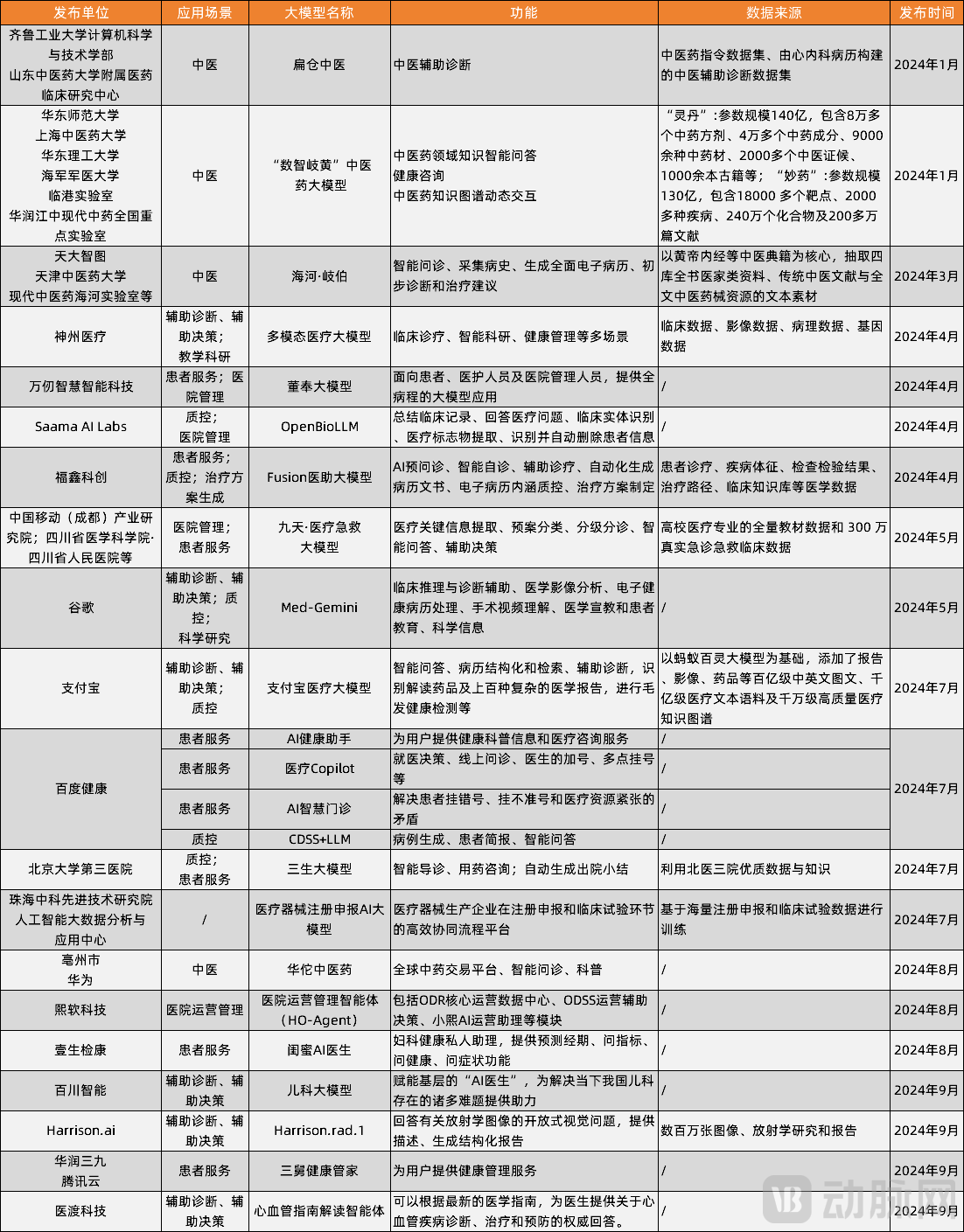
Various Agents Released in 2024 (Incomplete Statistics)
For numerous internet companies focusing on AI agents, the pre-consultation scenario is an indispensable choice.
On one hand, the pre-consultation phase is characterized by high-frequency communication and rapid response; the needs of both doctors and patients align closely with the strengths of AI agents, thereby fully leveraging the capabilities of generative AI.
On the other hand, clinical data involved in the during-consultation and post-consultation phases requires localized deployment as mandated by most hospitals, yet the majority lack the infrastructure necessary to support large language models. In contrast, pre-consultation scenarios such as patient guidance, online inquiry, and triage have lower security requirements for health data, thereby reducing deployment complexity for enterprises and expanding the potential user base for monetization.
Furthermore, as internet healthcare emerged, companies had already integrated substantial AI into pre-consultation processes and accumulated ample operational experience. Leveraging these advantages, iFlytek Healthcare, Tencent Health, and Baidu Lingyi Zhihui have all established their presence in this area.
iFlytek Healthcare’s Spark large language model directly addresses the pain point of doctor-patient communication. Powered by the Spark large language model, AI can simulate free-flowing conversations between doctors and patients, intelligently recommending appropriate medical departments and suitable physicians based on patients’ descriptions of their conditions. Meanwhile, the large language model can automatically generate electronic medical records (EMRs) by leveraging information such as patients’ symptom descriptions and medical histories, thereby enhancing the efficiency and accuracy of medical record documentation.
Tencent Health shares a similar logic with iFlytek Medical, but it more precisely addresses the need for “pre-consultation.” Leveraging its prior experience in intelligent triage, Tencent Health has developed an AI-powered pre-consultation system using large language models. After scheduling an appointment, patients can engage in a detailed pre-consultation with the system, providing information such as chief complaints, medical history, and medication contraindications in advance. During the formal consultation, physicians already have a preliminary understanding of the patient’s condition, enabling them to ask more targeted questions and thereby improving diagnostic accuracy.
Baidu Lingyi Zhihui has advanced at a slightly faster pace, introducing three applications in the pre-consultation phase: intelligent triage and guidance, smart appointment slot addition, and intelligent waiting management. First, intelligent triage and guidance addresses patients’ common needs for triage and departmental referral. Supported by large language models, AI can simulate the pre-consultation process, guiding patients to accurately describe their symptoms, leveraging reasoning capabilities to summarize and analyze the information, and precisely matching patients with the appropriate clinical departments and specialists based on their conditions. Through this approach, hospitals can maximize the utilization of effective medical resources, enabling every physician to fulfill their professional value.
Secondly, the value of smart appointment add-ons lies in filling the "vacuum zones" within hospitals' previous service systems. The core benefit of intelligent appointment add-ons is transforming what was once a unilateral request from patients into a mutual "agreement" between doctors and patients. Specifically, patients first interact with an AI model online while uploading their test results; the model then extracts a summary of medical history and key positive findings, helping physicians quickly determine whether specialist consultation is necessary, thereby enabling precise appointment scheduling. Real-world implementation data from Wuhan Union Hospital demonstrates that this approach significantly reduces the time physicians spend reviewing records and communicating with patients, while also aiding in more accurate diagnosis of underlying causes, thus effectively enhancing the quality of care.
Finally, intelligent waiting aims to optimize physicians’ consultation efficiency and enhance patients’ healthcare experience. With AI support, when seeing patients in the consultation room, physicians need only a few seconds to review the organized medical records and quickly grasp the patient’s general condition. As a result, physicians not only save time on consultations and documentation but also enable more precise and efficient doctor–patient communication, leading to more accurate clinical decision-making.
Certainly, many companies have also recognized the value of AI agents in areas such as patient follow-up and medication instructions, building patient communities, and ultimately seeking payment from pharmaceutical companies. Ultimately, the various innovations achieved by internet healthcare in the past are now being upgraded to a new era by AI agents.
Given the rapid deployment, strong demand, and ease of application development in pre-consultation scenarios, this area has naturally become a red ocean crowded with AI agents. Consequently, many companies are choosing to bypass this intense competition and bet on the future by focusing their strategies on B-side pharmaceutical companies or hospitals.
The digital transformation of pharmaceutical companies and the development of smart hospitals in recent years have equipped B-end users in the healthcare industry with fairly mature intelligent capabilities, but also concealed some new challenges.
For example, in some cases, pharmaceutical companies have invested heavily in introducing various digital systems during their digital transformation initiatives; however, due to a lack of rational system integration, the systems across different departments remain incompatible.
Some enterprises also hope to leverage digital tools to enhance communication efficiency and fully capitalize on customer relationship insights. In practice, however, sales personnel often lack adequate training and guidance. Faced with overly complex forms, they exhibit strong resistance, frequently omitting or incorrectly entering data, which creates significant obstacles during the implementation of digital systems.
Therefore, to promote the practical implementation of AI agents on this foundation, it is essential to ensure that AI integrates as seamlessly as possible into existing systems and that the system itself is user-friendly, facilitating effective communication with users.
Most importantly, the capabilities of AI agents must be differentiated from those of legacy smart hospital systems to fully leverage the advantages of generative AI.
After all, managers today already have access to a wealth of analytical tools; what they need is not the drill, but the hole.
For example, Xiruan Technology’s recent hospital operations AI agents have already achieved commercial deployment in multiple hospitals. In an interview, Chen Chong, the company’s founder and chairman, stated, “As a highly specialized social organization with complex management models, hospitals are subject to clear policy requirements from the state regarding their operations. Internally, they also maintain comprehensive management systems and standardized operational procedures. The sheer volume of content and complexity of these processes often cause healthcare professionals to expend considerable time and effort on document retrieval and process handling.”
To help enhance overall hospital operational efficiency and promote the comprehensive and accurate implementation of hospital management systems, XiRuan Technology has developed the XiaoXi AI Operations Assistant. This assistant integrates hospital operations-related policies and regulations into a knowledge base, leveraging domain-specific large language models, Agent technology, traditional machine learning techniques, and underlying multi-format knowledge bases to deliver three core applications: intelligent knowledge Q&A, intelligent data analysis, and an intelligent operational experience.
For healthcare professionals, simply asking a question when applying for business travel provides clear guidance on reimbursement policies. To query departmental operational data, they can just ask the Xiao Xi AI Operations Assistant and receive the desired information directly. Furthermore, “Xiao Xi” can perform comprehensive analysis and interpretation of the data. Whether it involves approvals for budgets, reimbursements, or contracts, healthcare workers can access these functions with a single click through their conversation with Xiao Xi, enabling easy operation without the need to log into different interfaces or operating systems.
Revisiting Hospital Administrators with Greater Demands for Intelligent Solutions. Although operational systems not powered by generative AI can still summarize operational data, their shortcomings are evident: first, the data dimensions displayed on the platform are limited and difficult to expand in a timely manner; second, they lack effective interactivity, forcing administrators to rely on pre-designed algorithms for analyzing data along specific dimensions, thereby preventing them from making personalized data processing requests.
In contrast, intelligent agents for hospital operations management can help administrators obtain various in-depth data analyses and services in real time, and automatically push the data they wish to monitor based on their preferences. Even if the initially pushed content does not fully meet the administrators’ managerial needs, the system supports further customization and delivery of desired information through multimodal interaction.
Overall, intelligent agents for hospital operations management have gradually become a key technological pathway to enhance the efficiency and effectiveness of healthcare institutions, significantly improving the operational efficiency of hospitals.
Despite technological breakthroughs enabling AI agents to rapidly capture previously established markets and demonstrating the potential for “killer apps,” their existing flaws remain evident in practical operation.
When large language models fail to meet performance standards, many AI agents cannot provide absolutely correct answers in patient triage and clinical decision support, thereby harboring inherent risks.
Moreover, while it is easy for existing enterprises to build an AI agent, making their agent stand out among numerous similar applications still requires substantial investment in high-quality data. Only through continuous training, fine-tuning, and accumulation of model capabilities can enterprises gradually develop superior business competencies.
This is a test for most startups, meaning that companies must not only maintain R&D but also increase investment in the implementation of large models. After all, more implementation cases can feed back into the model, further enhancing its generalization ability.
Therefore, AI agents still have a considerable distance to travel from commercialization to profitability. Especially in today’s climate, where the fierce competition among hundreds of large language models has reached a fever pitch, operators of AI agents may need to reevaluate their cash flow to ensure they can sustain operations until ultimate victory is achieved.