

Evonetix Files IPO Prospectus Highlighting Its Proprietary Chip-Based Thermal Control DNA Synthesis Platform

evonetix
Gene Synthesis Technology R&D Provider
As one of the key enabling technologies in synthetic biology, DNA synthesis technology provides the foundational materials for both basic research and applied fields in synthetic biology. With continuous advancements and innovations in DNA synthesis technology, it has become possible to synthesize longer and more complex DNA sequences, offering greater possibilities for constructing complex genetic circuits, synthesizing novel biomolecules, and engineering the genomes of organisms.
May 10, 2023Synthetic biology company Evonetix has once again driven innovation in DNA synthesis technology, creating a new paradigm for DNA synthesis.On that day, Evonetix announced that it had delivered its first batch of chip-synthesized DNA to Dr. Jenny Molloy’s laboratory in the Department of Chemical Engineering and Biotechnology at the University of Cambridge, using its proprietary DNA synthesis platform, and that this batch of synthesized DNA products passed testing successfully. This milestone demonstrates that Evonetix’s DNA synthesis platform can successfully synthesize DNA using its thermally controlled semiconductor chip technology, enabling the company to begin large-scale, accurate synthesis of long DNA sequences.
Evonetix, founded in 2015, aims to introduce semiconductor technology into DNA synthesis by developing a rapid “DNA-on-a-chip” technology for the large-scale generation of accurate, high-fidelity DNA.On February 7, 2023, Evonetix announced the completion of its latest funding round of £20 million (approximately $26.68 million). To date, the company has completed four funding rounds totaling over $70 million (approximately RMB 490 million).
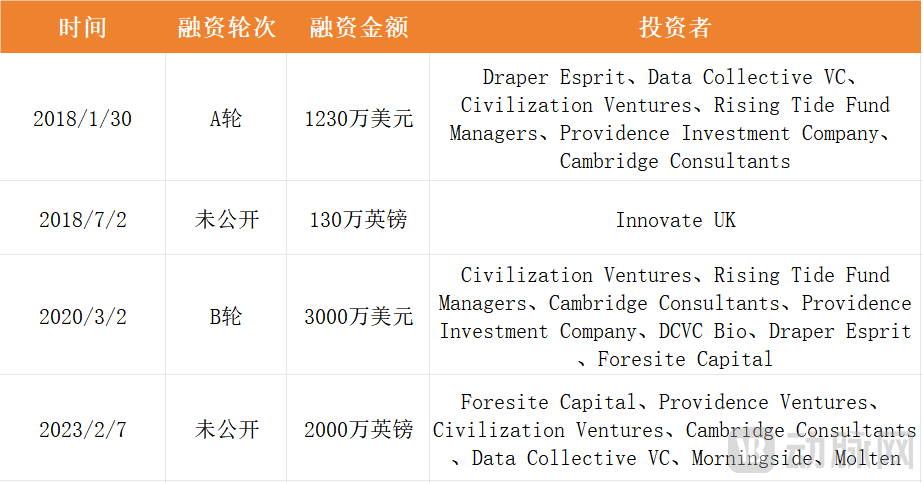 Data source: Crunchbase official website; graphic by VCBeat
Combining semiconductor technology with thermal control technology to achieve DNA synthesis on chips through precise temperature control
Currently, chemical synthesis and enzymatic DNA synthesis are common DNA synthesis technologies. However, chemical synthesis still faces insurmountable limitations in terms of DNA strand length, synthesis cost, and environmental impact. Today, the DNA synthesis industry is trending toward more efficient and environmentally friendly innovative solutions. As a result, enzymatic DNA synthesis, along with chip-based inkjet, photochemical, and electrochemical methods, is receiving increasing attention and research interest.
Among these, enzymatic DNA synthesis is a biotechnology that utilizes the catalytic activity of DNA polymerases to synthesize DNA strands. The application of this technology requires precise control over reaction conditions, such as temperature, pH, and ionic strength, to ensure enzyme activity and stability. Furthermore, current typical enzymatic DNA synthesis methods rely on more traditional platforms, such as column-based synthesizers. This implies that the technology faces challenges in significantly increasing the number of DNA sequences prepared in parallel. Consequently, when synthesizing large quantities of diverse, long sequences, its synthesis efficiency and quality are correspondingly limited.
In this regard,Evonetix has developed a novel semiconductor-based DNA synthesis technology and built a new generation of benchtop DNA synthesis platforms for laboratories based on this technology. The platform is compatible with enzymatic DNA synthesis technology, promising rapid synthesis of ultra-long, sequence-complex DNA strands.
EEvonetix’s DNA synthesis technology is based on custom MEMS (micro-electromechanical systems) silicon chips, leveraging thermal control to regulate key chemical steps in the synthesis process. By precisely controlling the temperature at thousands of reaction sites on a single chip surface, it ensures accurate DNA synthesis, ultimately enabling large-scale production of DNA sequences.
Specifically, Evonetix combines CMOS (complementary metal-oxide-semiconductor) technology with MEMS silicon chips to create a microfluidic thermal array chip carrier based on the precise, independent control of semiconductor MEMS silicon chips. The surface of each chip features thousands of independently thermally controlled reaction sites. This synthesis method controls the accurate synthesis of DNA by regulating the temperature at these reaction sites. According to the Evonetix website, these reaction sites can synthesize DNA sequences in parallel simultaneously, meeting the needs for complex library construction and long-chain DNA assembly, thereby addressing the DNA supply bottleneck in the field of synthetic biology.
It is worth noting that,The key to the chip's ability to rapidly synthesize DNA sequences in parallel lies in the temperature control at each reaction site.To this end, Evonetix has developed a novel closed-loop thermal control system. Leveraging this thermal control technology, Evonetix can precisely and independently regulate the temperature of the fluid volume at each reaction site, and further utilize thermal modulation to initiate, accelerate, or decelerate reactions at various locations on the chip.
Leveraging custom silicon chips, Evonetix enables the synthesis of long DNA sequences. This DNA synthesis process employs a “binary assembly” approach. First, during synthesis, temperature control at each reaction site allows for selective deprotection of the growing DNA strands, preparing them for the addition of new bases. The newly added bases bind exclusively to the deprotected oligonucleotides. Furthermore, by sequentially introducing reagents containing each of the four bases (A, C, G, and T) and utilizing timed thermal deprotection, distinct sequences are synthesized at each reaction site.
Subsequently, the synthesized oligonucleotides are released individually and transported from the current reaction site to the next. At the subsequent reaction site, the oligonucleotides are captured by an electric field and annealed with their complementary strands, ultimately assembling into specific long DNA sequences. Thereafter, the temperature at the reaction site is raised to a precise, sequence-specific level, enabling the differentiation of erroneous sequences from those with correct homology and melting off any mismatched oligonucleotides. By eliminating synthesis errors during the assembly process, the proportion of incorrect sequences in the final product is effectively minimized, further ensuring the accuracy of the synthesized DNA sequences.
Currently, commonly used DNA synthesis technologies are difficult to optimize for the sequence assembly and error correction processes, with the quality of DNA synthesis mostly being checked only after synthesis and purification.Evonetix’s proprietary silicon-chip synthesis technology enables parallel DNA synthesis across thousands of independently thermally controlled reaction sites. Furthermore, by optimizing reaction conditions and incorporating advanced error-correction mechanisms, Evonetix further ensures the quality and accuracy of DNA synthesis.
Launch the Early Access Program for Synthetic DNA to Accelerate the Commercialization of Chip-Based DNA Synthesis Technology
To further advance the commercialization of its semiconductor-based chip DNA synthesis technology and develop a next-generation benchtop DNA synthesis platform, Evonetix requires partners capable of providing biosensor solutions, MEMS processing, and specialized semiconductor precision machining services.
To this end,Since January 2019, Evonetix has been collaborating with Analog Devices, Inc. (ADI), a globally leading multinational semiconductor company, and its innovation hub, Analog Garage, to jointly advance the development and commercialization of Evonetix’s first benchtop DNA synthesis platform.
In December 2023, Evonetix and ADI once again signed an agreement for the joint development and commercial supply of DNA synthesis platforms. Under the terms of the agreement, ADI will continue to invest in the development of Evonetix’s semiconductor-based Evaleo® series of DNA synthesis instruments, helping to continuously optimize silicon chip technology design to establish a new technological benchmark, ultimately elevating thermal control technologies for DNA synthesis and assembly to a new level.
In the press release, Evonetix also stated that the company is collaborating with ADI to develop a DNA synthesis platform based on semiconductor chip technology. This platform is expected to enable the synthesis of high-fidelity, long DNA sequences within three days. Building on this capability, the design-build-test cycle for antibody, vaccine, and protein engineering can be shortened from months to days.
Furthermore, to further validate its semiconductor chip-based DNA synthesis technology, Evonetix launched an Early Access Program for semiconductor chip-synthesized DNA in 2022. Researchers can apply to join the company’s early trial program to gain access to the first batch of synthetic DNA products manufactured using its technology.
It is worth mentioning that,On October 5, 2023, Evonetix announced the first installation of its DNA synthesis development platform at Imperial College London (ICL) for the evaluation of human disease and infection research. This marks the first time Evonetix has installed this platform at an external scientific research institution for customer use and commercialization.Previously, Evonetix’s chip-based DNA synthesis technology was successfully delivered to the University of Cambridge for evaluation and testing, further demonstrating its synthesis efficiency and supporting the company’s development.
Domestic and International Companies Race to Deploy, Accelerating the Commercialization of Enzymatic DNA Synthesis Technology
Enzymatic DNA Synthesis TechnologyEnzymatic DNA synthesis is a biotechnology that leverages the catalytic activity of enzymes to synthesize DNA molecules. This technology primarily relies on the catalytic action of DNA polymerases and other enzymes to construct DNA strands. It enables relatively mild reaction conditions and high enzyme specificity, allowing for precise control over the DNA synthesis process. Furthermore, enzymatic reactions typically exhibit high catalytic efficiency, facilitating the rapid production of large quantities of DNA molecules.
Compared with traditional chemical synthesis techniques, enzymatic DNA synthesis technology offers significant advantages in terms of synthesis length, efficiency, cost, and other aspects, and is regarded as the next-generation technology capable of driving a transformative shift in DNA synthesis.
Currently,In addition to Evonetix, numerous domestic and international enterprises and research teams have entered the field of enzymatic DNA synthesis, continuously driving breakthroughs in this technology and expanding its applications.
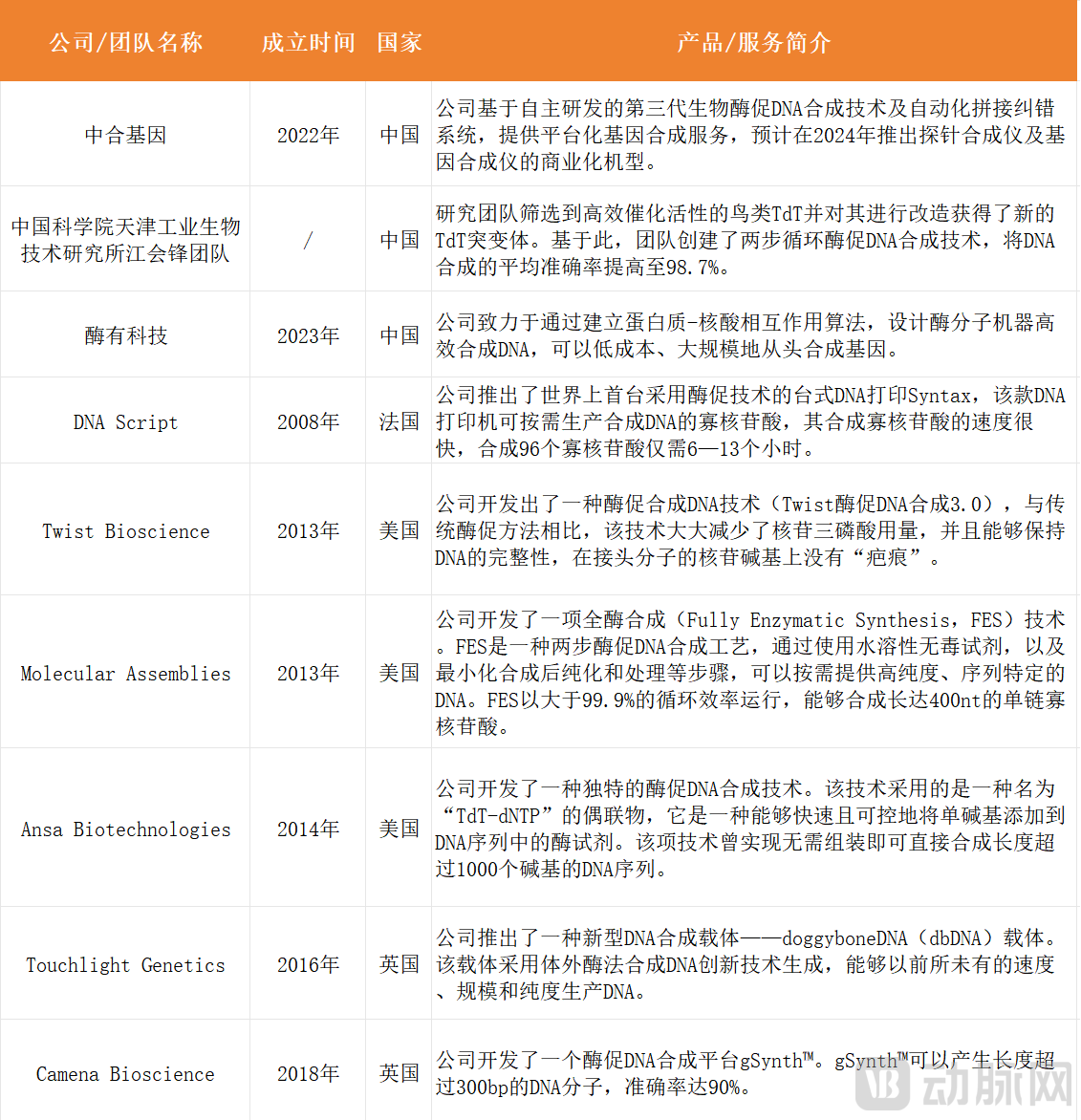 Image source: Compiled from public information; graphic by VCBeat (listed in no particular order; data is incomplete)
From this perspective, enzymatic DNA synthesis technology has gradually moved from the laboratory to broader application scenarios, providing more efficient and precise DNA synthesis tools for scientific research in the field of synthetic biology, thereby driving transformative development in synthetic biology and related industries. However, the industrial development of enzymatic DNA synthesis technology is still in the stage of technical validation and exploration, and large-scale commercial application has not yet been achieved globally.
The core of synthetic biology lies in the precise control and programming of biological components, thereby creating biological entities capable of performing specific tasks. It is for this reason that the advancement and maturation of enabling technologies, such as DNA synthesis and gene editing, are key to the forward development of synthetic biology.
In the future, as technology continues to advance and application scenarios expand, researchers will continue to optimize enzymatic reaction conditions, improve the catalytic efficiency and specificity of enzymes, and reduce synthesis costs to promote further maturation and refinement of this technology. Ultimately, enzyme-mediated DNA synthesis technology may be able to synthesize longer fragments of DNA, better serving the prospects of large-scale, high-throughput DNA synthesis applications, thereby driving the development of synthetic biology.