

China's Second Domestic Class 1 Veterinary Chemical Drug Approved: Lizutinib Marks the Dawn of Chinese Pet Innovation Drug Going Global
On October 16, the Ministry of Agriculture and Rural Affairs issued an announcement approving the market launch of “Lishutinib” and “Lishutinib Tablets,” two Class I new veterinary chemical drugs developed by Gegwu (Zhuhai) Biotechnology Co., Ltd., Elanco (Shanghai) Animal Health Co., Ltd., and Elanco (Sichuan) Animal Health Co., Ltd., for the control of allergic pruritus in dogs.
This marks the second Class I veterinary chemical drug approved for market launch in eight years. According to public information, Lishutinib is an original drug developed by Gegwu Biotechnology. Industry analysts suggest that the appearance of Elanco, a global animal health giant, on the marketing authorization certificate may indicate that Gegwu Biotechnology has entered into a licensing collaboration with Elanco based on Lishutinib, positioning itself as a pioneer in the overseas expansion of innovative Chinese pet pharmaceuticals.
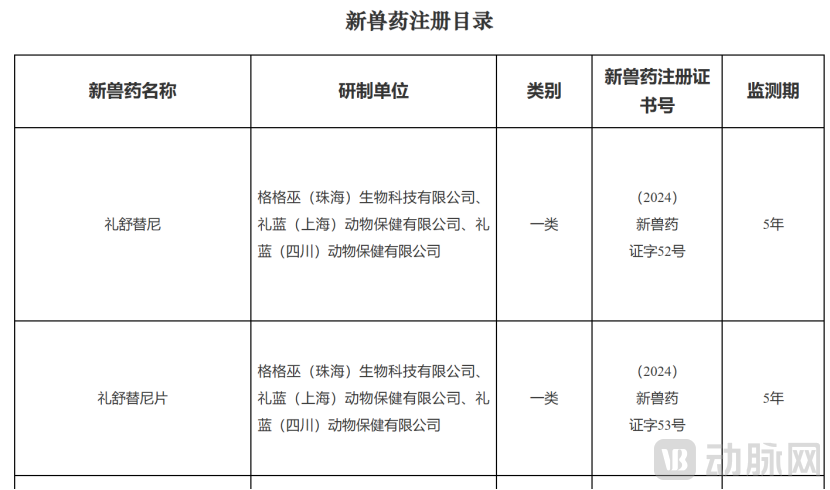
(Image source: Announcement No. 835 of the Ministry of Agriculture and Rural Affairs)
According to 21st Century Business Herald, the newly approved lisocitinib is the third veterinary drug worldwide targeting JAK kinases, filling a gap in this field in China and providing a new option for treating canine pruritus domestically.
Pruritus is one of the primary reasons pet owners seek veterinary care for their dogs, with both owners and veterinarians seeking more therapeutic options in canine dermatology. Currently, approximately 17 million dogs in the United States suffer from allergic skin diseases, including atopic dermatitis, food allergies, or flea hypersensitivity.
The two previously approved JAK inhibitors, both sanctioned by the FDA for the treatment of allergic pruritus in dogs, are Zoetis’s (spun off from Pfizer’s animal health division) JAK inhibitor Apoquel (oclacitinib) and Elanco’s JAK inhibitor Zenrelia (ilunocitinib tablets).
Zoetis’s oclacitinib was first approved for market launch in 2013, with a chewable formulation gaining approval in 2023. Over an 11-year period, oclacitinib firmly dominated the global canine dermatology market, valued at $1.7 billion. This landscape remained unchallenged until September 2024, when Elanco’s Zenrelia (a once-daily oral medication) received approval, breaking its monopoly.
Zenrelia has been approved for the control of pruritus (itching) associated with allergic dermatitis and atopic dermatitis in dogs at least 12 months of age. Meanwhile, Elanco stated that Zenrelia has received its initial approval from the Brazilian Ministry of Agriculture, Livestock and Food Supply, with a planned market launch in the fourth quarter of 2024. Regulatory reviews for market entry in other regions, including Canada, Europe, and Japan, are also underway.
Following the successive approvals of Zenrelia and ruxolitinib tablets, Elanco has expanded its global footprint. As both are once-daily oral formulations, it can be inferred that Elanco is continuously strengthening its portfolio in canine dermatological indications, such as allergic pruritus and atopic dermatitis in dogs. In fact, mergers and acquisitions and platform pipeline collaborations are standard practices for Elanco, a leading global animal health company:
In the 1960s,Eli LillyRestructured the agricultural and industrial sales divisions to establish Elanco Products Company, which included the first antibiotic dedicated exclusively to veterinary use. The company continuously expanded its business and product portfolio by establishing agricultural units and opening regional offices. From 2000 to 2012, it successively acquired partners including Ivy Animal Health, Janssen Animal Health, ChemGen, and Lohmann Animal Health, thereby expanding its operations in feed enzymes, pharmaceuticals, and other areas within the poultry and pet sectors.In 2015, it acquired Novartis Animal Health; in 2016, it acquired Boehringer Ingelheim’s innovative vaccine platform for veterinary medicine; in 2019, Elanco completed its spin-off from Eli Lilly and was listed on the New York Stock Exchange; in August 2020, Elanco completed the acquisition of Bayer’s animal health division for $6.89 billion, becoming the second-largest player globally.
In 2021, Elanco acquired Kindred Biosciences for approximately $444 million, securing three blockbuster dermatology pipeline assets expected to launch by 2025 and advancing its opportunity to enter the dermatology market.
Meanwhile, the global animal health market shows a clear trend toward intensification.According to statistics, the market share of the top five global animal health companies far exceeds 50%. Following the acquisition and integration of Bayer’s animal health division, Elanco has become the world’s leading aquaculture animal health brand by sales volume. Meanwhile, Elanco Animal Health China has become the only animal health company in China covering all five major business segments: swine, poultry, cattle, pets, and aquaculture.
High Attention Naturally Stems from China’s “Supermarket”:In 2020, Elanco’s sales revenue in the Chinese market ranked second among its global regional markets, trailing only its domestic U.S. market. China’s business volume accounted for 5% of the company’s global total, while growth in the Chinese market contributed more than 30% to Elanco’s overall global growth.In addition, Elanco is gradually building up its production capacity in China. In 2021, it announced that it would relocate the global production line for its flagship product, Tylvalosin, to its Shanghai factory.
In a previous interview, Lu Zhibin, then General Manager of Elanco Animal Health for Greater China, stated that,Elanco Animal Health has long maintained an interest in Chinese animal health companies. It would consider such mergers and acquisitions if they could accelerate the achievement of corporate objectives; however, “M&A is not an easy endeavor and involves an element of chance, so it remains uncertain when such a transaction might occur.”
Lu Zhibin also noted that for a long period, animal health was largely affiliated with pharmaceutical companies as merely a business unit, accounting for no more than 10% of internal operations, typically ranging between 2% and 5%. Furthermore, there are differences in business models between animal medicines and human pharmaceuticals. The strategies of pharmaceutical companies could influence the innovative development of animal health businesses, whereas independent animal health operations enjoy greater autonomy.
In overseas markets, established animal health giants such as Zoetis (spun off from Pfizer Animal Health), Boehringer Ingelheim Animal Health, Merck Animal Health, Elanco, IDEXX, and Ceva have been deeply entrenched in the pet pharmaceutical sector for decades. Pet vaccines and deworming medications, such as Purevax (a Zoetis product) and Drontal (a Bayer product), have long dominated the global consumer market.
Overall, animal health giants and their parent multinational corporations (MNCs) initially exhibited a trend toward spin-offs and independence. Meanwhile, as the “pet boom” continues to intensify globally, major animal health companies are steadily increasing their investments in pet care and innovative R&D. Veterinary pharmaceutical innovators such as Kindred Biosciences have also seen widespread emergence over the past two decades. This growth is driven by the substantial unmet needs that remain in areas such as pet oncology and immune-mediated diseases in companion animals.
In contrast, large animal health companies are less flexible in their strategic layout than startups but possess more targeted capabilities along with regional and local advantages. For pharmaceutical companies whose core business is the R&D of innovative human drugs, their affiliated animal health subsidiaries benefit from a structure that ensures relative operational independence. Meanwhile, given that the development of innovative pet medicines involves long cycles, high risks, and technical platform barriers, these subsidiaries collaborate closely with their parent innovative drug companies to achieve technology sharing and risk mitigation.For example, the originator of resibufogenin, Gegwu Biopharma, is Guangzhou Yinming Biopharmaceutical Technology Co., Ltd., whose pipeline covers multiple fields including ophthalmic drugs, recombinant botulinum toxin, and tumor immunology.
A surge of innovative pet pharmaceutical companies, driven by emerging technologies as their foundational force, emerged around 2010.In August 1980, the State Council promulgated the Interim Regulations on Veterinary Drug Administration, the first policy and regulation in the People's Republic of China aimed at standardizing veterinary drug management. Between 2000 and 2010, domestic regulations and policies related to veterinary drugs entered a phase of rapid development and refinement. The Regulations on the Administration of Veterinary Drugs underwent multiple revisions, and several supporting regulations were issued, establishing comprehensive regulatory safeguards across the entire lifecycle of veterinary drugs, including production, research and development, distribution, and supervision. This period marked the emergence of an initially mature framework for policy and regulation in China’s veterinary drug sector.
Prior to 2010, there were few enterprises in China dedicated exclusively to the production of veterinary medicines for pets. Most traditional animal health pharmaceutical companies expanded their production lines or restructured their pet drug manufacturing divisions to produce pet medications alongside their general veterinary products. However, since most of these traditional enterprises lacked specialized pipelines for pet-specific drugs, their production scales remained small and their product portfolios limited, failing to meet the growing demand for dedicated pet medications driven by the rapid development of the pet industry.
According to incomplete statistics from VCBeat, 70% of innovative enterprises established after 2010 have secured financing in recent years amid the capital winter, with well-known investment firms such as Morningside Venture Capital, Gaorong Capital, and Legend Star having participated.Most of these startups are concentrated in the niche sector of veterinary pharmaceuticals, with innovative technologies and products.
However, emerging companies that have recently entered the pet pharmaceutical sector, given the lengthy drug development cycles, currently have pipelines mostly in preclinical or clinical stages, with most yet to reach the market or alleviate financial pressure.In this context, subsidiaries of innovative pharmaceutical companies such as Gegwu Biotechnology may be able to accelerate the advancement of their innovative pipelines into clinical trials and market launch, leveraging their parent companies’ technology platforms, technical teams, and process expertise.
Specifically, the majority of domestic entities with Good Clinical Practice (GCP) qualifications are top-tier agricultural universities and animal health giants. Most innovative companies entering the pet pharmaceutical sector have strong foundational support or backing in terms of underlying logic and technical capabilities; for instance, their teams often have backgrounds in agricultural universities, human pharmaceutical development, or veterinary drug development. This ensures that bottlenecks do not arise during subsequent stages such as technology transfer, optimization, and product iteration.
According to the official website of Yinming Biology, Gegwu Biology’s original small-molecule drug GGW102 has completed Phase II clinical trials and is currently in Phase III clinical trials. GGW102 is an immune checkpoint inhibitor targeting feline infectious peritonitis and is classified as a Class 1.1 new veterinary drug.Feline Infectious Peritonitis is an immune-mediated disease caused by feline coronavirus (FCoV), which is fatal in most cases, and there are no officially approved drugs available on the market worldwide.
Repeated moves by animal health giants and the rise of innovative pet pharmaceutical companies all point to the strong sales potential of pet medicines, which may become the next major growth driver in the animal health sector.
According to QYResearch data, the global pet pharmaceutical market size reached USD 12.608 billion in 2019 and is projected to reach USD 20.058 billion by 2026, with a compound annual growth rate (CAGR) of 7.04%. Among these, the Chinese market has witnessed rapid changes in recent years; in 2019, the market size for pet pharmaceuticals in China reached USD 176 million, and it is expected to reach USD 481 million by 2026, with a CAGR of 16.44%.
In the broader pet consumer market, growth momentum is equally strong. Data released by the Asia Pet Research Institute shows that China’s pet consumption market size reached RMB 206.5 billion in 2020; according to statistics from the American Pet Products Association (APPA), the U.S. pet market size had already reached $103.6 billion in 2020.
Public financial reports show that Zoetis generated over $4.5 billion in revenue in the first half of 2024, with companion animal revenue exceeding $3 billion, accounting for more than 60%; Elanco achieved total revenue of $2.389 billion in the first half of 2024, with its pet health business generating $1.218 billion, representing over 50% of the total.
References:
VCBeat: “The Booming Multi-Billion-Dollar Pet Drug Market: Three Key Challenges Facing Chinese Companies”
21st Century Business Herald: “Nansha-Based Company’s Original Pet Drug Approved for Market Launch, Leading China’s Innovative Pet Medicines in Going Global”
The Paper: “Elanco Animal Health: China’s Animal Health Industry Has Significant Room for Growth, and the Company Is Interested in Acquiring Chinese Firms”
PharmaCircle “Animal Health, a Hot Golden Track: The Layout of Giant Elanco”