

LUCI: China's First Domestically Developed Adjustable Intracranial Thrombectomy Stent Receives NMPA Approval
On October 22, 2024, Grand Pharmaceutical Group Limited issued an announcement stating that it had jointly developed with Nanjing Kainite Medical Technology Co., Ltd. a treatment forAcute Ischemic StrokeofAdjustable Intracranial Thrombectomy Stent Product "Cormorant", recentlyMedical Device Registration Certificate Issued by the NMPA。
It is reported that"Cormorant" is China's first domestically produced adjustable intracranial thrombectomy stent., this product approval marks another breakthrough in Grand Pharmaceutical’s portfolio layout within the neurointerventional sector.
As the developer of Cormorant, Grand Pharmaceutical Group Limited is not limited to drug R&D. In fact, it has made significant progress in innovative medical devices, particularly in the field of precision interventional diagnosis and treatment for cardiovascular and cerebrovascular diseases. To date, Grand Pharmaceutical has laid out 14 products across three directions: access management, structural heart disease, electrophysiology, and heart failure. Including Cormorant, nine access management products have been approved for marketing.
Manually Adjustable Stent Size for Vessel Matching, Enabling Safer and More Effective Thrombectomy
Acute ischemic stroke is a common type of stroke. According to the "Chinese Guidelines for the Diagnosis and Treatment of Acute Ischemic Stroke 2023" released in June 2024, this type of stroke accounts for 69.6%-72.8% of new stroke cases in China. According to a report released by Southwest Securities in 2024, the number of patients with acute ischemic stroke was approximately 3.95 million in 2022, with about 85,000 surgical procedures performed.Market size: approximately RMB 1 billion。
These diseases are primarily caused by cerebral vascular occlusion, which leads to ischemia and hypoxia in brain tissue. Failure to receive timely treatment may result in neuronal injury and functional impairment. Consequently, patients often suffer from sequelae after the onset of the disease, and the condition carries a high mortality rate.
Currently, the main treatment options for acute ischemic stroke are intravenous thrombolysis and endovascular therapy. Intravenous thrombolysis is simple and rapid to administer, but it is only applicable to patients within 4.5 hours of symptom onset. Furthermore, for patients with large vessel occlusion, intravenous thrombolysis may fail to achieve effective vascular recanalization. In contrast, endovascular therapy has a longer time window and fewer patient restrictions; however, it demands higher expertise from physicians and involves greater procedural complexity.
Currently, mechanical thrombectomy in interventional therapy is the preferred treatment for acute ischemic stroke.. However, most thrombectomy stents currently used in clinical practice have a uniform diameter, making it difficult to address occlusions in vessels that are either excessively large or narrow. The Cormorant device is well-positioned to resolve this challenge.
According to the announcement by Grand Pharmaceutical Group Limited, the Cormorant adopts a round-wire braided structural design,Can be manually adjusted to the ideal diameter in vitro to match the target vesselMeanwhile, the entire stent implantation process is fully visible and radiopaque, enabling operators to better adjust the stent based on the location and total length of the thrombus, thereby optimizing its fit within the occluded vessel and achieving a higher recanalization rate. The adjustable features of the Cormorant stent not only enhance its engagement with the thrombus, improving procedural efficacy, but also reduce vascular injury, thereby enhancing procedural safety. Furthermore, the Cormorant stent is fully radiopaque, facilitating more precise manipulation by physicians.
Relevant products have already been approved for marketing overseas
Cormorant is the first domestically produced adjustable intracranial thrombectomy stent, while similar products have already been approved overseas.
The Tigertriever stent, launched by Rapid Medical, is the world’s first adjustable, fully radiopaque stent retriever. Reportedly, this device employs a unique 3D braiding technology in which every braided filament is radiopaque, enabling full visualization throughout the procedure. Physicians can accurately assess the relationship between the stent and the thrombus based on the stent’s deployment configuration, thereby enhancing procedural safety and success rates. Moreover, the Tigertriever features an innovativeControllable Expansion TechnologyIt can better adapt to the dimensions of occluded vessels in patients with acute ischemic stroke, while balancing high embolus capture capability and a low rate of vascular injury.
This product successively obtained EU CE certification and FDA marketing approval in 2018 and 2021, respectively, and received marketing approval from the National Medical Products Administration (NMPA) of China in August 2023, becoming the first approved adjustable intracranial thrombectomy stent in China.
Additionally, to address thrombotic issues in narrow vessels, Rapid Medical has launched the Tigertriever 13, the smallest thrombectomy stent in the world to date. Reportedly, this stent is 83% smaller than similar products on the market and enables thrombectomy in intracranial vessels measuring 1–2.5 mm in diameter. Currently, no other devices on the market can treat vascular occlusions in this size range.
Additionally, this stent features an adjustable function that allows physicians to modify its diameter during the procedure to overcome excessive resistance encountered during thrombectomy, thereby achieving superior thrombus capture. Currently, this stent has received FDA marketing approval and CE certification.
18 Domestic Intracranial Thrombectomy Stents Approved
Beyond adjustable intracranial thrombectomy stents, intracranial thrombectomy stent technology has witnessed significant development. To date, according to data from the National Medical Products Administration,A Total of 18 Domestically Produced Intracranial Thrombectomy Stents Have Been Approved for Market Launch。
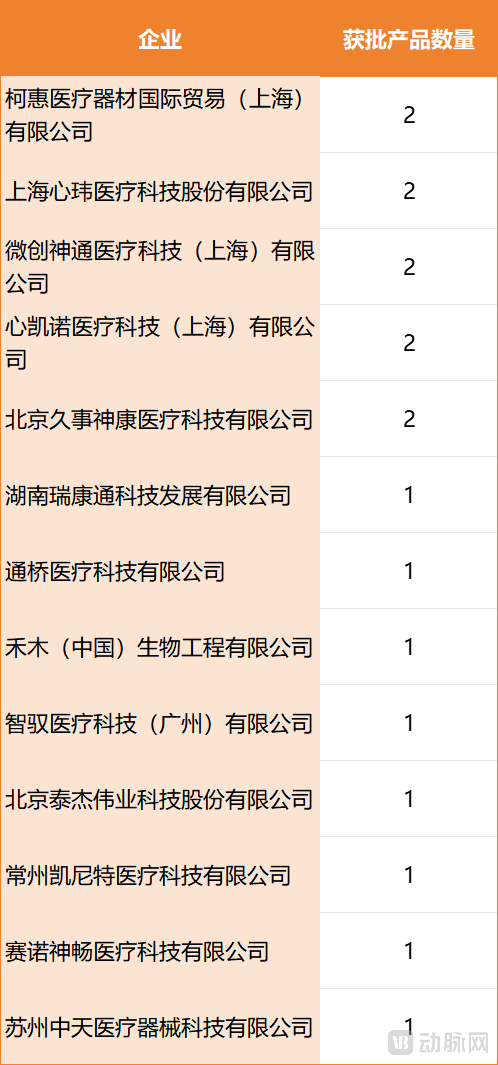
Approval Status of Domestically Produced Intracranial Thrombectomy Stents (Source: National Medical Products Administration)
In terms of product types, domestically produced intracranial thrombectomy stents have demonstrated a trend toward diversification. Stents developed and manufactured by different companies feature distinct design characteristics and technological innovations, thereby meeting a wide range of clinical needs.
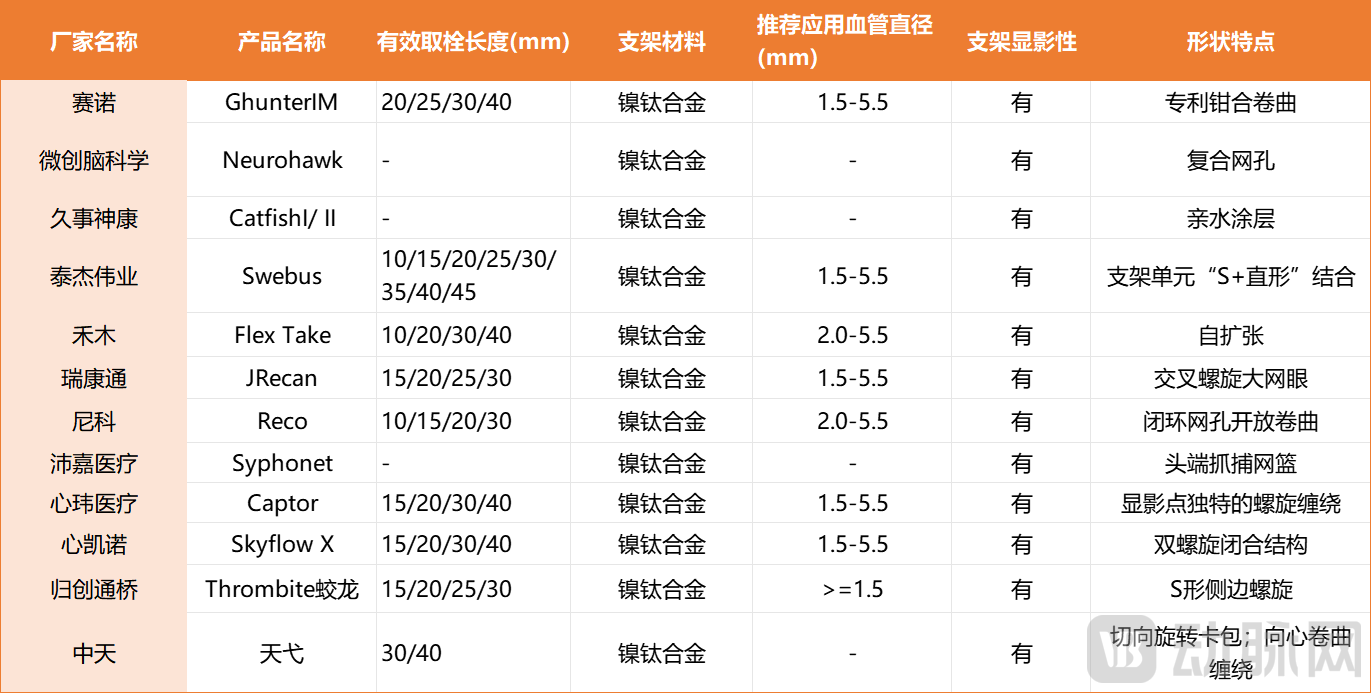 Comparison of Selected Approved Products
Currently, innovations in intracranial thrombectomy stents are primarily focused on shape design. For instance, clamping and coiling configurations can increase the contact area between the stent and the thrombus, thereby enhancing thrombectomy efficiency; self-expanding designs allow the stent to automatically adjust to an appropriate size without external force, accommodating vessels of varying diameters; and S-shaped designs create a spiral configuration along the side of the stent, facilitating better conformity to vascular curvature. These innovative designs aim to improve the performance of intracranial thrombectomy stents, making them more effective and safer in the treatment of acute ischemic stroke.
In addition, more companies are beginning to pursue comprehensive size options, aiming to provide personalized medical products for a wider variety of stroke patients.
Overall, the domestic market for intracranial thrombectomy stents is experiencing rapid development, with the approval of Grand Pharmaceutical Group Limited’s “Cormorant” stent highlighting a breakthrough in domestic innovation capabilities. As these capabilities continue to advance, the field of intracranial thrombectomy stents is poised to achieve import substitution with domestically produced alternatives, thereby meeting greater clinical demand and improving patient outcomes.