

Invisible Aligners Soar in Popularity—Is Fixed Orthodontics Still Holding Strong?
According to the latest financial data, in the first half of 2024, Align Technology, with revenues of $2.025 billion, rose for the first time to become the world’s leading dental consumables manufacturer, surpassing Dentsply Sirona, Straumann, and Envista—even amid a slowdown in Align Technology’s revenue growth. This figure vividly demonstrates the strong momentum of clear aligner orthodontics.
Clear aligner orthodontics has indeed become a blockbuster product in the dental market, with new products and concepts emerging endlessly. In the marketplace, the buzz surrounding clear aligner orthodontics has nearly drowned out the other major orthodontic modality: fixed orthodontics.
However, fixed orthodontics has a century-long history. Through extensive exploration and the accumulation of clinical cases, the technology has matured, making it applicable to the correction of various types of malocclusion. With relatively lower treatment costs, it remains the most mainstream orthodontic approach.
A wide range of imported orthodontic appliances from companies such as Ormco, Solventum (formerly 3M’s healthcare business, spun off into an independent company in 2024), American Orthodontics (AO), Tomy (Japan), Forestadent (Germany), and TP Orthodontics (US) are extensively used; among domestic companies,Aimondi,Huawen Orthodontics,Pute Medical,Fixed orthodontic products from Sanbi Orthodontics, Xinya Orthodontics, and others have also garnered a strong reputation.
According to data from Frost & Sullivan, in 2023, the size of China’s orthodontics market, calculated based on end-user prices, was RMB 61 billion, with the fixed orthodontics segment accounting for RMB 48 billion, or 78.7%. In terms of case volume measured by manufacturer shipments, there were 3.74 million cases, of which 3.24 million were fixed orthodontics cases, representing 86.6%. By 2030, the number of fixed orthodontics cases is projected to grow to 5.54 million, with the market size reaching RMB 70 billion.
So, as clear aligner orthodontics has surged in popularity in recent years, what has become of fixed orthodontic products?
Long before the advent of clear aligners, the field of orthodontics had already addressed aesthetic concerns by introducing ceramic brackets, marking a significant innovation in orthodontic treatment. Currently, various types of ceramic brackets are widely used in clinical practice and are referred to as “semi-invisible” orthodontics. With the emergence of clear aligners, characterized by their transparency and bracket-free design, near “fully invisible” treatment has been achieved, leading to their rapid rise in the orthodontic market.
“Invisible orthodontics combines aesthetics and comfort, to some extent driving fixed orthodontics to continuously improve in these two areas,” said Dr. Luo Gang, Chief Medical Officer of Meiya Dental. Ceramic brackets have improved aesthetics to a certain degree, while recent bracket designs such as spherical and egg-shaped ones have become a major direction for enhancing comfort.
Historically, most of the discomfort associated with fixed orthodontic treatment stemmed from irritation of the oral mucosa caused by the sharp edges of brackets, often necessitating the use of orthodontic protection wax to reduce friction and alleviate discomfort. VCBeat has observed thatA variety of brackets with streamlined designs have emerged on the market, predominantly from domestic brands.
In 2018, Oou Medical launched the OBrace spherical self-ligating brackets, which address common issues with traditional metal brackets, such as oral mucosal irritation and debonding, through their spherical design. Since then, Oou Medical has continued to expand its product line around this spherical design, introducing the Spherical Lingual Sheath Tube, OBRACE5S, Bei Comfortable, and Qing Comfortable series, all aimed at reducing oral trauma and enhancing patient comfort.
In 2024, Oo Medical launched its new product QBRACE2, which further reduces discomfort during orthodontic treatment through unique manufacturing processes and materials.
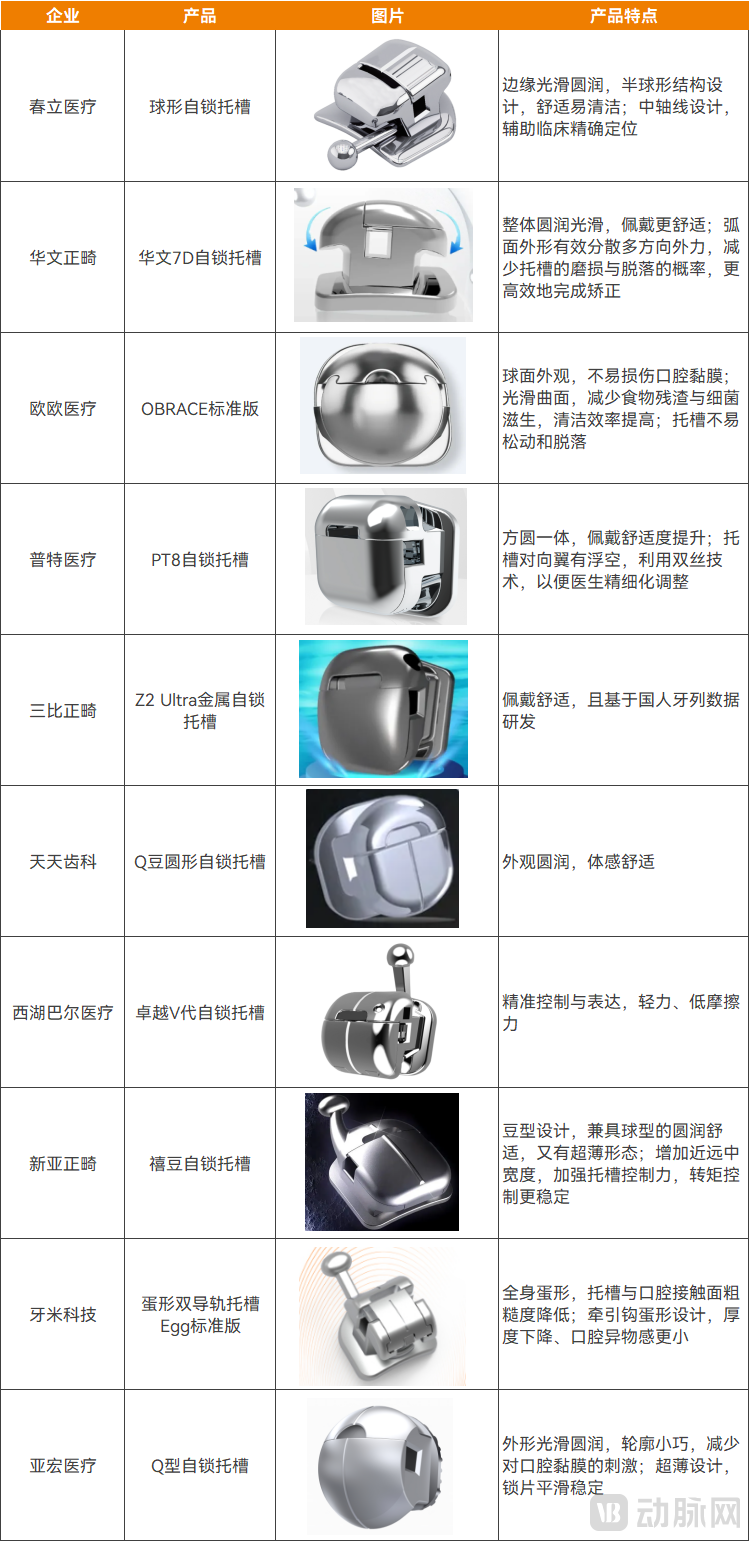
Orthodontic Brackets Featuring Smooth Design in Recent Years, Source: Corporate Official Website and Social Media
Yami Technology has launched a series of "egg-shaped" double-rail brackets. Their primary design features include an overall egg-shaped profile and a smooth surface, which reduce the roughness of the bracket-oral cavity interface and lower the incidence of oral ulcers. The traction hooks also feature an egg-shaped design with reduced thickness, minimizing the sensation of foreign bodies in the mouth.
Similar streamlined bracket designs include the Xidou self-ligating brackets from New Asia Orthodontics, the 7D self-ligating brackets from Huawen Orthodontics, the Q-type self-ligating brackets from Yahong Medical, and the Q-Bean round self-ligating brackets from Tiantian Dental.
Thinner and lighter orthodontic brackets represent another design direction aimed at improving comfort.
For example, Ormco has launched the Mini Diamond Twin-Wing Series of mini brackets. Their slim, rounded design enhances patient comfort, while micro-etching on the metal mesh base increases the bonding surface area for secure adhesion.
Regarding domestically produced products, multiple models are equipped with mini versions to reduce bracket size. For example, Yami Technology’s egg-shaped dual-rail bracket in the Mini Ultra-Thin version has a thickness of only 0.205 cm.
In summary,Fixed orthodontics focuses on improving product comfort through streamlined and ultra-thin designs.
Additionally,With the advancement of orthodontic technology, light-force treatment has gradually become a key principle in appliance design.Light orthodontic forces not only improve patient comfort but also promote periodontal health, protect posterior anchorage, and enhance the rate of tooth movement. For instance, products such as Amed’s ProMIM Passive Self-Ligating Brackets (2nd Generation) and ActMIM Active Self-Ligating Brackets, as well as Ouyou Medical’s OBRACE 5S Spherical Comfort Orthodontic Brackets, all feature light-force designs.
In Luo Gang’s view, as a mature treatment modality, fixed orthodontics is unlikely to undergo disruptive innovation in the short term; its innovations are primarily incremental improvements.
As public awareness of oral health and facial aesthetics grows, an increasing number of children and adolescents are undergoing orthodontic treatment, making early intervention a hot topic in the fields of orthodontics and pediatric dentistry.
Pediatric dentofacial deformities are generally characterized by abnormal occlusion of the upper and lower dental arches and malaligned teeth. In severe cases, serious consequences such as mandibular prognathism, craniofacial deformities, and maxillary protrusion may occur. These conditions not only impair normal facial and oral development but may also adversely affect psychological well-being due to compromised aesthetics.
“Adults, considering their social image, are generally willing to opt for clear aligners if they can afford them. However, when choosing orthodontic products for children, parents tend to prefer fixed appliances,” said Luo Gang.
Indeed, while clear aligner orthodontics offers superior aesthetics, it demands high patient compliance, typically requiring 22 hours of daily wear; failure to adhere to this regimen may compromise treatment outcomes or prolong the orthodontic course. Additionally, clear aligners must be removed during meals, with patients needing to brush their teeth and reinsert the aligners promptly afterward, which raises the risk of forgetfulness or loss of the appliances. These limitations pose significant challenges for children and adolescents.
Therefore, for many children and adolescents, fixed orthodontics is an ideal approach that can achieve treatment outcomes with relatively high efficiency and quality.
However, fixed orthodontic appliances may impair the self-cleaning function of teeth by hindering salivary flow, or cause retention of food debris and dental plaque, thereby altering the oral microecological environment and leading to health issues such as enamel demineralization and dental caries. During the course of treatment, significant pain may also result in resistance and non-compliance among pediatric patients, compromising therapeutic outcomes.
It is understood that,Self-ligating brackets, by eliminating the need for additional ligatures and reducing auxiliary components, lessen the sensation of foreign bodies in the patient’s oral cavity and facilitate oral hygiene maintenance. Compared with conventional metal bracket appliances, self-ligating bracket appliances can reduce the incidence of oral health problems during orthodontic treatment.
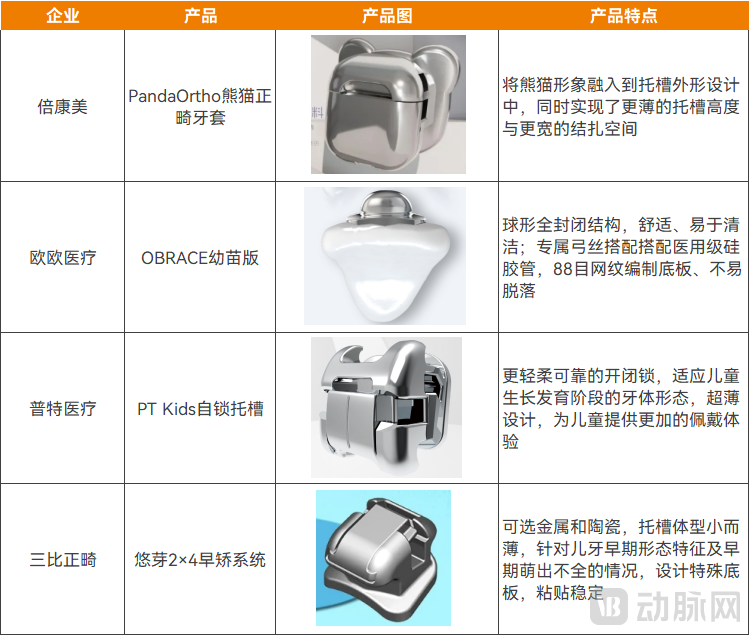
Partial Orthodontic Brackets for Children and Adolescents, Source: Official Website and WeChat Account of the Company
Currently, more companies are launching self-ligating brackets specifically designed for children and adolescents.
In 2024, Beikangmei launched the PandaOrtho orthodontic braces. Featuring an overall rounded profile and a fully enclosed design, the brackets are less likely to irritate the oral mucosa and are easier to clean, while the panda-inspired aesthetic helps alleviate patients’ psychological resistance to orthodontic treatment. Through meticulously calculated mechanical design, PandaOrtho brackets achieve a reduced bracket height and a wider ligation space, thereby minimizing oral irritation and accelerating the orthodontic process.
Oou Medical has launched the OBrace Seedling Edition, primarily targeting early orthodontic treatment of malocclusion in children and adolescents aged 7–12. Designed based on dental morphology and arch expansion during childhood development, the OBrace Seedling Edition features spherical brackets and proprietary archwires paired with φ2 medical-grade silicone tubes, enhancing comfort for pediatric patients during treatment.
Putian Medical’s PT Kids self-ligating brackets are also designed based on the dental morphology characteristic of children’s growth and development stages, reducing bracket thickness. Meanwhile, precisely adjusted opening and closing forces ensure that less force is required to operate the locking slide while still providing reliable locking stability.
Compared with traditional fixed orthodontic brackets, products designed specifically for children and adolescents are optimized in terms of bracket size, shape, and tooth-surface fit based on the dental characteristics of this age group, thereby enhancing comfort and reducing health risks.
Traditional fixed orthodontic treatment relies heavily on the clinician’s expertise. In recent years, the rapid advancement of digital technologies, integrated with 3D printing, has optimized chairside workflows and promoted the personalization of fixed orthodontic care.
First, indirect bonding technology based on digitalization and 3D printing has significantly improved doctors' work efficiency and amplified the service effectiveness of skilled orthodontists.
“During the initial phase of orthodontic treatment, the precise positioning and bonding of orthodontic brackets are critical, as they directly influence subsequent treatment outcomes. This is particularly important in straight-wire appliance therapy,” said Luo Gang. He noted that there can be significant differences in outcomes depending on whether this step is performed by an experienced clinician or a junior doctor; inaccurate bracket placement can substantially compromise treatment efficacy. Digital tools can assist clinicians in bracket positioning and the design of indirect bonding trays, enabling rapid bracket bonding through 3D-printed guides. “The digital design can be carried out by experienced clinicians, while the bonding procedure can be performed by junior doctors.”
Currently, digital-based indirect bonding techniques are increasingly being applied in fixed orthodontic treatment.
For example, New Asia Orthodontics, in collaboration with a renowned domestic medical expert team, has launched the ICCURA bracket-guided bonding technology. The digital positioning and guided bonding based on this technology is widely applicable to various bracket types both domestically and internationally.
Sanbi Orthodontics’ Meibeisi Digital Intelligent Aesthetic Fixed Appliance System, based on Andrews’ six keys to normal occlusion, enables personalized bracket positioning according to the patient’s curve of Spee and occlusal plane; it also employs a 360-degree encapsulating transfer tray to minimize errors during bracket transfer.
In the Aoshimei Digital Fixed Orthodontic System launched by Beikangmei, the sapphire thermosensitive orthodontic guide combines advanced materials science with precision manufacturing technology to assist clinicians in rapidly bonding brackets intraorally. The material’s thermosensitive properties allow the positioning device to soften within the oral cavity, thereby facilitating a smoother bonding process.
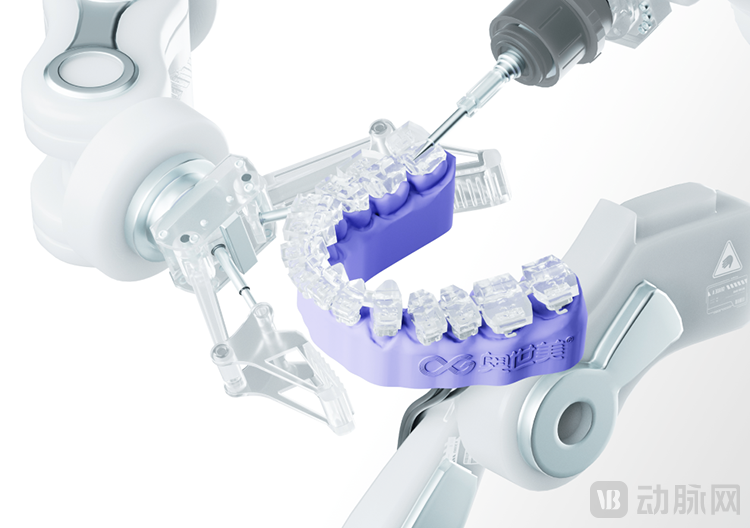
Aoshimei 3D-Printed Orthodontic Guide
Personalization is a core feature of clear aligner therapy, with each set of aligners designed and manufactured based on the patient’s dental status at a specific stage. In contrast, traditional fixed orthodontics does not share this characteristic; brackets of the same brand and specifications have relatively standardized product parameters.
Luo Gang introduced that orthodontic brackets were previously mass-produced on factory assembly lines according to preset dimensions and parameters. Now, leveraging 3D printing technology, brackets can be personalized, with parameters such as baseplate thickness and torque customized for each individual bracket to achieve personalized orthodontic treatment.
Specifically,Mass-produced brackets are applied uniformly to all patients, without consideration for individual dental anatomy or malocclusion types. During treatment, anomalous tooth movement may compromise the orthodontist’s intended ideal outcome, necessitating additional refinements such as bracket repositioning, wire bending, or the addition of auxiliary appliances.
With the growing demand for personalized orthodontic treatment and the support of digitalization and 3D printing technologies, customized fixed orthodontic brackets have emerged.
Abroad, LightForce Orthodontics has launched a 3D-printed fixed orthodontic appliance system. Its accompanying LightPlan cloud-based software supports digital treatment planning and designs personalized bracket parameters for each patient. The brackets are fabricated using polycrystalline alumina via 3D printing, enabling comprehensive customization to precisely match the unique morphology of each patient’s teeth.
Since its establishment in 2015, LightForce Orthodontics has frequently attracted capital interest, securing multiple rounds of financing. In 2023, the company completed an $80 million Series D funding round to expand its production capacity.
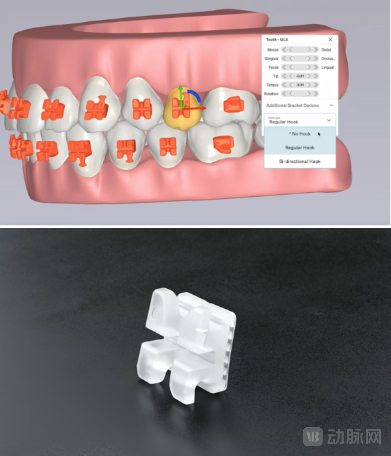
Digital Design and 3D-Printed Brackets, Image Source: LightForce Official Website
In China, companies such as Jingong Orthodontics and Tengyi Medical are capable of manufacturing customized orthodontic brackets. Among them, Jingong Orthodontics has launched the FORMULA S customized self-ligating bracket system, which performs comprehensive treatment outcome simulations based on patients’ digital data, employs digital workflow design, and utilizes CNC machining and 3D printing technologies to fabricate the appliances, thereby achieving goal-guided precise orthodontic treatment.
Tengyi Medical’s SO SWEET Customized Orthodontic Bracket System is also built on precision and comfort, delivering fully customized brackets for the entire dentition. Personalized brackets are designed based on calculated compensation data, featuring unique bracket torque that conforms better to the tooth surface, thereby enhancing treatment accuracy.
In the customized model, brackets can be digitally designed and simulated preoperatively to create virtual design models, thereby reducing production costs and shortening the time required for model modifications. The applications mentioned above primarily target labial orthodontics; for lingual fixed orthodontics, which demands a higher degree of personalization, digitalization and 3D printing can play a more significant role.
For example, Ruitong Biotech has independently developed metal 3D printers and launched the eBrace Yimei personalized lingual orthodontic appliance, enabling customized production based on individual needs. By leveraging digital tooth arrangement, high-precision 3D printing, fully automated bracket polishing, and fully automated archwire bending technologies, it achieves superior orthodontic outcomes.
Overall,, digitalization and 3D printing technologies have propelled fixed orthodontics forward by a significant margin in dimensions such as treatment precision, personalization, and clinician workflow efficiency. In the digital era, while the experience and expertise of orthodontists remain core service elements, skilled clinicians can leverage technological assistance to deliver greater value at critical stages of treatment.
In fact, whether it is fixed orthodontics or clear aligner therapy, the ultimate goal lies in continuously improving the comfort, aesthetics, precision, and overall efficiency of orthodontic treatment.
To achieve the same goal, the two approaches can even be integrated. For example, Oumou Medical has launched an orthodontic solution that combines spherical brackets with clear aligners, selecting the most appropriate treatment modality based on the specific cases of children, adolescents, or adults, as well as the actual needs at different stages of correction.
In addition, companies such as Amond, Put Medical, Xinya Medical, Tengyi Medical, and Ruitong Bio have simultaneously established a presence in both fixed orthodontics and clear aligner therapy, developing a diversified portfolio of orthodontic products.
Although fixed orthodontics and clear aligner therapy exhibit a certain degree of competitive relationship in terms of market share, they can draw mutual insights from each other when viewed from the perspectives of service objectives and corporate strategy. The iteration of digital technologies has further provided a bridge for their complementarity. Therefore, against the backdrop of a flourishing orthodontic market, fixed and clear aligner treatments are increasingly progressing side by side.