

Behind the NewCo Boom: Who's In, Who's Watching?
Currently, NewCo is arguably the hottest topic in the innovative drug sector. The reason behind this is that all the wealth-creation myths in the innovative drug industry since 2024 have been linked to NewCo.
In mid-September, Candid Therapeutics, an overseas innovative pharmaceutical company that prominently announced a $370 million financing round, set the record for the highest fundraising amount in the biopharmaceutical industry since 2024. Both of its core products were acquired from newly established overseas NewCo companies spun out of Chinese pharmaceutical firms. These two NewCos are TRC004, jointly established by Genor Biopharma and Two River, among others, and Vignette Bio, incubated through a collaboration between EMBiotech and Foresite Capital. Furthermore, among the five biopharmaceutical companies that listed on the NASDAQ this year, two are NewCos that obtained their core assets from China, with licenses sourced from Allist Pharmaceuticals and Haisco Pharmaceutical, respectively.
More importantly, behind the boom in the NewCo model, Chinese innovative drug assets are playing an increasingly critical supporting role. Consequently, domestic biotech companies that have been constrained by a lack of funding to advance R&D have seen new hope and are now gearing up for action.
NewCo is essentially BD plus financing.
“We have engaged with numerous domestic biotech companies, which are showing great enthusiasm for establishing NewCos,” Li Rui, a partner at Niukou Capital, told VCBeat. Niukou Capital is currently handling multiple NewCo projects. The high recognition of Chinese innovative drug assets in the U.S. market, coupled with the robust capital activity there, has fueled the current surge in NewCo formations.Li Rui predicts that, starting in 2025, NewCo transactions involving domestic innovative drugs will occur more frequently.“However, most people are still unsure about how to proceed,” he pointed out.
Previously, another investor engaged in cross-border biopharmaceutical transactions also stated in a media interview that an increasing number of Chinese innovative pharmaceutical companies are seeking to expand their products into overseas markets through various channels.More than half of the companies are willing to consider the NewCo model.In the past, it was mostly overseas funds seeking partners for the NewCo model of innovative drugs in the Chinese market, but recently, more and more Chinese pharmaceutical companies have taken the initiative to propose NewCo needs.
At its core, the NewCo model is a more sophisticated approach to innovative drug asset transactions, integrating asset deals with equity transactions—namely, business development (BD) plus financing. In 2014, Vivek Ramaswamy, a former Wall Street hedge fund manager and current U.S. presidential candidate, founded Roivant Sciences, positioning it as an entity dedicated to “rescuing forgotten drugs in the pharmaceutical industry.” Roivant’s operational logic involves continuously acquiring undervalued assets from large pharmaceutical companies, selecting promising pipeline candidates that are overlooked by these majors, establishing new companies to advance their R&D, and ultimately generating returns by facilitating the acquisition of these new entities by large pharmaceutical firms. This represents the prototype of the NewCo model.
In China, the surge in NewCo activity has been largely driven by Hengrui Medicine’s high-profile entry into this space. In May 2024, after Hengrui Medicine licensed its GLP-1 product portfolio to its overseas subsidiary, Hercules, other innovative pharmaceutical companies such as Keymed Biosciences, Genor Biopharma, and Biocytogen also completed a series of NewCo transactions in quick succession. In these deals, Chinese biotech firms typically license the ex-Greater China rights of one of their pipeline assets to a newly established overseas entity—the NewCo—as consideration, thereby securing upfront payments, milestone payments, and other benefits from business development (BD) transactions, along with an equity stake in the NewCo.
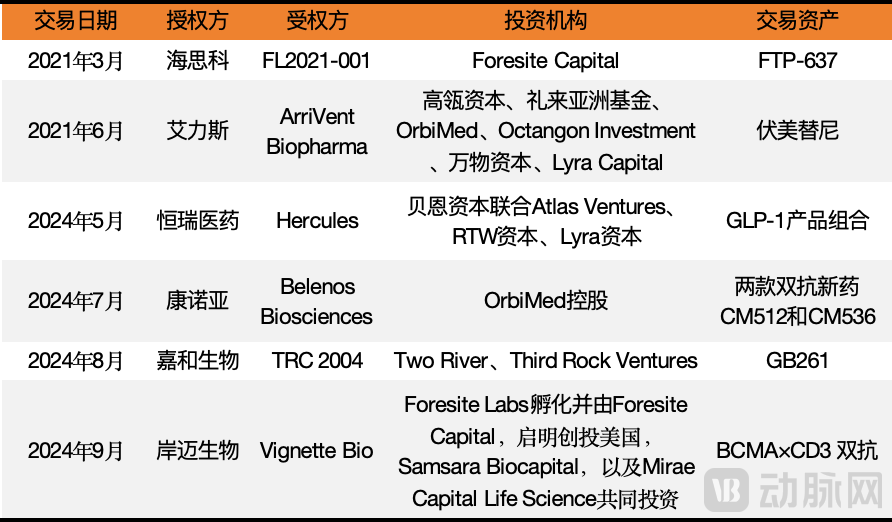
NewCos Involving Some Domestic Biotechs Data Source: VCBeat Orange Database
Notably, unlike conventional spin-offs, NewCo exhibits a strong overseas orientation, primarily operating in the U.S. market. In existing cases, although licensed Chinese innovative drug pipelines serve as the core assets, NewCo is structured as a purely American entity. It typically features a Caucasian management team, completes financing or goes public in the U.S. market, and operates independently, with the ultimate expectation of being acquired by multinational corporations (MNCs) to facilitate early-stage shareholder exits.
In Li Rui’s view, NewCo is a more suitable model for China’s current biotech sector than BD. On the one hand,Through the NewCo transaction, domestic biotech firms secure upfront payments equivalent to those in traditional asset business development (BD) deals, thereby facilitating the continued development of their domestic R&D pipelines. More importantly, by retaining partial equity stakes in the NewCo, these firms maintain the opportunity to share in the NewCo’s future capital appreciation, realizing value through a NASDAQ listing or eventual acquisition by a multinational corporation (MNC). Furthermore, assets licensed via traditional BD face inherent uncertainties within MNCs; for instance, shifts in corporate strategy may downgrade an asset’s strategic priority, leading to reduced R&D investment or even termination of the agreement. Such outcomes would not only eliminate the prospect of future milestone payments for the domestic biotech licensor but also preclude other potential operational avenues for the asset during that period. In contrast, a NewCo can be established around a single-pipeline asset, ensuring that funds are prioritized exclusively for its development and eliminating the risk of termination. This structure offers the highest level of protection for domestic biotech licensors.
In the US market, where venture capital investment in innovative drugs remains robust, NewCos can more readily secure tens of millions or even hundreds of millions of dollars to independently conduct subsequent clinical trials for their pipelines in the United States, until they generate clinical data recognized by multinational corporations (MNCs), thereby creating substantial commercial returns. A typical case is Hengrui Medicine’s business development (BD) transaction involving its TCLP pipeline, which resulted in the forfeiture of future value-appreciation rights associated with the pipeline. Through this early-stage BD deal, Hengrui Medicine received only tens of millions of dollars; however, the buyer resold the pipeline for over a hundred million dollars just three months later, while Hengrui had no right to share in the profit differential.
On the other hand,In business development (BD) transactions, multinational corporations (MNCs) often prefer mature pipelines that have entered Phase II or III clinical trials and are expected to reach the market within two years. For domestic biotech companies, these mature pipelines typically constitute their core assets, and BD transactions can significantly impact their subsequent operations. After nearly a decade of sustained focus, Chinese biotechs have now built extensive pipelines, many of which possess global competitiveness. However, most of these pipelines remain in early stages and still rely on external financing for further development. Currently, the financing environment for innovative drugs in China is highly challenging: U.S. dollar funds are hesitant to invest, while RMB funds offer valuations that are too low. The emergence of NewCo has undoubtedly optimized the process of matching innovative drug assets with capital.
Based on existing cases, spinning off overseas rights to relatively early-stage pipelines does not conflict with the domestic listing of Chinese biotech companies. “We have observed that in practice, as long as the assets have not reached Phase II or Phase III clinical trials, such spin-offs can significantly facilitate domestic listings, as they demonstrate the business development (BD) potential and international recognition of the pipeline,” Li Rui told VCBeat. Meanwhile, conducting clinical trials in the United States through a NewCo objectively supplements overseas clinical data for the pipeline, thereby supporting the advancement of clinical development in China.
Finally, and most importantly, NewCos are essentially funded by investors, whereas the payers in business development (BD) deals are multinational corporations (MNCs). Globally, only a handful of MNCs have the financial capacity to engage in BD transactions. In a market with limited buyers, it is extremely challenging to secure favorable prices or negotiate advantageous terms. However, given the large number of venture capital (VC) firms in the United States, NewCos can typically secure their initial overseas financing smoothly, using these funds to pay the upfront fees to licensors. As R&D progresses, NewCos can also continue to raise capital more conveniently.
Trading at the Stage of Highest Capital Leverage Ratio
“NewCo is an interim entity, with the ultimate goal of being acquired in its entirety by a multinational corporation (MNC).”Zhu Jielun, a partner at Button Capital, pointed out that identifying suitable assets for NewCo formation can yield investment returns of more than 10-fold, which forms the basis of the wealth-creation myth surrounding NewCos.
Overall, NewCo is divided into two phases: the transaction phase and the operational phase. Typically, the transaction phase of NewCo lasts approximately six months, while the operational phase continues for two to three years.
During the transaction phase, NewCo’s sponsors must simultaneously prepare for the establishment of the new company—including drafting the business plan, compiling a list of potential investors, conducting roadshows, and assembling the management team—and initiate business development (BD) processes related to the asset pipeline, such as due diligence and licensing agreements. The transaction phase concludes once NewCo is formally registered and investor capital has been secured. Historically, the timeline for NewCo transactions is significantly shorter than that for direct investments or standalone BD deals, which involve more complex due diligence and data review processes.
The operational phase of NewCo is the core driver of value creation in this transaction. During this process, NewCo focuses on fundraising and developing its licensed pipeline. In most cases, NewCo typically manages only one pipeline, with a maximum of three, utilizing tens of millions to over $100 million in funding to fully develop these one or two products. If Phase I clinical trials are completed but the data require further observation, or if the competitive landscape shifts, NewCo will need to secure additional financing or pursue a separate listing on NASDAQ to continue clinical development. This effort persists until robust and compelling data are generated that attract the interest of multinational corporations (MNCs).
“Typically, drug pipelines in the Pre-IND phase through Phase I and Phase IIa clinical trials are most suitable for forming a NewCo,” pointed out Zhu Jielun, as capital can exert the greatest leverage effect during this period.
Based on past practices, a NewCo with a post-money valuation of $100–150 million typically raises $80–100 million. After approximately three years of operations, the expected exit value can reach $1–1.5 billion. For asset pipelines with Phase II clinical data, M&A prices are generally around $1 billion. Conversely, if a pipeline that has already completed Phase II clinical trials is used to establish a NewCo, the company’s post-money valuation could reach $400–500 million, with a final exit price potentially ranging from $1.5–2 billion; in this scenario, the corresponding leverage multiple would be relatively lower. Using earlier-stage pipelines entails higher risks, and the operational outcomes of the NewCo become significantly less predictable. “Therefore, we believe that pipelines around Phase I clinical trials, which have generated relevant safety and efficacy data allowing for thorough value assessment while maintaining reasonable valuations, represent the ideal assets for establishing a NewCo,” stated Zhu Jielun.
According to Zhu Jielun, in a NewCo structure, USD-denominated fund investors typically hold more than 50% of the equity, while the licensor of the asset pipeline holds around 20% (in some cases up to 30%), with the remaining equity allocated to the management team, forming a three-party ownership structure. Traditionally, it was believed that only when USD funds provided substantial capital to assemble a management team responsible for clinical development, business development (BD), and capital operations—to seek licenses for innovative drug assets for development—could the entity be called a NewCo. However, in Zhu Jielun’s view, this “purely overseas NewCo” represents a narrow definition of the term. For Chinese biotech companies, a more effective strategy during the NewCo formation process is to leverage complementary strengths between overseas and domestic management teams. This model is referred to as a “Hybrid NewCo.”
An objective reality is that in new drug development, the cost of hiring overseas teams is 3–5 times higher than that of Chinese teams, and even more so in clinical trials, where it can be as high as 5–10 times, with lower efficiency. However, the M&A ecosystem for innovative drugs in the United States is robust, with 20–30 transactions occurring annually. Since 2023, particularly following the acquisition of Gracell Biotechnologies by AstraZeneca, Chinese assets have accounted for an increasingly larger share of these M&A deals.
In this way, during the early stages of NewCo, particularly before the completion of Phase I clinical trials, the Chinese team can take the lead, with the U.S. team joining in at the Phase II clinical trial stage. In China, there is a large patient population, and the capabilities and experience of Principal Investigators (PIs) and clinical trial centers are continually improving. In the future, more than half of the patients for Phase I and Phase II clinical trials may be recruited domestically, forming a “Hybrid NewCo” structure. This model leverages U.S. venture capital funding, combined with Chinese assets and teams, to initially establish a “Hybrid NewCo.”
After a period of operation, “Hybrid NewCo” will either be acquired directly by a multinational corporation (MNC) or introduce an overseas team to transform into a “Purely Overseas NewCo,” leveraging their capabilities in conducting clinical trials in the United States, as well as their business development (BD) and capital market transaction expertise, to further identify suitable counterparties. “This aspect of the overseas team’s capability is highly valuable, but it will not benefit the NewCo without sufficient clinical data,” pointed out Zhu Jielun. He noted that the NewCo strategy can be implemented in two steps: first, develop a marketable asset, and then secure a favorable price, facilitating the final exit transaction through the most appropriate model at the optimal timing.
Of course, for NewCo, the most critical task is to generate high-quality clinical data. After all, the ultimate goal of this interim state is to be acquired by a multinational corporation (MNC).
What Is the Most Suitable Pipeline for NewCo?
“NewCo is definitely making a move to capitalize on the hype, and it needs to cater to the preferences of MNCs and USD-denominated funds,” pointed out Zhu Jielun.
At present, the most sought-after NewCo models in the market focus on autoimmune drugs, metabolic disease drugs, and bispecific antibodies. For instance, the targets of the two NewCo transactions involving Genor Biopharma and EMBiologics are both TCE bispecific antibodies, which are currently highly popular, while Hengrui Medicine’s transaction involves three drugs developed based on GLP-1, a star target for metabolic diseases. Furthermore, although not yet publicly announced, industry insiders have revealed that NewCo deals for domestically produced ADC products will be disclosed successively. Some cutting-edge therapeutic technologies, including gene therapy and cell therapy, are also exploring the possibility of adopting the NewCo model, whereas NewCo transactions based on small-molecule drug pipelines remain relatively rare.
The underlying logic mirrors the reasons why antibody-drug conjugates (ADCs) and bispecific antibodies have become hot pipelines for cross-border business development (BD) since 2023. In cross-border transactions, these two asset classes are favored by foreign pharmaceutical companies because Chinese biotech firms excel at engineering optimization. Once an innovative drug molecule is validated, Chinese biotech firms demonstrate strong capabilities in engineering modifications such as extending half-life, reducing toxicity, and widening the therapeutic window. By delivering solid performance in these areas, Chinese biotech firms continue to attract overseas buyers willing to pay premium prices. In fact, the commercial value generated by such drug pipelines is often comparable to that of completely novel first-in-class targets.
Ivonescimab, the most sought-after Chinese innovative drug asset recently, is an engineered bispecific antibody. In Zhu Jielun’s view, although the transaction between Akeso and Summit does not technically take the form of a NewCo, it is essentially a NewCo deal. Before licensing in ivonescimab, Summit had virtually no pipeline assets. However, following the release of head-to-head data showing ivonescimab’s superiority over Keytruda, Summit’s market capitalization once surged to $16 billion, underscoring the strong global monetization potential of high-quality clinical assets from Chinese biotech companies.
In this sense, the next star NewCo deal is likely to emerge from engineered bispecific antibodies and ADC drugs with clinical differentiation advantages. “Of course, it is generally not advisable to use the most core assets for a NewCo, after all, the parent company’s equity exit still relies on an IPO in China,” emphasized Zhu Jielun.
Ultimately, NewCo transactions remain an intermediate stage in the new drug development chain, with the ultimate goal still being to develop high-quality medicines that address unmet clinical needs. The significance of capital involvement through various models lies in accelerating this process. Li Rui pointed out that at present, US dollar funds exhibit strong enthusiasm for NewCo deals. Regarding domestic new drug assets, the China teams of US dollar funds are more familiar with the overall ecosystem compared to purely overseas US dollar teams, and possess stronger cognitive capabilities regarding specific pipelines, potentially driving NewCo transactions more efficiently.