

Why an Ophthalmologist Chose the Digital Therapeutics Path: BeiYiChen Health Files IPO Prospectus
An ophthalmologist embarking on an entrepreneurial journey typically opens a clinic, whereas a regional executive from the informatization industry may found a new information technology company.
What entrepreneurial direction would an entrepreneur with dual backgrounds in ophthalmology and health informatics choose?
Zhang Yi, founder of Beiyichen Health Nanjing Information Co., Ltd. (hereinafter referred to as “Beiyichen”), an associate chief physician in pediatric ophthalmology and former Marketing Director for the Jiangsu Region of the Healthcare Division at Neusoft Group’s Nanjing Branch, has chosen to enter the field of digital therapeutics in ophthalmology.
In terms of the number of approved products, ophthalmic digital therapeutics have begun to show their promise. According to incomplete statistics, as of August 2023, more than 22 ophthalmic digital therapeutic products had received official approval in China, accounting for half of the digital therapeutics market. Driven by this trend, more companies are enthusiastically engaging in product development and market expansion.
Beiyichen is one such company. “The perception-learning-based virtual reality visual rehabilitation training platform integrates virtual reality with visual function training, adopting binocular dichoptic digital therapeutics based on VR/AR technologies to achieve closed-loop management across the entire process—including vision screening, pre-diagnosis self-testing, post-diagnosis training, and physician intervention. This approach thoroughly addresses pain points for both patients and healthcare providers while enhancing the precision and adherence of training.” This statement serves as Beiyichen’s concise summary of its business layout and operational model. Its core competitiveness is also “embedded” within this description.
Abandoning Traditional Instrument-Based Approaches to Build an Ecosystem for VR-Based Visual Function Rehabilitation Training
“At present, most ophthalmic digital therapeutics companies still adhere to the traditional ‘device-like’ model,” Zhang Yi candidly stated in an interview with VCBeat.
The implications of this statement can be examined from two perspectives. First, digital therapeutics in ophthalmology currently rely predominantly on a “product delivery” model and are largely confined to post-diagnostic training phases, with minimal involvement in pre-diagnostic screening and intra-diagnostic assessment. Second, in terms of market promotion, these companies often depend on traditional approaches such as expert endorsements and exhibition displays, mirroring the marketing strategies employed for conventional medical devices.
However, digital therapeutics in ophthalmology possess unique characteristics—eye health is a long-term and continuously evolving process that requires a “dynamic” platform capable of continuous monitoring and timely intervention to support the dynamic management of eye health. In other words, monitoring and intervention are complementary and indispensable in maintaining eye health, requiring long-term, dynamic coordination. Therefore, companies specializing in ophthalmic digital therapeutics should focus on eye health data across the entire cycle—pre-diagnosis, during diagnosis, and post-diagnosis—and take corresponding measures accordingly.
Furthermore, ophthalmic digital therapeutics exhibit unique characteristics in market promotion, distinctly different from medical devices such as ultrasound systems and neurointerventional products. On one hand, adolescent eye health has become a national priority, with clear targets established for myopia prevention and control. This has led to greater diversification among industry stakeholders, encompassing schools, communities, hospitals, optometry centers, and households. On the other hand, ophthalmic digital therapeutics involve the generation of substantial amounts of data, making the effective utilization of such data a critical issue that must be addressed in practical applications.
Based on this, Bei Yichen decided to forge a new path by dedicating himself to building a “Perceptual Learning-Based Virtual Reality Visual Rehabilitation Training Platform.” Designed specifically for children and adolescents aged 3–16, the platform encompasses an integrated digital-intelligent management and monitoring system for pediatric eye health, a virtual reality visual prevention and rehabilitation training system tailored for hospitals and optometry centers, a dedicated virtual reality visual prevention and rehabilitation training system for patients and their families, and an ecologically integrated virtual reality visual prevention and rehabilitation training system. This series of initiatives injects new vitality and possibilities into the development of digital therapeutics in ophthalmology.
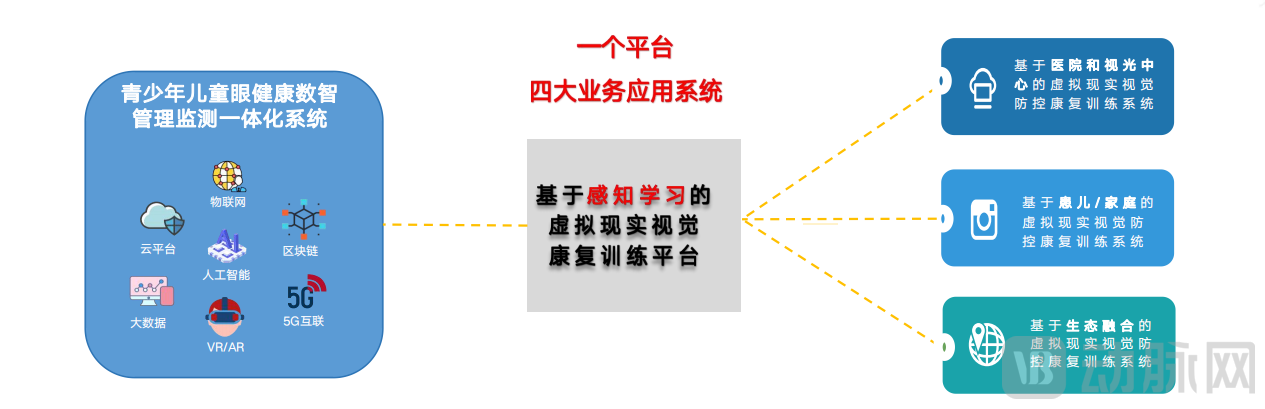
Specifically, Bei Yichen is committed to leveraging its “Virtual Reality Visual Rehabilitation Training Platform Based on Perceptual Learning” to build a closed-loop ecosystem for adolescent eye health management that spans the pre-diagnosis, diagnosis, and post-diagnosis stages while closely integrating various industry stakeholders. This ecosystem comprehensively covers all aspects of eye health management, leaving no gaps from initial screening and professional diagnosis to subsequent treatment and follow-up.
During the pre-consultation screening phase, Bei Yichen achieved comprehensive coverage of visual acuity testing through its self-developed automated vision screener. This device not only measures basic indicators such as uncorrected visual acuity, corrected visual acuity, and contrast sensitivity, but also integrates a series of specialized testing functions, including binocular vision assessment, fusion vision examination, stereopsis testing, and color vision testing, thereby ensuring the comprehensiveness and accuracy of screening results.
According to Zhang Yi, the Beiyichen self-service vision screener has demonstrated excellent performance in practical applications. Its screening time has been significantly reduced to 15–20 seconds, which not only greatly alleviates the workload of healthcare professionals and school nurses but also markedly enhances the convenience and accuracy of vision screening.
Notably, this self-service vision screening device also incorporates large language model (LLM) technology. Supported by advanced algorithms, it can rapidly and accurately interpret vision examination reports, providing children and their parents with clear and concise information on ocular health. This feature not only makes it easier for parents to understand and monitor their children’s eye health but also provides robust support for subsequent interventions and treatments.
Upon completion of the screening process, if any children are identified with visual function abnormalities, the system will immediately prompt them to visit a hospital or optometry center for further examination and confirmation. Following professional assessment by physicians, these children will receive timely and specialized interventions, thereby effectively safeguarding their eye health.
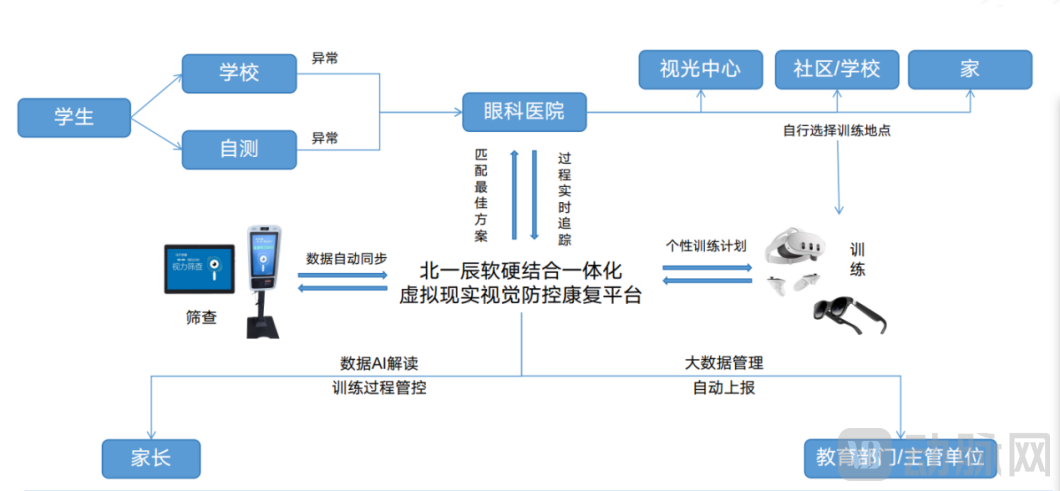
Notably, within the meticulously crafted ecosystem of Bei Yichen, children are not only afforded the opportunity to select visual function rehabilitation training products independently developed by Bei Yichen, but also enjoy the freedom to choose from other high-quality third-party visual rehabilitation training products.
As for Bei Yichen’s flagship product—the Virtual Reality Visual Training and Adjunctive Therapy System—it integrates advanced visual stimulation and visual learning technologies, aiming to precisely activate signal transmission pathways in the visual nerves, thereby deeply optimizing and enhancing the brain’s neural signal processing and integration capabilities. This approach improves therapeutic efficacy and enhances the overall treatment experience.
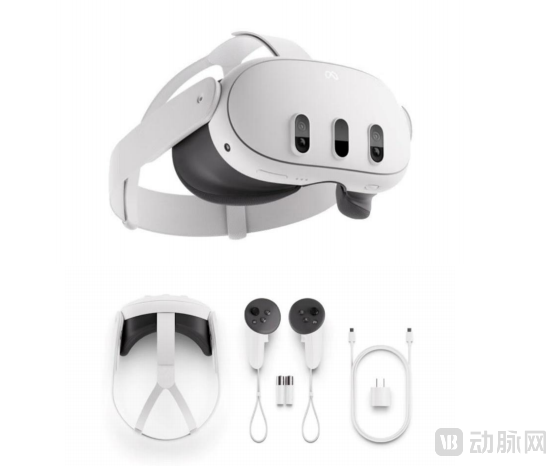
Taking amblyopia treatment as an example, the system employs a dichoptic training model, combined with carefully curated scenario-based content, to effectively guide patients through targeted vision rehabilitation exercises, with a particular emphasis on strengthening the suppressed eye. Compared with traditional occlusion therapy, this digital therapeutic not only improves treatment adherence in children but also pays greater attention to safeguarding their psychological well-being, thereby preventing feelings of inferiority that may arise from treatment.
In addition to amblyopia treatment, Bei Yichen’s virtual reality vision training and adjuvant therapy system has a broad scope of application, extending to small-angle strabismus, convergence insufficiency, and myopia prevention and control. Within this system, Bei Yichen deeply explores and fully leverages the potential value of eye health data, making it a key factor in enhancing treatment precision.
Notably, eye health data is seamlessly integrated into the Beiyichen Virtual Reality Visual Prevention and Rehabilitation Platform during the screening phase, establishing comprehensive eye health records that provide a solid foundation for physicians to tailor personalized training regimens. Throughout the training process, each session’s data is accurately recorded and uploaded to the platform. This not only offers a scientific basis for evaluating training efficacy but also enables information interoperability among hospitals, optometry centers, families, and schools, thereby jointly constructing a comprehensive, dynamic monitoring system for children’s eye health.
Through meticulous data collection and compliant data circulation, Bei Yichen not only ensures the professionalism and personalization of children’s visual function rehabilitation training programs, but also achieves long-term attention to and continuous protection of children’s eye health.
Five Collaboration Models to Comprehensively Drive Product “Market Launch”
Within the meticulously constructed ecosystem of Beiyichen, we can clearly discern the presence of diverse stakeholders beyond Beiyichen itself, including schools, hospitals, optometry institutions, and families.
First, Bei Yichen works closely with government-related agencies to jointly promote myopia prevention and control as well as eye health management in schools. Through the government-affiliated public platform established by Bei Yichen, children with abnormal screening results can be precisely referred to partner hospitals or optometry centers, ensuring they receive timely care and treatment.
Secondly, Bei Yichen has engaged in extensive cooperation with insurance institutions. As the health and medical insurance market matures, it has gradually expanded from the critical illness sector to the consumer-oriented medical field, with optometry and vision care emerging as a standout segment. Leveraging its keen insights, Bei Yichen has established strategic partnerships with leading insurance providers such as PICC (led by Xingcan Jiabao) and Taikang, jointly exploring broader market opportunities.
The third business model is the DTC (Doctor-to-Consumer) model. Bei Yichen’s virtual reality visual training and adjunctive therapy system empowers physicians, making the platform user-friendly for doctors and transforming it into a practical tool that fosters strong engagement with pediatric patients and their parents. This, in turn, encourages consumers to pay for timely access to medical services.
Furthermore, Bei Yichen is committed to empowering optometry centers by providing support for the development of information systems, including electronic medical records, and equipping them with the capabilities of an eye health management ecosystem platform, thereby enhancing the service standards of these centers.
Finally, Beiyichen is actively exploring a fifth business model—directly opening up for franchising to invest in and build Beiyichen Vision Care Centers. The launch of this model marks a more comprehensive and in-depth expansion of Beiyichen’s presence in the eye health sector. Currently, Beiyichen’s market footprint covers Jiangsu Province, particularly Nanjing and its surrounding cities.
Four Major Bottlenecks Remain in Ophthalmic Digital Therapeutics, with “Seamless Integration” Emerging as the Key Future Trend
In the interview, Zhang Yi repeatedly emphasized to VCBeat that digital therapeutics in ophthalmology hold immense development potential, particularly in myopia prevention and control as well as strabismus and amblyopia treatment. He highlighted this from the introduction of U.S. clinical guidelines for amblyopia management to the vast and urgent market demand, underscoring their undeniable value.
However, what factors are hindering the further expansion of digital therapeutics in ophthalmology, resulting in suboptimal market penetration?
Zhang Yi pointed out that the development of digital therapeutics in ophthalmology faces four major challenges. First and foremost, some physicians lack sufficient knowledge of optometry and may even harbor certain biases. Therefore, it is imperative to strengthen optometric training for physicians and place greater emphasis on the cultivation of professional optometrists.
Secondly, there is a “bias” in current public science education efforts. Most optometry awareness campaigns focus on schools, often overlooking another crucial group—parents. Mr. Zhang Yi firmly believes that without parental involvement, public education on optometry will struggle to achieve desired outcomes. Therefore, he recommends prioritizing parents as the key target audience for optometry knowledge dissemination and advocates for parental accompaniment in every science outreach activity aimed at children.
Third, the limitations of VR hardware devices have also constrained, to some extent, the development of digital therapeutics for ophthalmology in the field of eye health among children and adolescents. As physiological characteristics such as head circumference and interpupillary distance change with age in this population, VR hardware requires corresponding adaptations. Unfortunately, however, there are currently no VR hardware devices on the market that are fully suitable for children and adolescents. Addressing this issue will require joint efforts from hardware manufacturers and software developers.
Finally, digital therapeutics for ophthalmology must continue to deepen its efforts in technological R&D and application. In Zhang Yi’s view, ophthalmic digital therapeutics do not necessarily have to rely on gamified formats; instead, they should evolve toward “seamless integration,” enabling users to undergo visual function training unconsciously during daily screen-based activities, such as using smartphones or attending online classes. Currently, Beiyichen has initiated the development of related products and sincerely invites like-minded partners to join hands and advance together!