

WeDoctor's Medical AI Model Tops CMB Benchmark and Files for IPO
The medical AI sector is heating up, with numerous players entering the market. As industry competition intensifies, barriers related to technology and data are gradually becoming apparent.
Recently, the CMB (Comprehensive Medical Benchmark in Chinese), a leading domestic evaluation platform for large medical models, updated its Chinese Medical Model Evaluation (CMB-Exam) rankings on its official website. The Weiyi Large Medical Model topped the list with an average score of 91.71.
As a comprehensive, multi-layered medical benchmark specifically designed for the Chinese healthcare environment, CMB encompasses over 280,000 questions and complex case consultations, simulating real-world clinical scenarios to thoroughly evaluate large language models’ medical knowledge and clinical consultation capabilities. This achievement by WeDoctor not only highlights its technological leadership in the field of medical AI but also validates its pivotal role in driving the digital and intelligent transformation of the traditional healthcare services industry.
WeDoctor has been strategically positioned in the medical AI sector for many years. Leveraging its robust large language model capabilities, it has established an AI-empowered closed-loop ecosystem encompassing “medical care, pharmaceuticals, diagnostics, health management, and disease management.” This framework delivers full-lifecycle health management for patients, spanning pre-diagnosis, during-diagnosis, and post-diagnosis stages. Furthermore, WeDoctor has pioneered a B2B2C commercialization pathway, thereby unlocking new market opportunities for the industry. According to media reports, WeDoctor’s revenue continues to grow steadily and is projected to approach RMB 10 billion this year.
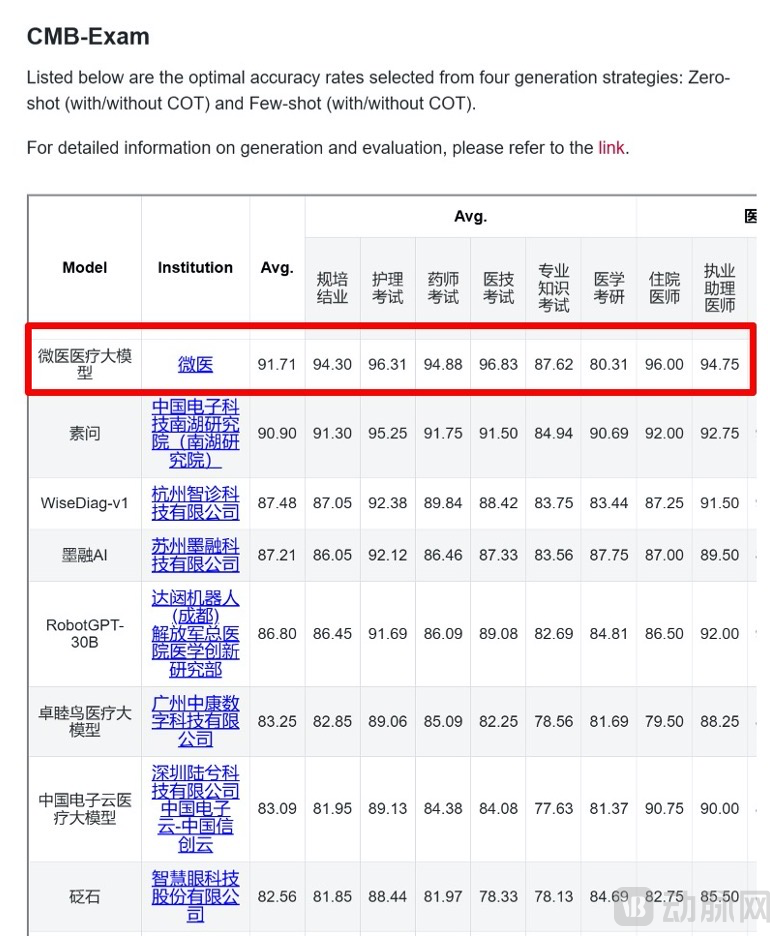
Figure | WeDoctor Medical Large Language Model Ranks First on the CMB Medical Test Set
It is understood that the WeDoctor Medical Large Language Model has significantly enhanced its adaptability and problem-solving capabilities in conversational scenarios by implementing various strategies, including alignment training, supervised fine-tuning for role-playing dialogues, and reinforcement learning from human feedback. Leveraging diverse real-world application scenarios such as the AI Hospital and the AI Healthcare Community, the WeDoctor Medical Large Language Model has demonstrated exceptional performance across multiple dimensions, including training data, efficacy evaluation, and practical application, thereby solidifying its leading position in the highly competitive medical AI sector.
At the application level of large language models, WeDoctor’s four self-developed intelligent agents—“AI Doctor,” “AI Pharmacist,” “AI Health Manager,” and “AI Intelligent Control”—have been deployed at scale in numerous medical institutions. Particularly within health consortia and AI-enabled hospitals, they have established a closed-loop application covering the entire patient journey, from pre-consultation through consultation to post-consultation care. At the data level, the WeDoctor platform has accumulated over 400 million dialogue records, 200 million medical cases, and 200,000 physician diagnosis and treatment records, providing a solid foundation for the deep learning and effective application of AI products.
Leveraging models such as the “AI Health Consortium” and AI-powered hospitals, WeDoctor has pioneered the 2H2C commercialization pathway, marking the first mature, commercially implemented business model in the medical AI industry. Compared to the pure 2C approach characteristic of Internet Hospital 1.0, the 2H2C model demonstrates significant potential in scaling user bases and deeply unlocking value-added services.
Taking Micro Medical’s operations in Tianjin as an example, Tianjin Weiyi Digital Intelligence Hospital, as the lead entity, collaborated with 266 community health service centers and over 2,000 stations and clinics across the city to jointly establish the Tianjin Primary Care Digital Health Consortium. Through the unified deployment of a “Four Clouds” platform—comprising cloud management, cloud services, cloud pharmacy, and cloud diagnostics—the consortium provides Tianjin residents with integrated online-and-offline medical and healthcare services encompassing prevention, diagnosis, treatment, management, and wellness. Empowered by AI, the Tianjin Health Consortium serves more than 18,000 patients daily, with its basic service scale continuing to grow steadily.
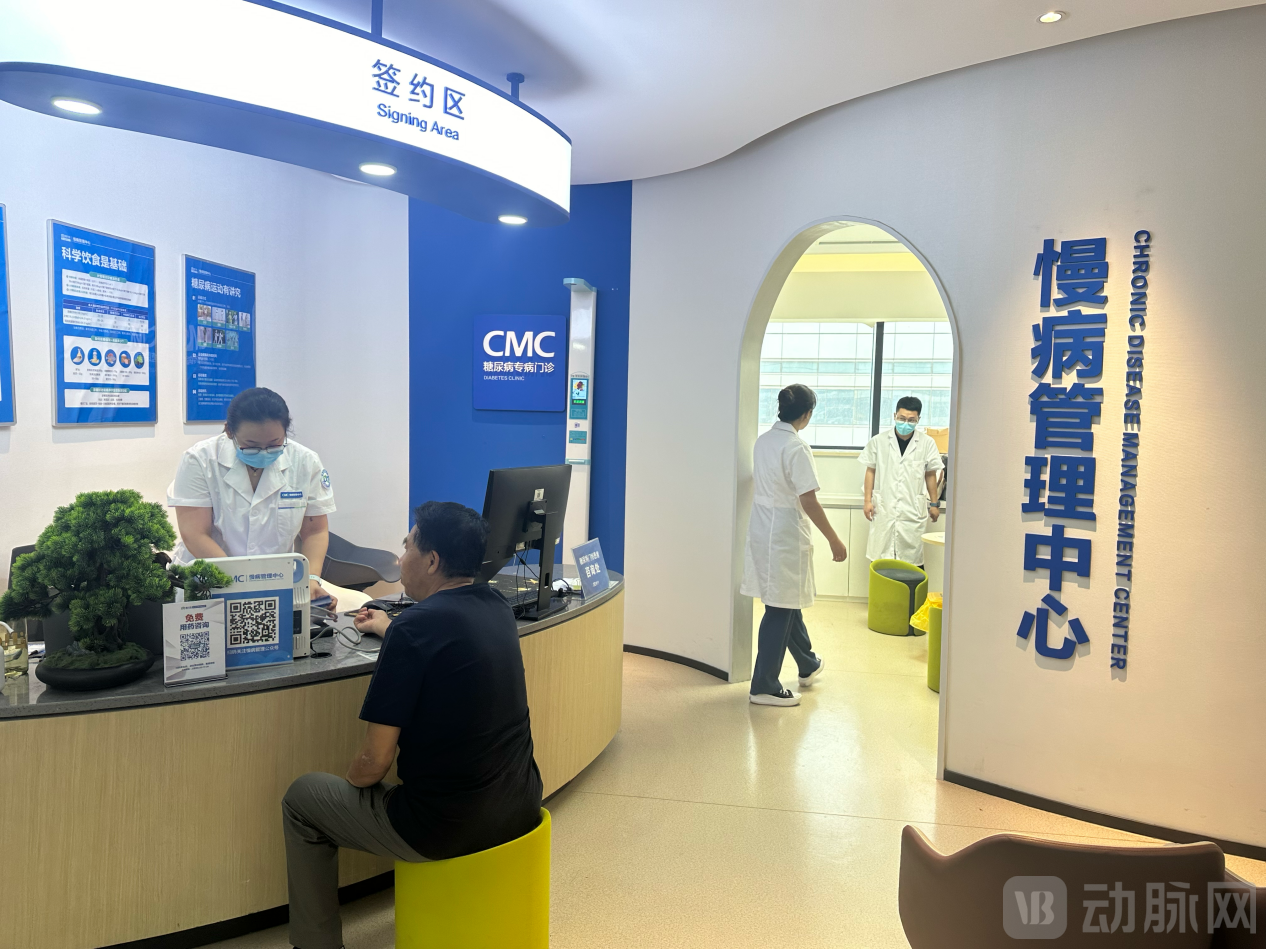
Figure | Micro Medical AI Health Community's Chronic Disease Management Center
AI-empowered chronic disease management has effectively improved outcomes. Currently, the Tianjin Health Consortium has established 238 chronic disease management centers, with nearly 200,000 chronic disease patients enrolled and managed under filed records within these centers. In conjunction with family doctor contract services, Tianjin is exploring payment reform to implement capitated global budgeting for family doctor contracts, following the adoption of diagnosis-related group (DRG) payment methods.
The “AI Healthcare Community” model has emerged as an ideal scenario for 2H2C commercialization. Official data show that after more than three years of operation in Tianjin, 80.3% of enrolled patients have proactively returned to primary care facilities, outpatient visits at primary hospitals have increased by 23% to 50%, public satisfaction has reached 97%, and the average monthly out-of-pocket medical expenditure per patient with diabetes under special outpatient coverage has decreased from RMB 1,643 to RMB 1,255, representing a 23.6% reduction.
Behind the commercialization of new pathways enabled by leading-edge technology lies WeDoctor’s first-mover advantage in strategic layout and its continuously expanding medical AI ecosystem.
As early as 2017, WeDoctor joined hands with Zhejiang University to establish the Ruiyi Artificial Intelligence Research Center, whose research achievements have been applied at scale in WeDoctor’s business scenarios. Not long ago, the Key Laboratory of Medical Imaging Artificial Intelligence, jointly established by WeDoctor, Zhejiang University, and the Second Affiliated Hospital of Zhejiang University School of Medicine, was officially recognized as a Provincial Key Laboratory of Zhejiang Province. According to insiders, WeDoctor is leveraging the capabilities of this key laboratory to advance the development of a medical large model evaluation platform and promote the formulation of industry standards for medical large models.
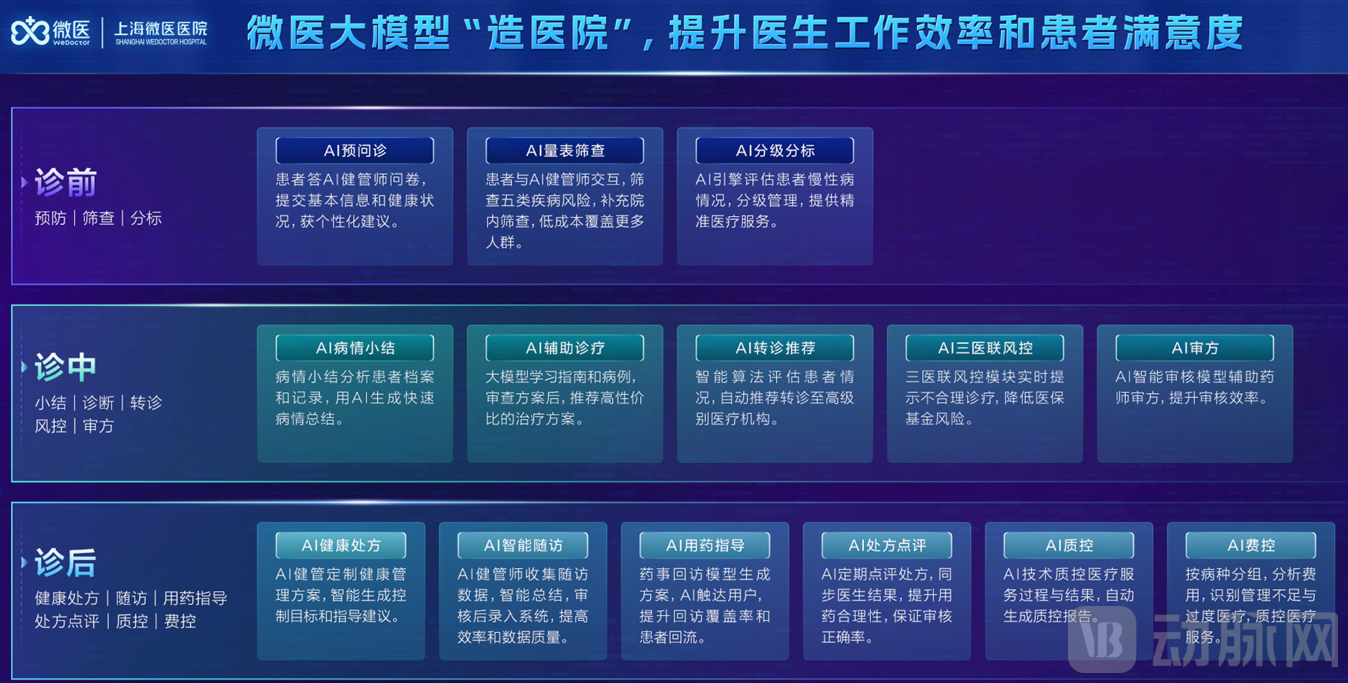
Figure | AI Applications in WeDoctor's AI Hospital
Previously, WeDoctor joined forces with partners such as Tencent and Shanghai Ruijin Hospital to jointly advance the development of large medical AI models, focusing on the “integrated management of six chronic diseases” to create specialized intelligent healthcare products. In April this year, WeDoctor supported the launch of the Full-Life-Cycle Integrated Management Center for Six Chronic Diseases in Sanming, Fujian Province. This center has enabled the “transfer” of cutting-edge diagnostic and treatment technologies from Shanghai Ruijin Hospital to primary care settings.
Liao Jieyuan, founder of WeDoctor Group, publicly stated in earlier years that AI would help China’s millions of primary healthcare institutions achieve “leapfrog development.” From today’s perspective, as a pioneer who has “worked on AI the longest in the healthcare industry and worked on healthcare the longest in the AI industry,” Liao Jieyuan not only held this belief but also acted accordingly.
Notably, leveraging advantages such as data-driven capabilities and ecosystem synergy, WeDoctor has established a WeDoctor MaaS (Model as a Service) product matrix, with large medical language models as its technological foundation and extensive healthcare service scenarios as its application base. This not only fosters synergistic development of internal operations but also opens new avenues for external collaboration.
Empowered by AI, WeDoctor is accelerating its efforts to resolve the “impossible trinity” dilemma facing traditional healthcare, thereby establishing a unique operational and business model. The high demands of developing large medical language models—spanning technical R&D, real-world data, and application scenarios—have created substantial barriers to entry within the industry. It is foreseeable that as WeDoctor’s AI ecosystem expands, more innovative service scenarios and business models will continue to emerge, injecting new momentum into the digital and intelligent upgrading of the healthcare sector and accelerating its intelligent transformation.