

Boston Scientific Accelerates China Localization with New Manufacturing Hub and Strong Double-Digit Market Growth
In 2024, multinational corporations in the global medical technology sector have been vigorously investing in and establishing manufacturing facilities in China. According to statistics from VCBeat, over the past two years, more than ten multinational companies—including Boston Scientific, Olympus, Karl Storz, Intuitive Surgical, and Zeiss—have invested in setting up factories in China for the first time. This trend not only underscores their long-term commitment to the Chinese market but also reflects the growing influence of the Chinese market within the global medical technology landscape.
Taking Boston Scientific as an example, the company’s first manufacturing base in China was recently completed and opened for operation. The project took only one year from signing to completion, fully demonstrating the company’s determination to advance its localization strategy.Boston Scientific’s Lingang factory is located in the Life Blue Bay Pharmaceutical Specialty Industrial Park within the Lingang New Area of Shanghai. Integrating office, laboratory, warehousing, and production facilities, it will focus on the manufacturing of medical consumables and devices in the future. The company plans to leverage China’s supply chain advantages to establish the Lingang facility as a highly efficient and excellent plant within its global supply network, primarily serving the Chinese market and enhancing access to cutting-edge medical technologies through local production.
Multinational corporations (MNCs) that pioneered the establishment of a full industry chain in China, spanning from R&D to production, have entered the payoff period. Amid the prevailing trends of normalized centralized procurement and domestic substitution in China’s medical device market, performance in the Chinese market has demonstrated strong growth momentum, with Boston Scientific achieving double-digit growth in its China operations.
China has become the world’s second-largest medical device market, making its significance to multinational corporations (MNCs) in healthcare technology self-evident. However, the market also faces a more complex and challenging growth trajectory. As MNCs introduce more segments of their industrial chains into China, the deepening of localization strategies will have a profound impact on the domestic industrial chain. This will not only facilitate the upgrading of domestic supply chains but also drive technological advancements and innovation in related industries.
For multinational corporations (MNCs), adopting a localization strategy enables them to better understand the demands of the Chinese market and respond more swiftly to market changes, thereby achieving higher growth. Meanwhile, this also helps enhance China’s position in the global medical device industry chain and promotes high-quality development of the domestic industry.
How Can MNCs Achieve Growth in Complex Environments Through Localization Strategies?
It is understood that Boston Scientific’s China factory will initially manufacture consumables for intravascular ultrasound (IVUS) products, providing Chinese patients and healthcare providers with more new health options. The development history of Boston Scientific’s Polaris IVUS system in China demonstrates how localization strategies have driven growth across different market stages.
According to Frost & Sullivan data, the domestic IVUS market size reached RMB 1.65 billion in 2022 and is projected to grow to RMB 5.74 billion by 2030, representing a compound annual growth rate (CAGR) of approximately 16.8%.
Since its debut at the China International Import Expo (CIIE) in 2019, Boston Scientific has continuously adjusted its business strategy over the past five years to adapt to the evolution of China’s IVUS market.
In the first phase, the domestic IVUS penetration rate was very low. Boston Scientific focused on market education, raising the domestic IVUS penetration rate from 1% to 5%.。
In the second phase, following the volume-based procurement (VBP) of coronary stents, the frequency of procedures such as IVUS, OCT, and FFR increased, while the number of domestic competitors for IVUS products also grew. Boston Scientific began advancing the localization of its Polaris intravascular ultrasound system. In 2022, leveraging the Medical Device Registrant (MAH) system, it achieved local production in China while simultaneously supplying overseas markets. The inclusion of IVUS catheters in VBP in 2023 enabled Boston Scientific to respond flexibly to the procurement policy.
In Phase III, China’s IVUS market experienced rapid growth driven by centralized procurement policies, with the penetration rate rising to 15%, and the application of technology began to expand to secondary hospitals.Boston Scientific has shortened its supply cycle and more efficiently met market demand by leveraging the advantages of local production. Establishing local manufacturing facilities is a key component of this strategy; although it requires significant initial investment, it reduces production costs and better serves the needs of the local market in the long run.
Local production also incorporates Chinese R&D capabilities.Historically, R&D at multinational corporations (MNCs) was typically led by their global headquarters, resulting in prolonged timelines for innovative products to enter the Chinese market. The establishment of local manufacturing facilities has accelerated this process, enabling products to respond more rapidly to local market demands.
At this year’s China International Import Expo (CIIE), Boston Scientific will showcase the upgraded version of Polaris—the next-generation intravascular ultrasound (IVUS) system, AVVIGO+ MAH. This product integrates AI capabilities, offers a multi-modality platform, and incorporates FFR and DFR measurements to optimize IVUS-based lesion assessment. Developed with substantial involvement from Boston Scientific’s China team, and leveraging the Medical Device Registrant (MAH) system, the core console is manufactured in China and will be pre-launched at this year’s CIIE.
In the future, the localization of consumables for Boston Scientific’s intravascular ultrasound (IVUS) products demonstrates the rapid response capability of domestic production in local supply chains, enabling multinational corporations (MNCs) to respond more flexibly to changes in the Chinese market.
As China’s industrial supply chain matures, the role of multinational corporations (MNCs) in the country has shifted from mere product introducers to transmitters of advanced manufacturing expertise. By deeply integrating with local supply chains, they are jointly building manufacturing hubs with global influence. In this process, digital factories have become a key driver of performance growth and sustained profitability. The application of smart manufacturing technologies is expected to boost production efficiency by 30% to 40%.
Despite significant progress in manufacturing within China’s high-end medical device industry, there remains a gap compared to global leaders in terms of automation and digitalization. The production of medical devices is characterized by high product variety, small batch sizes, complex processes, and discrete manufacturing, which imposes higher demands for advanced automation.
According to a survey by the Shenzhen Medical Device Industry Association, the automation density in the medical device industry is relatively low compared to the 3C and automotive industries, indicating significant room for improvement.
Boston Scientific’s Lingang Factory integrates cutting-edge global automation technologies, introduces advanced international expertise to enhance the intelligent manufacturing capabilities of China’s medical device industry chain, and features three major highlights.
The biggest highlight of the Lingang factory is its smart manufacturing capabilities.Achieved full lifecycle automation control from raw materials to finished products, ensuring product quality and compliance of production processes. By introducing industry-leading intelligent systems for enterprise management, manufacturing execution management (MES), product lifecycle management (PLM), facility management, central monitoring, and employee training, and by integrating and customizing software systems according to factory needs and product specifications, the Lingang Factory achieves comprehensive visibility of the production base. It enables real-time monitoring of production lines, tracking and tracing all data from raw materials through the production process, guiding staff to execute procedures correctly, ensuring the efficient flow of production elements such as raw materials and supplied components, and guaranteeing that products are manufactured on schedule, on time, and in a cost-effective manner, thereby realizing paperless, flexible, and high-quality smart manufacturing.
This full-lifecycle automated control is a benchmark for the global manufacturing industry. Through refined management and forecasting, it maximizes efficiency while minimizing unnecessary waste and inventory.
In terms of digital management, the Lingang factory has made digital transformation its core strategy, leveraging Internet of Things (IoT), big data analytics, and cloud computing technologies to achieve real-time analysis of equipment performance and predictive maintenance. This has not only improved production efficiency and reduced operational costs, but also accelerated Boston Scientific’s response to changes in supply and demand.
Furthermore, the Lingang factory is not only a smart factory but will also become a facility deeply integrated with the domestic supply chain.. Boston Scientific aims to leverage collaborations with local Chinese suppliers in the future, creating development opportunities for these suppliers through its manufacturing facilities, helping them enhance their delivery capabilities, and thereby driving the upgrading of China’s domestic medical device industry chain.
Boston Scientific is systematically driving the transformation and upgrading of its local industrial chain by adhering to unified global quality standards. By facilitating continuous optimization and improvement among local suppliers in raw material delivery and digital operations, the company is gradually cultivating and enhancing the competitiveness of its local supply partners, improving communication and response efficiency within the local supply chain, thereby achieving a more stable and agile local supply base.
This not only helps to enhance China's position in the global medical device industry chain, but also provides strong support for the success of MNCs in the Chinese market.
In an ever-evolving market environment, multinational corporations (MNCs) are continuously adapting their strategies in the Chinese market. With the rise of domestic players, market competition has intensified, leading to increased price pressure. Meanwhile, the government’s volume-based procurement (VBP) policy, aimed at reducing healthcare costs, has made hospitals more price-sensitive. To navigate regulatory changes and fierce market competition, it is crucial for MNCs to deeply implement localization strategies.
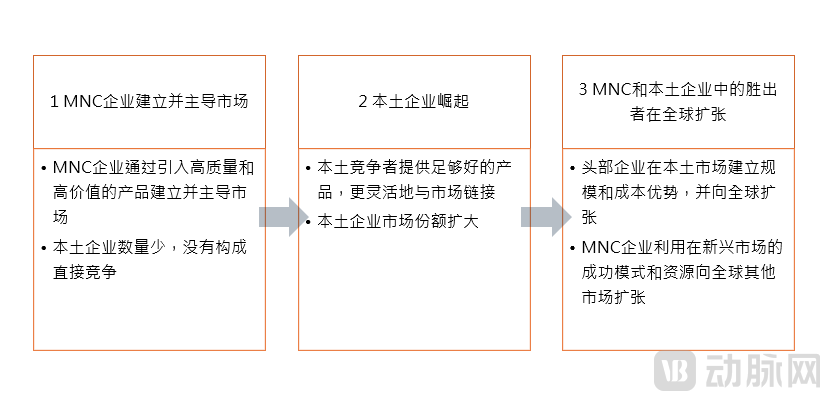
Three Stages of MNC Expansion in Emerging Markets | Source: McKinsey
In addition to establishing local manufacturing facilities, multinational corporations (MNCs) have also adopted other strategies to address challenges:
First, to explore high-growth, high-tech niche sectorsIn addition to establishing local manufacturing facilities in China, Boston Scientific has actively expanded into multiple high-growth sectors, such as electrophysiology, pacemakers, and peripheral interventions, while introducing its most advanced global products. For instance, in July 2024, Boston Scientific’s FARAPULSE™ Pulsed Field Ablation system received regulatory approval in China, and it is expected to become a new growth engine in the Chinese market in the coming years.
Secondly, expand the scope and depth of product coverage.Multinational corporations (MNCs) are reaching broader market segments by implementing initiatives targeted at lower-tier markets and collaborating with local enterprises. Boston Scientific has established partnerships with multiple Chinese medical device companies, covering areas such as product distribution, mergers and acquisitions, and R&D and manufacturing, thereby achieving more comprehensive market penetration.
Finally, the strategic layout of localization across the entire industry chain.Boston Scientific has adopted a localization strategy covering all segments of the entire industry chain—including trade, manufacturing, R&D, investment, and services—to address the complex changes in the market environment.
Looking ahead, the further deepening of multinational corporations’ (MNCs) localization strategies will have a positive impact on China’s high-end medical device industry chain. Companies that have adopted flexible and comprehensive localization strategies have taken the lead in achieving high growth in their China operations. According to the Shenzhen Medical Device Industry Analysis Report, China’s medical device output value is approximately RMB 990 billion, accounting for a relatively low share of the global total. In the future, China has the potential to become a global manufacturing hub for medical devices, which requires its integration into the core supply chain of high-end medical devices worldwide and establishing itself as a primary manufacturing base for MNCs.
Currently, Boston Scientific has established manufacturing facilities in China and localized the production of its core products. This move accelerates the advancement of China’s high-end medical device industry chain toward becoming a global hub for medical device manufacturing. Through such localization strategies, multinational corporations (MNCs) can not only enhance their own competitiveness but also promote the overall development of China’s medical device industry, achieving a win-win outcome.